Lavritech
Lavritech develops controllers and a software platform for monitoring and automating engineering systems, covering applications and equipment integration.
0
Project description
How Does Lavritech Build Modular Industrial Controllers, and Where Does the W5500 Fit?
Lavritech develops controllers and a software platform for monitoring and automating engineering systems, covering applications such as telemetry, energy monitoring, climate control, and equipment integration. Across several of its ESP32-based controllers, wired Ethernet is implemented with a WIZnet W5500 module connected over SPI, alongside interfaces such as Wi-Fi, RS-485, LoRa, and cellular connectivity. Lavritech
Rather than building one fixed PLC configuration, Lavritech approaches industrial control as a modular system. Controller hardware, communication interfaces, I/O modules, firmware options, web configuration, MQTT, Modbus, and Lavritech Cloud can be combined according to the deployment. Lavritech Wiki
Components
WIZnet W5500 × optional 1 per Ethernet-equipped controller — Lavritech's hardware documentation explicitly says that its controllers use an Ethernet module based on the WIZnet W5500. The module connects to the ESP32 through the controller's SPI region and provides the wired LAN interface. Lavritech Wiki
ESP32-family MCU × 1 — Lavritech's L1 series is based on ESP32-family processors. The MCU runs Lavritech firmware, automation logic, web configuration, and the application layer around interfaces such as Ethernet, Wi-Fi, RS-485, and LoRa. Lavritech Wiki
RS-485 / Modbus interfaces — industrial field devices, meters, sensors, and equipment can be connected through Modbus RTU, while Lavritech also documents MQTT and Modbus-related functionality in its controller software. Lavritech
From Controllers to an Automation Platform
Lavritech describes itself as a developer and manufacturer of controllers and a software platform for monitoring and automation of engineering systems. Its stated deployment areas include dispatch and telemetry, energy monitoring and metering, climate control, and engineering infrastructure. The company also documents MQTT and Modbus integrations, wired and wireless networking, and remote configuration. Lavritech
That broader platform is important when looking at the hardware.
A Lavritech controller is not presented simply as an ESP32 carrier with Ethernet. Its firmware can be configured through a web interface, updated over the air, connected to Lavritech Cloud or external MQTT brokers, and combined with sensor and I/O modules. Lavritech Wiki
The current controller family spans compact Wi-Fi/RS-485 devices through larger Ethernet-equipped controllers and specialized LED-control hardware. Lavritech's comparison page lists L1 Mini D3, L1 Lite, L1 Max, L1 Mini D1, and LED PLC, with Ethernet present on the L1 Lite, L1 Max, and LED PLC categories. Lavritech Wiki
However, Ethernet support alone is not enough to claim W5500 use. For this article, W5500 attribution is limited to products where Lavritech documentation names the chip explicitly.
L1 Lite: W5500 as a Configurable Ethernet Option
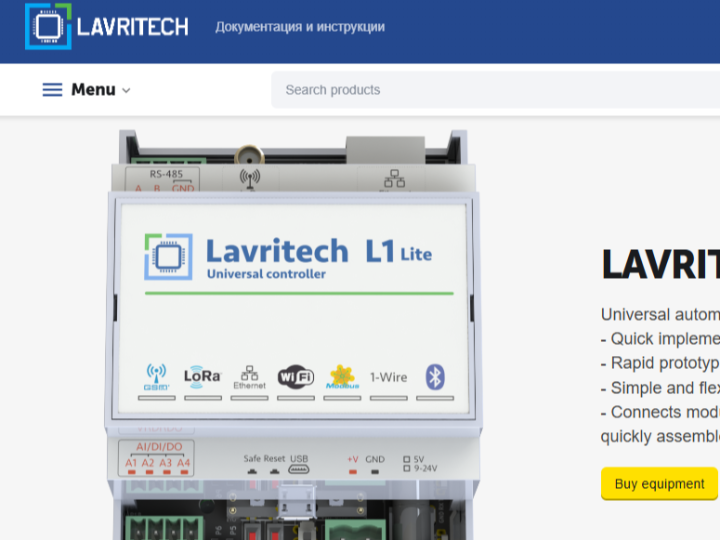
The Lavritech L1 Lite is an ESP32-based general-purpose controller for monitoring and automation. Lavritech positions it for building systems, engineering infrastructure, wired and wireless sensors, energy monitoring, and automation. Lavritech Wiki
Its base interfaces include Wi-Fi and RS-485, while Ethernet, LoRa, GSM, displays, and additional modules can be selected according to the configuration. The documentation labels the Ethernet connector directly:
“communication is provided by the SPI module W5500.” Lavritech Wiki
The company's store provides an unusually concrete confirmation. L1 Lite configurations are offered with combinations such as an ESP32-DevKitC-32E + Ethernet W5500 module, with LoRa either installed or omitted. Versions without the Ethernet module are also listed. Lavritech Market
That matters because W5500 is an option in the modular architecture rather than a mandatory part of every L1 Lite.
L1 Max: More Expansion, Same Wired-Ethernet Pattern
The L1 Max extends the same architecture toward larger automation systems.
Lavritech describes it as a controller-gateway for monitoring and automation, supporting Modbus RTU, Ethernet, Wi-Fi, and LoRa, with scenarios, algorithms, cloud functions, and a larger expansion system than the L1 Lite. Lavritech
Its hardware documentation again identifies the Ethernet path explicitly:
Ethernet connector → SPI W5500 module → wired LAN. Lavritech Wiki
The underlying LavriBoard7 Max documentation is even clearer. It states that the board can optionally be fitted with an Ethernet module “on the WIZnet W5500 chip”, installed in the board's SPI region to connect the controller to a local network. Lavritech Wiki
Current L1 Max Starter Kit configurations in Lavritech's shop likewise include selectable versions with Module Ethernet W5500. Lavritech Market
For a WIZnet reader, this provides a useful example of the same Ethernet controller being reused across several members of an industrial product family rather than appearing in a single isolated board.
The SPI Region Is the Real Architectural Detail
One of the more interesting parts of Lavritech's design is what it calls the SPI region.
This region can be configured for WB SPI expansion modules, W5500 Ethernet, and other board functions. Lavritech explains that when W5500 Ethernet is selected, a standard W5500 module is installed in this region and provides network access for the controller. Lavritech Wiki
This flexibility comes with a real hardware trade-off.
Lavritech states that installing the W5500 module blocks part of the WB SPI connector and some output terminals. The SPI resources used by WB SPI expansion and the networking configuration are therefore not completely independent. Lavritech Wiki
That limitation is worth highlighting because it shows what modularity means at PCB level: the same physical resources can be assigned differently depending on the controller ordered for a particular project.
It is not an architecture where every possible interface is available simultaneously without consequence.
L2 Gate D2 Shows the W5500 Interface Down to GPIO Level
The L2 Gate D2 documentation goes further than simply naming W5500.
Lavritech publishes the ESP32 GPIO mapping for its Ethernet interface:
| Function | ESP32 GPIO |
|---|---|
| MOSI | GPIO2 |
| SCLK | GPIO0 |
| CS | GPIO4 |
| INT | GPIO14 |
| RST | GPIO13 |
| MISO | GPIO15 |
These pins are explicitly documented under “Ethernet interface W5500.” Lavritech Wiki
This makes L2 Gate D2 particularly useful to an engineering reader because it establishes both the chip identity and its host interface rather than merely showing an RJ45 connector.
M1-PLC-9D: W5500 Inside an All-in-One Control Board
Lavritech also documents W5500 in the M1-PLC-9D, an open-board controller intended for integration into control systems and smart LED applications.
The board combines an ESP32 main processor, RS-485, relay outputs, 1-Wire, I²C, expansion sockets, optional LoRa and cellular connectivity, and Ethernet. The Ethernet connector is documented as using a W5500 controller over SPI. Lavritech Wiki
A concrete configuration illustrates the industrial focus.
M1-PLC-9D supports 9–24 V DC, includes two 250 VAC / 8 A relay outputs, can support up to 32 Modbus slave devices per RS-485 interface, and is specified for operation from -30 °C to +50 °C. Lavritech lists MQTT, OTA, scripts, automation logic, Modbus templates, and a web interface among its software capabilities. Lavritech Wiki
Those values are Lavritech's published product specifications; they are not independent WIZnet measurements.
Where the W5500 Fits
Across these products, the W5500 has a consistent job:
it adds wired Ethernet to the ESP32-based controller through SPI.
Lavritech's documentation does not assign sensor acquisition, Modbus RTU processing, relay control, automation scripting, or cloud logic to the W5500. Those remain functions of the controller platform and its firmware.
WIZnet documents the W5500 itself as a Hardwired TCP/IP Ethernet controller with an integrated 10BASE-T/100BASE-TX MAC/PHY, eight hardware sockets, 32 KB of internal TX/RX memory, and an SPI host interface. WIZnet Document System
The architectural relationship can therefore be summarized as:
Field devices / sensors / meters
↓
RS-485 / I/O / LoRa
↓
ESP32 + Lavritech firmware
↓
W5500 over SPI
↓
Ethernet LAN → MQTT / automation infrastructure
The exact application traffic carried over W5500 varies according to the controller configuration and firmware. Lavritech documents MQTT, web interfaces, Modbus-related functions, and cloud connectivity at platform level, but the sources used here do not establish a per-socket or per-protocol W5500 allocation for each controller. Lavritech
Wired and Wireless Are Meant to Coexist
Another useful aspect of the Lavritech architecture is that Ethernet does not replace wireless networking.
The L1 Lite and L1 Max product families support combinations of Ethernet, Wi-Fi, RS-485, and LoRa, with cellular options available in some configurations. Lavritech Wiki
That gives integrators several possible paths:
RS-485 for local industrial devices,
Wi-Fi for wireless LAN access,
W5500 Ethernet for wired LAN connectivity,
LoRa for longer-range low-data-rate devices, and
cellular options where another backhaul is required.
The important part is configurability rather than one prescribed topology.
Not Every Lavritech Controller Uses W5500
This distinction should remain explicit.
The current Lavritech comparison page lists L1 Mini D3 and L1 Mini D1 without Ethernet, while L1 Lite and L1 Max include Ethernet support. Lavritech Wiki
The L1 Mini D3 documentation specifically lists no Ethernet port and gives Wi-Fi, RS-485, and optional LoRa as its communications interfaces. Lavritech Wiki
Lavritech also lists Ethernet in its LED PLC family, but the sources reviewed for this article do not explicitly identify the Ethernet silicon there as W5500. For that reason, this article does not claim that every Ethernet-capable Lavritech product uses WIZnet.
The chip-level evidence is strongest for L1 Lite, L1 Max, L2 Gate D2, and M1-PLC-9D.
What Is Published and What Is Not
Lavritech publishes substantially more hardware information than a typical finished industrial controller vendor.
Its public Wiki documents controller architecture, expansion connectors, W5500 use, SPI regions, GPIO mappings on some products, supported interfaces, operating ranges, firmware functions, MQTT, Modbus, OTA, and product setup. Lavritech Wiki
The store also allows individual configurations to be inspected, including whether an Ethernet W5500 module is present. Lavritech Market
What these sources do not provide is a complete source-level description of how every Lavritech firmware service maps onto W5500 sockets, measured Ethernet throughput for the controllers, latency measurements, or detailed Ethernet-vs-Wi-Fi reliability comparisons.
Those should not be inferred from the presence of W5500.
For a WIZnet Reader
For a WIZnet reader, the useful thread is not merely that another ESP32 product contains a W5500.
Lavritech shows how the W5500 can become a repeatable wired-network building block inside a configurable family of industrial and building-automation controllers.
The same Ethernet architecture appears across controllers of different sizes and purposes, while the rest of the system can be configured with RS-485, Wi-Fi, LoRa, GSM, I/O modules, firmware options, MQTT, Modbus, and cloud connectivity.
In other words, W5500 is not the application.
It is the wired-network layer that Lavritech can insert into different controller configurations without redesigning the entire automation platform.
Related Reading
The WIZnet Maker project ESP32 + W5500 Based Modbus TCP Client shows the same ESP32/W5500 combination at code-example scale, with an ESP32 communicating with a Modbus TCP slave through W5500. WIZnet Makers
Modbus RTU to REST API Gateway for ESP32 Ethernet Systems approaches the architecture from the gateway side: RS-485/RS-232 field devices are exposed to Ethernet software through an ESP32 and W5500. WIZnet Makers
DINO PLC V2 is another industrial-control comparison, using W5500 for wired Modbus TCP and MQTT while an ESP32 provides the controller logic and Wi-Fi. WIZnet Makers
FAQ
Does Lavritech really use WIZnet W5500?
Yes. Lavritech's own Wiki explicitly states that its Ethernet module is based on the WIZnet W5500, and individual controller documents identify W5500 as the SPI Ethernet interface. Lavritech Wiki
Which Lavritech controllers are confirmed to use W5500?
The sources reviewed here explicitly identify W5500 in L1 Lite, L1 Max, L2 Gate D2, and M1-PLC-9D. Lavritech Wiki
Is W5500 standard in every L1 Lite?
No. Ethernet is configurable. Lavritech sells L1 Lite variants both with and without the W5500 Ethernet module. Lavritech Market
What does W5500 do in these controllers?
It provides the wired Ethernet interface through SPI. W5500 itself integrates a 10/100 Ethernet MAC/PHY and hardware TCP/IP resources. WIZnet Document System
Do all Lavritech products contain W5500?
No. Some controllers, such as L1 Mini D3, are documented without Ethernet. Other product families may offer Ethernet, but this article attributes W5500 only where Lavritech explicitly identifies the chip. Lavritech Wiki
Can Lavritech controllers also use Wi-Fi?
Yes. Ethernet-equipped L1 Lite and L1 Max configurations retain Wi-Fi and can also support additional communication options depending on configuration. Lavritech Wiki
