


Which W5100 Remote I/O Board Lets a PC Control H8 Peripherals Through an API?
Technowave LANM3069D-S uses W5100 Ethernet and an H8 controller to expose digital, analog and timer I/O through Windows libraries.
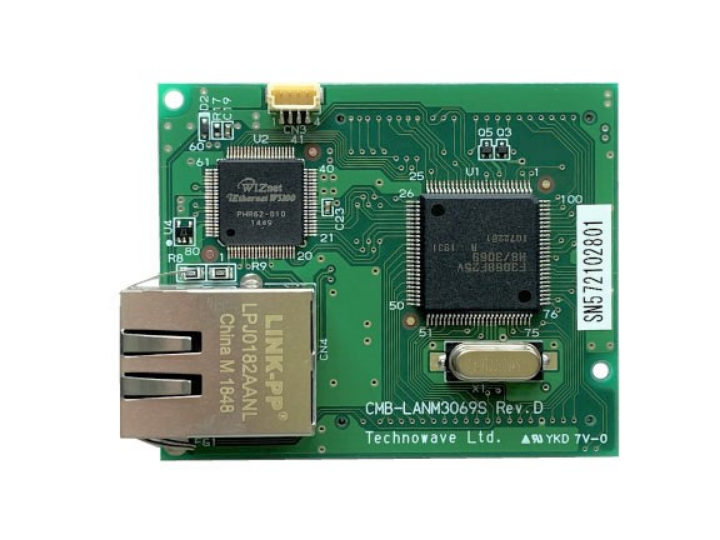
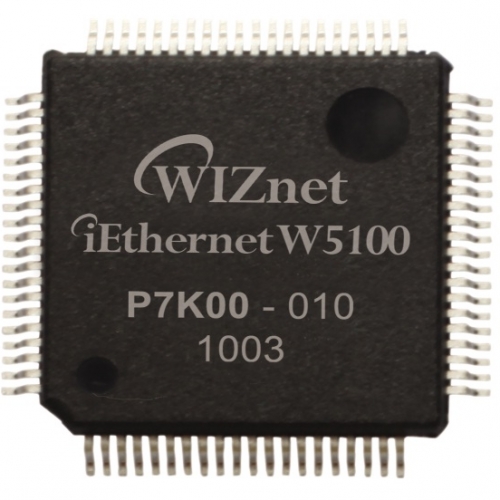
WIZnet - W5100
x 1

Standard onboard Ethernet and hardware TCP/IP controller; indirect parallel bus to the Renesas H8 MCU.
W5100 Remote I/O from a Windows Application
Technowave, a manufacturer of industrial I/O and measurement-control equipment in Tokyo, Japan, sells the LANM3069D-S as a compact Ethernet I/O board. The board combines a Renesas H8/3069R microcontroller with a WIZnet W5100 and preloaded control firmware. A Windows application calls the supplied library to read inputs, change outputs and operate timers over Ethernet, making physical I/O available through ordinary software function calls.
Remote I/O means that the electrical inputs and outputs sit beside the equipment, while the application that uses them runs on a connected computer. An application programming interface, or API, gives that program named operations such as reading an analog channel. Technowave supplies the communication layer that carries those operations to the board.
The current family also includes LANM3069D-SL, which uses an H8/3029 and 3.3 V I/O rather than the 5 V I/O of D-S. Both contain W5100 and require a 5 V board supply. Technowave introduced the D-S revision in 2021; its direct shop listed the D-S board at JPY 9,800 before tax when checked on September 7, 2026. The official product page and current manual explain the supplied functions and electrical requirements.
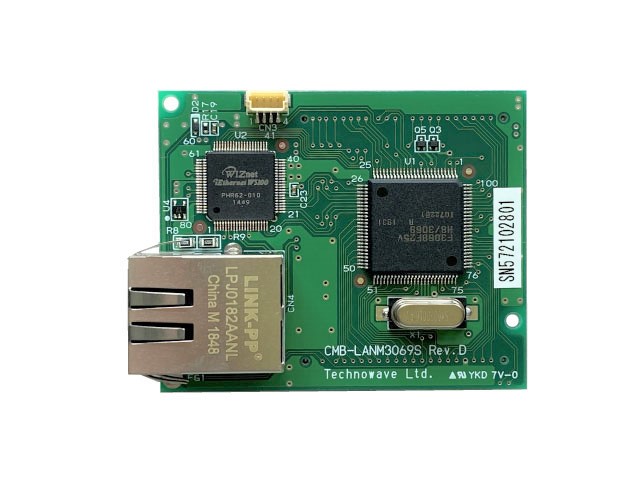
The LANM3069D-S hardware, with W5100 and H8 visible on the same PCB. Photo: Technowave.
What Happens After a PC Calls the Library?
The LANM3069D-S arrives with system firmware that interprets commands and operates the H8 peripherals. On the computer, the TWB library sits above the USBM3069 library and the Windows networking layer. The developer writes the application behavior; the supplied libraries handle network communication with the board.
The M3069 programming reference makes that interface concrete. TWB_OpenByAddress() connects to a specified device, TWB_PortRead() and TWB_PortWrite() access digital ports, and TWB_ADRead() reads an analog input. Other documented calls configure pulse-width modulation, which controls the timing of an output pulse, read counters, and exchange serial data.
The official sample archive includes an especially useful C# starting point. In CSSamples/AnalogSampleCS/Form1.cs, the program opens a device by address, writes DA0 and DA1 through TWB.PortWrite, and reads all four analog channels through TWB.ADRead. The port example separately shows how an application selects an input or output direction before accessing a shared port.
The LAN connection can start from either end: the computer can connect to the board in server mode, or the board can connect to the computer in client mode. After either connection is established, the computer still sends the control commands. A developer who needs autonomous behavior instead uses the separate user-firmware extension mechanism described in the development manual.
The user-firmware mechanism lets a developer add local behavior while retaining the supplied I/O services. Technowave presents this as a way to implement additional commands and processing that needs to run on the microcontroller. The practical choice is therefore where the application logic should live: a PC application can coordinate ordinary reads and writes, while a custom H8 program can perform the additional local operation that the equipment requires.
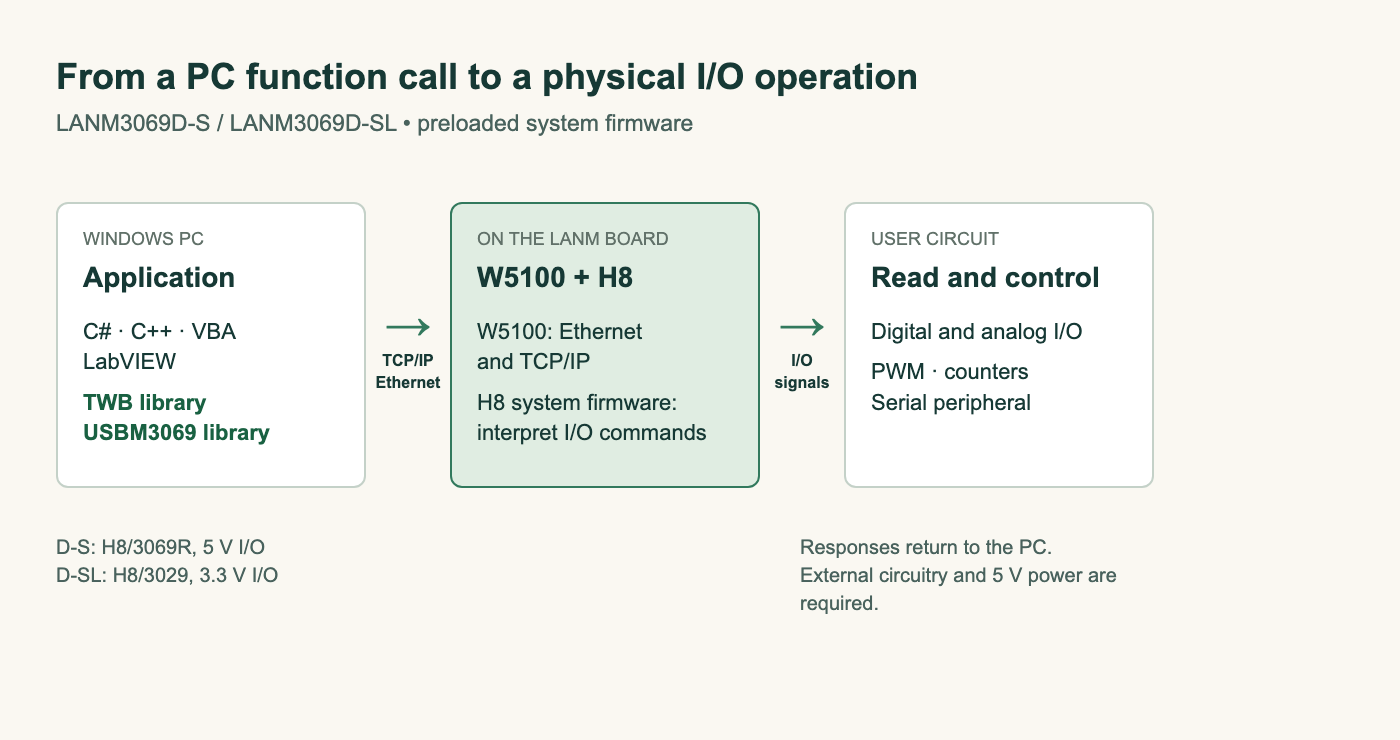
Authored technical diagram: the supplied libraries connect PC operations to H8 I/O through W5100 Ethernet.
How Does W5100 Connect to the H8 Controller?
The W5100 provides the Ethernet and hardware TCP/IP path for LANM3069D-S. The H8 interprets the application commands and operates its local peripherals. This division keeps network protocol processing in the W5100 while the microcontroller supplies the control behavior exposed by the library.
The hardware interface is also specific. Technowave documents indirect bus mode, and the published board schematic shows the W5100 connected through two address signals and eight data signals. This is a parallel connection between the two chips on the board.
Section 6.2 of the W5100 datasheet states, “Indirect Bus I/F mode uses 2bit address line and 8bit data line”. The controller selects an internal address through address registers, then reads or writes a data register. That detail is useful when studying how an existing microcontroller bus can host Ethernet hardware.
For application developers, the TWB calls sit above this chip-level interface. A C# program reading an input normally works with a board handle and channel number, while the installed firmware and communication libraries manage the lower layers. For hardware developers, the schematic provides the more detailed connection reference.
Which Electrical Configuration Should Be Ordered?
The LANM3069D-S is an embedded board measuring approximately 54 × 44 mm, excluding protruding connectors. Its 1.27 mm connector pitch suits installation on a carrier or custom circuit. Technowave explicitly requires external circuitry for operation, so the bare board is a component of an instrument or controller that the buyer integrates.
The board exposes digital I/O, four 10-bit analog inputs and two 8-bit analog outputs, together with timer, counter and serial functions. An analog input converts a voltage into a number; an analog output performs the reverse operation. Peripheral functions share pins, so the connector assignments and electrical limits matter when planning simultaneous functions.
The voltage choice applies to the I/O signals: D-S uses 5 V I/O; D-SL uses 3.3 V I/O. Both current D-series variants use a 5 V supply. The analog outputs also need an appropriate load or buffer circuit, as the vendor FAQ explains when discussing output voltage falling under load.
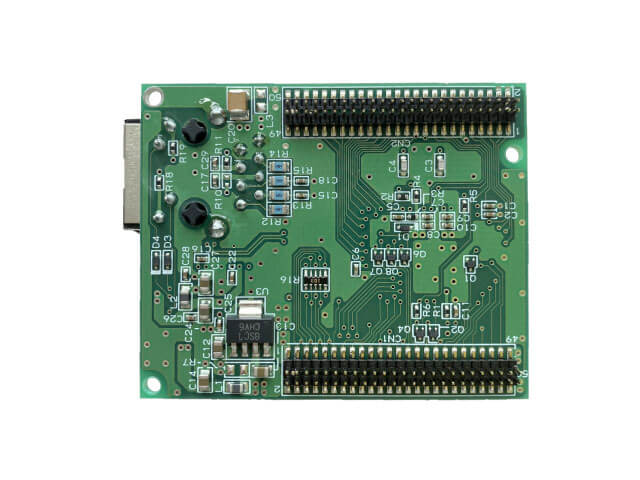
The underside exposes the connector rows used by a carrier or custom circuit. Photo: Technowave.
A Product Family Built Around Shared Host Software
The LANM3069D-S belongs to a longer-running Technowave I/O family. USBM3069-S(L) and USBM3069-HS(L) are USB counterparts with much of the same physical layout, I/O behavior and host-library interface. The family gives developers a way to retain application concepts while choosing the connection and board variant required by their equipment.
The D-S name records a component transition. A March 2021 notice maps LANM3069-S and LANM3069C-S to LANM3069D-S, and LANM3069-SL to LANM3069D-SL. Technowave explains that an Ethernet-controller component was discontinued, requiring a board revision; power consumption changed, and existing customers were advised to reevaluate the replacement.
The family also has a documented measurement use outside the vendor catalog. In a 2014 Chuo University doctoral thesis, Hayato Omori describes a laboratory excavation experiment in which a conditioned six-axis force-sensor signal reaches an older LANM3069 analog-input board. A C# application controls the motor and collects the data. The example concerns the earlier LANM3069 and illustrates an actual measurement-software workflow within this product family.
Vendor, Availability, and Price
Technowave Ltd. develops, manufactures and sells industrial I/O products and measurement-control equipment from Musashino, Tokyo. The company provides direct purchasing, sales contact and technical support. The prices in this comparison were visible on its direct shop on September 7, 2026.
| Configuration | Price before Japanese tax | Price including tax |
|---|---|---|
| LANM3069D-S, 5 V I/O | JPY 9,800 | JPY 10,780 |
| LANM3069D-SL, 3.3 V I/O | JPY 10,300 | JPY 11,330 |
| M3069-S debugging carrier | JPY 6,900 | JPY 7,590 |
| D-S debugging set with carrier and AC adapter | JPY 18,400 | JPY 20,240 |
The D-S order page and D-SL order page both displayed quantity entry and cart controls. Public stock quantities were not shown. The Ethernet cable is excluded; buyers should confirm delivery for their required quantity and destination through the sales contact.
The direct-shop terms list bank transfer and cash on delivery, with shipping and payment charges separate from the product price. The general delivery window is within 15 days after payment confirmation or a cash-on-delivery order, with notification if a stock shortage causes a delay. Returns require contact within seven days of arrival; initial-defect remedies have a separate 14-day window.
For an initial D-S setup, the listed debugging set combines the board, M3069-S carrier and UA310-0520 AC adapter. The debugging carrier brings the connections to 2.54 mm pitch and adds configuration jumpers, an RS-232 transceiver and 128 KB of SRAM. The separate H8 compiler/debugger package is needed for the custom-firmware development route, rather than ordinary PC-controlled I/O.
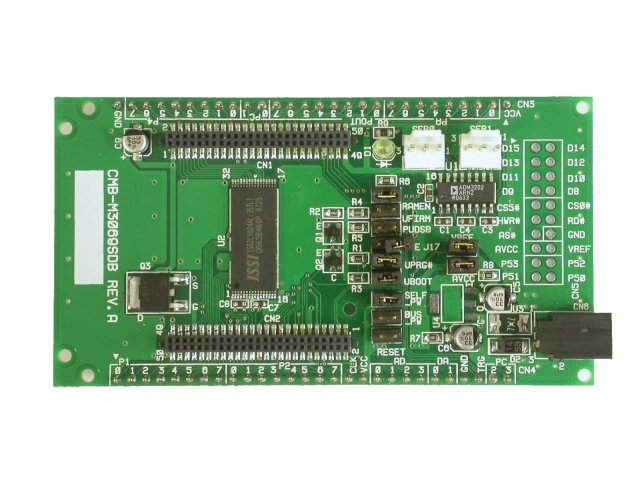
Optional M3069-S debugging carrier, shown without an I/O board installed. Photo: Technowave.
Where Does This Approach Fit?
The LANM3069D-S is useful when the application belongs on a computer and the physical I/O belongs inside another piece of equipment. The supplied functions offer a starting point for measurement software, instrument interfaces and custom control panels. Buyers still design the external electrical connections, mounting and application behavior.
The software ecosystem deserves an early compatibility check. Technowave publishes source examples built with Visual Studio 2005, Excel 2007 and LabVIEW 7.1, alongside later library and firmware downloads. A team adopting the board should confirm its intended Windows and development-tool versions with the supplier before committing to an installation.
Related WIZnet Maker Reading
For a LabVIEW application that communicates through a standard industrial protocol, the STM32 and W5500 Modbus TCP project is a useful companion. The developer builds the register-based device behavior, while LANM3069D-S exposes the supplied TWB control interface.
For a finished I/O unit with an enclosure and relay outputs, the Teracom TCW241 article offers another buying perspective. Comparing the two makes the integration decision clearer: how much electrical interfacing and packaging should arrive with the product, and how much belongs in the custom equipment?
FAQ
Q. Does LANM3069D-S require custom H8 firmware? The board ships with system firmware for PC-controlled I/O. Custom user firmware is a separate route for additional commands or autonomous operation.
Q. Is W5100 an optional Ethernet module? W5100 is installed on both LANM3069D-S and LANM3069D-SL as part of the standard board.
Q. What changes between D-S and D-SL? D-S uses H8/3069R and 5 V I/O; D-SL uses H8/3029 and 3.3 V I/O. Both current boards require 5 V power.
Q. Can the bare board operate without a carrier or external circuit? External circuitry is required. Technowave offers matching debugging carriers and board/carrier/power-adapter sets for an initial setup.
Q. Where can developers inspect the API and examples? Technowave publishes the M3069 programming reference, Windows and LabVIEW sample archive, board schematic and user-firmware documentation. These are linked in the Documents panel.
-
Technowave LANM3069D-S product page
Official product, I/O capabilities and carrier/accessory family.

-
LANM3069D-S and D-SL user manual
W5100, H8 variants, power requirements, connector assignments and PC control architecture.
-
M3069 programming reference
TWB library functions for digital and analog I/O, timers, counters and serial communication.
-
Official Windows and LabVIEW sample programs
Vendor sample source archive including the C# analog and digital-port examples.
-
LANM3069D-S(L) circuit schematic
Board Rev.D schematic showing W5100, H8 and the parallel interface.
-
M3069 user-firmware development manual
Optional additional commands and autonomous H8 program development.
-
LANM3069D-S direct purchase
Current 5 V I/O board pricing, optional carrier, adapter and debugging set.
-
LANM3069D-SL direct purchase
Current 3.3 V I/O variant; the board supply remains 5 V.
-
2021 LANM3069 board revision notice
Official predecessor-to-D-S/D-SL transition caused by component discontinuation.
-
Legacy LANM3069 research use at Chuo University
2014 Hayato Omori thesis, chapter 9 p77: earlier LANM3069 board in a force-sensor/C# laboratory experiment.
-
W5100 datasheet v1.2.8
Official chip reference; section 6.2 explains the indirect parallel bus.


