


What Does the HATRON PLCino Gain from Its Optional W5500 Ethernet Module?
HATRON pairs Arduino Micro-compatible 24 V control with an optional HT008 W5500 module, DIO8 expansion and a public conveyor example.
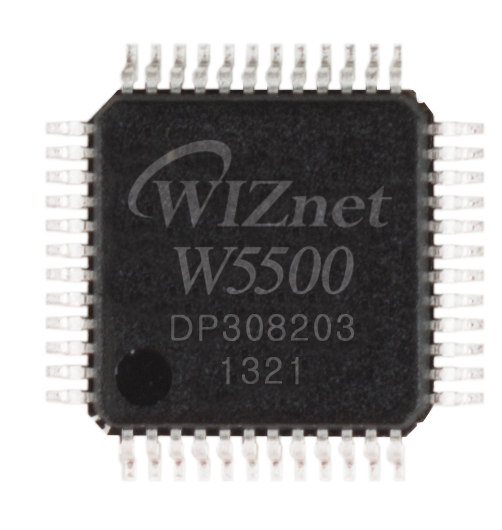
WIZnet - W5500
x 1

W5500 Ethernet controller in the separately purchased HATRON HT008 module. It connects to PLCino through the SPI extension interface and is documented in the vendor R1.0 schematic.
A Network Option Beside the Local Controller
The HATRON PLCino is a DIN-rail controller for small automation jobs: read industrial sensors, switch low-current outputs and run application logic written with the Arduino IDE. Ethernet arrives through a separate module, HT008, which connects to the controller over an IDC cable. HATRON explicitly identifies the network chip as the W5500.
HATRON GmbH is based in Steinhagen, Germany, and offers electronics, software, manufacturing and control-cabinet services. It describes PLCino as an Arduino Micro-compatible derivative with industrial interfaces. The useful commercial story is the combination of a controller, expansion modules and public examples. A buyer can inspect how the local I/O works before deciding what network application to add.
Vendor, Availability, and Price
The official product page, checked on 7 September 2026, lists PLCino HT001 at €199 for one unit and the HT008 Ethernet module at €84.90 for one unit. Both prices exclude VAT and shipping. HATRON states that its offer is for business customers only. Quantity tiers are published, but the single-unit prices provide the clearest comparison for an initial setup.
Ordering is through direct contact with HATRON at info@hatron.de or +49 5204 9058 491. The site publishes prices and contact details, but no live inventory count or guaranteed dispatch date. A quotation should therefore confirm the supplied hardware revision, availability, destination, delivery cost and required accessories. Adding the two listed prices gives €283.90 before tax and shipping, not a separately advertised bundle price.
The Ethernet listing says the IDC connecting cable is included. It also describes a DIN-rail enclosure and an acrylic board guard. Application wiring and field devices are separate considerations. The linked January 2026 business terms describe general warranty conditions, including a twelve-month general period subject to the stated exceptions; the order terms should be checked for the particular supply.
HT008 is a separate purchase. The base controller price does not include a wired Ethernet interface.
What the Base Controller Already Provides
PLCino brings several interfaces onto one board: five digital outputs, four digital inputs, four analog inputs, CAN, RS485 and a 5 V UART connection. The analog channels cover two 0–10 V and two 4–20 mA signals. HATRON identifies two PWM-capable outputs in the product brochure. A battery-backed clock, EEPROM and board-temperature sensor support applications that need local state and timing.
The datasheet makes the electrical limits more useful than a generic industrial label. It specifies outputs up to 150 mA per channel, with a lower total continuous-current limit than five times that figure, and says they are not short-circuit protected. These outputs therefore need to be matched to the actual load and driver arrangement. The conveyor example should not be interpreted as permission to connect an arbitrary motor directly.
The UART and RS485 connection share a multiplexed UART resource. They are not two independent serial ports simply because both connectors appear in a feature list. The supplied code includes mode-selection macros, making that distinction visible to the programmer. CAN is handled separately through an MCP2515 interface, with its own application library requirements.
USB-C supports program transfer and debugging. HATRON also documents powering the logic from USB for desktop programming, while noting that the 24 V portions are then unavailable. This is a useful commissioning boundary: a successful USB upload does not demonstrate operation of the field-side circuitry.
How HT008 Adds W5500 Ethernet
HATRON calls HT008 compatible with the Arduino Ethernet library and explicitly instructs users to assign the correct chip-select during initialization. Its Ethernet schematic shows the W5500, SPI connections, network connector and local voltage regulation. The published revision provides direct evidence of the chip choice, rather than relying on the appearance of an RJ45 socket.
The expansion connector carries SPI and I²C signals along with power. In the network module, the W5500 supplies the Ethernet MAC, PHY and TCP/IP resources; the PLCino application remains responsible for deciding which sensor states or commands to exchange. HATRON describes a 10/100 Ethernet interface, not a measured application transfer rate.
The distinction between library compatibility and a complete application matters here. The downloadable PLCino library and conveyor sketch do not contain an Ethernet server or a finished protocol bridge. HT008 provides a documented hardware route for adding one. A web page, telemetry format or connection-recovery policy would still need to be implemented and tested in the chosen application.
The W5500 documentation explains the chip resources available through its socket interface. A PLCino sketch selects the services it will provide and the data it will exchange. The network module and application code therefore form complementary parts of an Ethernet-enabled controller.
A Conveyor Example Gives the I/O a Purpose
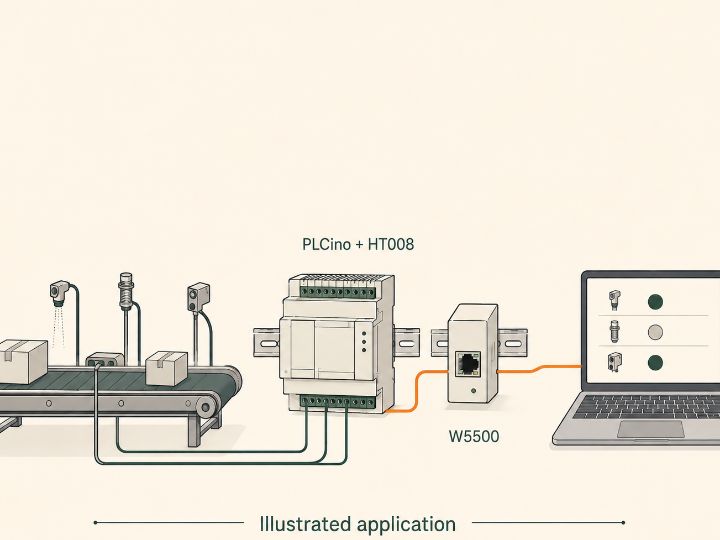
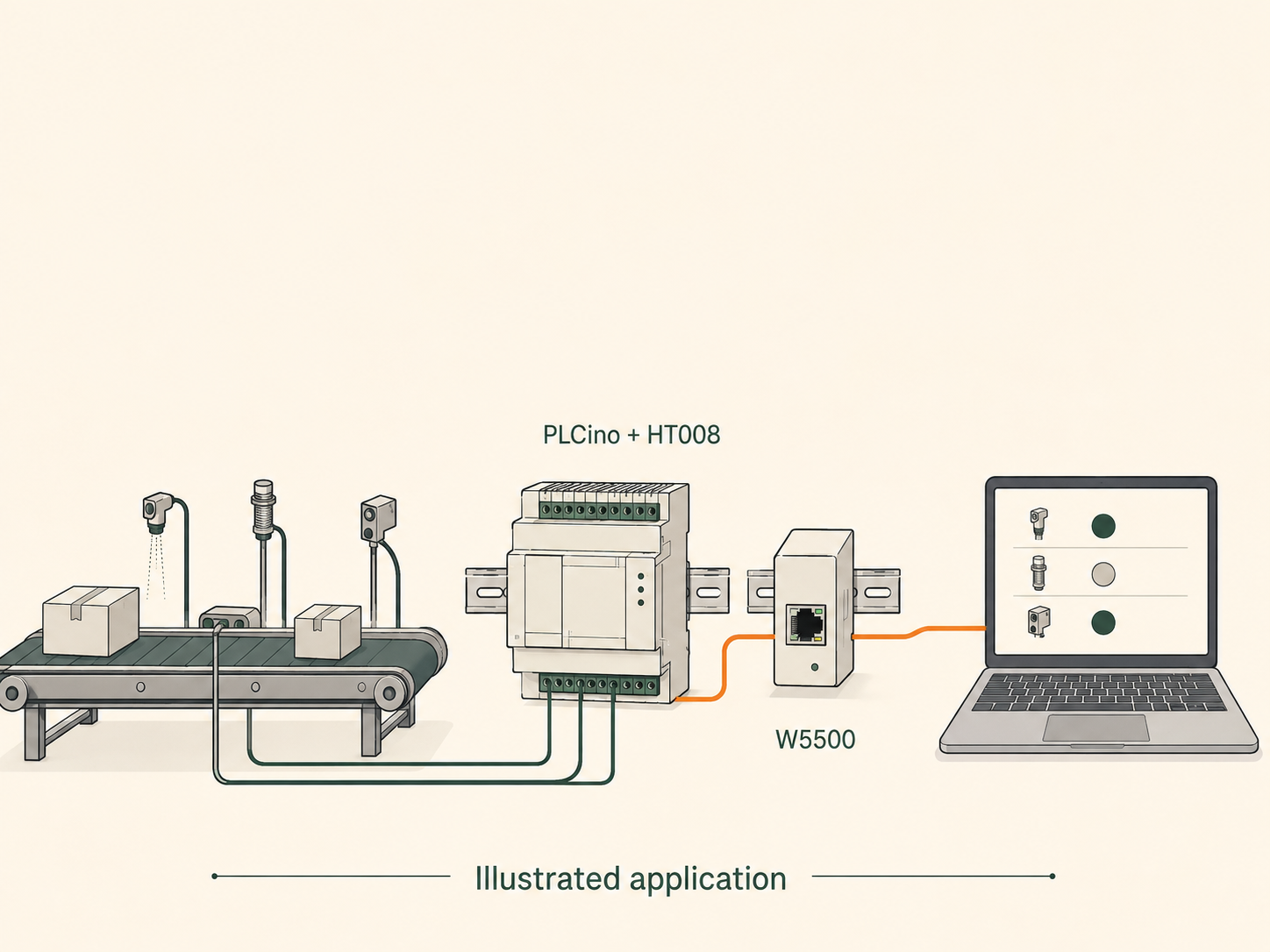
The strongest application material is the vendor accumulation-conveyor example. It uses three sensor states: an entry sensor, a sensor at the accumulation position and a signal for the next position. The program starts or stops the conveyor according to occupancy and downstream availability. This gives the terminal-level features a concrete operating context.
The downloadable sketch also checks a 15-second timeout after the most recent start-condition timestamp. A true start condition refreshes that timestamp on each loop. It packs the sensor states and run flag into a status byte, then prints a message when that state changes. These details show how the example organizes the local control loop. The timer is application logic; machinery requiring a safety-rated stop needs its own appropriate control arrangement.
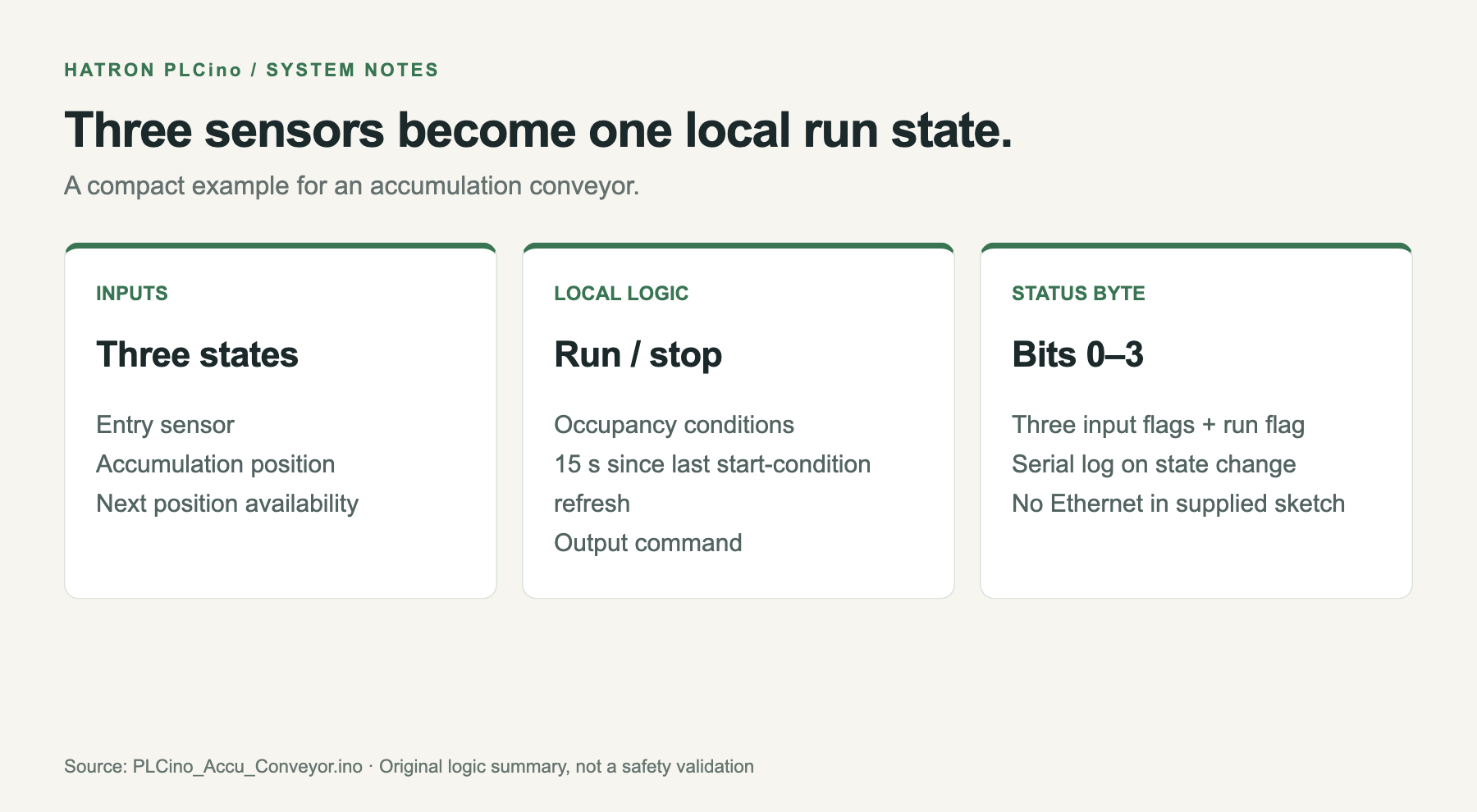
That status byte is a practical starting point for an Ethernet extension: a developer could report it to a supervisory computer while preserving local sensor handling. This is an integration possibility derived from the code. The supplied sketch currently prints through Serial; it should not be described as already sending conveyor telemetry through HT008.
The public example demonstrates local conveyor logic. Network monitoring is a separate application extension.
This separation is valuable during commissioning. The local sequence can be tested with the sensors and outputs first. Ethernet can then be added with a defined behavior for a disconnected cable or unavailable remote computer. Neither the module nor a generic Arduino network example determines that behavior automatically.
The Physical Setup Behind the Conveyor Example
HATRON's demo page does not stop at the sketch. It also shows the accumulation-conveyor example built on a physical bench: a short belt carrying labeled test boxes, driven by a SEW frequency inverter, with the PLCino controller and its power and safety components mounted on a DIN rail underneath. A second photo on the same page connects each of the three photoelectric sensors, the controller and the inverter with labeled wiring, matching the entry, accumulation and next-position roles described in the sketch.
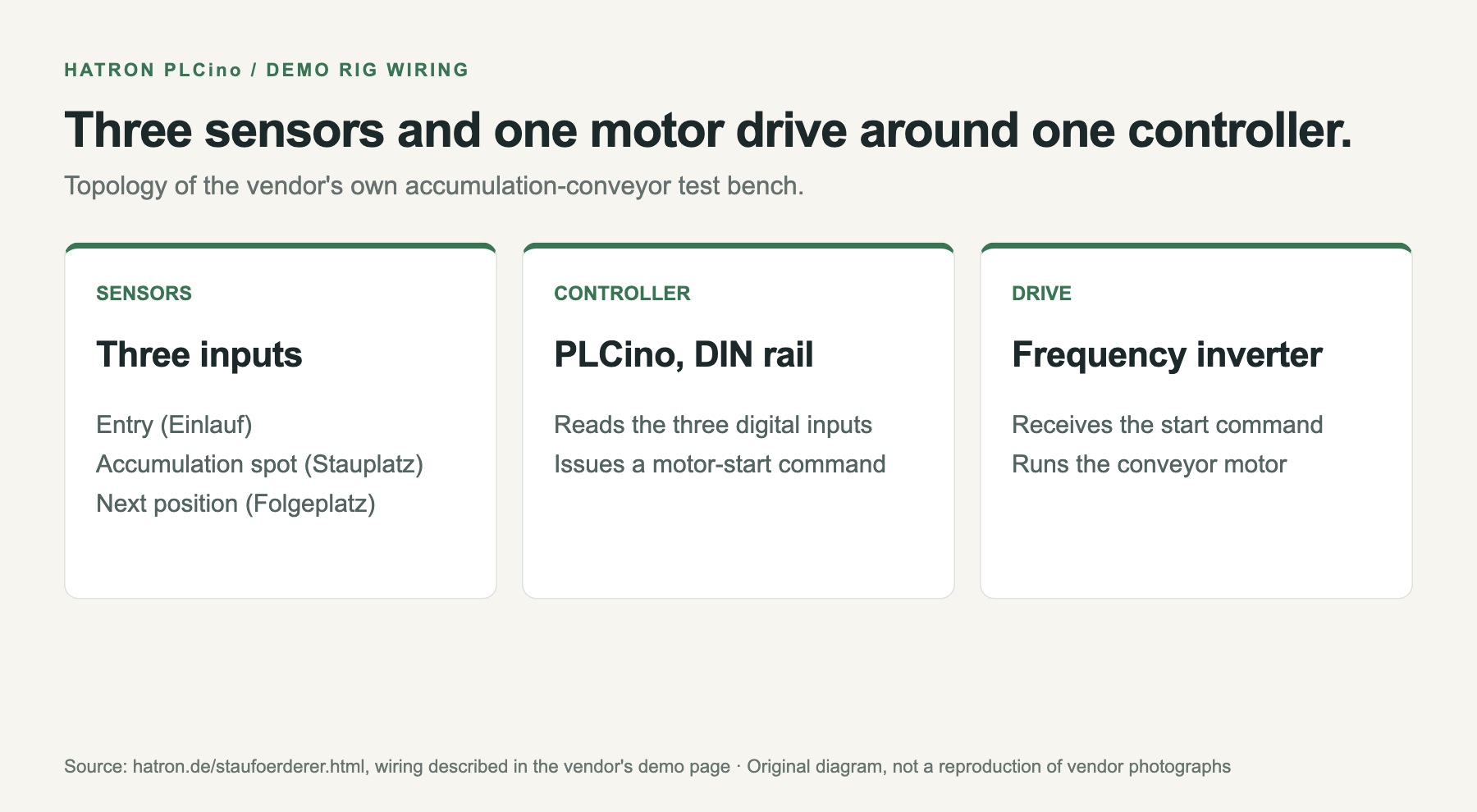
The accumulation-conveyor page carries both the wiring photo and the photo of the assembled test bench. The PLCino product page separately shows the bare controller, a green DIN-rail enclosure with a USB-C port and screw terminals, without the enclosure or field wiring added for the demo. Viewing the two pages together is the clearest way to see how the sketch, the schematic and the physical build correspond to each other.
The Product Family Expands in Different Directions
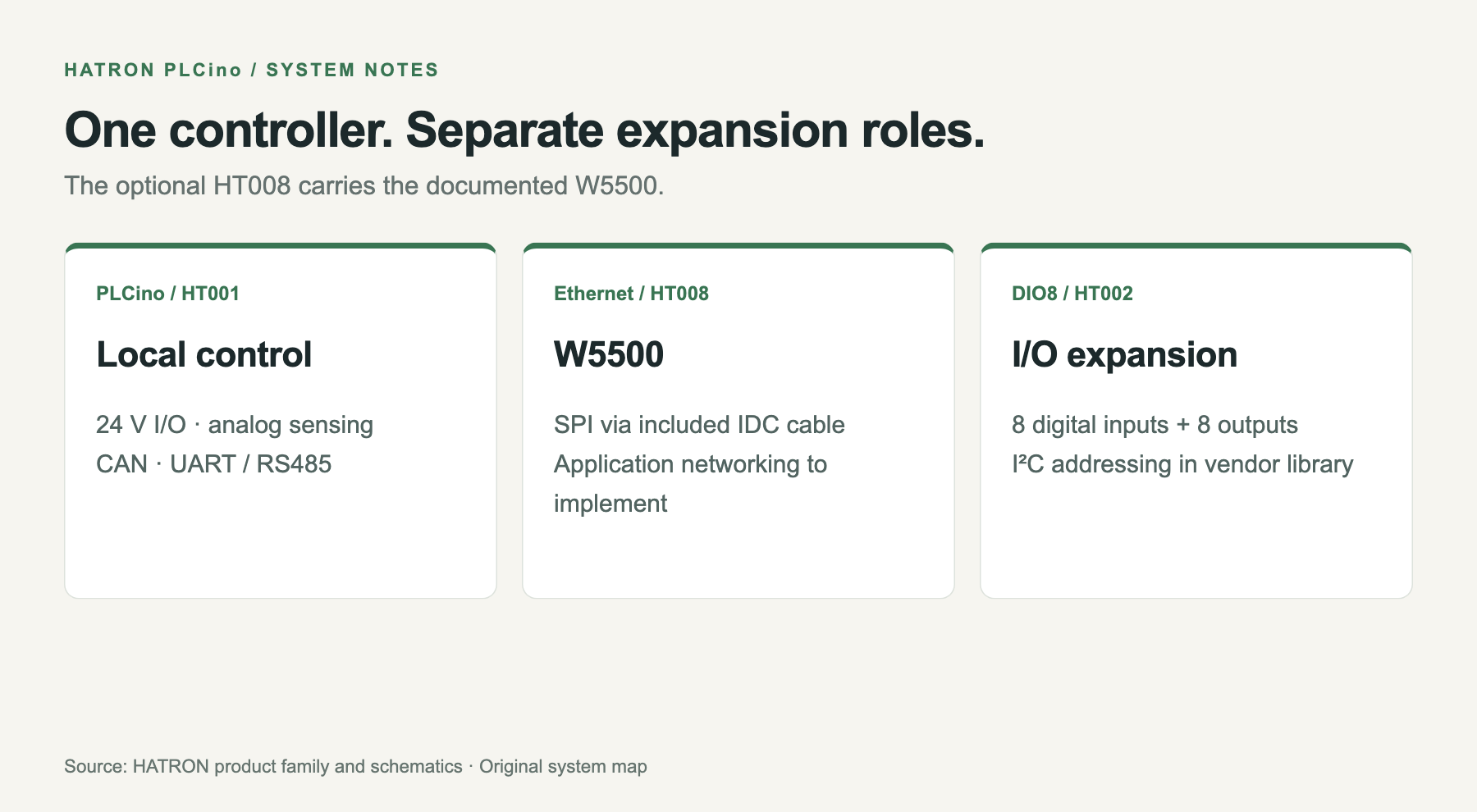
The official catalog distinguishes three relevant accessories. DIO8, HT002, adds eight digital inputs and eight digital outputs. HT004 exposes the extension interface through screw terminals. HT008 supplies the W5500 Ethernet interface. These are different functions within the same controller system, not three equivalent network products.
| Product | Function | Ethernet function |
|---|---|---|
| PLCino HT001 | Local controller and field interfaces | No Ethernet module included |
| DIO8 HT002 | Eight digital inputs and eight outputs | Local expansion, separate from Ethernet |
| IDC adapter HT004 | Extension-port wiring access | Local expansion, separate from Ethernet |
| Ethernet HT008 | Network module for PLCino | W5500 explicitly documented |
The PLCino library archive adds a useful software view of DIO8. Its source accepts module IDs from zero through seven. Reads use an input-device address based on 0x20 + ID; writes use 0x38 + ID. It keeps a remembered output byte for bit-level operations. The header warns that the output state must be initialized before using the single-output helper.
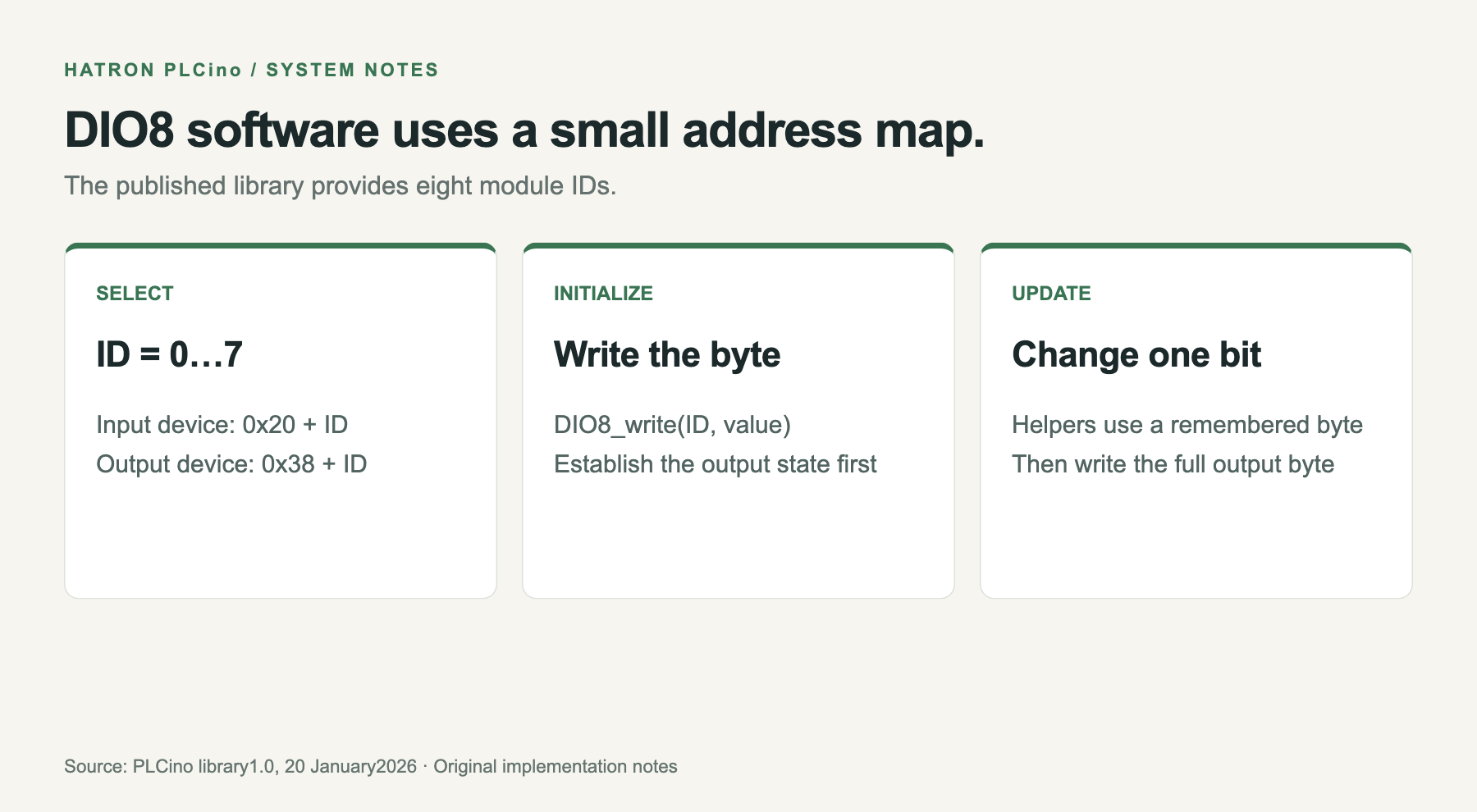
The header is dated 20 January 2026, version 1.0. It also explicitly leaves CAN, UART/RS485, clock and EEPROM communication to the user application and appropriate drivers. That is a more precise description of the package than calling it a universal PLC runtime. Motor modules mentioned as being in development in the April 2026 brochure should likewise be kept separate from the currently listed accessories.
Documentation and Integration Boundaries
HATRON publishes schematics, mechanical files and examples, describing the hardware and example projects as open source. The library download did not contain a separate license file, so those statements should not be converted into an assumed MIT grant. The original documents and real product photographs are linked for inspection; this article uses newly authored explanatory visuals.
The conveyor example provides a starting sequence for a small materials-handling station. A builder can adapt the three sensor positions to a local process, then use the documented interfaces for additional sensing or supervisory communication. Commissioning should establish the actual sensor polarity, output load and stop behavior, alongside the network application added to the example.
The resulting purchase is best understood as a compact programmable controller with an optional, documented Ethernet interface. Its appeal lies in the available I/O and inspectable integration material. The finished machine application, network behavior and acceptance tests remain part of the work built around it.
Related Projects
GEVINO Motor with W5500 offers a comparison with another European controller using an optional Ethernet module. Sensoper SC-EN-I6-TO4 provides a contrasting network-I/O product. These are independent product systems, not compatible PLCino accessories.
FAQ
Q. Does PLCino include Ethernet as standard? No. The W5500 is identified in the separate HT008 Ethernet module.
Q. What does one controller plus Ethernet cost? The observed single-unit prices total €283.90 before VAT and shipping. Availability and the final quotation require vendor confirmation.
Q. Is the conveyor example already networked? Its published code logs state changes through serial output. Ethernet telemetry would be an additional implementation.
Q. Can DIO8 expand the local I/O? Yes. The vendor describes eight inputs and eight outputs per module, with eight module IDs supported by the published library.
Q. Is there a finished Ethernet gateway firmware? None was found in the reviewed downloads. HATRON documents Arduino Ethernet library compatibility for HT008.
한국어 (Korean)
독일 슈타인하겐에 있는 HATRON GmbH가 만드는 산업용 컨트롤러입니다. 아두이노 마이크로와 핀 호환이면서 현장에서 쓰는 24V 입출력과 통신 인터페이스를 한 장에 올렸습니다. 개발보드와 PLC 사이 어디쯤에 놓인 물건이라고 보시면 됩니다. DIN 레일용 케이스에 들어가서 배전반이나 분전반에 그대로 설치할 수 있습니다.
기본 본체에는 디지털 출력 5개와 입력 4개, 0에서 10V와 4에서 20mA 아날로그 입력이 각각 2채널씩 들어 있습니다. 통신은 CAN과 RS485, 5V UART가 붙어 있는데 UART는 RS485와 자원을 나눠 쓰기 때문에 독립된 두 포트가 아닙니다. 그 밖에 배터리로 유지되는 시계와 EEPROM, 온도 센서가 올라가 있습니다.
이더넷은 기본이 아닙니다. HT008이라는 별도 모듈을 사서 확장 포트에 IDC 케이블로 연결해야 붙고, 그 모듈에 W5500이 들어갑니다. 제조사가 공개한 HT008 회로도에 W5500과 SPI 배선, 네트워크 커넥터, 전압 레귤레이터가 그려져 있습니다. 소프트웨어는 아두이노 Ethernet 라이브러리를 그대로 쓰되 초기화할 때 칩 선택 핀을 맞춰 지정하라고 안내합니다.
여기서 구분할 게 있습니다. 라이브러리가 붙는다는 것과 완성된 네트워크 기능이 들어 있다는 건 다른 얘기입니다. 제조사가 공개한 PLCino 라이브러리와 컨베이어 예제에는 이더넷 서버나 프로토콜 브리지가 없고, 상태 변화를 USB 시리얼로 출력할 뿐입니다. 웹 페이지든 원격 통신이든 재접속 처리든 쓰는 쪽이 직접 짜야 합니다.
컨베이어 예제는 센서 세 개로 입구와 적재 위치, 다음 공정 자리를 보고 벨트를 세우고 돌리는 로직입니다. 기동 조건이 가장 최근에 찍힌 시각에서 15초가 지나면 타임아웃을 겁니다. 다만 이건 응용 로직이지 안전 등급을 받은 정지 기능이 아닙니다.
가격은 본체 HT001이 199유로, HT008 이더넷 모듈이 84.90유로로 부가세와 배송비는 별도입니다. 기업 고객만 상대하고 주문은 이메일이나 전화로 받습니다. 재고와 납기는 따로 확인해야 합니다.
-
PLCino and HT008 official product page
Current B2B product prices, own W5500 statement and real product photographs.

-
PLCino datasheet
Electrical limits, enclosure, interfaces and USB-only power boundary.
-
HT008 Ethernet schematic
W5500 and SPI hardware evidence, revision 1.0 dated 23 September 2025.
-
PLCino base schematic
Controller hardware reference.
-
PLCino April 2026 brochure
Current family view; motor modules marked under development.
-
PLCino library
Header version 1.0 dated 20 January 2026 and DIO8 address/output helpers.
-
Accumulation conveyor example
Vendor application notes for a three-sensor accumulation conveyor.
-
Conveyor Arduino sketch
Three sensors, run-state byte, serial logging and a timeout based on the last start-condition refresh.
-
DIO8 product page
PLCino-compatible digital I/O expansion module connected through I2C.
-
HATRON company information and website terms
Manufacturer address, contact information and website use terms.
-
Business terms January 2026
Sales, delivery and warranty terms; quotation still required.


