


Why Did EaseEmbro Put a W5500 Wired Option in Its ESP32-S3 Attendance Terminal?
Surat factory WiFi is unreliable, so the EaseEmbro MES gives its ESP32-S3 fingerprint terminal a W5500 wired Ethernet option. The platform runs 33 factories.
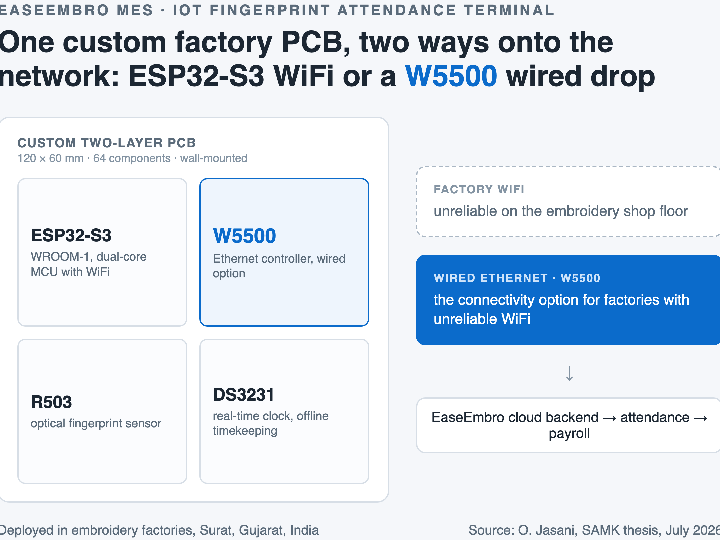
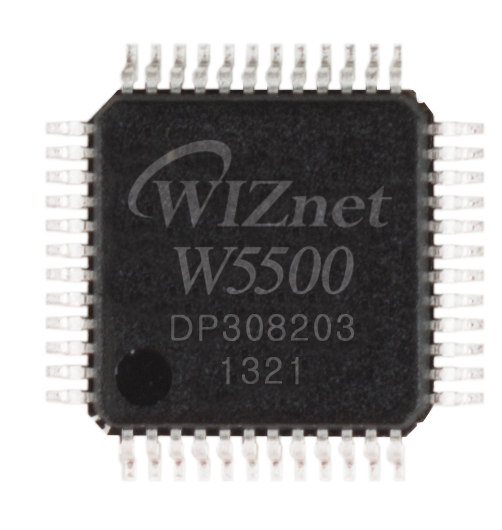
WIZnet - W5500
x 1

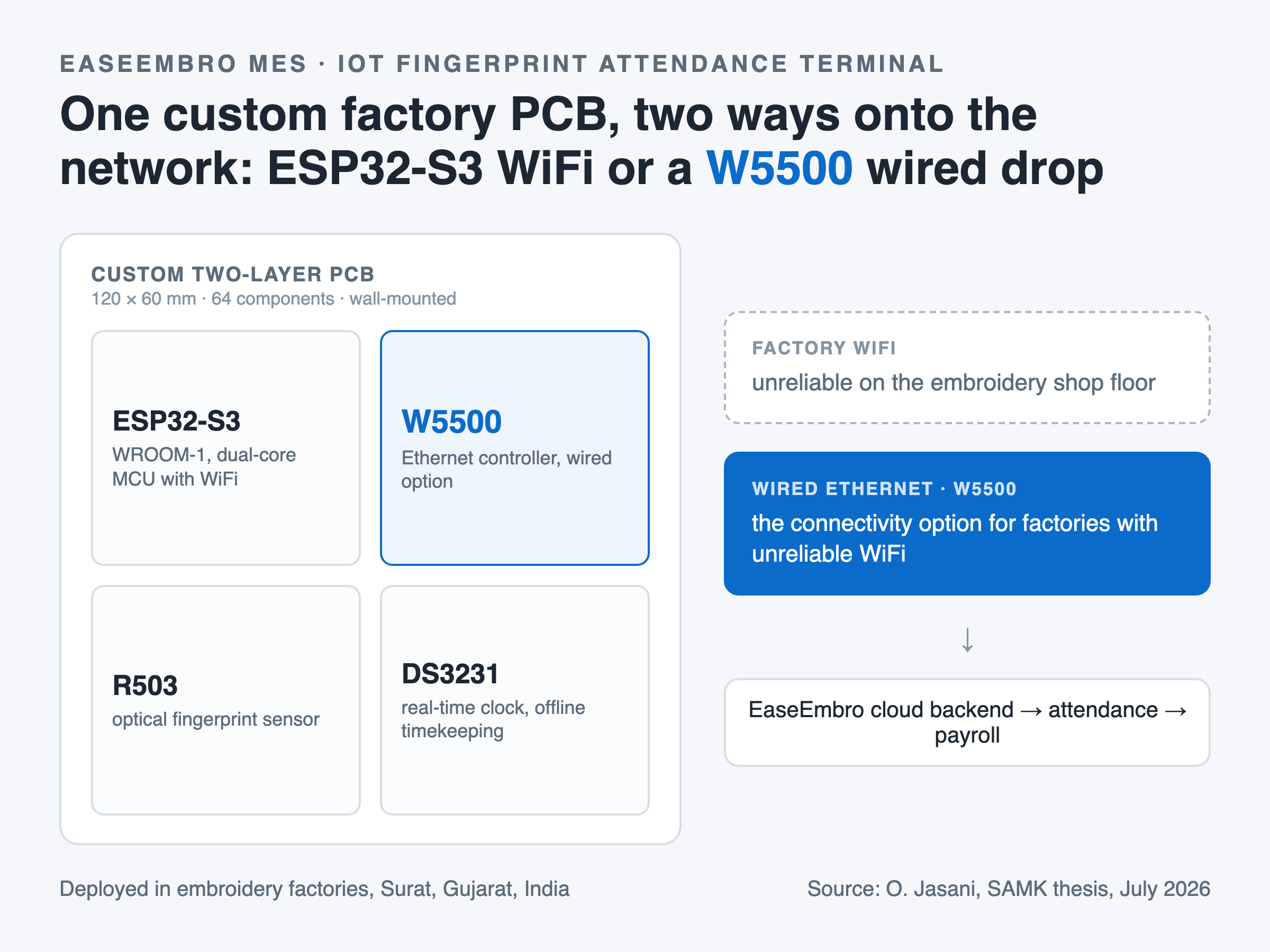
Ethernet controller on the terminal's custom 120x60 mm PCB; wired connectivity option for factories with unreliable WiFi (thesis section 4.9)
📌 A Factory MES From Surat That Builds Its Own Attendance Hardware
Om Jasani is a Data Engineering graduate of Satakunta University of Applied Sciences (SAMK) in Finland and the founder and CEO of Sampurna Labs, an R&D engineering company established in 2025 in Surat, Gujarat, India. His bachelor's thesis, accepted into the Finnish open repository Theseus on July 29, 2026, documents EaseEmbro, a multi-tenant manufacturing execution system (MES) that its abstract calls "commercially deployed across 33 embroidery factories in Surat, India, automating each factory's production-data-to-payroll pipeline."
Alongside its mobile and desktop software, EaseEmbro offers a purpose-built, wall-mounted fingerprint attendance terminal, and that terminal is where WIZnet enters the design: the board pairs an ESP32-S3 with a W5500 Ethernet controller, so a factory whose WiFi cannot be trusted can move attendance events over a cable instead.
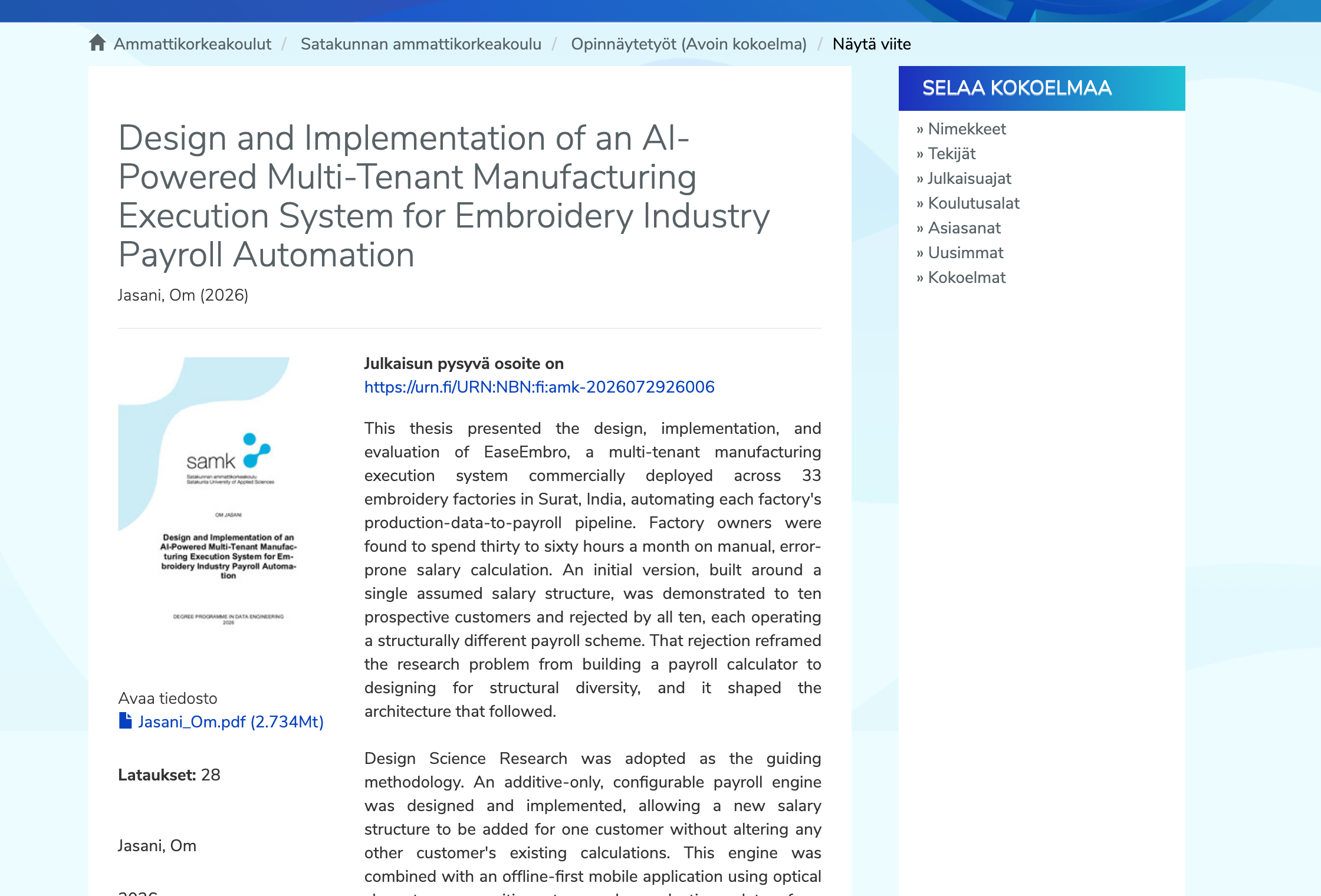
The 92-page thesis, downloadable from Theseus under URN:NBN:fi:amk-2026072926006, reads differently from most academic IoT papers because its system was already a paying product: the platform had been live with real factory customers for roughly five months at the time of writing, after an earlier internal development period.
Thirty to Sixty Hours of Payroll, Every Month
The problem EaseEmbro sells against is measured in the thesis introduction: embroidery factory owners in Surat typically spend thirty to sixty hours every month calculating salaries by hand. Workers are paid piece-rate, by stitches or frames produced rather than by the hour, and each factory layers its own bonuses, shift differentials, and deductions on top. An early software version assumed one standard salary structure, was demonstrated to ten prospective customers, and was rejected by all ten, which pushed the design toward an additive-only payroll engine: a new customer's salary structure can be added without touching anyone else's calculations.
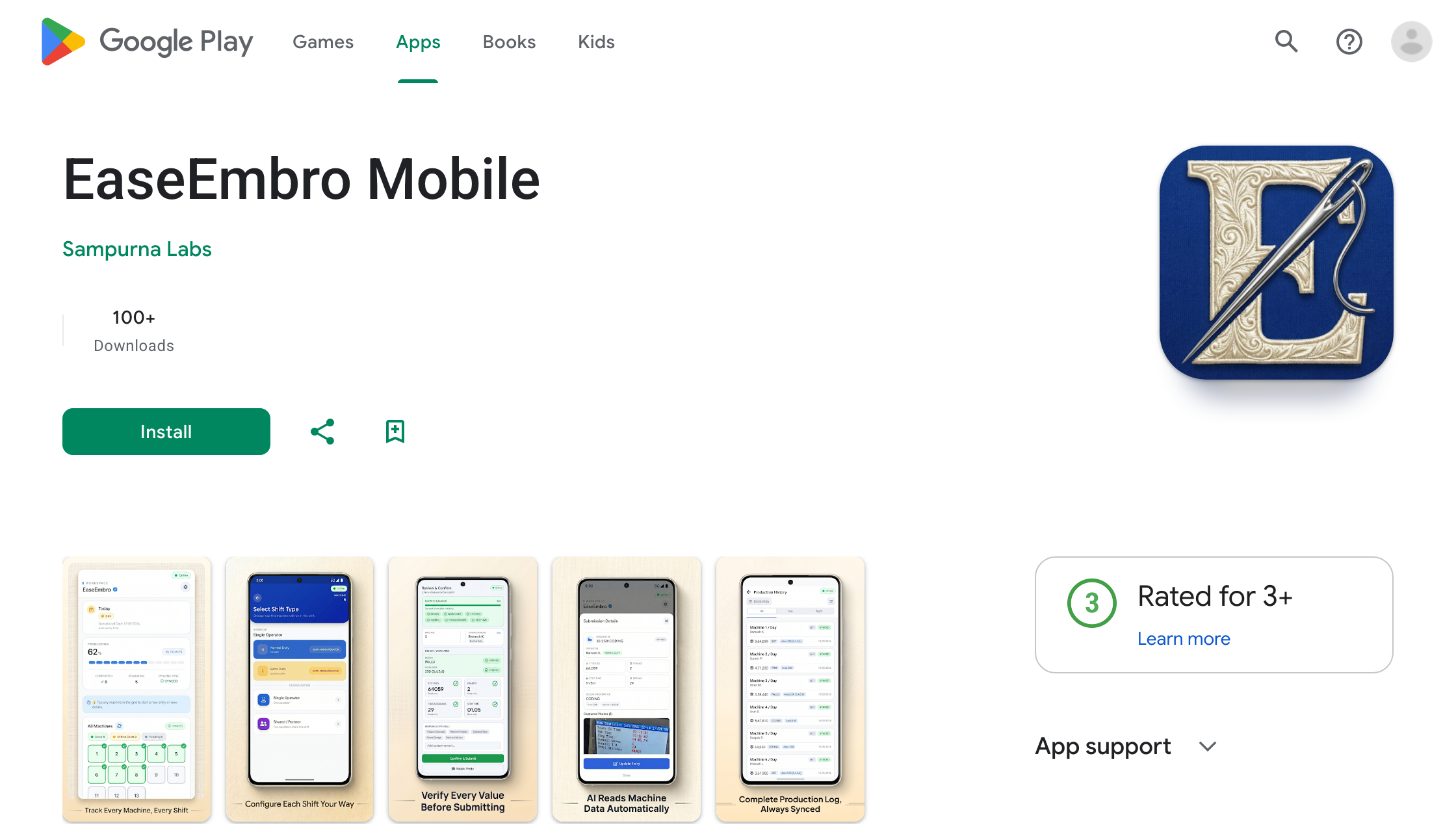
Production data enters the system through a mobile app: a supervisor photographs an embroidery machine's display, and optical character recognition (OCR, software that reads numbers out of a photo) running on Google's Gemini 3.1 Flash-Lite extracts the stitch counts. Across the live customer base the thesis reports 13,860 scored extractions, median confidence 95 percent, with 97.0 percent scoring 0.90 or above.
Attendance is the other half of payroll, and EaseEmbro gives each factory two ways to capture it: face recognition with liveness detection on a supervisor's phone, or the fixed fingerprint terminal this article is about, chosen per factory by budget and preference.
Inside the Wall-Mounted Fingerprint Terminal
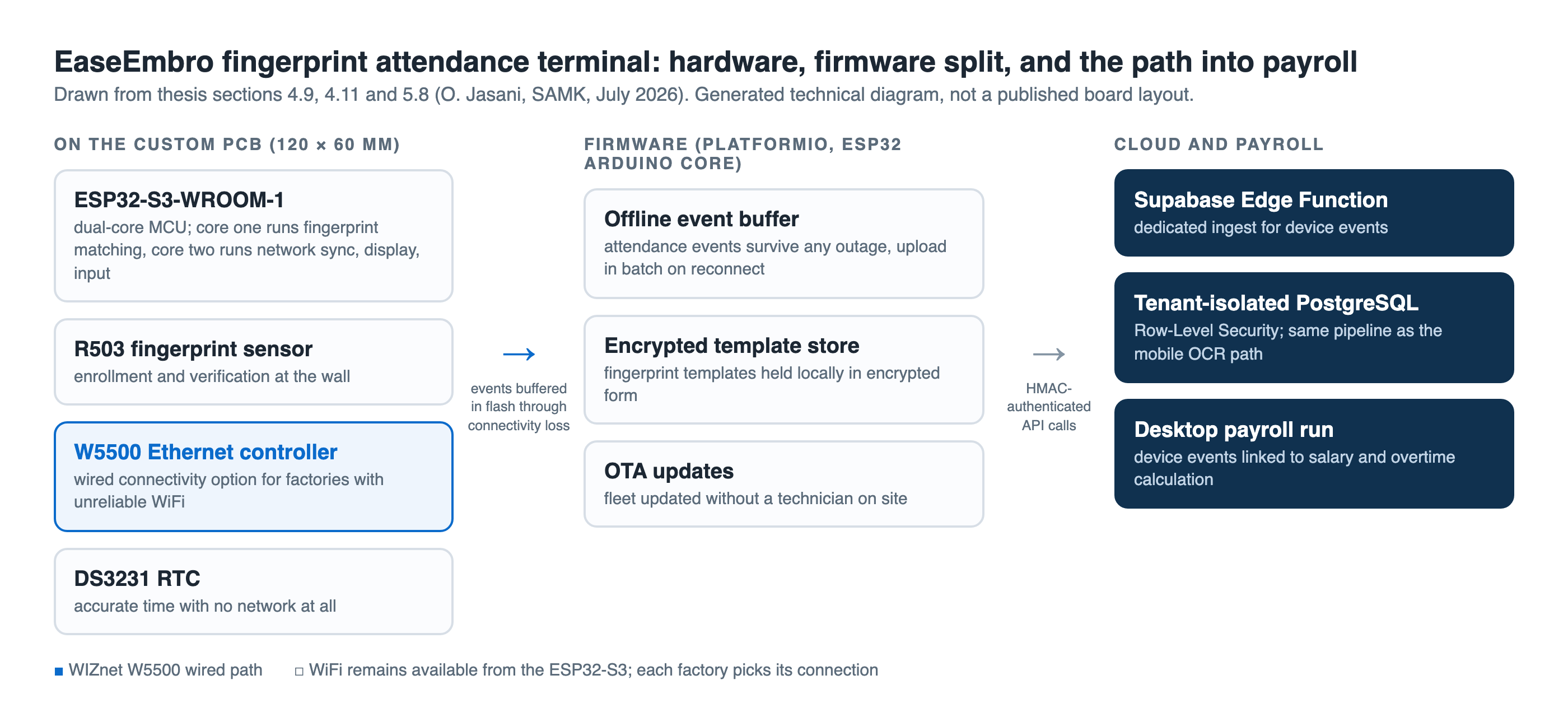
Section 4.9 of the thesis describes the terminal for factories "that would rather have a dedicated fixed device than rely on supervisor smartphones." The controller is an ESP32-S3-WROOM-1, a dual-core microcontroller with integrated WiFi, chosen in the thesis's words as "a low-cost, SME-appropriate entry point into industrial IoT". Fingerprint enrollment and verification run through an R503 optical sensor.
The networking sentence is worth quoting in full: "A W5500 Ethernet controller gives factories with unreliable WiFi a wired connectivity option, and a DS3231 real-time clock module keeps time accurately even with no network connection at all." Every part of that set shares one custom two-layer PCB of 120 by 60 millimetres, carrying 64 components and four mounting holes for wall installation and factory-floor durability.
The terminal is not a bench prototype. Once the design was finished, the thesis states, "PCB fabrication, contract assembly, and field deployment went ahead for the customers who chose this hardware path."
⚙️ Role of the WIZnet W5500
The W5500's job here is insurance against the radio environment. Surat's embroidery factories run multi-head machines around the clock, and the thesis treats unreliable factory WiFi as a given: the terminal buffers attendance events locally through any connectivity loss and uploads them in batch once the connection returns. A wired drop through the W5500 shortens those offline windows exactly where WiFi behaves worst, and the DS3231 keeps timestamps trustworthy even when no network is available at all.
The scope is worth stating plainly. The W5500 appears in exactly one sentence of the 92-page thesis, so the wired path is a deliberate hardware provision rather than a chapter-length networking study. Because the W5500 sits with every other part on the one custom PCB, it reads as standard fit on the board, and wired versus wireless is each factory's deployment choice rather than a separate hardware variant.
The firmware is closed, and the thesis does not name the Ethernet library that drives the W5500, so the socket-level details stay unverified. What the document does establish is the reason for the chip's presence: wired reliability where WiFi fails, stated by the maker rather than inferred by us.
Firmware on Two Cores
Section 5.8 says the terminal firmware is built with PlatformIO on the ESP32 Arduino core and deliberately splits the ESP32-S3's two cores. One core handles fingerprint sensing and match events, the path a worker is physically waiting on, while the other handles network synchronisation, display updates, and physical input, so a slow network operation never delays a scan.
The fleet is field-serviceable by design: over-the-air updates reach devices scattered across factories, enrollment records sync to the cloud so a worker is recognised across multiple terminals in one factory, and firmware iterations were driven by prototype units tested in real deployments rather than a lab bench.
From Fingerprint Match to Salary Slip
Device security is layered unusually deeply for an SME attendance box. The terminal authenticates its cloud API calls with HMAC, keeps enrolled fingerprint templates in encrypted local storage, and carries physical tamper detection.
On the cloud side, a dedicated Supabase Edge Function ingests device events into the same tenant-isolated PostgreSQL schema, enforced by Row-Level Security, that the mobile and desktop applications use. Terminal attendance therefore flows into payroll through the same pipeline as the OCR production data, and the desktop application links those synchronized events directly to salary and overtime calculation.
Field Numbers After Five Months
The thesis reports its field results candidly, noting they are the founder's own operational monitoring rather than an independent audit.
| Field result | Figure | Where stated |
|---|---|---|
| Factories live on the platform | 33, all in Surat, Gujarat | Section 6.2, July 2026 |
| Hardware terminal deployments | roughly fifteen users across the customer base | Section 6.8 |
| Day-to-day fingerprint verification | effectively instantaneous, within the sensor datasheet spec | Section 6.8 |
| First-attempt enrollment success | around 60 percent | Section 6.8 |
| OCR extractions scored | 13,860, median confidence 95 percent | Abstract and chapter 6 |
| Manual payroll before EaseEmbro | 30 to 60 hours per factory per month | Section 1.2 |
The 33-factory figure describes the software platform; the hardware attendance path has gone out to roughly fifteen users who chose it over the mobile alternative. Verification once enrolled has been, in the thesis's words, "an unqualified success," while first-time enrollment succeeded only about 60 percent of the time, a usability finding the author reports honestly and mitigates with the parallel mobile face-recognition path.
Customers who picked the hardware terminal gave a consistent reason: a fixed device needs no daily supervisory attention, whereas mobile attendance still depends on someone actively operating a phone every day.
Sampurna Labs and the SmartAttend Listing
Sampurna Labs is the thesis's commissioning organization and the company operating EaseEmbro commercially. Its website, sampurnalabs.tech, lists the fingerprint terminal as a shipped product under the name SmartAttend Biometric Terminal, alongside the EaseEmbro Production Suite and an STM32-based Modbus RTU edge gateway reference design called IndustrialEdge.
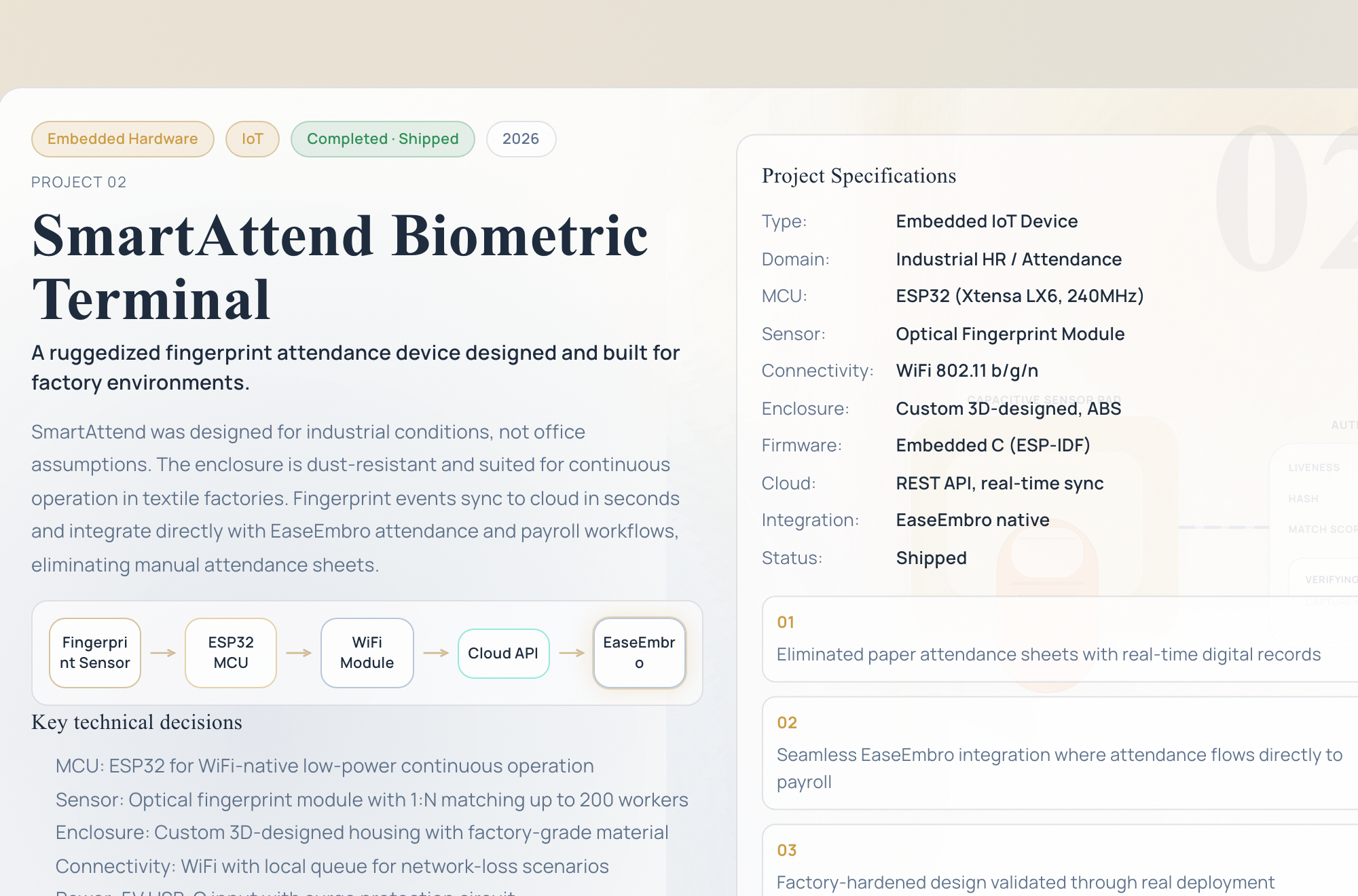
One difference between the two sources is worth naming. The vendor specification block lists an ESP32 with WiFi connectivity and ESP-IDF firmware, with no Ethernet option, while the July 2026 thesis describes an ESP32-S3-WROOM-1 with the W5500 wired option and a PlatformIO build on the ESP32 Arduino core. This article follows the thesis, the fuller technical description of the hardware; we did not find a published reconciliation of the two.
Where It Fits - Value and Limits
For readers building commercial SME hardware, the reference pattern is the value: biometric sensor, ESP32-S3, W5500 wired fallback, and RTC on one small contract-assembled PCB, backed by offline-first buffering and HMAC-authenticated ingest into a multi-tenant backend. The pattern is documented inside a system with paying factories, and the stated reason for the W5500, wired connectivity where factory WiFi is unreliable, transfers to almost any fixed industrial terminal.
The limits are equally clear. No photograph of the terminal or its PCB has been published anywhere we could find, all 26 images in the thesis being diagrams and app screenshots. The firmware and schematics are closed, the Ethernet library is unnamed, pricing is not public, and the deployment metrics are self-reported by the founder. The thesis PDF itself is All rights reserved, so its figures are not reproduced in this article.
Related WIZnet Maker Projects
- IntelliDrive - ESP32 + W5500 Gate Controller Suite pairs the same ESP32-plus-W5500 combination with a fingerprint sensor in a commercial vendor's PlatformIO firmware. The difference is the job: IntelliDrive automates gates and doors, while EaseEmbro's terminal feeds attendance into a payroll engine. The same wired WIZnet pattern thus reaches two different commercial products.
- A PoE Smart Access Panel Powered by W5500 is a DIY wall panel on the identical ESP32-S3 and W5500 pairing, with fingerprint among its authentication methods. The difference is context: the panel is a one-off ESPHome build for a home, whereas the EaseEmbro terminal is contract-assembled for factory rollout, a hobby-versus-commercial contrast on one chip pairing.
- Arduino W5500 Smart Factory Monitor for ThingsBoard also uses W5500 wired Ethernet to move factory-floor data to a cloud dashboard. The difference is depth: the monitor is a two-node sensor demo, while EaseEmbro carries its wired data into salary calculation for real customers, showing where such a prototype can end up.
❓ FAQ
Q. What does the EaseEmbro attendance terminal use the WIZnet W5500 for? The W5500 gives the terminal a wired Ethernet option for factories whose WiFi is unreliable, as stated in thesis section 4.9. It sits on the same custom 120 by 60 millimetre PCB as the ESP32-S3, the R503 fingerprint sensor, and the DS3231 clock, and each factory chooses wired or wireless at deployment.
Q. Is the terminal open source, and which Ethernet library does it use? No, the firmware is a closed commercial product. The thesis states it is built with PlatformIO on the ESP32 Arduino core but does not name the Ethernet library, so the driver stack behind the W5500 is not publicly verifiable.
Q. How widely is this hardware actually deployed? As of the July 2026 thesis, the EaseEmbro software platform ran 33 embroidery factories in Surat, while the fingerprint terminal had gone out to roughly fifteen users who chose the hardware attendance path. Other factories use the mobile face-recognition option.
Q. Why not rely on the ESP32-S3's built-in WiFi alone? The thesis treats unreliable factory WiFi as an operating assumption in Surat's embroidery plants. A W5500 wired drop shortens the terminal's offline buffering windows, and the DS3231 keeps accurate timestamps even with no network at all.
Q. Where can I read the original source? The full 92-page thesis is open access on Theseus at URN:NBN:fi:amk-2026072926006, published July 2026 and verified reachable on August 28, 2026. The PDF is All rights reserved, permitting personal use only.
-
Thesis PDF: AI-Powered Multi-Tenant MES for Embroidery Payroll (Jasani, 2026)
Full 92-page SAMK bachelor's thesis; section 4.9 documents the W5500 terminal hardware

-
Theseus permanent record (URN)
Permanent URN link to the open-access record, accepted July 29, 2026
-
EaseEmbro Mobile on Google Play
Production-entry app by Sampurna Labs, updated July 18, 2026; subscription required
-
Sampurna Labs projects page
Vendor listing of the SmartAttend Biometric Terminal (shipped 2026) and the EaseEmbro Production Suite
-
Sampurna Labs
Company site of the Surat, Gujarat R&D engineering firm founded by Om Jasani in 2025


