


How Does NFC-Based Interactive Media Control Work with ESP32 and W5500?
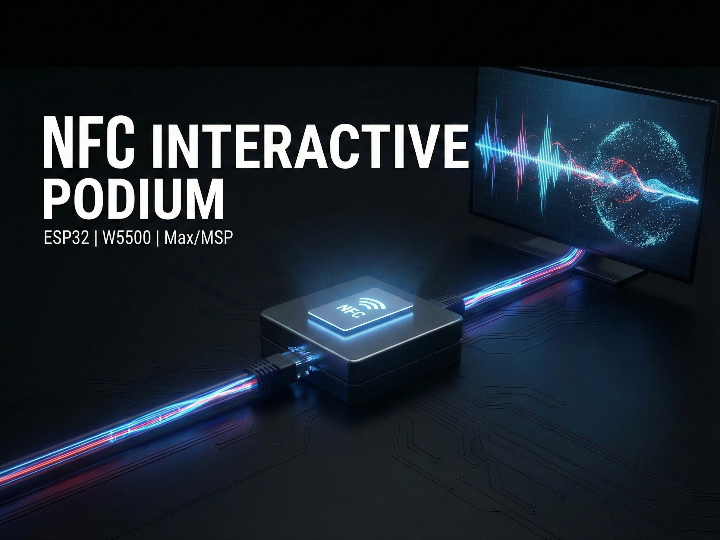
The NFC_ESP32_W5500_PODIUM is an interactive media control system designed for live performance, museum installations, and interactive exhibitions.
Espressif - ESP32
x 1

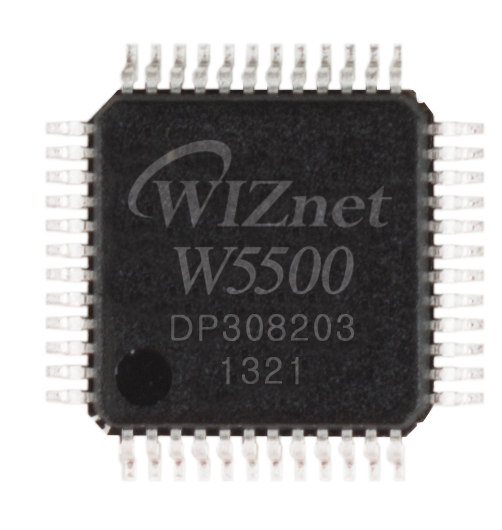
WIZnet - W5500
x 1
1. What This Project Actually Is
The NFC_ESP32_W5500_PODIUM is an interactive media control system designed for live performance, museum installations, and interactive exhibitions.
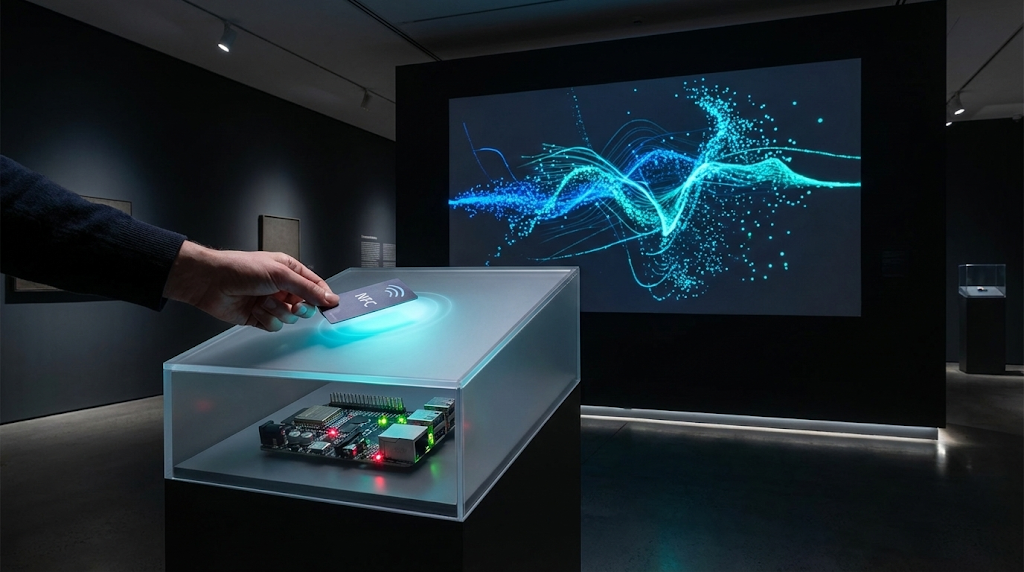
At the hardware level, the system combines:
- ESP32 as the real-time NFC polling and network controller
- WIZnet W5500 for deterministic wired Ethernet communication
- NFC Reader (PN532/RC522) for contactless tag identification
- Max/MSP patches for audio-visual media response
At the protocol level, it implements OSC (Open Sound Control) over UDP, the de facto standard for real-time media control in professional audio-visual environments.
The project is not a simple NFC demo. The inclusion of Max/MSP patches (30.6% of codebase) and Processing visualizers indicates this is intended for production interactive installations where reliability and latency matter.
Why Wired Ethernet Over Wi-Fi?
This project deliberately chooses W5500 wired Ethernet over ESP32's built-in Wi-Fi for critical reasons:
Latency Predictability
Wi-Fi latency varies from 1ms to 100ms+ depending on interference, channel congestion, and AP load. W5500 provides consistent sub-millisecond Ethernet latency—essential when an NFC tap must trigger immediate audio-visual response.
Reliability in RF-Dense Environments
Performance venues, museums, and exhibition halls often have severe Wi-Fi congestion from visitor devices, production equipment, and competing networks. Wired Ethernet is immune to these issues.
No Association Delays
Wi-Fi reconnection after brief disconnection can take 2-10 seconds. W5500 link recovery is instantaneous—critical for installations that run continuously for months.
Deterministic Behavior
In live performance, unpredictable network behavior is unacceptable. W5500's hardware TCP/IP stack provides consistent timing that software stacks cannot guarantee.
2. System Architecture
2.1 Data Flow
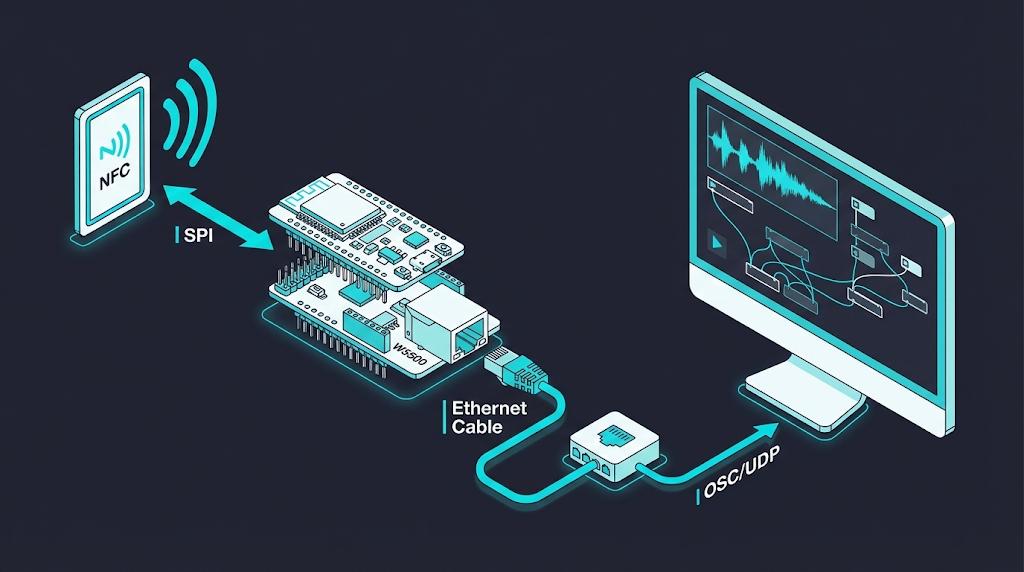
2.2 Event Processing Pipeline
- NFC Polling: ESP32 continuously polls NFC reader for tag presence
- UID Extraction: When tag detected, unique identifier is read
- OSC Message Formation: UID converted to OSC message format
- UDP Transmission: W5500 sends OSC packet to configured IP/port
- Max/MSP Reception: OSC message triggers media cue or parameter change
2.3 Timing Characteristics
| Stage | Typical Latency |
|---|---|
| NFC Detection | 50-100ms |
| UID Read | 10-20ms |
| ESP32 Processing | <1ms |
| W5500 UDP Send | <1ms |
| Network Transit | <1ms (local) |
| Max/MSP Response | <10ms |
| Total End-to-End | ~80-150ms |
This latency is imperceptible to users tapping an NFC tag and hearing/seeing the corresponding media response.
3. Why W5500 Is the Right Choice for Interactive Installations
3.1 Hardware TCP/IP Offloading
W5500 handles all Ethernet protocol processing in dedicated silicon:
- Zero CPU overhead for packet framing, checksums, retransmission
- Predictable timing regardless of network traffic load
- 8 independent hardware sockets for simultaneous connections
This matters because ESP32's CPU can focus entirely on NFC polling and application logic without network interrupts disrupting timing.
3.2 Comparison: W5500 vs. ESP32 Wi-Fi for Interactive Media
| Aspect | W5500 Ethernet | ESP32 Wi-Fi |
|---|---|---|
| Latency | <1ms, consistent | 1-100ms, variable |
| Reliability | 99.99%+ uptime | Subject to RF interference |
| CPU Load | Near zero | 10-30% for TCP/IP stack |
| Reconnection | Instant | 2-10 seconds |
| Installation | Cable required | Wireless |
| RF Immunity | Complete | None |
For installations where a missed or delayed trigger means a failed visitor experience, W5500's determinism is worth the cabling requirement.
3.3 Professional Audio-Visual Standards
The choice of OSC over UDP aligns with industry practice:
- Ableton Live, QLab, Resolume, TouchDesigner all support OSC
- UDP's fire-and-forget model matches real-time control requirements
- No TCP handshake overhead for time-critical messages
W5500's hardware UDP socket implementation delivers OSC messages with minimal and consistent latency.
4. NFC Integration Patterns
4.1 Tag-to-Content Mapping
The system likely implements a lookup table mapping NFC UIDs to content triggers:
// Conceptual mapping structure
struct TagMapping {
    uint8_t uid[7];
    char oscAddress[64];
    float oscValue;
};

// Example mappings
TagMapping contentMap[] = {
    {{0x04, 0xA3, 0x12, 0x8B}, "/exhibit/1/play", 1.0},
    {{0x04, 0xB7, 0x23, 0x9C}, "/exhibit/2/play", 1.0},
    {{0x04, 0xC1, 0x34, 0xAD}, "/audio/guide/3", 1.0},
};
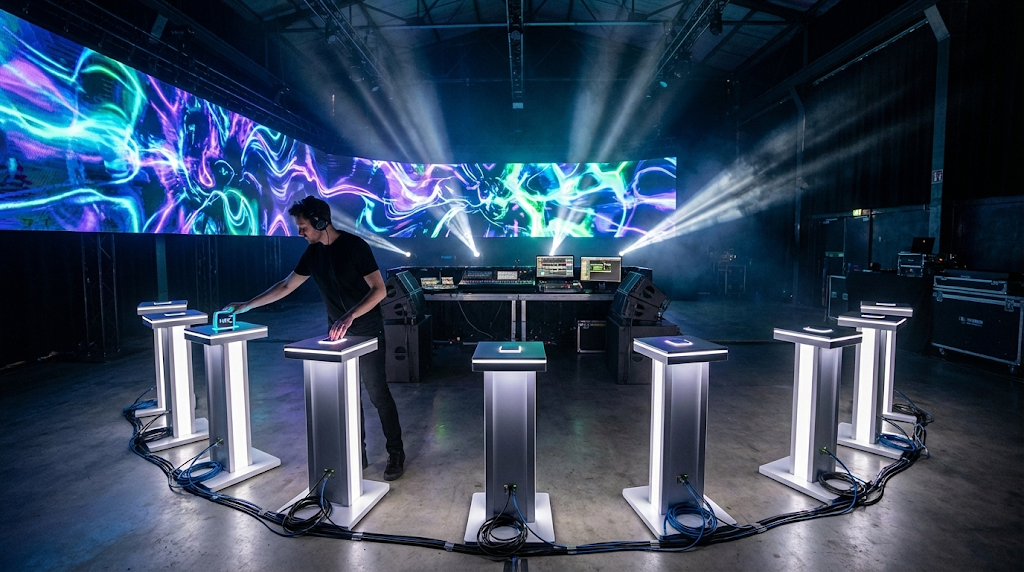
4.2 Use Case Scenarios
Museum Audio Guide
- Visitor taps NFC-tagged exhibit label
- ESP32 reads tag UID, sends OSC to audio system
- Corresponding audio track plays on nearby speakers
Interactive Performance
- Performer places NFC cards on podium
- Each card triggers different visual/audio element
- Real-time composition through physical object manipulation
Escape Room / Game Installation
- Players collect NFC objects throughout experience
- Scanning objects at checkpoints advances game state
- Max/MSP coordinates puzzles, lighting, sound
5. Max/MSP Integration
The 30.6% Max/MSP codebase indicates sophisticated media handling:
5.1 OSC Reception in Max/MSP
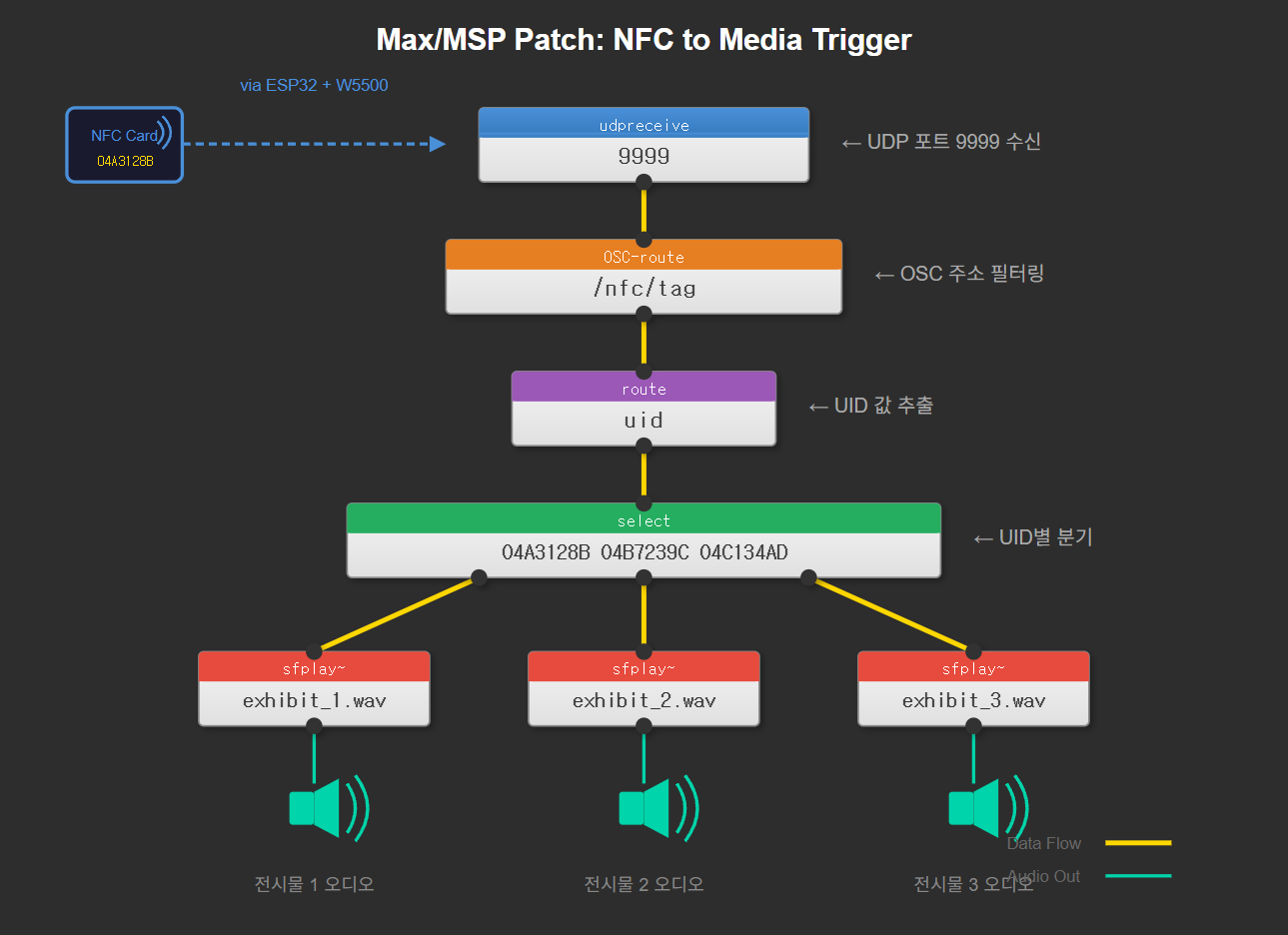
5.2 Why Max/MSP?
- Visual programming accessible to artists and designers
- Real-time audio/video processing without code compilation
- Industry standard in interactive installations
- OSC native support for network-based control
The Processing component (1.0% of codebase) likely provides visualization for debugging or secondary displays.
6. Hardware Configuration
6.1 Typical Pin Mapping (ESP32 + W5500)
| W5500 Pin | ESP32 Pin | Function |
|---|---|---|
| MOSI | GPIO23 | SPI Data Out |
| MISO | GPIO19 | SPI Data In |
| SCLK | GPIO18 | SPI Clock |
| CS | GPIO5 | Chip Select |
| INT | GPIO4 | Interrupt (optional) |
| RST | GPIO21 | Hardware Reset |
6.2 NFC Reader Connection (PN532 via SPI)
| PN532 Pin | ESP32 Pin | Function |
|---|---|---|
| MOSI | GPIO23 | Shared SPI Bus |
| MISO | GPIO19 | Shared SPI Bus |
| SCLK | GPIO18 | Shared SPI Bus |
| SS | GPIO15 | NFC Chip Select |
| IRQ | GPIO2 | Tag Detection |
Note: W5500 and PN532 share SPI bus with different chip selects—standard practice for ESP32 multi-device SPI configurations.
7. Production Deployment Considerations
7.1 Network Architecture
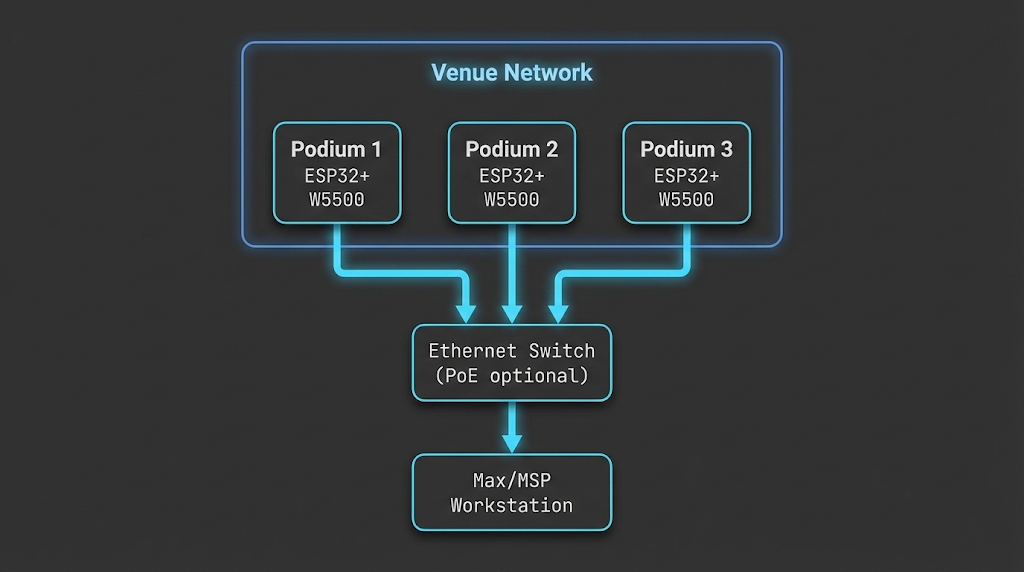
7.2 Reliability Features for Long-Term Installations
- Static IP Configuration: No DHCP dependency for consistent addressing
- Watchdog Timer: ESP32 auto-recovery from software hangs
- Connection Monitoring: Periodic heartbeat to detect network issues
- Graceful Degradation: Local feedback (LED) even if network fails
7.3 Power Considerations
| Power Option | Advantages | Disadvantages |
|---|---|---|
| USB 5V | Simple, common | Separate cable |
| PoE (802.3af) | Single cable | Requires PoE switch/injector |
| Battery + USB | Portable | Limited runtime |
For permanent installations, PoE eliminates separate power wiring and enables remote power cycling.
FAQ
Q1: Why use W5500 instead of ESP32's built-in Wi-Fi?
Wired Ethernet provides deterministic latency and immunity to RF interference—critical for live performance where a missed trigger ruins the experience. Wi-Fi's variable latency (1-100ms) and reconnection delays (2-10s) are unacceptable for real-time interactive media.
Q2: What NFC readers are compatible?
The project likely supports PN532 (recommended for range and reliability) or RC522 (lower cost). Both communicate via SPI with ESP32.
Q3: Can multiple podiums work together?
Yes. Each ESP32+W5500 unit sends OSC to a central Max/MSP instance. Standard Ethernet switching handles multiple sources. OSC addresses can include podium identifiers for routing.
Q4: What's the maximum practical distance from podium to Max/MSP workstation?
Standard Ethernet supports 100m cable runs. With a PoE switch, power and data travel the same cable, simplifying installation in large venues.
Q5: Is this suitable for outdoor installations?
With appropriate weatherproofing, yes. W5500's wired connection is more reliable outdoors than Wi-Fi, which suffers from environmental interference.
Q6: Can I use this without Max/MSP?
Yes. Any software supporting OSC can receive messages: TouchDesigner, Resolume, QLab, Processing, or custom applications. The ESP32 simply sends UDP packets with OSC-formatted data.
Q7: What happens if network connection is lost?
The ESP32 continues NFC polling and can provide local feedback (LED, buzzer). OSC messages are queued or dropped depending on implementation. W5500 recovers instantly when connection restores—no reboot required.


