High-Precision Pharmaceutical Monitoring System (USP Dissolution Standard)
High-Precision Multi-Sensor Temperature Monitoring System (Oxeltech PC Module v2.0)
COMPONENTSHardware components
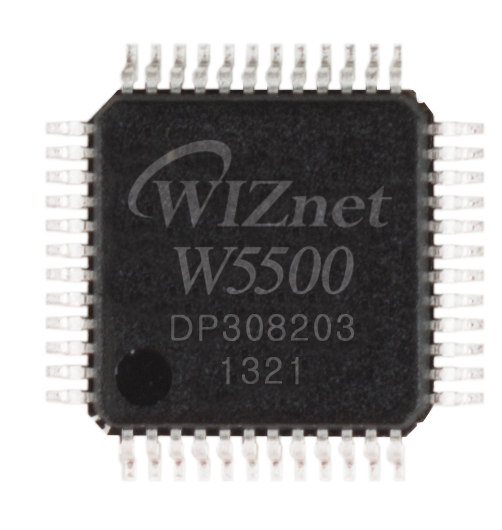
WIZnet - W5500
x 1
Software Apps and online services
mqtt - MQTT
x 1
PROJECT DESCRIPTION
[English Version]
Source Mention & Context
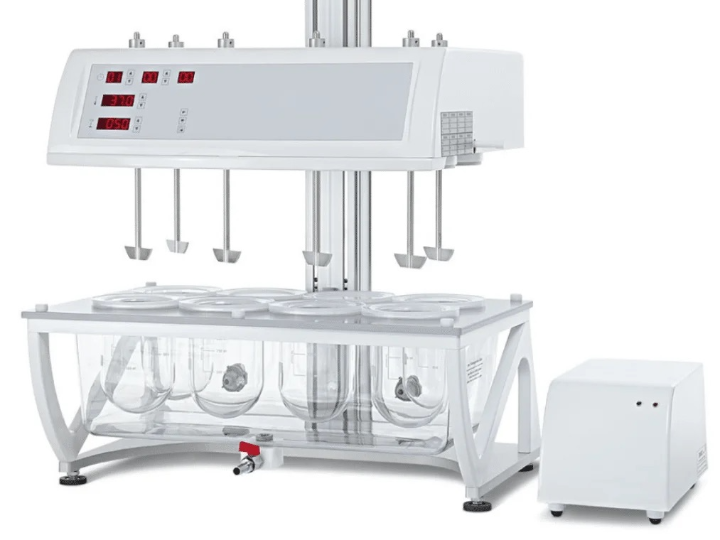
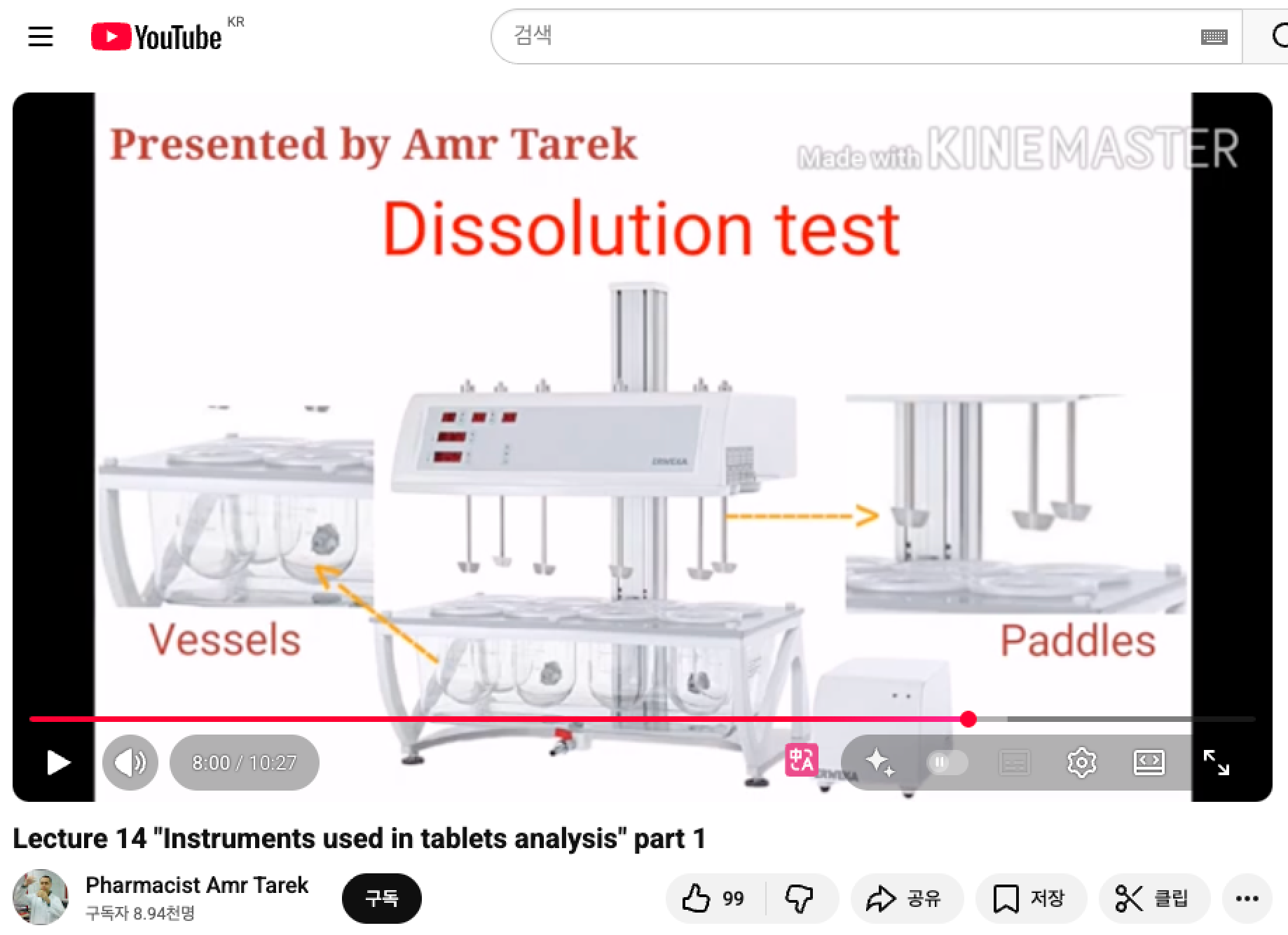
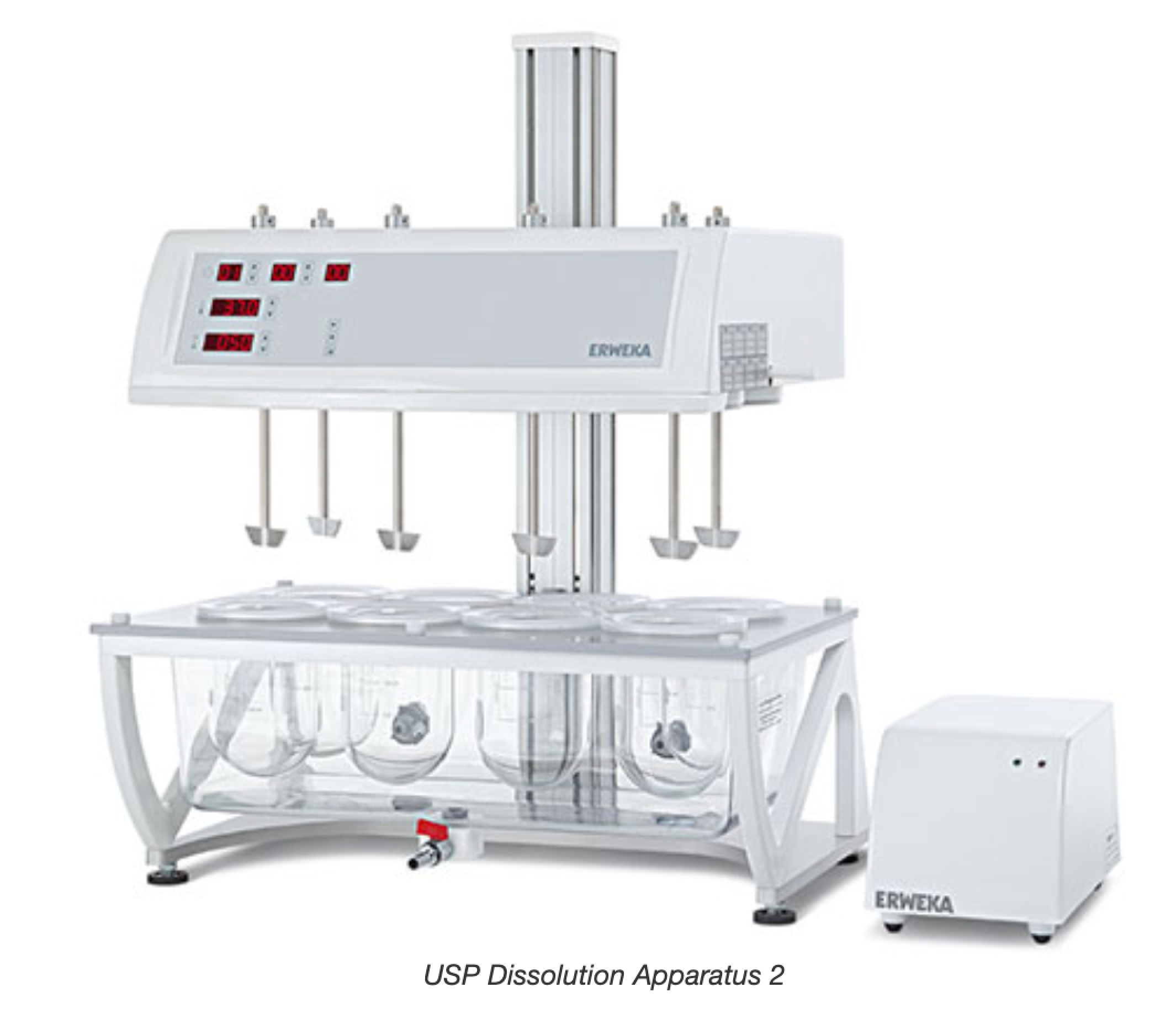
Original Project by Team Oxeltech (Oxeltech PC Module v2.0) This system is designed for high-end Dissolution Testers, widely known through industry leaders like ERWEKA. These instruments are essential in pharmaceutical quality control, as featured in professional educational content like Lecture 14 "Instruments used in tablets analysis" part 1
by Pharmacist Amr Tarek (a recognized pharma influencer with 8.94K+ subscribers). The choice of WIZnet technology here isn't just for connectivity; it's a strategic decision to meet the Data Integrity requirements of the USP (United States Pharmacopeia).
Dissolution testing is a controlled process used to determine the rate at which an active pharmaceutical ingredient (API) is released from a solid dosage form (e.g., a tablet). A USP Dissolution Monitoring System ensures that the test conditions—specifically temperature—are maintained with extreme precision (typically within ±0.2°C) and that all data is recorded without loss, fulfilling the ALCOA+ principles of data integrity.
2. Why WIZnet? (Technical Necessity & Performance Upgrade) In a pharmaceutical laboratory, a missing data point can invalidate an entire batch test. WIZnet's W5500 provides a "Technical Necessity" that Wi-Fi or software-based Ethernet cannot match:
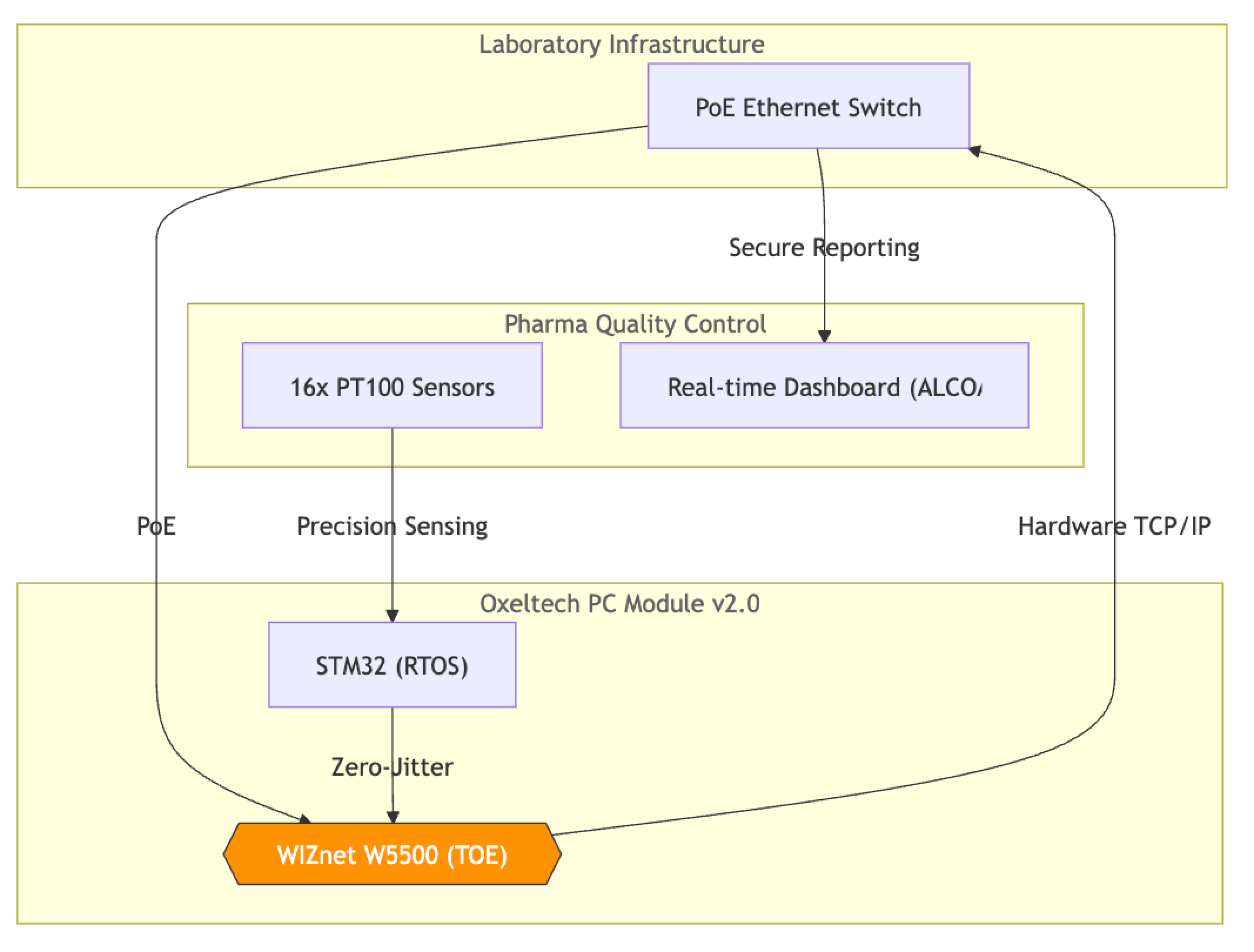
Hardware TOE (TCP/IP Offload Engine): By processing the network stack in a dedicated chip, it protects the critical sensor sampling loops from network-related CPU spikes.
Determinism: It ensures fixed-latency communication, which is vital for the 16-channel PT100 scanning cycle.
Performance Evolution (v1 to v2): The module evolved from an 8-sensor standalone unit to a 16-sensor connected system with 0.1°C resolution and ±0.2°C accuracy.
PoE Infrastructure: Simplifies lab environment by providing isolated power and data as per IEEE 802.3af standards.
3. Development Highlights: Hardware & Firmware Engineering
Hardware Development:
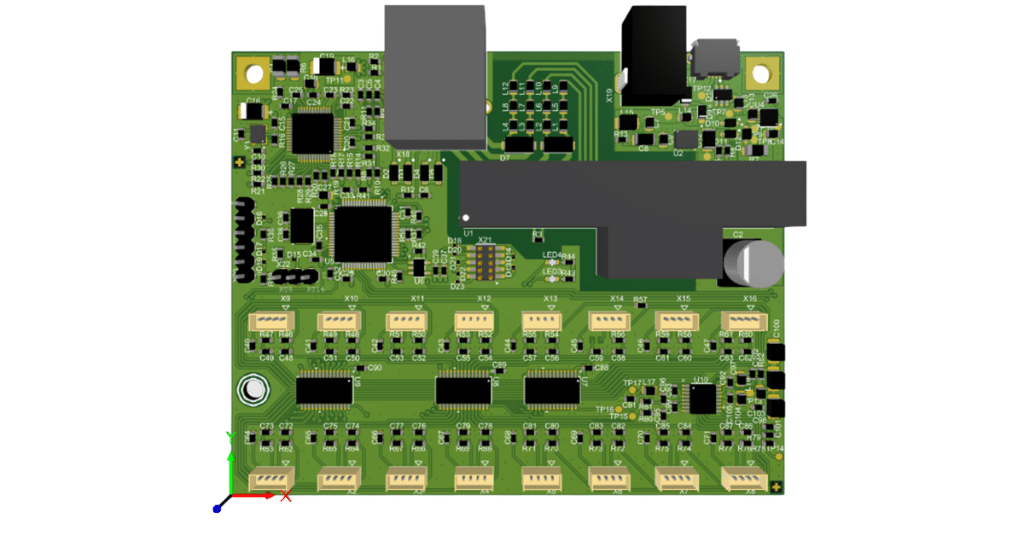
Designed PCB using Altium to accommodate 16 PT100 sensors.
Integrated dual Ethernet & USB interfaces for flexible communication.
Engineered strictly to meet Isolation Barrier requirements for maximum safety.
Firmware Development:
Implemented CMSIS-RTOS for deterministic sensor polling.
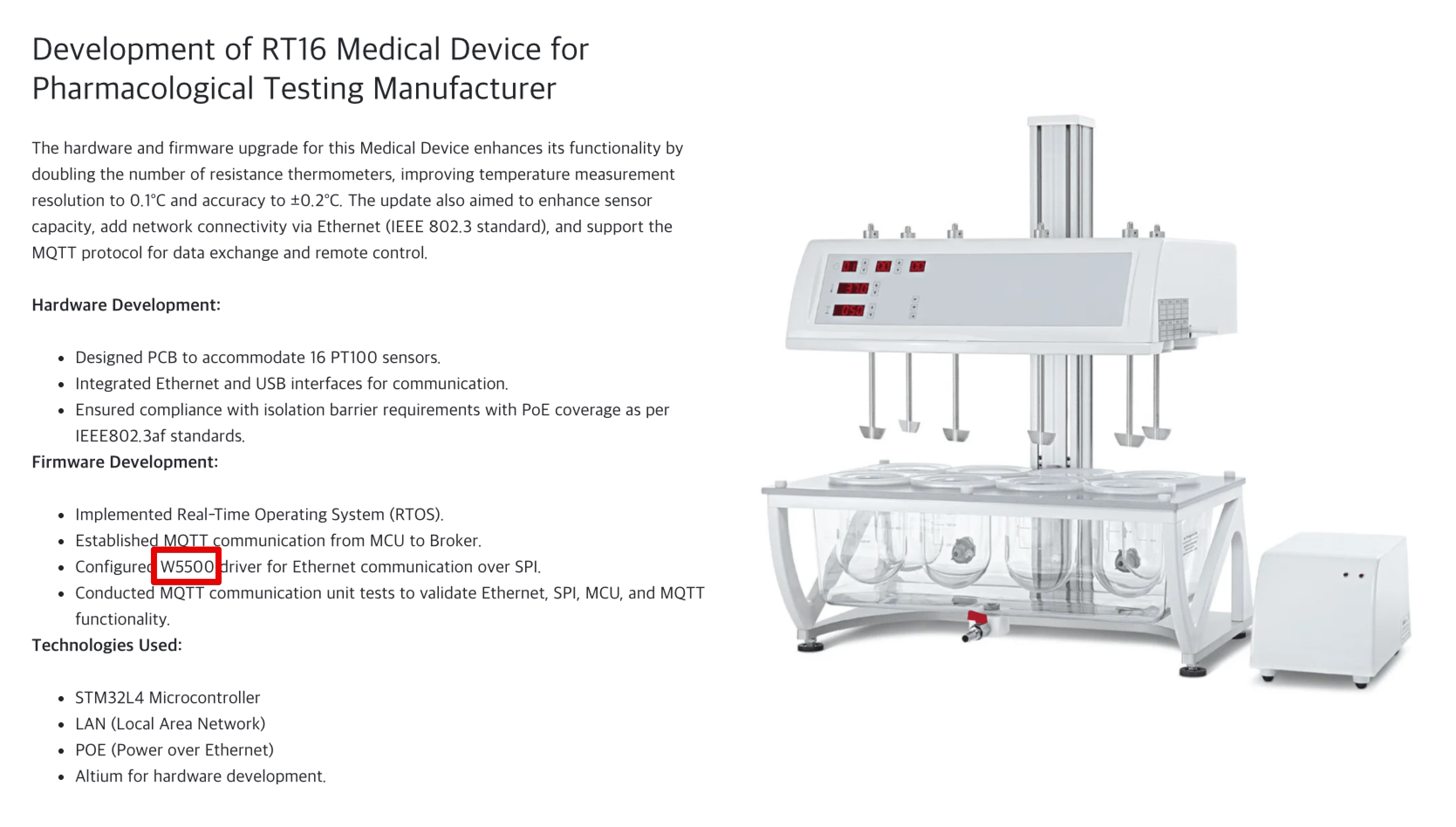
Configured the W5500 driver over SPI for stable high-speed networking.
Established MQTT communication from MCU to Broker with comprehensive Unit Testing (Ethernet, SPI, MCU, and MQTT) to validate the entire data chain.
4. Strategic Alignment: The Role in IoMT (Internet of Medical Things) This project is a definitive example of IoMT for Pharmaceutical Quality Control. By connecting high-precision laboratory sensors to the internet via WIZnet's reliable hardware, it transforms a standalone tester into an intelligent, connected node. In the IoMT ecosystem, WIZnet provides the reliable "Nervous System" that ensures every byte of clinical data is captured and analyzed without compromise.
5. Conceptual Implementation: High-Precision MQTT Transmission This conceptual logic demonstrates how WIZnet's technology ensures pharmaceutical data integrity by restructuring a sample MQTT transmission using direct hardware socket control.
Q: Why is ±0.2°C accuracy critical for ERWEKA-style testers?
A: Pharmacopeial standards (USP/EP) mandate strict temperature consistency. Even a slight deviation can change the API release rate, leading to quality failures.
Q: Does W5500's TOE assist in meeting 21 CFR Part 11?
A: Yes. Data Integrity is a pillar of 21 CFR Part 11. By using W5500, the system prevents packet loss at the hardware layer, ensuring that electronic records are complete.
Q: How does the system manage 16 PT100 sensors simultaneously?
A: It utilizes a high-speed SPI bridge and CMSIS-RTOS. One task polls the ADC, while another independent task pushes the structured JSON payload through the W5500's hardware socket.
[Korean Version]
출처 및 배경 (Context)
Team Oxeltech 제작: 제약용 고정밀 모니터링 시스템 본 모듈은 ERWEKA와 같은 세계적인 제약 장치 제조사가 사용하는 용출 시험기(Dissolution Tester)의 핵심 컨트롤러라고
Oxeltech은 이 장비의 신뢰성을 완성하기 위해 WIZnet W5500을 선택했습니다.
1. USP 용출 시험 모니터링이란 무엇인가요? (정의)
용출 시험은 알약과 같은 고형 제제가 규정된 조건에서 녹아 나오는 속도를 측정하는 시험입니다. USP 용출 시험 모니터링 시스템은 이 과정에서 온도를 ±0.2°C 오차 내로 관리하고, 모든 실험 데이터를 손실 없이 기록하여 제약 품질 관리의 핵심인 '데이터 무결성(Data Integrity)'을 보장하는 역할을 합니다.
PoE 기반 인프라 혁신: IEEE 802.3af 표준을 따르는 PoE 시스템을 통해 별도 전원 공사 없이 LAN 선 하나로 안정적인 전력을 공급하며 노이즈를 획기적으로 줄였습니다.
3. 개발 하이라이트: 하드웨어 및 펌웨어 엔지니어링
하드웨어 개발 (Hardware Development):
Altium을 활용하여 16개 PT100 센서를 수용하는 정밀 PCB 설계.
범용성을 위한 이더넷 및 USB 듀얼 인터페이스 통합 구현.
엄격한 안전을 위한 절연 배리어(Isolation Barrier) 요구사항 준수 설계.
펌웨어 개발 (Firmware Development):
실시간성 보장을 위한 CMSIS-RTOS 기반 시스템 구축.
SPI 통신 기반의 W5500 드라이버 최적화 및 MCU-Broker 간 MQTT 통신 수립.
이더넷, SPI, MCU, MQTT 전 과정의 단위 테스트(Unit Test)를 통한 시스템 무결성 검증.
4. 전략적 가치: IoMT(의료 사물 인터넷)의 핵심 인프라
이 프로젝트는 제약 품질 관리 분야의 IoMT(Internet of Medical Things)구현의 전형을 보여줍니다. 고정밀 센서와 위즈넷의 신뢰성 있는 이더넷 기술력을 결합함으로써, 단순히 데이터를 모으는 것을 넘어 환자의 안전과 직결되는 의약품 제조 데이터의 투명성과 효율성을 극대화합니다. WIZnet은 IoMT 혁신의 가장 기초적이면서도 강력한 토대인 '신뢰할 수 있는 신경계' 역할을 수행합니다.
5. 개념적 구현: W5500 기반 고정밀 MQTT 전송
본 가상 코드는 W5500 하드웨어 소켓을 활용해 제약 데이터 무결성을 보장하는 핵심 로직을 시각화합니다.
/* 개념적 코드: WIZnet 기반 제약 품질 관리용 MQTT 전송 로직 */
void publish_dissolution_log(float sensors[16]) {
    char json_buffer[512];
    sprintf(json_buffer, "{\"device\":\"ERWEKA-v2\", \"temps\":[%.2f, ...]}", sensors[0]);

    if (getSn_SR(MQTT_SOCKET) == SOCK_ESTABLISHED) {
        send_mqtt_payload(MQTT_TOPIC_QC, json_buffer);
        Log_Info("Data integrity verified and transmitted via W5500");
    } else {
        backup_to_flash(json_buffer);
    }
}
6. FAQ (심층 분석)
Q: ERWEKA 스타일의 시험기에서 ±0.2°C 정밀도가 왜 중요한가요?
A: 온도는 용출 속도에 직접적인 영향을 미칩니다. 제약 표준(USP/EP)은 이 정밀도를 엄격히 규정하고 있으며, WIZnet 기술은 이 데이터를 실시간으로 보고하는 신뢰 통로가 됩니다.
Q: W5500이 21 CFR Part 11(전자 기록) 준수에 도움이 되나요?
A: 네. 데이터 무결성은 해당 규정의 핵심입니다. 하드웨어 레벨에서 스택을 처리하는 W5500은 소프트웨어 방식보다 패킷 유실 가능성이 낮아 안전한 기록 생성에 기여합니다.
Q: 16개의 PT100 센서를 동시에 어떻게 관리하나요?
A: 고속 SPI 브리지와 CMSIS-RTOS를 사용합니다. 하나의 전용 태스크가 ADC를 통해 모든 채널을 폴링하고, 독립된 통신 태스크가 W5500 소켓을 통해 JSON 데이터를 전송합니다.