


How to Build Industrial Ethernet with W5500 on the ERQOS EQSP32CE ESP32-S3 PLC?
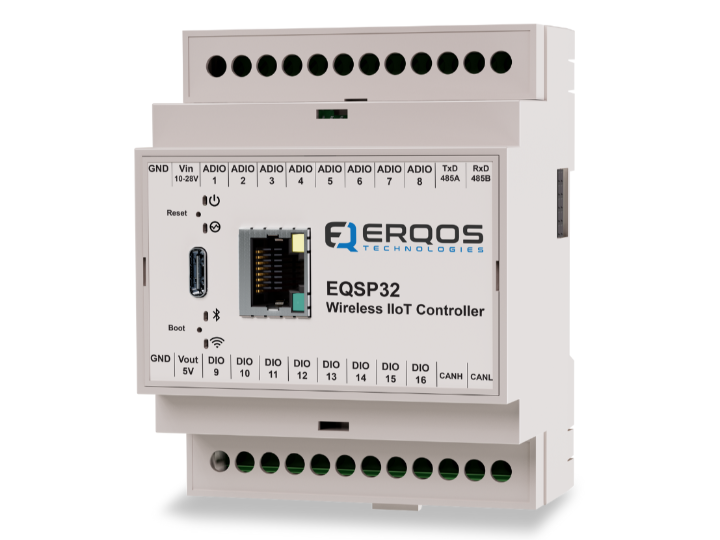
The ERQOS EQSP32CE is an ESP32-S3-based industrial controller that combines I/O, RS232/RS485, CAN, Wi-Fi, BLE, and wired Ethernet in a DIN-rail PLC format
WIZnet - W5500
x 1

Summary
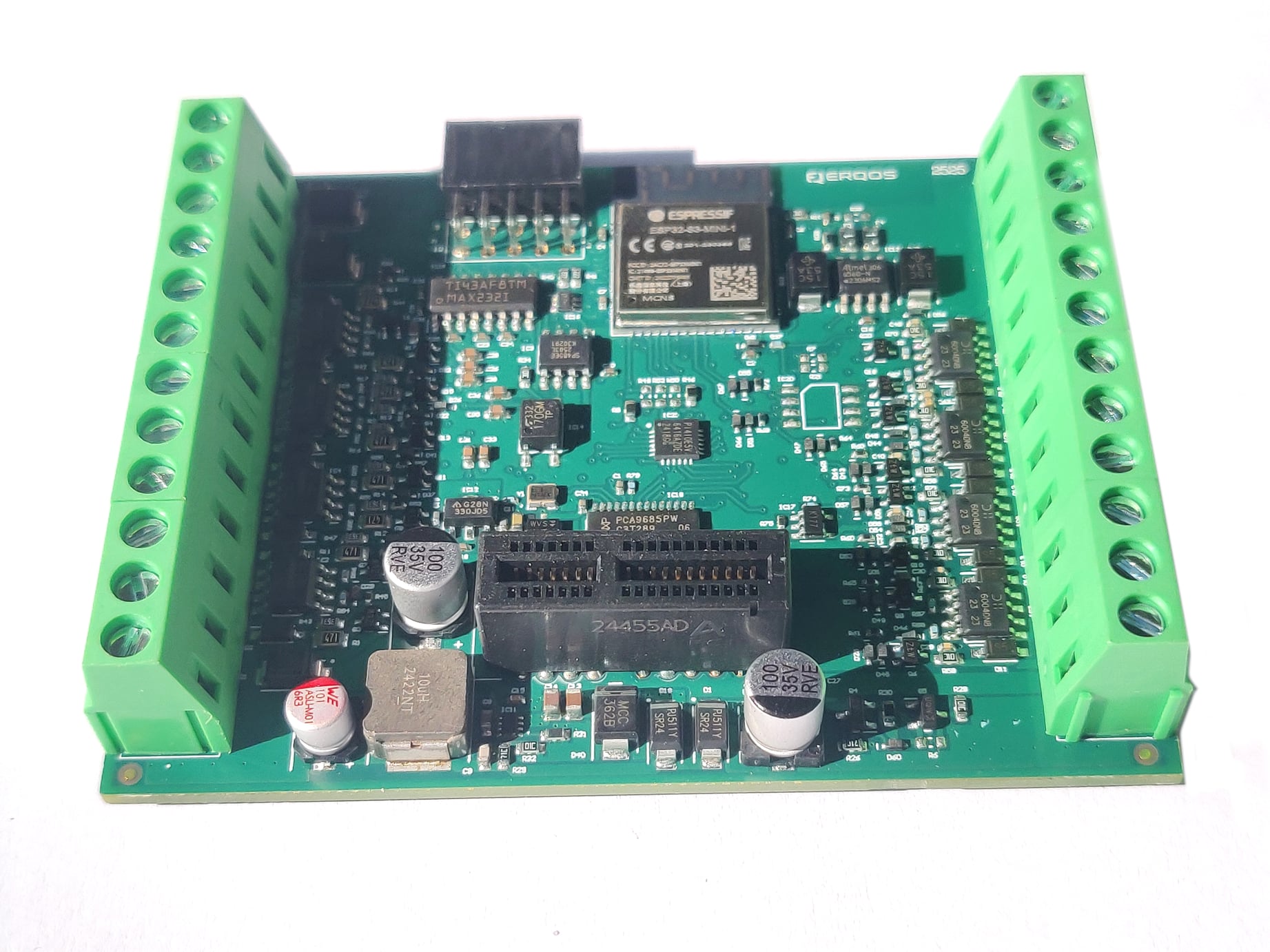
The ERQOS EQSP32CE is an ESP32-S3-based industrial controller that combines protected field I/O, RS232/RS485, CAN, Wi-Fi, BLE, and wired Ethernet in a DIN-rail PLC format. A hardware teardown identifies the Ethernet device as the WIZnet W5500, which provides the controller's SPI-connected 10/100 Ethernet path to the RJ45 interface. ERQOS software then presents Ethernet as a managed system service with DHCP or static addressing, link-state monitoring, MQTT connectivity, and automatic Wi-Fi failover. The W5500 contains a hardwired TCP/IP engine, although the public ERQOS sources inspected do not expose enough of the Ethernet implementation to confirm whether EQSP32CE firmware actively uses W5500 hardware TCP sockets for TOE processing.
What the Project Does
EQSP32CE is designed as a compact industrial controller rather than a conventional ESP32 development board. Its ESP32-S3 runs at up to 240 MHz with 512 kB RAM and 8 MB Flash, while the surrounding hardware provides 16 configurable field terminals, including protected digital I/O, 0–10 V analog measurement and 4–20 mA current inputs. It also integrates RS232, half-duplex RS485, CAN bus, USB-C programming, Wi-Fi, BLE and an RJ45 Ethernet connection. The unit operates from 7–26 V DC, mounts on DIN rail, and is specified for an ambient range of -20 °C to +55 °C.
In a typical industrial deployment, the controller can therefore sit directly between field equipment and an IP network:
Sensors / switches / 4–20 mA transmitters → EQSP32CE I/O → ESP32-S3 application → Ethernet or Wi-Fi → MQTT / Modbus TCP / supervisory system
ERQOS's network manager automatically initializes available interfaces. Ethernet has priority when a wired link is available, while Wi-Fi can provide fallback connectivity. The software also allows both interfaces to remain active when automatic switching is disabled—for example, Ethernet can be dedicated to a local Modbus TCP network while Wi-Fi supplies Internet connectivity.
The controller is produced by Erqos Technologies P.C., headquartered in Koropi, Greece. ERQOS states that its products are designed and developed in Greece and positions the EQSP32 family between closed traditional MicroPLC platforms and open microcontroller boards that generally require additional industrial packaging, protection and interface circuitry. The company lists process control, building automation, water management, energy management, agriculture, automated test and robotics among its target applications.
Where WIZnet Fits
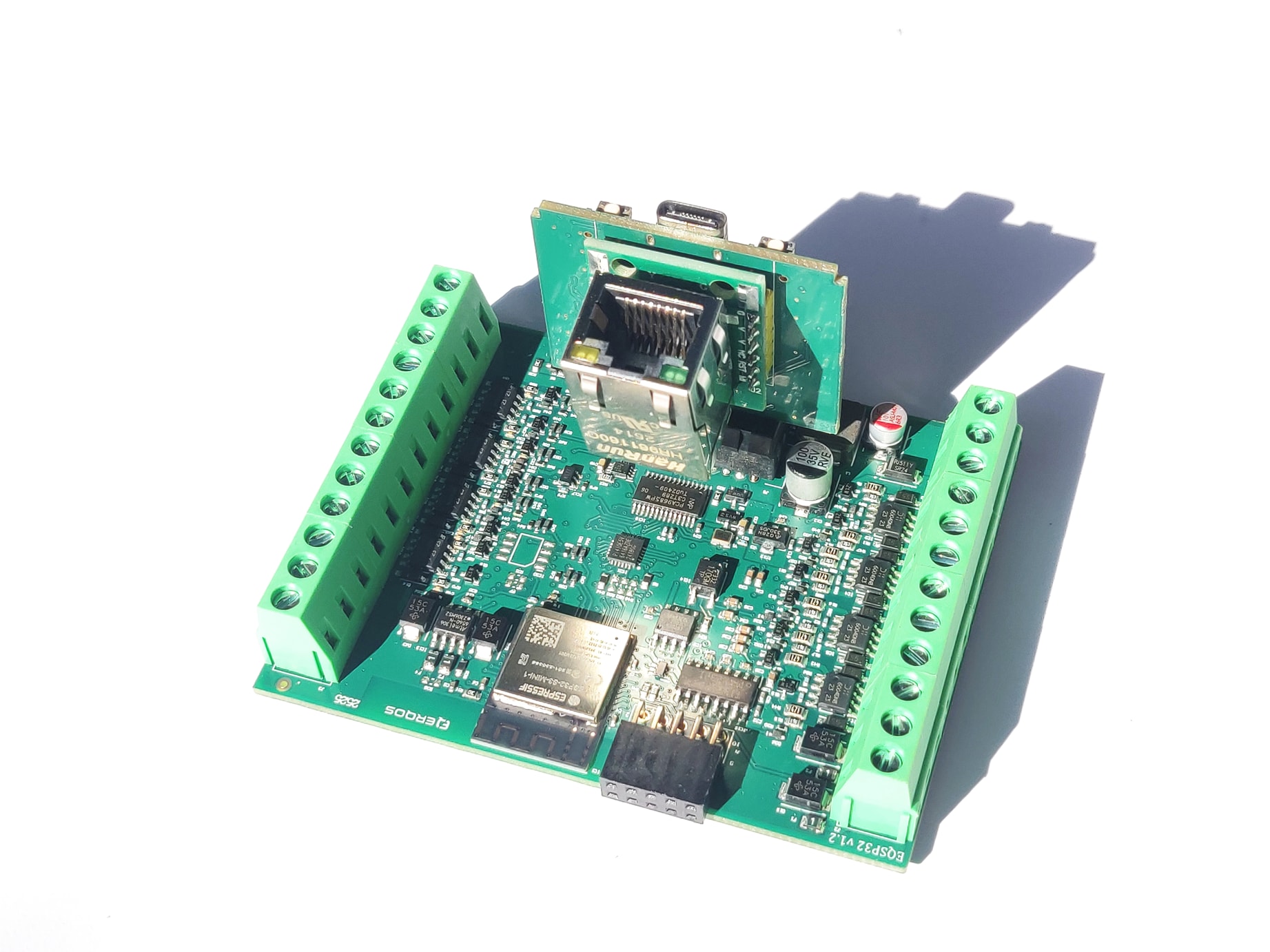
The teardown of the Ethernet model explicitly identifies the Ethernet controller as the WIZnet W5500 and shows it implemented as part of a separate Ethernet module attached to the main EQSP32CE electronics. The W5500 therefore forms the wired-network boundary between the ESP32-S3 controller and the RJ45 Ethernet connection.
The architecture can be represented as:
Industrial I/O / RS485 / CAN
↓
ESP32-S3 application and ERQOS system supervisor
↓
Ethernet software interface
↓
SPI
↓
W5500
↓
10/100 Ethernet PHY → RJ45 → industrial LAN
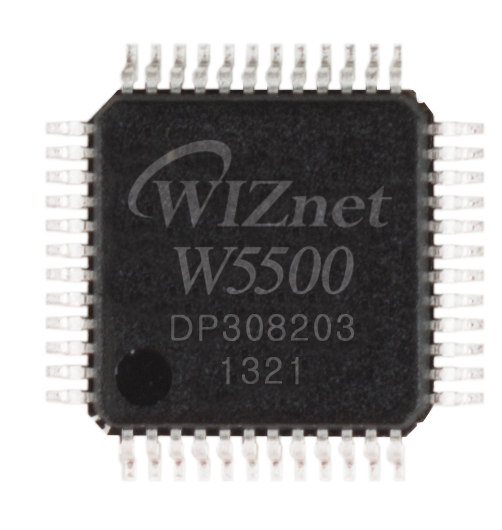
The W5500 integrates both a 10/100 Ethernet MAC and PHY and communicates with an external MCU through SPI. It also contains WIZnet's hardwired IPv4 TCP/IP engine, eight hardware sockets and 32 kB of internal TX/RX buffer memory. SPI operation can run at up to 80 MHz.
Those characteristics make the device technically well matched to an ESP32-S3 controller that needs Ethernet without a large parallel interface or separate MAC-plus-PHY arrangement. The host only needs an SPI connection and the required Ethernet support circuitry.
There is, however, an important distinction between using a W5500 and using its TCP/IP Offload Engine.
The publicly visible EQSP32 source exposes Ethernet status, IP addressing and interface-management APIs, but the actual implementation resides in the precompiled src/esp32s3/libEQSP32.a. The reviewed source does not expose W5500 socket-register operations, WIZnet ioLibrary calls or other code that would prove that TCP sessions are executed directly by the W5500 hardware sockets. Therefore, it is accurate to identify W5500 as the EQSP32CE Ethernet controller, but not to claim verified TCP/IP CPU offload for this product from the currently public evidence.
Implementation Notes
The public EQSP32 library deliberately exposes networking at a higher abstraction level than the Ethernet IC.
From src/EQSP32.h, the controller defines Ethernet connection states:
enum EQ_EthernetStatus : uint8_t {
    EQ_ETH_DISCONNECTED = 0,
    EQ_ETH_CONNECTED,
    EQ_ETH_PLUGGED_IN,
    EQ_ETH_STOPPED
};
This interface distinguishes between physical cable detection and an online IP connection. That matters in an industrial controller because a plugged Ethernet cable does not necessarily mean DHCP or static addressing has completed successfully. Application code can query the state through getEthernetStatus() without communicating with W5500 registers directly.
The same header exposes network configuration through EQSP32Configs:
std::string staticIP = "0.0.0.0";
std::string gateway = "0.0.0.0";
std::string subnet = "0.0.0.0";
std::string DNS = "0.0.0.0";

bool disableNetSwitching = false;
Here, 0.0.0.0 selects DHCP. ERQOS documentation states that Ethernet is automatically initialized, normally receives an address using DHCP, and takes priority over Wi-Fi. If Ethernet disappears, the network manager switches to Wi-Fi unless automatic switching has been disabled.
This abstraction is useful for industrial application developers because user logic does not need to initialize SPI, configure W5500 socket memory or manually track link transitions.
It also means the exact low-level W5500 implementation cannot currently be inspected from the public library. The hardware-dependent ESP32-S3 implementation is distributed as src/esp32s3/libEQSP32.a, while the public header exposes the supported API. Consequently, no W5500 initialization or TOE socket code should be reconstructed from assumptions.
Price comparison
| Product | Approx. single-unit price | What you get | Relative to EQSP32CE |
|---|---|---|---|
| ERQOS EQSP32CE | €155 / $185 | ESP32-S3, Ethernet, Wi-Fi/BLE, RS232, RS485, CAN, 16 configurable I/O, 0–10 V + 4–20 mA | Baseline |
| NORVI ENET AE06 | $119–147 | ESP32, W5500 Ethernet, Wi-Fi/BLE, DIN rail, 8 DI + relay/0–10 V/4–20 mA depending model | ~20–35% cheaper |
| Industrial Shields ESP32 PLC 14 | from €109 | ESP32, 14 I/O, Wi-Fi/BLE; Ethernet/serial options depend on configuration | Cheaper entry point |
| Industrial Shields ESP32 PLC 21 | from €239 | ESP32, 21 I/O, larger PLC platform, configurable communications | ~54% more expensive |
| Industrial Shields WIS ESP32 | €229 | ESP32, Ethernet, Wi-Fi/BLE, RS485/UART, 13 I/O including 0–10 V / 4–20 mA | ~48% more expensive |
| DFRobot Edge101 | $57 | ESP32, Ethernet, RS485, CAN, Wi-Fi/BLE, 11 GPIO | Much cheaper, but more gateway than PLC |
| CONTROLLINO MAXI | €249 excl. VAT | Industrial Arduino-class PLC, Ethernet and substantial I/O | ~61% more expensive |
Practical Tips / Pitfalls
- Decide deliberately between DHCP and static addressing. DHCP is the normal default, while
staticIP,gateway,subnetandDNScan be set for fixed industrial networks. Static addressing is often preferable when a PLC must be reached reliably by an HMI, SCADA system or Modbus TCP client. - Understand Ethernet/Wi-Fi priority before deployment. Ethernet normally disables Wi-Fi once the wired interface is available. Set
disableNetSwitchingwhen Ethernet and Wi-Fi must serve different networks simultaneously. - Monitor link state separately from Internet availability.
EQ_ETH_PLUGGED_INrepresents a detected cable before the interface becomes fully online, which is useful for diagnosing DHCP, gateway or network configuration faults. - Do not assume W5500 TOE is active simply because the hardware supports it. W5500 can execute TCP/UDP through eight hardware sockets, but ERQOS's public binary implementation does not reveal which networking path is used internally.
- Inspect the Ethernet module mechanically for high-vibration installations. The independent RefCircuit teardown specifically criticized the board-to-board connection of the Ethernet daughterboard and the soldering/mechanical stability of its SMD RJ45 module. That is the reviewer's assessment rather than an ERQOS specification, but it is worth evaluating when the unit will be installed near machinery or frequent cable movement.
- Account for enclosure and environmental limits. EQSP32CE is IP20 rather than a sealed field device and is specified for -20 °C to +55 °C, so cabinet placement remains part of the system design.
- Use the RJ45 indicators during commissioning. ERQOS specifies green for link and yellow for Ethernet activity, giving a quick physical check before debugging IP configuration or application protocols.
FAQ
Q: Why does the EQSP32CE use the WIZnet W5500?
The W5500 gives the ESP32-S3 controller a compact SPI-based 10/100 Ethernet interface with integrated MAC and PHY rather than requiring a more complex external Ethernet subsystem. The chip also contains eight hardware sockets and 32 kB of internal networking memory. Those capabilities are technically useful in embedded controllers, although the available ERQOS source does not confirm that EQSP32CE firmware uses the hardware sockets for TCP/IP offload.
Q: How is the W5500 connected to the ESP32-S3 in the EQSP32CE?
W5500 uses SPI as its MCU interface, and the teardown confirms a W5500-based Ethernet module connected to the EQSP32CE main electronics. The exact ESP32-S3 GPIO assignments, SPI clock configuration and W5500 interrupt/chip-select wiring are not exposed in the public ERQOS documentation inspected, so specific pin assignments should not be inferred.
Q: What role does the W5500 play specifically in the EQSP32CE?
It provides the wired Ethernet hardware behind the EQSP32CE's RJ45 interface. Above that hardware, ERQOS's network supervisor handles Ethernet initialization, DHCP or static addressing, connection status, interface priority and failover. Applications can then use network services such as MQTT or Modbus TCP without directly managing the Ethernet IC.
Q: Can beginners use the W5500 Ethernet connection on the EQSP32CE?
Yes at the application level, because ERQOS hides most Ethernet bring-up behind eqsp32.begin() and its internal network services. A developer mainly needs to understand IP addressing and the application protocol being used. Low-level W5500 development is more advanced because it requires SPI, socket allocation and Ethernet debugging, but those operations are not exposed as normal user requirements in the EQSP32 API.
Q: How does W5500 Ethernet compare with the EQSP32CE's Wi-Fi connection?
Wi-Fi provides cable-free 2.4 GHz connectivity, while the W5500 provides a wired Ethernet path suited to fixed industrial networks. EQSP32CE uses Ethernet as the preferred interface by default and automatically falls back to Wi-Fi when Ethernet becomes unavailable. The two interfaces can also be kept active simultaneously—for example, Ethernet for local Modbus TCP and Wi-Fi for Internet access.