


How to Build a DIN-Rail ESP32-S3 Controller with W5500 for Industrial Automation?
Ayatec Sensoraya v2.1 is a configurable DIN-rail I/O controller built around the ESP32-S3, with the WIZnet W5500 used as the wired Ethernet interface

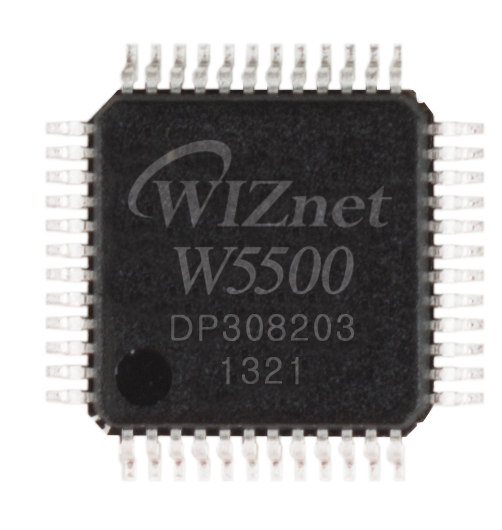
WIZnet - W5500
x 1

Espressif - ESP32
x 1
Summary
Ayatec Sensoraya v2.1 is a configurable DIN-rail I/O controller built around the ESP32-S3, with the WIZnet W5500 used as the wired Ethernet interface for HTTP and MQTT-class networked control. In this design, W5500 is not a side feature; it is the board’s stable wired transport option for cabinet automation, remote monitoring, and mixed I/O control where Wi-Fi alone is not enough.
What the Project Does
Sensoraya v2.1 is a family of three DIN-rail control boards—mini, medium, and maxi—intended for bespoke embedded systems rather than a fixed-function appliance. Across the range, the platform combines ESP32-S3 processing with relays, MOSFET outputs, GPIO, optocoupler inputs, analog inputs on the larger variant, USB-C, RTC, buzzer, and W5500 Ethernet, with all peripherals available simultaneously rather than traded off against each other as in earlier revisions.
From an automation standpoint, the board sits in the space between a smart-home controller and an open programmable PLC. The user guide positions it for relay boxes, irrigation, pool and spa control, gate control, thermostats, lighting, and monitoring systems, and it is physically designed around standard Hammond DIN enclosures for switchboard-style installation. That makes it credible for cabinet-level automation, OEM control panels, and custom building systems.
On price, the product is listed in a range of €39 to €229 depending on variant and assembly options. As listed on April 16, 2026, that puts the top end below a CONTROLLINO MAXI at €259 excl. VAT and an Industrial Shields ESP32 PLC 42 at €309, but above an Industrial Shields ESP32 PLC 14 at €109 and in the same general band as a KinCony KC868-E16S from $160. So the “overpriced” verdict depends on the benchmark: it looks expensive against DIY or prosumer DIN controllers, but not obviously overpriced against open programmable DIN PLC-style hardware.
Where WIZnet Fits
The exact WIZnet part here is the W5500. Ayatec’s own product and user-guide material describe Sensoraya v2.1 as an ESP32-S3 platform with a W5500 Ethernet module or port, and the official GitHub examples are organized with a dedicated 03_Ethernet section for Ethernet web-server and MQTT examples.
Architecturally, W5500 gives this board a wired network path that fits cabinet automation better than Wi-Fi alone. W5500 is a hardwired TCP/IP Ethernet controller with embedded MAC/PHY, SPI host connection up to 80 MHz, and 8 hardware sockets, so the ESP32-S3 can spend its time on I/O logic and application behavior instead of carrying the full burden of Ethernet handling in software. That is a sensible choice on a board that may already be switching relays, PWM-driving MOSFETs, polling sensors, and serving supervisory traffic at the same time.
For industrial automation fit, W5500 helps in the right way but does not, by itself, make the product a PLC-class industrial controller. Ayatec clearly emphasizes DIN enclosures, galvanically isolated optocoupler inputs, 7–30 V supply, and wired Ethernet, which are all good signs for real installations. But in the public material I reviewed, Ayatec does not foreground CE, UL, or IEC 61131 claims the way CONTROLLINO and Industrial Shields do. That places Sensoraya closer to a strong custom automation platform than a certified drop-in PLC replacement.
Implementation Notes
The board support header fixes the W5500 onto dedicated SPI pins in src/AyatecSensoraya2.x.h:
#define PIN_SCK 35
#define PIN_MOSI 36
#define PIN_MISO 37
#define PIN_SS 38
This matters because Ethernet is wired into the board definition itself, not treated as an optional external shield abstraction. In practice, that means W5500 is part of the platform contract for the board and its examples, which is exactly what you want in a control module meant for repeatable cabinet deployment.
The Ethernet example in examples/03_Ethernet/02_Ethernet_WebServer_MQTT/02_Ethernet_WebServer_MQTT.ino brings up the W5500 in the expected sequence:
SPI.begin(PIN_SCK, PIN_MISO, PIN_MOSI);
Ethernet.init(PIN_SS);
Ethernet.begin(mac);
That code is important because it shows the actual intended integration path: the ESP32-S3 drives W5500 over SPI, then layers an HTTP server and MQTT client on top. In other words, the board is meant to act as a networked automation endpoint, not just a relay bank with a web page.
Practical Tips / Pitfalls
- Treat this as a custom control module, not a certified PLC substitute. The hardware choices are sensible for cabinet automation, but the public material I reviewed does not present the same certification story that CONTROLLINO and Industrial Shields do.
- Plan power properly. The board requires 7–30 V DC and Ayatec recommends a supply capable of at least 10 W, which matters once relays, MOSFET loads, and peripherals are actually populated.
- Use the optocoupler inputs for noisy field wiring. Ayatec specifies galvanic isolation, positions them for long-distance and high-noise signaling, and quotes the EL357 path at 3,750 V RMS isolation with typical 18 μs response time.
- Do not use the multiplexed analog inputs for narrow pulses. Ayatec explicitly notes that those inputs are relatively slow because of multiplexer switching and can miss short impulses.
- Decide early whether the installation needs static IP behavior. The published Ethernet examples use
Ethernet.begin(mac)and then monitor link and local IP state, which is fine for DHCP-friendly LANs but worth tightening for fixed industrial panels. - Use the MOSFET power-routing jumpers carefully. The user guide documents both shared-VIN and isolated external-supply modes, which is useful for mixed-voltage loads but easy to misconfigure in the field.
FAQ
Q: Why use W5500 on this board instead of relying on ESP32-S3 Wi-Fi alone?
A: Because this board is trying to be a cabinet controller, not just a wireless gadget. W5500 adds a dedicated wired Ethernet path with hardwired TCP/IP, MAC, and PHY, which is a better fit for always-on control panels, remote HTTP access, and MQTT integration where Wi-Fi association, signal quality, and RF environment should not be part of the control problem.
Q: How does W5500 connect to the platform?
A: It is connected as an SPI Ethernet device on fixed board pins. Ayatec’s published header maps W5500 to IO35/36/37/38 for SCK, MOSI, MISO, and chip select, and the Ethernet examples initialize those pins directly before calling Ethernet.init() and Ethernet.begin().
Q: What role does W5500 play in this project specifically?
A: In Sensoraya v2.1, W5500 is the wired network transport for the controller. The published examples show it serving HTTP requests and maintaining MQTT connectivity, which means it is the part that turns the ESP32-S3 I/O board into a remotely reachable automation node rather than a local-only controller.
Q: Can beginners follow this project?
A: A motivated embedded beginner can, but it is not a first-week Arduino project. The software path is approachable because Ayatec publishes Arduino examples and an MIT-licensed repository, but the hardware is closer to panel automation than hobby breadboarding, so you should already be comfortable with DC power, relay loads, SPI peripherals, and safe cabinet wiring practice.
Q: Is this board overpriced compared with other devices in the market?
A: Compared with Wi-Fi-first smart controllers or DIY ESP32 relay hardware, it can feel expensive. Compared with open programmable DIN controllers, the picture changes: Ayatec tops out at €229, while CONTROLLINO MINI is €149 excl. VAT, CONTROLLINO MAXI is €259 excl. VAT, Industrial Shields ESP32 PLC 14 is €109, and Industrial Shields ESP32 PLC 42 is €309. The fair conclusion is that Sensoraya is priced like a mid-tier open automation platform, but it does not yet market the same certification depth as the more PLC-like competitors.