How to Build a Meshtastic Ethernet Gateway with W5500 on Raspberry Pi Pico 2?
This project is a Raspberry Pi Pico 2 carrier board for Meshtastic-style LoRa networking, combining an RP2350-based Pico 2, a WIZnet W5500, and Ebyte E22 Lora
0
Project description
Summary
This project is a Raspberry Pi Pico 2 carrier board for Meshtastic-style LoRa networking, combining an RP2350-based Pico 2, a WIZnet W5500 Ethernet module, and an Ebyte E22-900M30S LoRa module on one compact PCB. The W5500 provides the wired Ethernet path, while the E22 module handles long-range LoRa communication for gateway, monitoring, and Industrial IoT node designs.
What is Meshtastic?
Meshtastic is an open-source, community-driven communication project that lets small LoRa radio devices form an off-grid mesh network. It is meant for places where cellular service, Wi-Fi, or internet access is unavailable or unreliable.
In practical terms, Meshtastic devices can send short text messages, telemetry, and optional GPS/location data. Each device can relay messages for others, so a message can “hop” across multiple nodes instead of needing one direct long-range link.
For the Pico 2 + W5500 + E22 board, Meshtastic is the LoRa mesh networking side of the project. The E22 module provides the long-range radio link, while the W5500 provides wired Ethernet that could be used for a fixed gateway, backhaul, or management connection.
What the Project Does
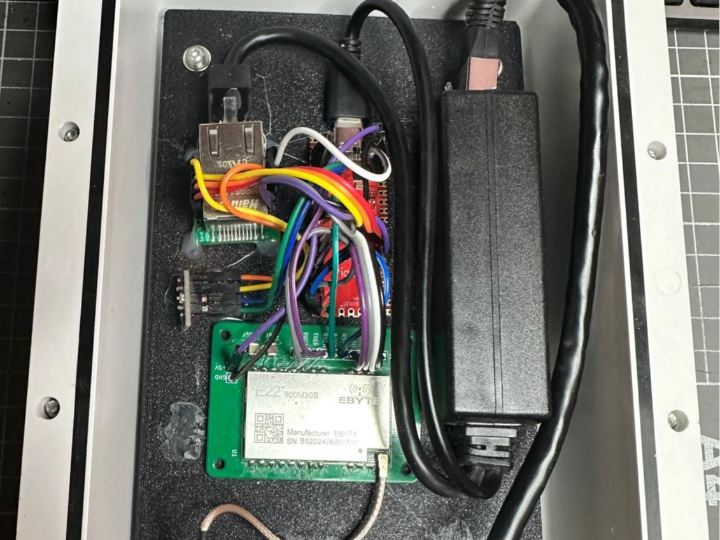
Pico2_W5500_E22 is an open hardware PCB project for building a Meshtastic-oriented node around Raspberry Pi Pico 2. The board integrates the Pico 2 as the controller, a W5500 Lite / USR-ES1 module for Ethernet, an Ebyte E22-900M30S module for 900 MHz LoRa, and headers for BMP280 sensing, I2C expansion, UART expansion, and PoE-powered deployment. The repository includes PCB images, Gerber files, a schematic SVG, a bill of materials, and pin-mapping documentation.
Meshtastic is an open-source, off-grid, decentralized mesh network designed to run on affordable low-power devices without depending on cell towers or internet infrastructure. In that context, this board is aimed at fixed or semi-fixed mesh nodes where LoRa provides long-range radio coverage and Ethernet can provide a stable wired uplink, backhaul, or local management interface.
The project should be read as a hardware integration prototype rather than a finished firmware reference. The README explicitly states that the PCB design is in a testing phase, and the repository does not include application firmware, W5500 driver code, Meshtastic board definitions, or verified runtime configuration files.
Where WIZnet Fits
The WIZnet product used in this project is the W5500, specifically through a W5500 Lite / USR-ES1 SPI Ethernet module. The README describes it as a hardwired TCP/IP Ethernet controller connected over SPI for reliable wired network connectivity.
In the board architecture, the W5500 sits between the Pico 2 and the wired Ethernet network. The Pico 2 communicates with the W5500 over SPI using MISO, MOSI, SCK, CS, reset, and interrupt signals. The E22 LoRa module is separate and uses UART plus GPIO mode-control pins. This separation is useful because the board can keep LoRa radio communication and Ethernet backhaul as two distinct interfaces instead of forcing one transport path to do both jobs.
The W5500 is a good fit for this design because it provides a hardwired TCP/IP stack, 10/100 Ethernet MAC/PHY, SPI support up to 80 MHz, 32 KB internal memory for TX/RX buffers, and 8 independent sockets. For a Pico 2 gateway-style node, that means the Ethernet path can be implemented through the W5500 socket model while the RP2350 remains available for Meshtastic logic, LoRa handling, sensor reads, and board management.
Implementation Notes
This repository does not include firmware source code, so W5500 initialization, SPI clock configuration, DHCP/static IP behavior, socket setup, and Meshtastic runtime behavior cannot be verified from code. The verified implementation evidence is at the hardware level: the README, bill of materials, schematic reference, Gerber archive, and pin-mapping table.
At the board level, the W5500 Ethernet interface is mapped as a standard SPI peripheral:
- MISO to Pico 2 SPI MISO
- MOSI to Pico 2 SPI MOSI
- SCK to Pico 2 SPI SCK
- CS to Pico 2 SPI CS
- RST to GPIO
- INT to GPIO
The Ebyte E22 module uses a different interface: TX/RX over UART, with M0 and M1 connected to GPIO for module mode control. This is the right hardware separation for a dual-network node because LoRa timing, serial radio control, and Ethernet packet handling do not compete for the same MCU peripheral.
The power and enclosure story is also part of the design. The bill of materials includes an 802.3af PoE-to-USB-C power source, a PoE injector, an N-female to U.FL pigtail, and a waterproof CAT6 RJ45 panel connector. That suggests the board is intended for installed nodes such as outdoor mesh gateways, weather stations, or Industrial IoT collection points rather than only bench-top prototyping.
Practical Tips / Pitfalls
- Treat this as a PCB prototype. The README says the design is still in testing, so reproduce the board only after checking the schematic, Gerbers, power rails, and module orientation.
- Verify the W5500 SPI pin assignment against the Pico 2 firmware target before writing Meshtastic board configuration.
- Keep W5500 reset and interrupt pins available in firmware. Reset is useful for Ethernet recovery, and interrupt-driven servicing can reduce polling overhead.
- Check power budget if using PoE. The Pico 2, W5500 module, E22 radio, BMP280, and any external peripherals must remain within the regulator and PoE module limits.
- Pay attention to RF layout and antenna placement. The E22-900M30S is a 30 dBm LoRa module, so antenna cabling, grounding, enclosure choice, and separation from Ethernet wiring matter.
- Decide early whether Ethernet is for backhaul, local management, MQTT/API bridging, or firmware maintenance. That decision affects socket count, IP configuration, and watchdog behavior.
- Add firmware validation separately. The repository proves the hardware concept, but it does not prove W5500 runtime behavior or Meshtastic compatibility from source code.
FAQ
Q: Why use the W5500 in this Pico 2 Meshtastic board?
A: The W5500 gives the board a wired Ethernet path with a hardwired TCP/IP stack, internal buffers, and socket support. That is useful for fixed Meshtastic gateways where LoRa handles the mesh side and Ethernet provides stable local-network or backhaul connectivity.
Q: How does the W5500 connect to the Raspberry Pi Pico 2?
A: It connects over SPI. The repository maps W5500 MISO, MOSI, SCK, and CS to the Pico 2 SPI bus, with W5500 RST and INT connected to GPIO pins.
Q: What role does the W5500 play in this project?
A: The W5500 is the wired Ethernet controller for the node. The E22 module provides LoRa radio communication, while the W5500 provides the Ethernet side that can be used for gateway, uplink, monitoring, or wired management functions.
Q: Can beginners follow this project?
A: Beginners can study the board layout and bill of materials, but reproducing it requires PCB assembly, Pico 2 firmware work, SPI Ethernet configuration, LoRa module configuration, and Meshtastic board-porting knowledge. The repo is more suitable for hardware builders who are comfortable validating a prototype.
Q: How does W5500 Ethernet compare with Wi-Fi for this type of node?
A: W5500 Ethernet is better suited for fixed nodes where cable access, stable power, and predictable network behavior are available. Wi-Fi can reduce cabling, but it adds RF dependency and shares the wireless environment with other devices, while this design already uses LoRa for long-range radio and can reserve Ethernet for a stable wired path.

