


How to Implement Mongoose Networking Library on STM32F4 using W5500
Mongoose Wizard generates a polished UI, but not a ready-made STM32CubeIDE template for STM32 + WIZnet W5500

WIZnet - W5500
x 1

Introduction
Mongoose Wizard is great at generating the application layer - Web UI, endpoints, and server logic- but embedded projects don’t fail at HTML. They fail at integration. The video focuses on a highly specific but widely relatable pain point: there’s no out-of-the-box Mongoose Wizard template for STM32 + W5500, so you don’t get a clean “known-good” starting point for CubeMX + HAL + SPI Ethernet. The author’s solution is classic embedded engineering: start from the working Arduino + W5500 example, then methodically replace Arduino abstractions with STM32Cube HAL functions until the same networking flow runs reliably on STM32.
The pain point the author is really describing
What the author ran into isn’t “a missing example” in the casual sense—it’s a missing bridge between two worlds:
- World A: UI + application logic (Wizard output).
Mongoose Wizard is designed to help you assemble a Web UI/REST API quickly without writing frontend code. That part is largely platform-agnostic. - World B: board bring-up + network plumbing (STM32 + W5500).
A W5500-based Ethernet design requires SPI + GPIO control (CS, Reset, often INT) and a working “driver glue layer” that gets packets in/out reliably. In STM32Cube projects, that glue usually means: CubeMX-generated init code + STM32 HAL calls + your own integration layer. (WIZnet’s own STM32CubeMX writeups emphasize that chip select is handled as GPIO and you typically wire extra pins like RST/INT.)
The gap is especially visible because Mongoose’s docs do provide:
- an Arduino + W5500 tutorial (with a ready pattern for SPI callbacks and DHCP flow)
…but the STM32CubeIDE step-by-step content is centered around STM32 Nucleo boards and their typical networking setups, not a generic “STM32 + external SPI Ethernet (W5500)” Wizard template.
So the author’s complaint is basically:
“Wizard got me 80% (UI + server), but the last 20% (STM32Cube + W5500 link layer) had no copy-paste starting point.”
That last 20% is where embedded projects tend to burn time.
Why the Arduino example becomes the “reference implementation”
Arduino is attractive here because it standardizes the messy parts:
- SPI transactions are already “one-liners” (transfer a byte, done).
- GPIO toggling for CS is trivial.
- The Mongoose Arduino W5500 tutorial explicitly describes the flow: initialize MCU + init Mongoose + init the TCP/IP layer + run the event loop, with DHCP as a default path.
So the author’s strategy—take a known-good Arduino W5500 sample and port it into STM32CubeIDE—is pragmatic:
- you keep the network-driver integration pattern (the most error-prone logic),
- and only swap out the platform wrappers (SPI/GPIO/delay/log).
This is a common embedded “porting move”: preserve what’s proven, replace the hardware abstraction.
What “porting to STM32Cube” usually means in practice (architecture view)
1) Hardware + CubeMX setup
- Configure SPI peripheral for W5500.
- Configure CS as a GPIO output (manual control is standard for W5500 modules).
- Configure RST GPIO (optional but strongly recommended) and INT pin if you plan to use interrupts instead of pure polling.
2) Replace Arduino “SPI wrappers” with STM32 HAL
Wherever the Arduino sample “begins a transaction / transfers bytes / ends transaction,” you map that to:
HAL_GPIO_WritePin(CS, LOW/HIGH)HAL_SPI_TransmitReceive(...)orHAL_SPI_Transmit/Receive(...)- small delays if needed during reset/bring-up
3) Confirm link and IP acquisition
Many Mongoose W5500 examples use DHCP by default. Your STM32 port must ensure the event loop runs often enough that DHCP completes and timers fire as expected.
4) Maintain performance and signal integrity expectations
W5500 supports high-speed SPI (up to 80 MHz), but the “works first time” SPI clock is usually much lower until wiring and signal quality are proven.
The “real” lesson: Wizard accelerates UI, not board-specific Ethernet bring-up
A useful framing for your curated article:
- Wizard is a UI/REST generator. It can’t assume every combination of MCU + external Ethernet module + SPI wiring + HAL choices.
- W5500 integration is mostly about the boundary layer. The chip is powerful (hardwired TCP/IP, integrated MAC/PHY, internal buffers), but your MCU still must provide a clean SPI/GPIO interface and a stable integration strategy.
- Therefore, the Arduino tutorial becomes the “missing template.” It’s the most concrete working example for W5500 in the Mongoose ecosystem, and porting is the fastest path.
FAQ
1) Why use WIZnet W5500 instead of a software TCP/IP stack on STM32?
W5500 integrates Ethernet MAC/PHY and a hardwired TCP/IP engine, which can reduce MCU load and simplify bring-up for wired connectivity. It also supports high SPI throughput (up to 80 MHz) and includes internal packet buffers, making it attractive for stable industrial-style networking compared to “bit-by-bit” software stacks on small MCUs.
2) How do you physically connect W5500 to an STM32Cube project?
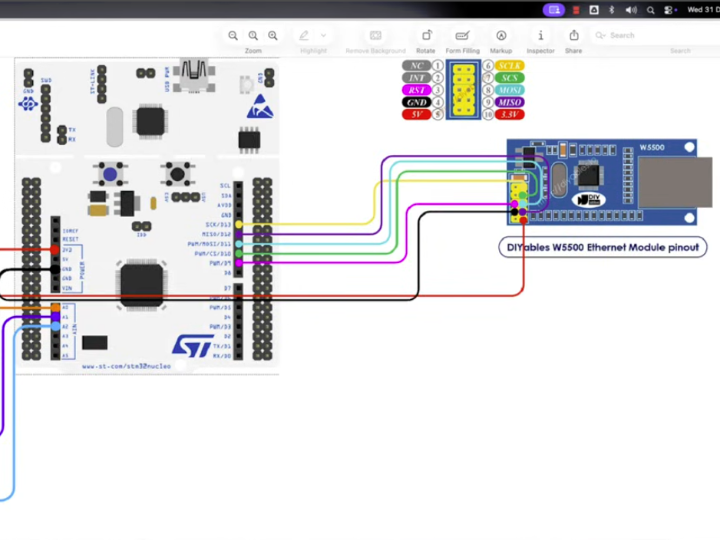
At minimum you need SPI (SCK/MISO/MOSI) plus CS as a GPIO (chip select is typically not driven by STM32 hardware NSS in these modules). Most builds also wire RST (for deterministic bring-up) and optionally INT (for event-driven receive). This matches common CubeMX-based integration guidance for W5500 modules.
3) What role does W5500 play in a “Mongoose Wizard” web dashboard project?
Wizard accelerates the Web UI + REST API layer, but you still need a network interface that can move data between the MCU and the LAN. In this pattern, W5500 is the Ethernet connectivity block: it’s the path by which the device gets an IP (often via DHCP) and serves HTTP endpoints that the dashboard calls.
4) Can beginners realistically follow the Arduino-to-STM32Cube porting approach?
Yes—because the “hard part” (a known-good reference integration) is already solved in the Arduino example. The beginner challenge is mostly mechanical: mapping Arduino SPI/GPIO calls to HAL, setting CubeMX pins correctly, and ensuring the main event loop runs frequently enough for DHCP/timeouts. It’s a very learnable path if you scope it to “get IP + serve one page” first.
5) What’s the alternative to W5500 for STM32 web dashboards, and what do you trade off?
If you choose an STM32 with native Ethernet MAC (RMII) and a PHY, you can follow more “standard” STM32Cube Ethernet flows and some existing Mongoose STM32CubeIDE tutorials. The tradeoff is hardware complexity (PHY + RMII routing) versus W5500’s simpler SPI wiring. Wi-Fi is simpler physically but can be less deterministic than wired Ethernet for industrial use.


