


How to Build an Industrial Geiger-Müller Datalogger with W55RP20-EVB-PICO?
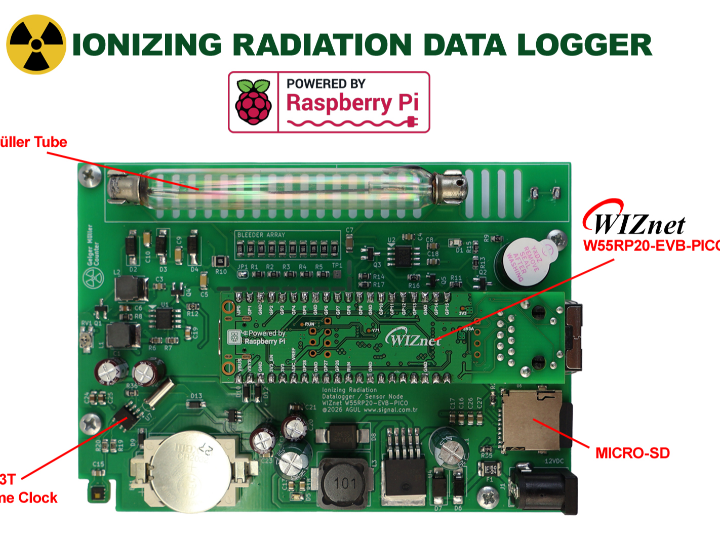
Signal Elektronik’s Geiger-Müller counter and datalogger uses the WIZnet W55RP20-EVB-PICO as the processing and wired-networking platform for a radiation-monito
WIZnet - W55RP20-EVB-Pico
x 1

Summary
Signal Elektronik’s Geiger-Müller counter and datalogger uses the WIZnet W55RP20-EVB-PICO as the processing and wired-networking platform for a radiation-monitoring node. The surrounding circuit adds a Geiger-Müller tube interface, high-voltage generation, pulse counting, SD-card storage, real-time clock, temperature/humidity sensing, alarm output, and 12 V power input. The result is more substantial than a basic maker demonstration: it resembles an early industrial monitoring reference design, although the published material does not demonstrate calibration, environmental qualification, certification, field deployment, or an existing production customer.
What the Project Does
The project turns a Geiger-Müller tube into a self-contained electronic measurement and logging node.
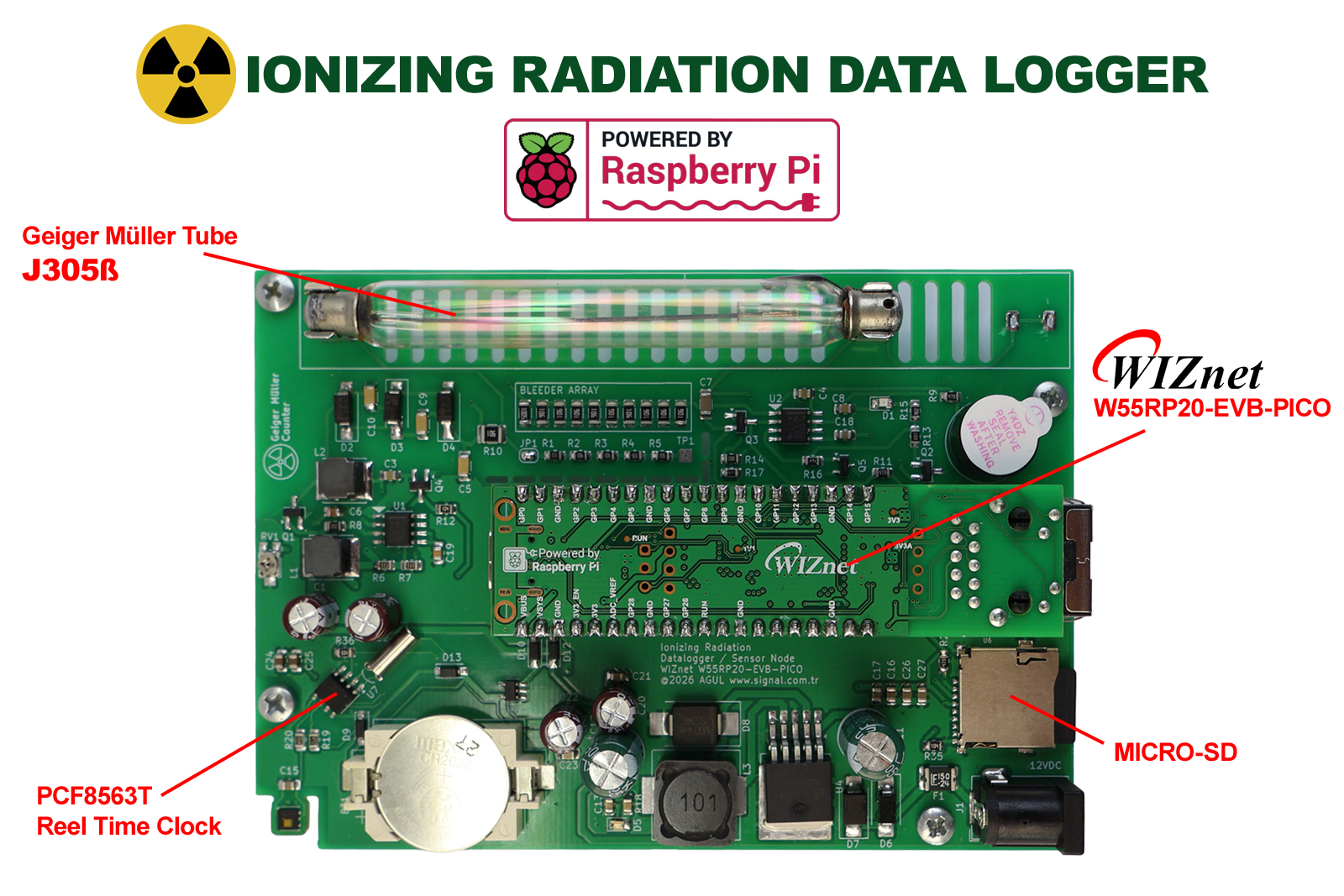
At the sensing end, the schematic uses an SBM20 Geiger-Müller tube together with a high-voltage generation section. The circuit includes NE555-based stages, high-voltage-rated capacitors and resistors, and a test point explicitly marked “57V for 400V.” The detector output is conditioned into a PULSECNT signal that can be read by the controller.
The design then adds the supporting functions expected from a standalone logger:
- an SD-card interface for local storage,
- a PCF8563T real-time clock with backup battery,
- an HDC1080 temperature/humidity sensor,
- a buzzer and click output for local indication,
- a 12 V barrel input with protection and power conversion,
- and a W55RP20-EVB-PICO as the main computing platform.
The resulting data flow is effectively:
Geiger tube → pulse conditioning → W55RP20 → timestamp/environmental data → SD storage and/or Ethernet
That architecture is relevant to industrial monitoring because local acquisition and local storage can continue independently of a remote server. Ethernet can then be used to move measurements into supervisory software, a database, or another monitoring system. The public schematic establishes the hardware path, but the available source does not expose the firmware or prove which application-layer Ethernet protocol was implemented.
From a commercialization perspective, the project is therefore better understood as an industrial proof-of-concept or reference platform, rather than as a finished radiation instrument.
The most plausible customer path is fixed or semi-fixed monitoring: laboratories, environmental stations, industrial rooms, research installations, educational facilities, or equipment that needs timestamped radiation-event logging. The published material does not establish that Signal developed it for a named customer or that a customer has already deployed it.
Where WIZnet Fits
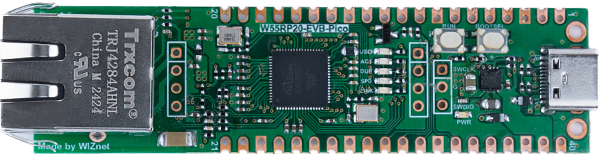
The exact WIZnet platform used in the schematic is the W55RP20-EVB-PICO. Signal explicitly places it as U3 in the design. Signals including PULSECNT, the RTC interface, temperature/humidity I²C lines, and the SD-card SPI interface are routed toward the board.
The W55RP20 itself integrates an RP2040-class microcontroller with WIZnet's W5500 Ethernet controller in one SiP. WIZnet documents the device with a hardwired TCP/IP engine, eight hardware sockets, 264 KB SRAM and on-chip flash; the EVB-PICO adds the physical 10/100 Ethernet interface and RJ45 connection.
That integration is significant in this application.
The microcontroller has several simultaneous jobs: count radiation pulses, service the RTC, acquire environmental measurements, maintain the SD-card filesystem, generate local indications, and potentially communicate with a remote system. Using WIZnet's hardware TCP/IP engine means TCP/IP processing and socket buffering do not have to be implemented entirely as a software network stack competing with those acquisition tasks. The W5500-derived networking portion provides eight sockets and 32 KB of dedicated TX/RX buffer memory.
For this type of equipment, the most important benefit is therefore not raw bandwidth. Radiation count data is relatively small.
The useful architectural property is separation between measurement firmware and network processing.
That makes W55RP20 particularly relevant to devices where sensing and logging remain the primary task while Ethernet is an additional communications channel.
How close is this to a real industrial design?
Technically, it has several characteristics that move it beyond a typical development-board demonstration.
The schematic contains its own detector high-voltage circuitry, protected 12 V power input, SD logging, backup RTC, environmental sensing, external indication, and mounting provisions. These are signs of a system being designed around an application rather than simply demonstrating that Ethernet works.
A reasonable maturity assessment is:
| Area | Current evidence | Industrial outlook |
|---|---|---|
| Radiation sensing circuit | Implemented | Promising |
| Pulse acquisition | Implemented electrically | Promising |
| Local SD logging hardware | Implemented | Strong |
| Battery-backed timestamping | Implemented | Strong |
| Environmental sensing | Implemented | Useful |
| 12 V system power | Implemented | Appropriate direction |
| Wired Ethernet | W55RP20-EVB-PICO provides it | Strong |
| Custom production Ethernet PCB | Not demonstrated | Still needed for many products |
| Firmware robustness | Not available for verification | Unknown |
| Calibration / traceability | Not demonstrated | Major remaining issue |
| EMC / surge / EFT testing | Not demonstrated | Major remaining issue |
| Environmental qualification | Not demonstrated | Unknown |
| Production enclosure | Not demonstrated | Still required |
| Existing customer deployment | Not documented | Unknown |
The commercial opportunity is consequently credible, but still pre-production.
For WIZnet, this is more interesting than a simple maker tutorial because the same architecture can be carried into other industrial instruments. A customer does not necessarily have to manufacture a Geiger counter. The pattern is reusable:
low-bandwidth sensor + local processing + local logging + wired remote communication
That can apply to environmental instrumentation, counters, condition-monitoring devices, laboratory equipment and industrial data loggers.
Implementation Notes
The complete firmware repository could not be verified from the supplied Signal page. The whitepaper URL currently returns a browser verification page to automated access, so no source-code snippet should be attributed to this project without additional firmware files from Signal.
The hardware implementation can, however, be verified directly from Signal's published KiCad schematic.
The W55RP20-EVB-PICO is connected to several application-level interfaces:
PULSECNT      → Geiger event input
TH-SDA/SCL    → HDC1080 temperature/humidity sensor
PCF-SDA/SCL   → PCF8563 RTC
PCF-INT       → RTC interrupt
SD-SCK
SD-SI
SD-SO
SD-CS         → SD-card interface
SDC-DETECT    → SD-card presence detection
These signal names are present directly in the published schematic and show that the W55RP20 is functioning as the central controller rather than being added only for Ethernet demonstration.
The detector section similarly exposes a conditioned PULSECNT signal through a transistor stage. That gives the MCU a digital event source suitable for accumulating counts over defined intervals.
For a commercial implementation, firmware would typically need to coordinate at least four independent functions:
Acquisition: count detector events without losing pulses.
Timekeeping: associate measurements with RTC timestamps.
Persistence: write records safely to SD storage and tolerate unexpected power loss.
Networking: expose or transmit measurements without disrupting acquisition.
The W55RP20's hardware TCP/IP architecture is useful specifically in the fourth function because WIZnet provides the socket-oriented network engine and dedicated network buffer memory in hardware.
What cannot currently be verified is whether Signal's firmware implements TCP, UDP, HTTP, MQTT, Modbus TCP or another application protocol. That should remain unspecified until the firmware becomes available.
Practical Tips / Pitfalls
- Treat detector calibration separately from Ethernet functionality. A network connection can reliably transport a count value without proving that the count has been converted into an accurate dose measurement. Calibration evidence is not included in the material reviewed here.
- Protect pulse acquisition from storage and network latency. Radiation pulses should be counted using an interrupt, counter peripheral or similarly deterministic mechanism rather than depending on the main logging/network loop.
- Design around SD-card failure. Industrial firmware should tolerate a missing, full or corrupted card without stopping radiation acquisition or Ethernet communication.
- Use the RTC as the authoritative measurement timestamp. The PCF8563 and backup battery already provide the hardware basis for preserving time across power interruptions.
- Preserve local operation when Ethernet disappears. A useful industrial logger should continue measuring and recording during cable, switch or server failure and recover network communication independently.
- Review the high-voltage section carefully during productization. The Geiger tube circuitry contains high-value resistors and kilovolt-rated capacitors and generates the detector operating voltage; PCB creepage, component ratings, enclosure access and production test strategy therefore matter independently of the low-voltage W55RP20 section.
- Do not confuse an EVB-based prototype with the final BOM. The W55RP20-EVB-PICO is appropriate for validation, while a volume product may eventually integrate W55RP20 and its Ethernet circuitry directly into the customer's PCB.
FAQ
Q: Why does this project use W55RP20 instead of a conventional MCU?
The W55RP20 combines the RP2040 processing architecture with WIZnet's W5500-derived hardwired TCP/IP engine. In this datalogger, the MCU already has sensor acquisition, pulse counting, RTC and SD-card responsibilities, so moving socket and TCP/IP processing into dedicated hardware separates networking from the measurement workload. The device supports eight hardware sockets and dedicated Ethernet TX/RX memory.
Q: How does W55RP20 connect to the Geiger-Müller hardware?
Signal uses a W55RP20-EVB-PICO as the controller board. The conditioned detector pulse reaches the board as PULSECNT; I²C lines connect the HDC1080 and PCF8563 peripherals, while separate SPI-style SD-SCK, SD-SI, SD-SO and SD-CS signals connect the SD card. Ethernet is provided by the W55RP20-EVB-PICO itself.
Q: What exactly does W55RP20 do in this project?
It acts as the central embedded controller and provides the platform's wired Ethernet capability. The schematic routes radiation-count, environmental-sensor, RTC and storage interfaces to the W55RP20-EVB-PICO, allowing one controller to acquire measurements, timestamp them, store them and potentially make them available over Ethernet. The published schematic verifies those hardware roles; the exact Ethernet application protocol cannot be verified from the currently accessible material.
Q: Can a beginner reproduce this project?
The digital portion is accessible to someone comfortable with RP2040 development, SPI, I²C and basic Ethernet concepts. The Geiger-Müller front end is considerably more advanced because it generates a high detector voltage and uses high-voltage components. For a beginner, reproducing the networking and logging subsystem first would be more appropriate than immediately rebuilding the entire detector power stage.
Q: Why use W55RP20 Ethernet instead of Wi-Fi for an industrial version?
Wi-Fi can reduce cabling and is appropriate where mobility or installation convenience dominates. W55RP20 Ethernet is more attractive when a monitoring device is permanently installed and the designer wants a physical wired link plus hardware TCP/IP sockets without running a full software TCP/IP stack on the application MCU. For this project, bandwidth is not the main requirement; predictable availability of the monitoring connection and separation of networking from measurement tasks are the stronger reasons to consider Ethernet. WIZnet documents the W55RP20-EVB-PICO with a 10/100 Ethernet PHY, eight hardware sockets and 32 KB of Ethernet buffer memory.