


How to Build a Rack-Management Controller on ESP32-S3 with W5500 Ethernet in TianShanOS?
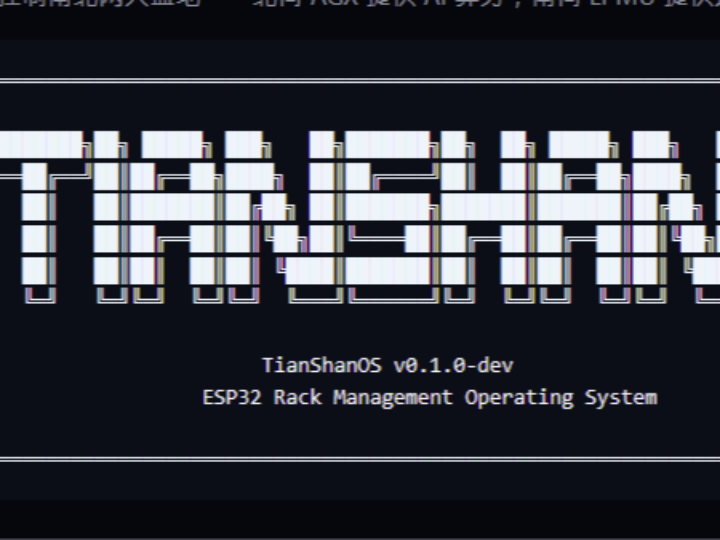
TianShanOS is an ESP-IDF v5.5+ framework that turns an ESP32-S3 into a rack-management controller.
WIZnet - W5500
x 1

Project introduction: what TianshanOS actually implements
TianShanOS is presented as a configuration-oriented (not code-oriented) embedded OS framework for server cabinet / rack management, built on ESP-IDF v5.5+ and explicitly targeting NVIDIA Jetson AGX carrier-board rack management scenarios.
The README describes:
- A modular, component-based layout (core framework, HAL, console, API, LED subsystem, networking, security, WebUI, storage, drivers).
- JSON configuration to define hardware pins and behavior, with runtime flexibility for loading pin/service configuration.
- A layered architecture and an “8-stage” style service startup concept (“服务管理层 (8阶段启动)”).
- A security-first feature set: HTTPS/mTLS, SSH public-key auth, AES-GCM, and permission levels.
- Networking includes Wi-Fi + Ethernet (W5500) + HTTP/HTTPS server, and WebUI provides REST API + WebSocket broadcast.
This is essentially a “microcontroller BMC-like controller”: not a full server BMC stack, but a practical embedded control plane for rack/carrier-board power, fans, sensors, and remote UI.
What “rack management” means (and where TianShanOS fits)
Rack management is the operational layer that keeps systems safe and serviceable: controlling power sequencing, fan curves, monitoring voltages/currents/temperatures, and exposing a remote interface (web/CLI/API) so an operator can check health and apply changes without physical access.
Traditional datacenter BMC stacks (e.g., OpenBMC) run on dedicated BMC silicon and provide a broad ecosystem for enterprise/HPC/cloud environments.
TianShanOS, by contrast, targets a lighter footprint: it’s designed around an ESP32-class MCU with modular services and a web console, making it attractive when you need “enough remote management” on custom hardware—without taking on a full Linux distribution.
Why ESP32-S3 + WIZnet W5500 is a strong platform choice
Wired-first reliability for control planes
For rack control, the network link isn’t a convenience—it’s the control plane. Wired Ethernet eliminates common Wi-Fi failure modes (RF congestion, roaming surprises, power-save jitter), which is especially important if your controller must remain reachable during incidents.
W5500 simplifies Ethernet integration over SPI
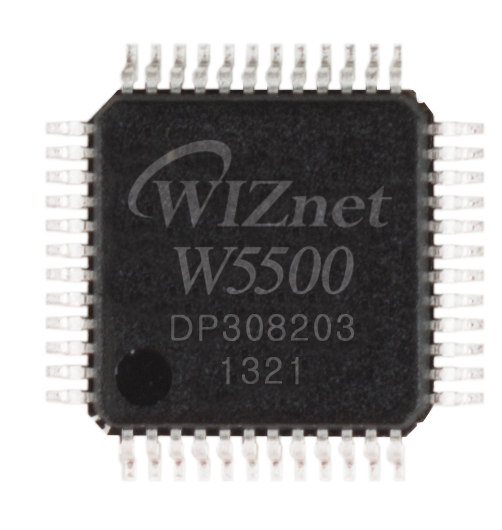
The WIZnet W5500 integrates 10/100 Ethernet MAC+PHY and is designed to connect to hosts over SPI (up to 80 MHz), with 32 KB internal buffer memory and support for multiple sockets/features typical of embedded Ethernet controllers.
In ESP-IDF ecosystems, there are established driver paths for W5500-class SPI Ethernet, which reduces “custom PHY bring-up” complexity.
Practical alternative comparisons
- Wi-Fi-only ESP32: simplest BOM, but less deterministic for 24/7 rack access.
- RMII PHY (e.g., LAN8720-style designs): great performance, but increases board-level clocking/layout constraints versus SPI wiring.
- Linux BMC/OpenBMC: maximum ecosystem and standards coverage, but far heavier (hardware + software) than an ESP32-S3 class controller.
Upgrade paths in the WIZnet family
If you want a compact wired controller without ESP32 Wi-Fi, a SiP like W55RP20 (RP2040 + W5500 integrated) is a natural direction for “Ethernet-first appliance controllers.”
Architecture explanation (repo-based + clearly marked conceptual details)
The repo’s README documents a layered architecture and modular component breakdown that maps cleanly to a rack controller:
(1) Configuration-driven boot
- Pins/services are described via JSON (“面向配置”), enabling a board profile under
boards/and keeping the core logic generic.
(2) Staged service startup
- An event/message bus plus service manager brings up subsystems in order: storage → config → networking → API/WebUI → drivers (fans/power/AGX control).
(3) Networking + UI
ts_netis the networking component (Wi-Fi + Ethernet + HTTP/HTTPS), whilets_webuiprovides REST + WebSocket. The current status table explicitly lists “Ethernet W5500” support.
Conceptual (because I could not reliably open code files in this environment): W5500 bring-up sequence
- Initialize SPI bus and W5500 reset GPIO
- Install an Ethernet driver instance, bind it to an ESP-IDF netif, and start link + DHCP
- Start HTTPS/mTLS endpoints and WebSocket broadcasting after network is ready
Important nuance: the W5500 has a “hardwired TCP/IP stack,” but Espressif’s W5500 driver documentation notes that the ESP driver path treats W5500 primarily as MAC/PHY while the TCP/IP stack is typically provided by the host (lwIP).
FAQ
1) Why use W5500 for rack management instead of Wi-Fi?
Rack management is a control-plane workload: you care about reachability during stressful conditions (RF noise, AP failures, interference). W5500 gives you a wired Ethernet path over SPI (up to 80 MHz) with internal buffering, and TianShanOS explicitly lists W5500 Ethernet as part of its networking feature set. Wired-first management reduces “it’s online except when I need it most.”
2) How do you connect ESP32-S3 to W5500 in an ESP-IDF project like TianShanOS?
Electrically, W5500 connects over SPI + a reset line (and optionally an interrupt). On the software side, ESP-IDF uses an Ethernet driver model: you bind the SPI Ethernet driver to a network interface, then your HTTP/HTTPS/WebSocket services sit on top. TianShanOS’s structure (ts_net for network + HTTP/HTTPS) fits that model well.
3) What role does W5500 play inside TianShanOS specifically?
Based on the repo’s status table, W5500 is the Ethernet option inside the networking module: “WiFi, Ethernet W5500, HTTP/HTTPS server.” That implies W5500 provides the stable wired interface used by the WebUI (REST + WebSocket) and any API-driven rack control operations—exactly where you want deterministic connectivity.
4) Can beginners deploy a W5500-based rack controller with this project?
If you’re comfortable with ESP-IDF workflows (idf.py set-target, menuconfig, build, flash monitor), you’re most of the way there. The bigger learning curve is usually hardware definition (pin/service JSON) and verifying your rack IO (fans/power monitors) matches the board profile. Ethernet via W5500 is often simpler to validate than Wi-Fi because link state and cabling are concrete.
5) W5500 vs RMII PHY (LAN8720-style) vs “real BMC/OpenBMC”: which is best?
W5500 shines when you want simple, reliable wired Ethernet on an MCU board without tight RMII clock/layout constraints. RMII PHY designs can be excellent for throughput and integration, but board design is less forgiving. OpenBMC is the right answer when you need full datacenter-grade BMC capabilities and a Linux ecosystem—but it’s far heavier than an ESP32-S3 class design.