


How to Integrate WIZnet W5500 SPI Ethernet on ESP-IDF for ESP32?
The eth-w5500 project packages WIZnet’s W5500 (SPI Ethernet) into an ESP-IDF-friendly component with a small, struct-based API
WIZnet - W5500
x 1

What the Project Does
This project is not an “end device” application—it’s a reusable ESP-IDF component that simplifies bringing up a W5500 module on ESP32-class targets. It aims to remove the usual glue code you write repeatedly (event loop setup, netif attach, DHCP/static IP selection, link/IP status tracking) and expose a minimal API (init(), start(), wait_for_ip(), status callbacks).
The Maker page describes it plainly as a “simple W5500 Ethernet driver for ESP-IDF… Pure C.”
Where WIZnet Fits
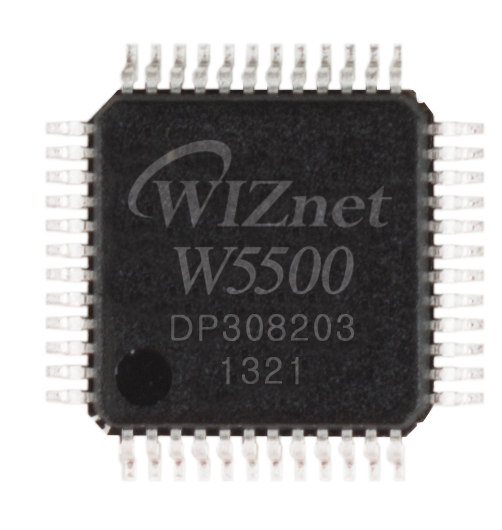
The WIZnet part here is the W5500—a SPI-connected Ethernet controller used as the external wired network interface for an ESP32/ESP32-S2/ESP32-S3/etc. In this integration model, the ESP runs the IP stack (lwIP via ESP-IDF), while the W5500 provides the Ethernet link over SPI and is managed through ESP-IDF’s Ethernet driver framework.
This is a practical fit for maker builds where you want wired Ethernet without adding a separate MAC+PHY combination—just SPI pins (plus optional INT/RST) and a stable, cabled network path.
Implementation Notes
Drop-in component installation
The component is intended to be pulled directly into an ESP-IDF project using the component manager:
idf.py add-dependency "drfhaust/eth-w5500"README.md in the project repository.)Minimal bring-up in app_main()
The README’s “Basic Usage (DHCP)” shows the intended flow: create a config struct, set SPI pins (at minimum CS plus the SPI signals if you’re not sharing an existing bus), then init + start:
eth_w5500_config_t cfg = ETH_W5500_DEFAULT_CONFIG();
cfg.spi_mosi = 23; cfg.spi_miso = 19; cfg.spi_clk = 18; cfg.spi_cs = 5;

eth_w5500_init(&cfg);
eth_w5500_start();README.md.)What it links against in ESP-IDF
The component’s build file makes the intent clear: it is designed around ESP-IDF’s Ethernet and netif layers:
idf_component_register( SRCS "eth_w5500.c" INCLUDE_DIRS "include" REQUIRES driver esp_eth esp_netif esp_event )CMakeLists.txt.)For makers, this matters because it means your “real” application can use the usual ESP-IDF networking patterns (sockets, HTTP clients, mDNS, etc.) once the netif is up—without inventing a parallel stack.
Practical Tips / Pitfalls
- Decide early: shared SPI bus vs dedicated. This project supports using an external SPI bus you already initialized, which is useful if you also have displays/sensors on SPI.
- Be honest about INT pin availability. If you don’t wire INT, plan for polling mode and keep your SPI wiring clean (short lines, good ground).
- Treat DHCP timeouts as a first-class failure mode. For maker demos, waiting is fine; for unattended installs, add a fallback (static IP, reboot strategy, or UI indicator).
- Keep SPI clock in a conservative range. The project documents an 8–25 MHz operating window in its configuration notes—start low when debugging signal integrity.
- Reset strategy matters. If your module exposes RST, wiring it gives you a recovery path when link negotiation or SPI gets wedged.
FAQ
Why choose the WIZnet W5500 for this kind of ESP-IDF maker build?
Because it’s a straightforward way to add wired Ethernet to ESP32-class boards using SPI, and it’s supported by ESP-IDF’s Ethernet driver model. You get a “normal” ESP-IDF netif that higher-level networking code can consume once the link is up and DHCP/static IP is configured.
How does the W5500 connect to the platform in this project?
Over SPI (MOSI/MISO/SCLK/CS), with optional INT (or polling if INT is not wired) and optional RST. The component exposes these as fields in a config struct so you can map them to your specific board/module wiring.
What role does the W5500 play in THIS project’s architecture?
It is the external Ethernet interface used by ESP-IDF’s Ethernet layer. The component’s job is to initialize the W5500-backed Ethernet driver, attach it to esp_netif, then provide simple status and control calls (start/stop, DHCP vs static IP, link/IP status).
Can beginners follow this integration?
Yes—if you’re already able to build/flash an ESP-IDF project and you understand basic LAN concepts (DHCP, IP address, gateway). The “beginner traps” are almost always hardware: wrong CS pin, missing ground reference, or assuming INT is required when polling is acceptable (and vice versa).
How does this compare to Espressif’s official W5500 driver/component?
Espressif’s official path is the espressif/w5500 component (and the broader esp-eth-drivers ecosystem), which is designed to plug into ESP-IDF’s Ethernet layer as a standard driver building block.
This project (drfhaust/eth-w5500) is best viewed as a convenience wrapper: it keeps configuration in a plain struct (instead of leaning on menuconfig/Kconfig) and provides one-call helpers like “wait for IP” and status callbacks, while still relying on the same ESP-IDF Ethernet/netif foundations.
If you want maximum alignment with Espressif’s examples and long-term “standard” patterns, start with espressif/w5500. If you want a smaller integration surface for maker prototypes (fewer moving parts in your app_main()), this wrapper can be a faster on-ramp.


