


How Does KinCony B4M Use W5500 for Reliable Smart Home Automation?
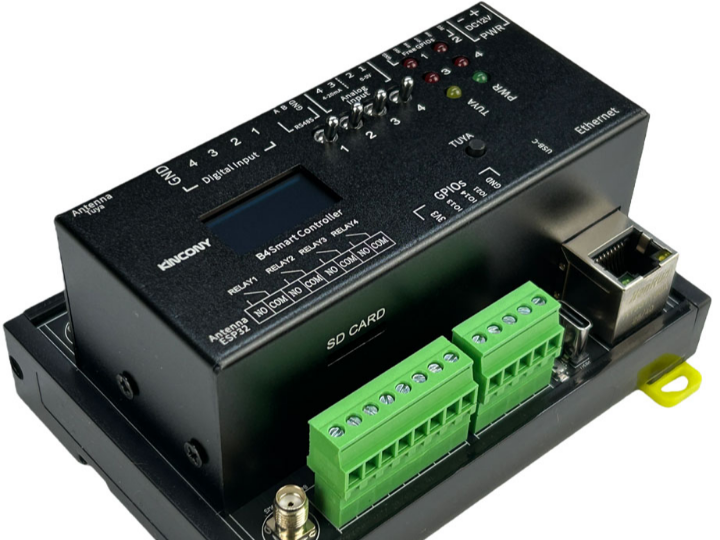
KinCony's B4M Smart Controller, introduced in 2026, is an interesting commercial example of this approach
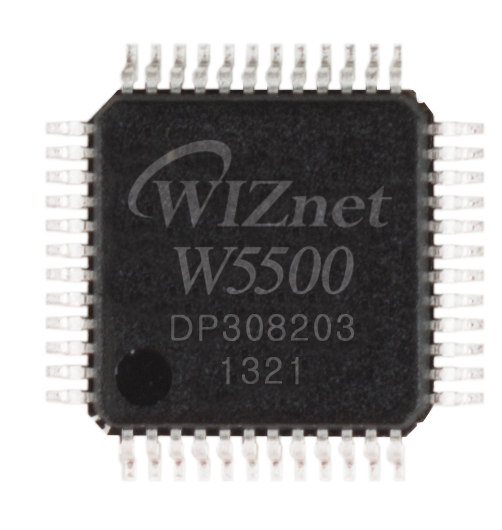
WIZnet - W5500
x 1

KinCony B4M과 B8M은 W5500을 스마트홈·빌딩자동화에 어떻게 확장하고 있는가?
📌 Overview
스마트홈과 빌딩자동화 제품은 Wi-Fi를 중심으로 발전해 왔지만, 실제 상시 운용되는 컨트롤러에서는 안정적인 유선 네트워크에 대한 수요도 계속 존재합니다.
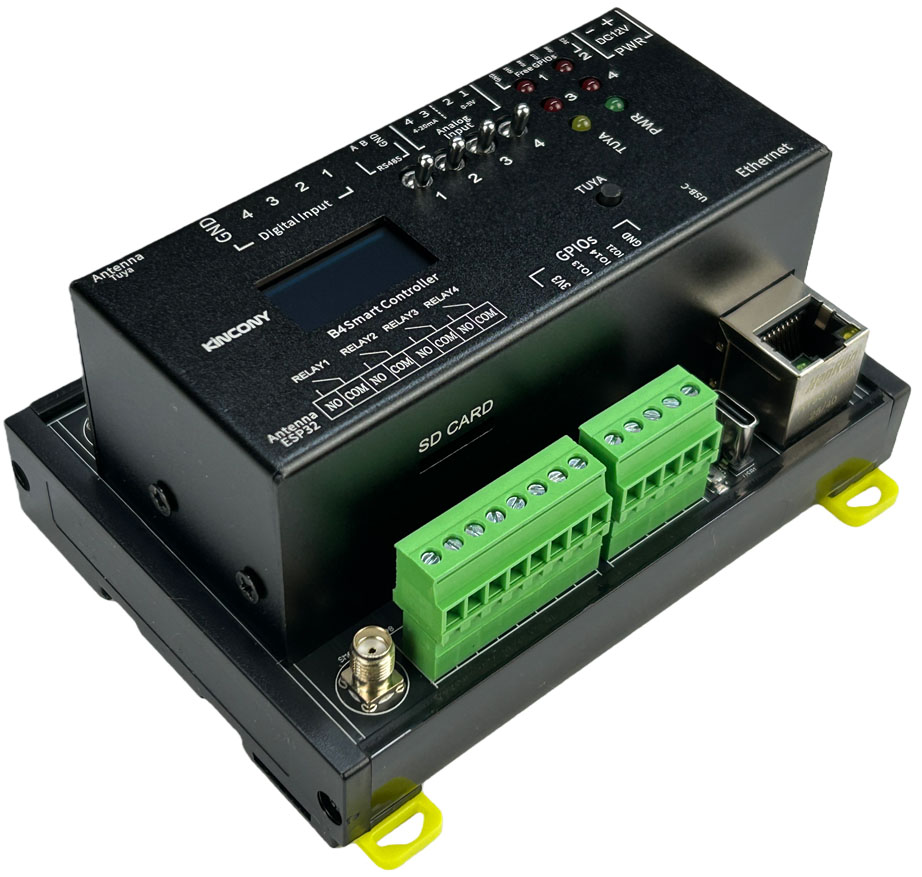
KinCony의 B4M과 B8M Smart Controller는 이런 Hybrid Connectivity 접근을 보여주는 상용 제품군입니다.
두 제품 모두 ESP32-S3를 기반으로 하며 Ethernet, Wi-Fi, Bluetooth, RS485 등의 다양한 인터페이스를 지원합니다.
차이는 제어 채널 수입니다.
B4M: 4채널 MOSFET 출력
B8M: 8채널 MOSFET 출력
https://www.kincony.com/esp32-smart-controller-b8m-8ch-mosfet.html
즉 같은 스마트 자동화 플랫폼을 기반으로 사용 규모에 따라 4CH 또는 8CH를 선택할 수 있는 제품군입니다. B4M은 DIN-rail 설치, Home Assistant/ESPHome/Tasmota 연동, MQTT 기반 Home Assistant Auto Discovery 등을 지원합니다.
핵심: KinCony는 W5500 기반 Ethernet을 단일 제품이 아니라 B4M/B8M 제품군으로 확장하여, 스마트홈과 빌딩자동화 시장에서 유선 네트워크를 하나의 기본 connectivity option으로 제공하고 있습니다.
B4M과 B8M은 어떻게 다른가?
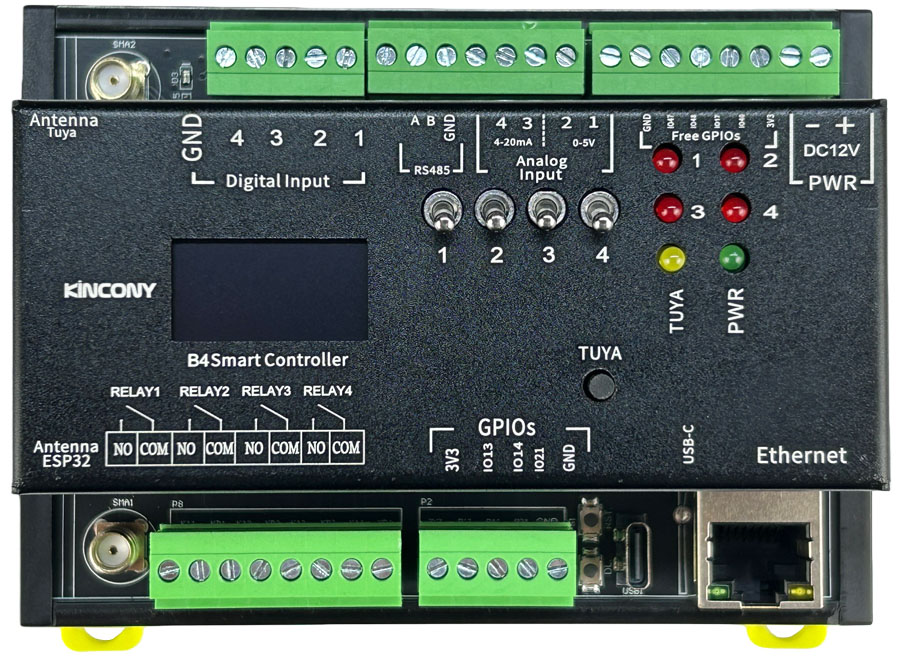
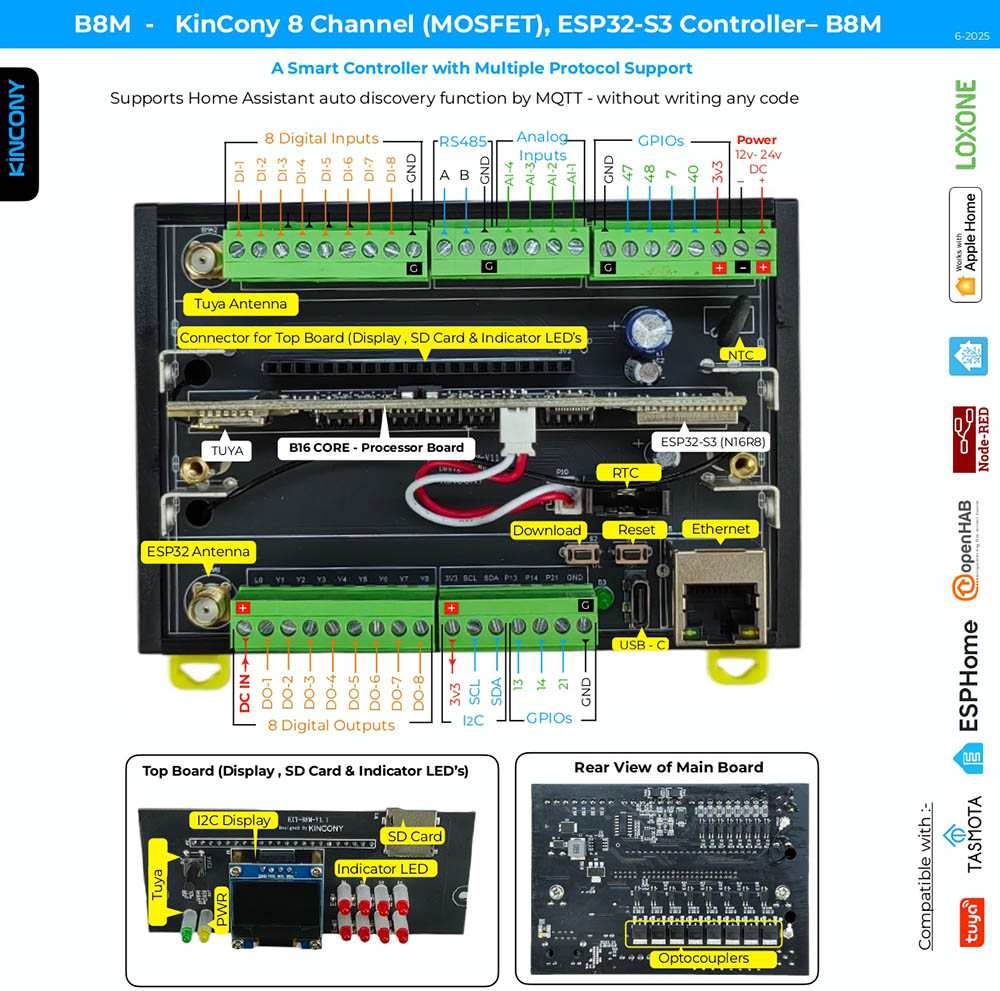
B4M과 B8M은 같은 제품군에 속하지만 제어 가능한 출력 채널 수가 다릅니다.
| Model | Main Difference | Target |
|---|---|---|
| B4M | 4CH MOSFET Output | 소규모 스마트홈·제어 시스템 |
| B8M | 8CH MOSFET Output | 더 많은 부하를 제어하는 자동화 시스템 |
B4M은 ESP32-S3-WROOM-1U를 기반으로 하며 Ethernet, Wi-Fi, Bluetooth, RS485, USB-C, I2C, LCD 등의 인터페이스를 제공합니다. 또한 0–5V 및 4–20mA analog input, dry contact input 등 자동화 시스템에 필요한 다양한 I/O를 통합하고 있습니다.
B8M은 같은 계열의 8채널 모델로, 더 많은 출력 제어가 필요한 환경을 목표로 합니다.
이 구조는 KinCony가 단순히 하나의 개발보드를 만든 것이 아니라 채널 규모에 따라 선택할 수 있는 상용 자동화 product family를 구축하고 있다는 점에서 의미가 있습니다.
왜 Wi-Fi와 Ethernet을 동시에 제공할까?
ESP32-S3는 이미 Wi-Fi와 Bluetooth를 지원합니다.
그런데도 KinCony는 B4M/B8M 제품군에 Ethernet을 함께 제공합니다.
이것이 이 제품군에서 가장 흥미로운 부분입니다.
Wi-Fi
↓
설치 편의성 / Wireless Access

Ethernet
↓
Stable Local Network

Bluetooth
↓
Local Device Connectivity

RS485
↓
Industrial Devices
즉 각 통신 방식이 서로 경쟁하는 것이 아니라 역할을 분담합니다.
스마트홈에서는 Wi-Fi가 편리하지만, Home Assistant나 MQTT 서버와 상시 연결되는 controller에서는 설치 환경에 따라 Ethernet이 더 적합할 수 있습니다.
B4M의 경우 KinCony는 Home Assistant를 LAN 기반 local control로, Tuya를 Internet 기반 remote control로 함께 활용하는 사용 방식도 제안하고 있습니다.
W5500은 제품군에서 어떤 의미를 가지는가?
B4M/B8M 사례의 의미는 W5500이 단순히 “Ethernet 기능을 추가하는 칩”으로 사용됐다는 데 있지 않습니다.
더 중요한 점은 동일한 commercial product family 전반에서 Ethernet connectivity가 반복적으로 채택되고 있다는 것입니다.
W5500
   ↓
B4M (4CH)
   ↓
Smart Home / Small Automation

W5500
   ↓
B8M (8CH)
   ↓
Larger Building Automation
즉 사용 규모가 달라져도 Ethernet connectivity는 유지됩니다.
이는 W5500이 특정 niche board의 기능이 아니라, KinCony가 정의한 smart automation architecture의 일부라는 점을 보여줍니다.
Home Assistant Ecosystem과의 연결
B4M은 ESPHome을 통해 Home Assistant와 연동할 수 있으며, KinCony의 KCS v3 firmware는 MQTT 기반 Home Assistant Auto Discovery도 지원합니다. 또한 Tasmota와 Apple HomeKit 지원도 제공됩니다.
이를 단순화하면 다음과 같은 구조가 됩니다.
Sensors / Switches / Analog Devices
             ↓
      KinCony B4M / B8M
             ↓
           W5500
             ↓
          Ethernet
             ↓
   Home Assistant / MQTT
             ↓
 Automation / Monitoring
이 구조에서 W5500은 실험용 Ethernet interface가 아니라 실제 스마트홈·빌딩자동화 시스템의 wired connectivity layer로 사용됩니다.
스마트홈을 넘어 빌딩자동화로
B4M/B8M 계열에는 Wi-Fi와 Ethernet뿐 아니라 RS485와 다양한 I/O가 함께 제공됩니다.
특히 B4M은 0–5V 및 4–20mA analog input, dry contact input을 지원하여 단순 스마트홈 기기 이상의 application을 고려한 설계입니다.
따라서 다음과 같은 시장으로 확장 가능합니다.
Smart Home
• Lighting
• Door / Sensor Monitoring
• Home Assistant

Building Automation
• HVAC
• Pump / Fan Control
• Environmental Monitoring

Industrial IoT
• 4–20mA Sensors
• RS485 Devices
• Remote I/O
B8M은 같은 architecture에서 출력 채널 수를 8CH로 확장해 더 많은 부하를 제어할 수 있는 선택지를 제공합니다.
🌐 마케팅 관점에서 보는 B4M/B8M의 의미
이 사례의 가장 중요한 포인트는 한 제품의 Design-in이 아니라 Product Family 수준의 Design-in이라는 점입니다.
B4M과 B8M은 채널 수가 다르지만 같은 application과 connectivity concept를 공유합니다.
따라서 W5500을 다음처럼 바라볼 수 있습니다.
Single Design-in
      ↓
Product Family Adoption
      ↓
Application Expansion
      ↓
Smart Home / Building Automation
마케팅 관점에서는 단순히
“W5500이 KinCony 제품에 사용됐다”
보다
“KinCony가 W5500 Ethernet을 4CH와 8CH smart controller 라인업 전반에 적용하고 있다”
가 더 강한 메시지입니다.
이는 W5500이 특정 제품의 부가 기능이 아니라, 해당 제품군의 networking architecture에 반복적으로 채택되고 있음을 보여주기 때문입니다.
From Component Marketing to Ecosystem Marketing
B4M과 B8M은 또 하나의 중요한 마케팅 포인트를 제공합니다.
W5500을 chip specification 중심으로 설명하면:
W5500
• Hardwired TCP/IP
• SPI Interface
• Ethernet
이지만 application 관점에서는:
W5500
   ↓
Reliable Ethernet
   ↓
ESP32-S3 Smart Controller
   ↓
Home Assistant / MQTT / ESPHome
   ↓
Smart Home & Building Automation
으로 이야기할 수 있습니다.
즉 component 자체의 기능보다 어떤 ecosystem과 application 속에서 사용되는가를 보여주는 것이 더 중요합니다.
B4M/B8M 사례는 W5500을 Home Assistant, ESPHome, MQTT와 같은 IoT ecosystem 속에서 설명할 수 있는 좋은 사례입니다.
Conclusion
KinCony B4M과 B8M은 ESP32-S3 기반의 스마트 자동화 컨트롤러 제품군으로, 4CH와 8CH MOSFET 출력이라는 차이를 가지고 있습니다. 두 제품군은 Ethernet과 Wi-Fi를 함께 제공하며, Home Assistant, ESPHome, MQTT 등 다양한 스마트홈 ecosystem과 연동될 수 있습니다.
이 사례의 핵심은 W5500이 하나의 제품에만 적용된 것이 아니라 동일 제품군 안에서 반복적으로 채택되고 있다는 점입니다.
마케팅 관점에서는 이를 통해 W5500을 단순한 Ethernet controller가 아니라,
Smart Home → Building Automation → Industrial IoT
로 이어지는 application ecosystem의 connectivity solution으로 포지셔닝할 수 있습니다.
How Do KinCony B4M and B8M Expand W5500 into Smart Home and Building Automation?
📌 Overview
Smart home and building automation products have largely evolved around Wi-Fi, but always-on controllers still require reliable wired connectivity in many installations.
KinCony's B4M and B8M Smart Controllers provide a useful commercial example of this hybrid approach.
Both are based on the ESP32-S3 and support multiple interfaces including Ethernet, Wi-Fi, Bluetooth and RS485.
Their key difference is the number of output channels:
B4M: 4-channel MOSFET output
B8M: 8-channel MOSFET output
This allows the same automation concept to scale from smaller installations to systems requiring more output control. The B4M also supports ESPHome, Home Assistant, Tasmota and MQTT-based Home Assistant Auto Discovery.
Key point: KinCony is extending W5500-based Ethernet across a B-series product family rather than using it in only one isolated product.
How Are B4M and B8M Different?
The B4M and B8M belong to the same smart controller family but target different control scales.
| Model | Main Difference | Typical Scale |
|---|---|---|
| B4M | 4CH MOSFET Output | Small smart home and automation systems |
| B8M | 8CH MOSFET Output | Larger automation installations |
The B4M uses an ESP32-S3-WROOM-1U and provides Ethernet, Wi-Fi, Bluetooth, RS485, USB-C, I2C and LCD interfaces, together with analog and dry-contact inputs.
The B8M extends the same concept to eight MOSFET output channels.
This is important because it shows that KinCony is building a scalable commercial automation product family, not just a single development board.
Why Offer Both Wi-Fi and Ethernet?
The ESP32-S3 already includes wireless connectivity.
Yet KinCony still provides Ethernet in the B4M/B8M family.
This suggests that the two connectivity options serve different roles.
Wi-Fi
↓
Wireless Convenience

Ethernet
↓
Stable Local Networking

Bluetooth
↓
Local Device Connectivity

RS485
↓
Industrial Devices
In other words, Ethernet and Wi-Fi are not necessarily competing technologies.
For controllers that remain permanently connected to Home Assistant, MQTT brokers or local automation systems, Ethernet can provide an additional networking option where wired installations are preferred.
KinCony even recommends using Home Assistant for local LAN control while Tuya can be used for Internet-based remote access.
What Does W5500 Mean at the Product-Family Level?
The most interesting aspect of the B4M/B8M case is not simply that W5500 provides Ethernet.
It is that Ethernet connectivity is maintained across multiple models in the same commercial family.
W5500
   ↓
B4M (4CH)
   ↓
Smart Home / Small Automation

W5500
   ↓
B8M (8CH)
   ↓
Larger Building Automation
As the number of controlled outputs scales, wired networking remains part of the architecture.
This makes W5500 more than a feature of one niche board—it becomes part of the connectivity strategy of the broader product family.
Connecting to the Home Assistant Ecosystem
The B4M supports ESPHome integration with Home Assistant, while KinCony's KCS v3 firmware supports MQTT-based Home Assistant Auto Discovery. Tasmota and Apple HomeKit are also supported.
A typical architecture can therefore look like:
Sensors / Switches / Analog Devices
             ↓
      KinCony B4M / B8M
             ↓
           W5500
             ↓
          Ethernet
             ↓
   Home Assistant / MQTT
             ↓
 Automation / Monitoring
In this scenario, the W5500 becomes the wired connectivity layer of a commercial automation system, rather than a device used only for Ethernet prototyping.
From Smart Home to Building Automation
The B4M/B8M family also combines Ethernet with interfaces such as RS485 and various I/O options.
The B4M, for example, provides 0–5V and 4–20mA analog inputs together with dry-contact inputs, allowing it to address applications beyond basic consumer IoT.
Potential applications include:
Smart Home
• Lighting
• Sensor Monitoring
• Home Assistant

Building Automation
• HVAC
• Pump / Fan Control
• Environmental Monitoring

Industrial IoT
• 4–20mA Sensors
• RS485 Devices
• Remote I/O
The B8M extends the same architecture to eight output channels for larger installations.
🌐 Marketing Perspective: From One Design-In to a Product Family
The strongest marketing point of this case is that it represents more than a single design-in.
B4M and B8M have different output capacities, but they share the same overall application and connectivity direction.
That creates a progression:
Single Design-in
      ↓
Product Family Adoption
      ↓
Application Expansion
      ↓
Smart Home / Building Automation
From a marketing perspective,
“W5500 is used in one KinCony product”
is less meaningful than:
“KinCony is applying W5500 Ethernet across its 4CH and 8CH smart controller family.”
This suggests that wired Ethernet is not an optional one-off feature but a recurring part of the product architecture.
From Component Marketing to Ecosystem Marketing
W5500 can be described at the component level as:
W5500
• Hardwired TCP/IP
• SPI Interface
• Ethernet
But the B4M/B8M case enables a broader application story:
W5500
   ↓
Reliable Ethernet
   ↓
ESP32-S3 Smart Controller
   ↓
Home Assistant / MQTT / ESPHome
   ↓
Smart Home & Building Automation
This is the difference between component marketing and ecosystem marketing.
Rather than communicating only the chip's technical features, commercial products such as B4M and B8M demonstrate where those capabilities create value in real applications.
Conclusion
KinCony's B4M and B8M are ESP32-S3-based smart automation controllers differentiated primarily by their 4-channel and 8-channel MOSFET outputs. Both belong to a broader hybrid connectivity architecture combining wired and wireless networking with smart-home and automation ecosystems.
The key insight is that W5500 adoption is visible not only in one controller but across a scalable product family.
From a marketing perspective, this supports positioning W5500 not simply as an embedded Ethernet controller, but as a connectivity solution that can expand across:
Smart Home → Building Automation → Industrial IoT.