


OpenJBOD: An Open-Source Network-Managed JBOD Controller with RP2040 and W5500
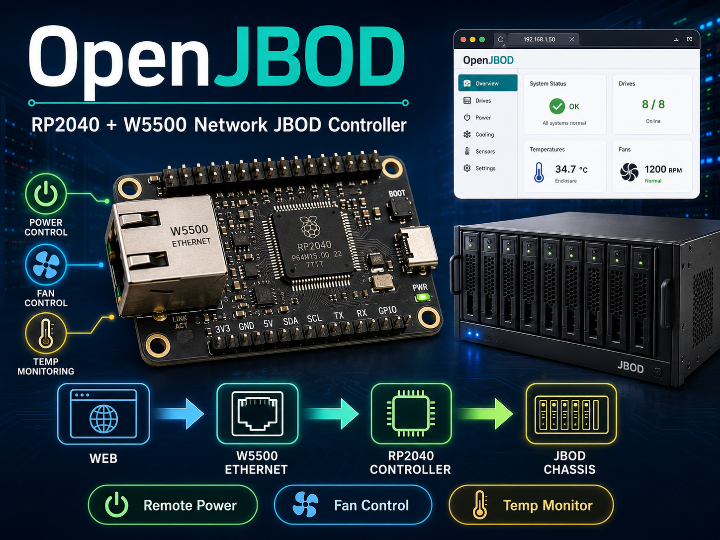
Its controller board combines an RP2040 MCU with the WIZnet W5500 Ethernet controller and supports standard ATX power supplies and power-only SAS expanders.

WIZnet - W5500
x 1

OpenJBOD: RP2040과 W5500으로 구현한 오픈소스 네트워크 JBOD 관리 보드
OpenJBOD는 RP2040과 W5500을 기반으로 JBOD 스토리지 섀시의 전원, 냉각팬, 온도 및 네트워크 설정을 웹에서 원격 관리할 수 있도록 설계된 오픈소스 하드웨어 프로젝트입니다. 표준 ATX 전원공급장치와 전원 전용 SAS Expander를 지원하며, KiCad 하드웨어 설계와 관리 소프트웨어가 공개되어 있습니다. 2025년 rev5 하드웨어와 2026년 Zephyr 기반 Tank 펌웨어로 지속적으로 발전하고 있습니다.
JBOD 섀시에도 전용 네트워크 관리 보드가 필요할까?
JBOD는 여러 개의 HDD 또는 SSD를 하나의 섀시에 구성하고, 외부 서버의 HBA나 SAS 컨트롤러를 통해 디스크에 접근하는 스토리지 구조입니다.
하지만 디스크 데이터 연결만으로는 섀시의 전원, 냉각팬, 온도와 같은 운영 상태를 원격으로 관리하기 어렵습니다. 일반적인 서버에는 BMC나 IPMI와 같은 관리 기능이 있지만, 개인이 직접 제작한 JBOD나 소규모 스토리지 섀시에는 이러한 기능이 없는 경우가 많습니다.
OpenJBOD는 이 문제를 해결하기 위해 개발된 오픈소스 JBOD 관리 메인보드입니다.
RP2040이 섀시의 전원과 환경 제어를 담당하고, W5500은 유선 Ethernet 연결을 제공해 사용자가 웹 인터페이스를 통해 JBOD를 원격으로 관리할 수 있도록 합니다.
프로젝트 구성
OpenJBOD 프로젝트는 하드웨어와 펌웨어가 각각의 GitHub 저장소로 관리됩니다.
| 구성 | 역할 |
|---|---|
| OpenJBOD RP2040 Baseboard | RP2040, W5500, 전원 및 팬 제어 회로가 포함된 관리 보드 |
| OpenJBOD Software | MicroPython 기반 웹 관리 소프트웨어 |
| OpenJBOD MicroPython | OpenJBOD 보드를 위한 MicroPython 보드 정의 |
| Tank | Zephyr RTOS와 C로 개발된 차세대 관리 펌웨어 |
하드웨어 저장소에는 KiCad 프로젝트, PCB 설계, 회로도, 풋프린트와 3D 모델이 포함되어 있습니다. W5500 네트워크 회로는 W5500.kicad_sch 파일로 별도 구성되어 있어 Ethernet 부분을 구체적으로 확인할 수 있습니다.
원본 저장소:
https://github.com/OpenJBOD/rp2040
OpenJBOD 조직:
주요 하드웨어
OpenJBOD 관리 보드의 핵심 구성은 RP2040과 W5500입니다.
RP2040
RP2040은 OpenJBOD의 메인 컨트롤러입니다.
JBOD 전원 상태를 제어하고 온도와 팬 상태를 확인하며, 사용자가 설정한 팬 제어 정책과 네트워크 관리 명령을 처리합니다.
W5500
W5500은 RP2040에 안정적인 유선 Ethernet 연결을 추가합니다.
사용자가 웹 브라우저나 API를 통해 OpenJBOD에 접속하면 W5500이 Ethernet 통신을 담당하고, RP2040이 실제 전원과 냉각 시스템을 제어합니다.
전체 제어 흐름은 다음과 같습니다.
Web Browser → Ethernet / W5500 → RP2040 → Power, Fan and Temperature Control
W5500은 디스크의 스토리지 데이터를 전송하는 역할을 하지 않습니다. HDD 데이터는 별도의 HBA와 SAS Expander를 통해 서버로 전송됩니다.
OpenJBOD에서 W5500의 역할은 JBOD 섀시를 원격으로 관리할 수 있는 네트워크 장치로 전환하는 것입니다.
ATX 전원공급장치와 SAS Expander 지원
OpenJBOD RP2040 Baseboard는 표준 규격의 ATX 전원공급장치와 함께 사용할 수 있도록 설계되었습니다.
SAS Expander는 PCIe 슬롯을 통해 전원을 공급받을 수 있습니다. 단, PCIe 데이터 통신이 필요한 제품이 아니라 전원만으로 독립 동작할 수 있는 SAS Expander여야 합니다.
공식 하드웨어 저장소에서는 Adaptec AEC-82885T와의 동작 테스트가 명시되어 있습니다.
이 구조를 이용하면 일반적인 PC용 ATX 전원공급장치와 중고 또는 범용 SAS Expander를 활용해 비교적 유연한 JBOD 시스템을 구성할 수 있습니다.
웹 기반 원격 관리
기존 OpenJBOD Software는 MicroPython 기반으로 개발되었습니다.
펌웨어 이미지는 MicroPython과 OpenJBOD 관리 소프트웨어를 함께 포함한 UF2 형태로 제공되며, RP2040의 BOOTSEL 모드를 이용해 설치할 수 있습니다.
설치 후 OpenJBOD는 네트워크 주소를 할당받고 웹 관리 인터페이스를 제공합니다.
주요 관리 기능은 다음과 같습니다.
- JBOD 전원공급장치 원격 On/Off
- 팬 속도 및 온도 상태 확인
- 사용자 정의 팬 커브 설정
- 관리자 사용자 구성
- 호스트 이름 설정
- DHCP 또는 정적 IP 설정
이를 통해 관리자는 JBOD 옆에 직접 가지 않고도 섀시의 기본 운영 상태를 확인하고 설정할 수 있습니다.
Zephyr 기반 Tank 펌웨어
OpenJBOD는 기존 MicroPython 소프트웨어와 함께 새로운 Tank 펌웨어도 개발하고 있습니다.
Tank는 Zephyr RTOS와 C를 기반으로 하며, RP2040용 UF2 펌웨어로 빌드할 수 있습니다.
Tank에서도 다음과 같은 기능을 제공합니다.
- JBOD 전원 원격 제어
- 팬 속도와 온도 등 섀시 환경 상태 확인
- 조절 가능한 팬 커브
- 원격 관리 사용자 생성
- 호스트 이름 및 정적 네트워크 주소 설정
- HTTP 및 HTTPS 지원
2026년 6월 공개된 1.0.0 릴리스 후보에는 네트워크를 통한 펌웨어 업데이트, A/B 펌웨어 이미지, 설정 백업과 복원, API 토큰 기반 인증과 같은 기능도 추가되었습니다.
이는 OpenJBOD가 단순한 일회성 홈랩 프로젝트를 넘어, 장기간 운용과 유지보수를 고려한 네트워크 관리 플랫폼으로 발전하고 있음을 보여줍니다.
오픈소스 하드웨어
OpenJBOD RP2040 Baseboard의 하드웨어 설계는 CERN Open Hardware Licence Version 2 – Permissive에 따라 공개되어 있습니다.
프로젝트에는 다음 자료가 포함됩니다.
- 전체 KiCad 프로젝트
- RP2040 MCU 회로
- W5500 Ethernet 회로
- 전원 제어 회로
- 팬 컨트롤러 회로
- 환경 센서 회로
- PCB 레이아웃
- 사용자 정의 심볼과 풋프린트
- 3D 모델
소프트웨어는 MIT License로 공개되어 있어 사용자가 기능을 분석하거나 자신의 JBOD 구성에 맞게 수정할 수 있습니다.
2025년 rev5 하드웨어
OpenJBOD 하드웨어는 최초 공개 후에도 여러 차례 개선되었습니다.
현재 공개된 최신 하드웨어 릴리스는 2025년 8월 29일의 rev5입니다.
따라서 이 프로젝트는 2024년경 시작된 오픈소스 홈랩 프로젝트이지만, 2025년 하드웨어 개정과 2026년 Tank 펌웨어 개발을 통해 현재도 계속 발전하고 있는 프로젝트로 볼 수 있습니다.
W5500이 중요한 이유
소형 관리 보드에 Wi-Fi를 사용할 수도 있지만, JBOD는 일반적으로 서버랙, 장비실 또는 금속 섀시 내부에서 장시간 운영됩니다.
이러한 환경에서는 유선 Ethernet이 다음과 같은 장점을 제공합니다.
- 안정적인 상시 연결
- 무선 신호 품질의 영향을 받지 않는 통신
- 기존 스위치와 서버 네트워크에 직접 연결
- 고정 IP 기반 관리
- 전원 재가동 후 일관된 네트워크 접근
- 원격 모니터링과 API 연동
W5500은 하드웨어 TCP/IP 기능을 제공하므로 RP2040이 전원, 팬, 온도 제어와 같은 관리 기능에 집중할 수 있도록 돕습니다.
OpenJBOD는 W5500이 단순 센서 데이터 전송뿐 아니라 스토리지 장비의 원격 관리 인터페이스에도 활용될 수 있음을 보여주는 사례입니다.
일반 W5500 프로젝트와의 차이점
일반적인 W5500 프로젝트는 MCU에 Ethernet 연결을 추가하고 센서 데이터를 HTTP나 MQTT로 전송하는 형태가 많습니다.
OpenJBOD는 Ethernet을 실제 스토리지 하드웨어의 운영 관리에 적용합니다.
| 일반적인 W5500 프로젝트 | OpenJBOD |
|---|---|
| 센서 데이터 전송 | JBOD 섀시 관리 |
| 단순 TCP Client 또는 Server | 웹 기반 관리 컨트롤러 |
| 네트워크 통신 예제 | 실제 하드웨어 전원 및 냉각 제어 |
| 소형 IoT 장치 | 다중 디스크 스토리지 섀시 |
| 단일 펌웨어 | 하드웨어, MicroPython 및 Zephyr 펌웨어 공개 |
이 프로젝트에서 W5500은 단순한 통신 부품이 아니라, JBOD를 원격 관리형 네트워크 장비로 만드는 핵심 인터페이스입니다.
활용 가능 분야
OpenJBOD의 구조는 JBOD 이외의 장비 관리에도 응용할 수 있습니다.
- 홈랩 스토리지 섀시
- NAS 확장 인클로저
- 서버랙 팬 컨트롤러
- 산업용 장비 전원 관리
- 원격 전원 분배 장치
- 네트워크 기반 환경 모니터
- 스토리지 테스트 장비
- 소형 데이터센터 설비 관리
- 연구실 서버 및 저장장치 관리
WIZnet Maker 유사 콘텐츠 비교
OpenJBOD와 유사한 Maker 콘텐츠들은 W5500을 이용해 서버, 랙 또는 네트워크 장비를 원격으로 관리한다는 공통점이 있습니다.
그러나 OpenJBOD는 일반적인 서버 제어 소프트웨어가 아니라, JBOD 섀시의 전원·팬·온도를 직접 관리하는 전용 오픈소스 메인보드라는 점에서 차이가 있습니다.
| 유사 콘텐츠 및 링크 | 공통점 | OpenJBOD의 차이점 |
|---|---|---|
| How to Build a Rack-Management Controller on ESP32-S3 with W5500 Ethernet in TianShanOS? | W5500 기반 유선 Ethernet을 이용해 랙 장비의 전원, 팬, 센서와 상태 정보를 원격으로 관리합니다. 웹 UI와 API를 제공하며, 소형 MCU를 BMC와 유사한 관리 컨트롤러로 활용합니다. | TianShanOS는 ESP32-S3에서 동작하는 범용 랙 관리 소프트웨어 프레임워크입니다. OpenJBOD는 RP2040과 W5500을 통합한 실제 PCB를 제공하고, ATX 전원공급장치, SAS Expander, 5개의 팬 및 외부 온도 센서를 직접 지원하는 JBOD 전용 하드웨어입니다. |
| simpleipmi | W5500을 사용해 서버랙 내부 장비에 안정적인 유선 원격 관리 연결을 제공합니다. 웹 기반 인터페이스와 전원 제어 기능을 MCU 수준의 소형 하드웨어로 구현합니다. | simpleipmi는 서버의 전원·리셋 버튼과 키보드·마우스를 원격으로 조작하는 DIY KVM/IPMI에 가깝습니다. OpenJBOD는 서버 화면이나 HID를 제어하지 않고, 디스크 섀시의 ATX 전원, 냉각팬, 온도와 SAS Expander 전원을 관리합니다. |
| How to Control a Server with ESP32 and W5500 Ethernet? | ESP32와 W5500을 이용해 서버, NAS와 네트워크 장비를 유선 LAN에서 원격 제어합니다. 웹 대시보드와 네트워크 명령을 실제 홈랩 장비 관리에 적용합니다. | 해당 프로젝트는 REST, MQTT 및 Dell iDRAC Redfish를 이용해 이미 네트워크 관리 기능이 있는 서버와 NAS에 명령을 전달합니다. OpenJBOD는 별도의 BMC가 없는 스토리지 섀시에 자체 관리 하드웨어를 추가하고, RP2040의 GPIO와 센서를 이용해 전원과 냉각장치를 직접 제어합니다. |
| RP2040 + W5500 Ethernet Development Board: QOpenRP-W5500 | RP2040과 W5500을 하나의 보드에 통합해 안정적인 유선 Ethernet 애플리케이션을 구현합니다. | QOpenRP-W5500은 다양한 IoT 및 자동화 프로젝트에 사용할 수 있는 범용 개발보드입니다. OpenJBOD는 동일한 RP2040·W5500 조합을 ATX 전원, 팬 컨트롤러, 온도 센서 및 SAS Expander가 포함된 완성형 스토리지 관리 보드에 적용했습니다. |
유사 콘텐츠에서 확인되는 차별점
1. 범용 랙 관리가 아닌 JBOD 전용 하드웨어
TianShanOS와 simpleipmi는 다양한 서버나 랙 장비를 관리하기 위한 범용 소프트웨어 또는 컨트롤러에 가깝습니다.
OpenJBOD는 JBOD 스토리지 섀시를 위해 처음부터 설계됐으며, ATX 전원 제어, SAS Expander 전원 공급, 다중 팬 제어와 온도 측정 기능을 하나의 PCB에 통합했습니다.
2. 외부 관리 API에 의존하지 않는 직접 제어
Server Control 프로젝트는 iDRAC Redfish, REST와 MQTT를 통해 이미 관리 인터페이스를 보유한 서버나 NAS에 명령을 전달합니다.
OpenJBOD는 관리 기능이 없는 섀시에 직접 설치됩니다. RP2040이 GPIO, 팬 컨트롤러와 센서를 직접 제어하므로 별도의 IPMI, BMC 또는 Redfish 지원 장비가 필요하지 않습니다.
3. 범용 개발보드에서 실제 장비 관리 보드로 확장
QOpenRP-W5500과 OpenJBOD는 모두 RP2040과 W5500을 사용합니다.
그러나 QOpenRP-W5500이 Ethernet 개발을 위한 범용 플랫폼이라면, OpenJBOD는 이 조합을 실제 스토리지 하드웨어의 전원 및 환경 관리에 적용한 목적형 보드입니다.
4. 하드웨어와 펌웨어가 함께 공개된 구조
OpenJBOD는 단순한 애플리케이션 코드만 제공하지 않습니다.
KiCad 회로도와 PCB, RP2040 보드 정의, MicroPython 관리 소프트웨어 및 Zephyr 기반 Tank 펌웨어를 각각 공개합니다. 따라서 개발자는 W5500 회로부터 웹 관리 기능까지 전체 시스템 구조를 함께 분석할 수 있습니다.
WIZnet 관점의 가치
OpenJBOD는 W5500이 실제 장비의 관리 네트워크에 어떻게 적용될 수 있는지를 보여주는 완성도 높은 오픈소스 사례입니다.
특히 다음과 같은 가치가 있습니다.
첫째, W5500이 RP2040 기반의 독립적인 장비 관리 컨트롤러에 적용되었습니다.
둘째, 단순 통신 데모가 아니라 전원, 냉각, 온도 및 사용자 관리가 결합된 실제 시스템입니다.
셋째, KiCad 하드웨어와 여러 펌웨어 구현이 공개되어 있어 개발자가 회로와 소프트웨어 구조를 함께 참고할 수 있습니다.
넷째, 2025년 하드웨어 개정과 2026년 Zephyr 펌웨어 개발이 이어져 지속적으로 관리되는 프로젝트입니다.
FAQ
Q1. JBOD란 무엇인가요?
JBOD는 “Just a Bunch Of Disks”의 약자로, 여러 HDD 또는 SSD를 하나의 섀시에 장착하고 외부 서버의 HBA나 SAS 컨트롤러를 통해 사용하는 스토리지 구성입니다.
RAID와 달리 JBOD라는 명칭 자체는 데이터 중복 저장이나 성능 향상 방식을 의미하지 않습니다.
Q2. OpenJBOD 보드가 HDD 데이터를 Ethernet으로 전송하나요?
아닙니다.
HDD의 실제 데이터는 HBA와 SAS Expander를 통해 서버로 전달됩니다. W5500 Ethernet은 OpenJBOD 관리 보드에 접속해 전원, 팬, 온도와 네트워크 설정을 관리하는 데 사용됩니다.
Q3. W5500은 어떤 역할을 하나요?
W5500은 RP2040에 10/100Mbps 유선 Ethernet 연결을 제공합니다.
사용자가 웹 브라우저 또는 API를 통해 접속하면 W5500이 네트워크 통신을 처리하고, RP2040이 전원공급장치, 팬과 센서를 제어합니다.
Q4. 일반 서버의 IPMI와 같은 제품인가요?
기능적으로 일부 유사하지만 완전한 IPMI 또는 BMC 구현은 아닙니다.
OpenJBOD는 JBOD 섀시의 전원과 환경 관리를 목적으로 합니다. 서버의 BIOS 화면, 원격 콘솔, 가상 미디어와 같은 엔터프라이즈 BMC 기능은 제공하지 않습니다.
Q5. 어떤 전원공급장치를 사용할 수 있나요?
OpenJBOD RP2040 Baseboard는 표준 ATX 전원공급장치를 대상으로 설계됐습니다.
사용 전에는 ATX 커넥터 규격, 전원 용량, 디스크 수와 SAS Expander의 소비전력을 확인해야 합니다.
Q6. 모든 SAS Expander를 사용할 수 있나요?
아닙니다.
PCIe 슬롯에서 전원만 공급받아 독립적으로 동작할 수 있는 SAS Expander가 필요합니다. PCIe 호스트와 데이터 통신을 해야만 동작하는 제품은 적합하지 않을 수 있습니다.
공식 저장소에서는 Adaptec AEC-82885T와의 테스트가 안내되어 있습니다.
Q7. 몇 개의 팬을 제어할 수 있나요?
공개된 OpenJBOD 하드웨어는 5개의 팬 연결을 지원합니다.
팬 속도와 온도를 모니터링하고 설정된 팬 커브에 따라 냉각 동작을 조절할 수 있습니다.
Q8. 외부 온도 센서를 연결할 수 있나요?
가능합니다.
보드 자체의 온도 측정뿐 아니라 외부 온도 센서를 디스크 또는 섀시 내부의 필요한 위치에 배치할 수 있도록 설계되었습니다.
Q9. DHCP와 고정 IP를 모두 지원하나요?
관리 소프트웨어에서 DHCP 또는 정적 IP 구성을 지원합니다.
서버랙처럼 관리 주소가 항상 동일해야 하는 환경에서는 정적 IP 또는 DHCP 예약을 사용하는 것이 편리합니다.
Q10. MicroPython과 Tank 중 어느 펌웨어를 사용해야 하나요?
기존 MicroPython 소프트웨어는 설치와 수정이 비교적 간단하며 웹 기반의 기본 관리 기능을 제공합니다.
Tank는 Zephyr RTOS와 C를 기반으로 개발되는 차세대 펌웨어로, HTTPS, 펌웨어 업데이트, A/B 이미지와 설정 백업 등 장기 운용을 고려한 기능을 추가하고 있습니다.
사용 목적과 현재 펌웨어의 안정화 상태를 확인한 뒤 선택해야 합니다.
Q11. 인터넷에 직접 노출해도 되나요?
권장하지 않습니다.
관리 보드는 전원과 냉각 기능을 제어하므로 외부 인터넷에 직접 노출하기보다 내부 관리망, VPN 또는 방화벽 뒤에서 사용하는 것이 안전합니다. 기본 인증정보와 네트워크 설정도 설치 전에 변경해야 합니다.
Q12. 직접 PCB를 제작할 수 있나요?
가능합니다.
RP2040 Baseboard의 KiCad 설계가 공개되어 있으므로 회로와 PCB를 검토해 제작할 수 있습니다. 다만 전원 회로, 커넥터 방향, BOM, PCB 제조 조건과 하드웨어 리비전을 충분히 확인해야 합니다.
Q13. OpenJBOD는 상용 제품인가요?
대형 스토리지 제조사가 판매하는 완제품은 아닙니다.
개인의 홈랩 문제를 해결하기 위해 시작된 오픈소스 프로젝트이며, 여러 하드웨어 개정과 별도 펌웨어 개발이 이어지고 있는 커뮤니티 기반 프로젝트입니다.
Q14. OpenJBOD의 가장 큰 차별점은 무엇인가요?
RP2040과 W5500을 이용한 단순 웹 서버 예제가 아니라, ATX 전원, SAS Expander, 팬, 온도 센서와 네트워크 관리 기능을 하나의 실제 JBOD 전용 PCB에 통합했다는 점입니다.
또한 하드웨어와 MicroPython·Zephyr 펌웨어가 함께 공개되어 전체 시스템을 분석하고 수정할 수 있습니다.
결론
OpenJBOD는 RP2040과 W5500을 이용해 JBOD 스토리지 섀시를 원격 관리할 수 있도록 만든 오픈소스 관리 메인보드입니다.
W5500은 안정적인 유선 Ethernet 연결을 제공하고, RP2040은 전원, 팬, 온도 및 사용자 설정을 처리합니다.
사용자는 웹 인터페이스를 통해 JBOD 전원을 제어하고, 섀시 환경을 확인하며, 팬 커브와 네트워크 설정을 변경할 수 있습니다.
이 프로젝트는 개인 홈랩의 문제를 해결하기 위해 시작되었지만, 공개 하드웨어 개정과 MicroPython 및 Zephyr 기반 펌웨어 개발이 이어지면서 실용적인 오픈소스 스토리지 관리 플랫폼으로 발전하고 있습니다.
OpenJBOD는 W5500이 일반적인 IoT 데이터 전송을 넘어 서버 및 스토리지 장비의 원격 관리 네트워크에도 효과적으로 적용될 수 있음을 보여줍니다.
OpenJBOD: An Open-Source Network-Managed JBOD Controller with RP2040 and W5500
OpenJBOD is an open-source hardware project designed to remotely manage the power, cooling fans, temperature, and network configuration of a JBOD storage chassis. Its controller board combines an RP2040 MCU with the WIZnet W5500 Ethernet controller and supports standard ATX power supplies and power-only SAS expanders. The project includes open KiCad hardware files, web-based management software, a 2025 rev5 hardware release, and the actively developed Zephyr-based Tank firmware.
Does a JBOD Chassis Need Its Own Network Management Board?
A JBOD system places multiple HDDs or SSDs in a single chassis and connects them to an external server through an HBA or SAS controller.
The storage connection alone, however, does not provide a convenient way to manage chassis power, cooling fans, temperature, and other operating conditions remotely.
Enterprise servers often include BMC or IPMI functionality, but self-built JBODs and small storage enclosures usually do not.
OpenJBOD addresses this problem with an open-source JBOD management motherboard.
The RP2040 handles power and environmental control, while the W5500 provides wired Ethernet connectivity. This allows users to monitor and manage the JBOD through a web interface.
Project Structure
The OpenJBOD project separates its hardware and firmware into several GitHub repositories.
| Component | Role |
|---|---|
| OpenJBOD RP2040 Baseboard | Management board containing the RP2040, W5500, power control, and fan-control circuitry |
| OpenJBOD Software | MicroPython-based web management software |
| OpenJBOD MicroPython | MicroPython board definitions for OpenJBOD hardware |
| Tank | Next-generation management firmware developed with Zephyr RTOS and C |
The hardware repository includes the KiCad project, PCB layout, schematics, footprints, and 3D models. The Ethernet circuit is provided as a dedicated W5500.kicad_sch schematic file.
Hardware repository:
https://github.com/OpenJBOD/rp2040
OpenJBOD organization:
Main Hardware Components
The key components of the OpenJBOD management board are the RP2040 and W5500.
RP2040
The RP2040 operates as the main system controller.
It controls the JBOD power state, monitors environmental conditions, manages cooling behavior, and processes configuration commands received through the network interface.
W5500
The W5500 adds stable wired Ethernet connectivity to the RP2040.
When a user accesses OpenJBOD through a browser or API, the W5500 handles the Ethernet communication and the RP2040 controls the physical hardware.
The management path can be summarized as:
Web Browser → Ethernet / W5500 → RP2040 → Power, Fan and Temperature Control
The W5500 does not transfer storage data from the hard drives. HDD data is handled separately by the server HBA and SAS expander.
Its role is to turn the JBOD chassis into a remotely manageable network device.
ATX Power Supply and SAS Expander Support
The OpenJBOD RP2040 Baseboard is designed to work with standards-compliant ATX power supplies.
A SAS expander can receive power through the PCIe slot, provided that the expander can operate independently with power only and does not require PCIe data communication.
The official hardware repository states that the board has been successfully tested with the Adaptec AEC-82885T.
This architecture allows builders to create flexible JBOD systems using common ATX power supplies and compatible SAS expanders.
Web-Based Remote Management
The original OpenJBOD Software is developed with MicroPython.
A combined UF2 image containing MicroPython and the OpenJBOD software can be flashed through the RP2040 BOOTSEL interface.
After installation, the controller obtains a network address and provides a web management interface.
Its main management functions include:
- Remotely switching the JBOD power supply on or off
- Viewing fan speed and temperature status
- Configuring an adjustable fan curve
- Managing remote users
- Configuring a custom hostname
- Selecting DHCP or a static IP address
These functions allow an administrator to check and configure the chassis without being physically present beside the JBOD.
Zephyr-Based Tank Firmware
OpenJBOD is also developing a newer firmware called Tank.
Tank is implemented in C on the Zephyr RTOS and can be built as an RP2040 UF2 firmware image.
Its management functions include:
- Remote JBOD power control
- Chassis environment monitoring, including fan speeds and temperature
- Adjustable fan-curve configuration
- Remote management user creation
- Custom hostname and static network configuration
- HTTP and HTTPS support
The Tank 1.0.0 release candidate published in June 2026 also introduced network firmware updates, A/B firmware images, configuration backup and restore, and API-token authentication.
These additions show that OpenJBOD is evolving beyond a one-off homelab build toward a maintainable network-management platform designed for continued operation.
Open-Source Hardware
The OpenJBOD RP2040 Baseboard hardware is published under the CERN Open Hardware Licence Version 2 – Permissive.
The repository includes:
- Complete KiCad project files
- RP2040 MCU schematic
- W5500 Ethernet schematic
- Power-control circuitry
- Fan-controller circuitry
- Environmental-sensor circuitry
- PCB layout
- Custom symbols and footprints
- 3D models
The management software is published under the MIT License, allowing developers to inspect and modify the implementation for their own JBOD configurations.
2025 rev5 Hardware
The OpenJBOD hardware has received multiple revisions since its initial publication.
The latest public hardware release is rev5, published on August 29, 2025.
OpenJBOD began as an open-source homelab project, but it continues to evolve through the 2025 hardware revision and the Zephyr-based firmware work released in 2026.
Why the W5500 Matters
A small management board could use Wi-Fi, but JBOD systems are commonly installed in server racks, equipment rooms, or metal enclosures and are expected to operate continuously.
Wired Ethernet provides several advantages in these environments:
- Stable, always-available connectivity
- Communication that is not affected by wireless signal quality
- Direct integration with existing switches and server networks
- Static-IP management
- Consistent access after power recovery
- Support for remote monitoring and API integration
The W5500 provides hardware-based TCP/IP networking, allowing the RP2040 to focus on power, fan, temperature, and management functions.
OpenJBOD demonstrates that the W5500 can be used not only for sensor-data transmission, but also as the management-network interface of storage equipment.
Difference from Typical W5500 Projects
Many W5500 projects add Ethernet to an MCU and transmit sensor data through HTTP or MQTT.
OpenJBOD applies Ethernet to the operational management of real storage hardware.
| Typical W5500 Project | OpenJBOD |
|---|---|
| Sensor-data transmission | JBOD chassis management |
| Simple TCP client or server | Web-based management controller |
| Network communication demonstration | Physical power and cooling control |
| Small IoT device | Multi-drive storage chassis |
| Single firmware example | Open hardware, MicroPython software, and Zephyr firmware |
In OpenJBOD, the W5500 is not merely a communication component. It is the core interface that turns a storage chassis into a remotely managed network device.
Potential Applications
The OpenJBOD architecture can also be adapted to equipment other than JBOD systems.
Potential applications include:
- Homelab storage enclosures
- NAS expansion chassis
- Server-rack fan controllers
- Industrial equipment power management
- Remote power-distribution devices
- Network-based environmental monitors
- Storage testing equipment
- Small data-center facility management
- Laboratory server and storage management
Comparison with Similar WIZnet Maker Projects
Similar projects on WIZnet Maker use the W5500 to provide reliable wired management for servers, racks, and other network equipment.
OpenJBOD differs because it is not only server-management software. It is a dedicated open-source motherboard that directly controls the power, cooling, and environmental conditions of a JBOD storage chassis.
| Similar Project and Link | Common Points | How OpenJBOD Is Different |
|---|---|---|
| How to Build a Rack-Management Controller on ESP32-S3 with W5500 Ethernet in TianShanOS? | Uses W5500 wired Ethernet to remotely manage rack power, fans, sensors, and system status. It provides a web interface and APIs and uses a small MCU as a lightweight BMC-like controller. | TianShanOS is a general-purpose rack-management software framework running on an ESP32-S3. OpenJBOD provides a physical RP2040 and W5500 PCB designed specifically for JBOD systems, with direct support for an ATX power supply, a SAS expander, five cooling fans, and external temperature sensors. |
| simpleipmi | Uses W5500 to provide a stable wired remote-management connection for equipment installed in a server rack. It implements web access and power control with compact MCU-level hardware. | simpleipmi is closer to a DIY KVM/IPMI system that controls a server’s power and reset buttons and emulates keyboard and mouse input. OpenJBOD does not provide video or HID control. It manages the ATX power supply, cooling fans, temperature, and SAS expander power of a disk chassis. |
| How to Control a Server with ESP32 and W5500 Ethernet? | Uses an ESP32 and W5500 to remotely control servers, NAS devices, and network equipment over a wired LAN. It applies web dashboards and network commands to a practical homelab-management system. | This project sends REST, MQTT, and Dell iDRAC Redfish commands to devices that already provide network-management interfaces. OpenJBOD adds its own management hardware to a storage chassis without a BMC and directly controls power, cooling hardware, and sensors through the RP2040. |
| RP2040 + W5500 Ethernet Development Board: QOpenRP-W5500 | Integrates the RP2040 and W5500 on one board for stable wired Ethernet applications. | QOpenRP-W5500 is a general-purpose development platform for IoT and automation projects. OpenJBOD applies the same RP2040 and W5500 combination to a purpose-built storage-management board with ATX power control, fan controllers, temperature sensors, and SAS expander support. |
Key Differences Identified from Similar Projects
1. Dedicated JBOD Hardware Rather Than a General Rack Controller
TianShanOS and simpleipmi are primarily general-purpose management frameworks or controllers for servers and rack equipment.
OpenJBOD was designed specifically for storage chassis. It integrates ATX power control, SAS expander power, multiple fan channels, and temperature monitoring on a single PCB.
2. Direct Hardware Control Without Depending on External Management APIs
The Server Control project sends Redfish, REST, and MQTT commands to servers and NAS devices that already have network-management capabilities.
OpenJBOD is installed in a chassis that may not have any built-in BMC. The RP2040 directly controls GPIOs, fans, and sensors, so IPMI, BMC, and Redfish support are not required.
3. Moving from a General Development Board to a Complete Equipment Controller
Both QOpenRP-W5500 and OpenJBOD use the RP2040 and W5500.
QOpenRP-W5500 is a general development board, while OpenJBOD applies the combination to a purpose-built controller for the power and environmental management of real storage hardware.
4. Open Hardware and Multiple Firmware Implementations
OpenJBOD provides more than an application-code example.
It publishes the KiCad schematics and PCB, RP2040 board definitions, MicroPython management software, and the Zephyr-based Tank firmware. Developers can therefore examine the complete system from the W5500 circuit to the web-management layer.
Value from a WIZnet Perspective
OpenJBOD is a complete open-source example of applying the W5500 to a real equipment-management network.
It provides several notable points of value.
First, the W5500 is integrated into an independent RP2040-based equipment controller.
Second, the project goes beyond a communication demonstration by combining power, cooling, temperature, user, and network management.
Third, both the KiCad hardware and multiple firmware implementations are available, allowing developers to study the circuit and software architecture together.
Fourth, the 2025 hardware revision and continued Zephyr firmware development in 2026 demonstrate that the project remains actively maintained.
FAQ
Q1. What is a JBOD?
JBOD stands for “Just a Bunch Of Disks.”
It is a storage configuration in which multiple HDDs or SSDs are installed in one enclosure and connected to an external server through an HBA or SAS controller. The term itself does not imply RAID redundancy or performance improvement.
Q2. Does OpenJBOD transfer HDD data over Ethernet?
No.
Storage data is transferred between the disks and server through the HBA and SAS expander. The W5500 Ethernet connection is used only to manage power, fans, temperature, and network settings.
Q3. What is the role of the W5500?
The W5500 provides the RP2040 with a 10/100Mbps wired Ethernet interface.
When a user connects through a browser or API, the W5500 handles network communication and the RP2040 controls the power supply, fans, and sensors.
Q4. Is OpenJBOD equivalent to IPMI or a server BMC?
It provides some similar management functions, but it is not a complete IPMI or BMC implementation.
OpenJBOD focuses on power and environmental management for a JBOD chassis. It does not provide enterprise BMC features such as BIOS video, remote console access, or virtual media.
Q5. Which power supplies are supported?
The OpenJBOD RP2040 Baseboard is designed for standards-compliant ATX power supplies.
Before use, builders should verify the connector pinout, PSU capacity, number of drives, and SAS expander power requirements.
Q6. Can any SAS expander be used?
No.
The SAS expander must be able to operate independently using power from the PCIe slot. A device that requires PCIe data communication with a host may not be suitable.
The official repository reports testing with the Adaptec AEC-82885T.
Q7. How many fans can OpenJBOD control?
The published hardware supports five fan connections.
The controller can monitor fan speed and temperature and adjust cooling behavior according to the configured fan curve.
Q8. Can external temperature sensors be connected?
Yes.
The design supports temperature monitoring on the controller and external sensors that can be placed near the disks or at other important locations inside the chassis.
Q9. Does it support both DHCP and static IP configuration?
Yes.
The management software supports DHCP and static network configuration. A static IP address or DHCP reservation is generally more convenient for equipment that must remain reachable at a consistent management address.
Q10. Should I use the MicroPython software or Tank firmware?
The original MicroPython software is relatively easy to install and modify and provides the basic web-management functions.
Tank is the newer Zephyr RTOS and C implementation. It is adding features for long-term operation, including HTTPS, firmware updates, A/B images, and configuration backup.
The appropriate choice depends on the required features and the maturity of the current firmware release.
Q11. Should the management interface be exposed directly to the Internet?
No.
Because the controller can operate the chassis power and cooling system, it should be placed behind a firewall, management LAN, or VPN instead of being exposed directly to the public Internet. Default credentials and network settings should also be changed before deployment.
Q12. Can users manufacture the PCB themselves?
Yes.
The RP2040 Baseboard KiCad design is published, allowing users to review and manufacture the hardware. Builders must carefully check the power circuitry, connector orientation, BOM, PCB production requirements, and selected hardware revision.
Q13. Is OpenJBOD a commercial product?
It is not a finished appliance sold by a major storage manufacturer.
It began as an open-source solution to a personal homelab problem and has developed into a community project with multiple hardware revisions and separate firmware implementations.
Q14. What is the main difference between OpenJBOD and a typical W5500 project?
OpenJBOD is not merely an RP2040 web-server or Ethernet demonstration.
It integrates ATX power control, SAS expander support, cooling fans, temperature sensors, and network management into a dedicated JBOD motherboard. Its open hardware and both MicroPython and Zephyr firmware also allow the complete architecture to be studied and modified.
Conclusion
OpenJBOD is an open-source management motherboard that uses the RP2040 and W5500 to remotely operate and monitor a JBOD storage chassis.
The W5500 provides stable wired Ethernet connectivity, while the RP2040 manages power, fans, temperature, users, and network configuration.
Through the web interface, users can control the JBOD power supply, monitor chassis conditions, configure fan curves, and update network settings.
Although the project began as a solution to a personal homelab problem, continuing hardware revisions and the development of both MicroPython and Zephyr-based firmware have turned it into a practical open-source storage-management platform.
OpenJBOD demonstrates that the W5500 can extend beyond conventional IoT data transmission and serve as the network-management interface for server and storage equipment.