



How Is Microchip Using MCP Servers to Build an AI-Native Semiconductor Developer Experience?
Microchip’s MCP Server shows how semiconductor product discovery is shifting from search-driven to AI-driven workflows.
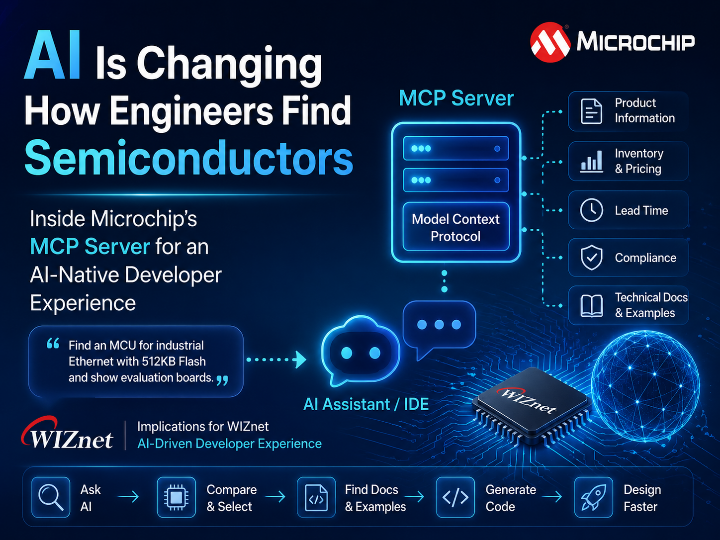
Microchip은 MCP Server로 반도체 제품 탐색과 개발 경험을 어떻게 AI 중심으로 바꾸고 있는가?
How Is Microchip Using MCP Servers to Build an AI-Native Semiconductor Developer Experience?
🇰🇷 한국어
📌 Overview
개발자가 새로운 MCU나 반도체를 찾을 때는 보통 제품 검색 페이지에서 조건을 입력하고, 여러 제품의 데이터시트를 비교한 뒤, 재고와 가격을 다시 확인합니다.
하지만 생성형 AI와 AI Coding Assistant가 개발 환경에 들어오면서 이 과정이 달라지고 있습니다.
이제 개발자는 다음과 같이 질문할 수 있습니다.
“산업용 Ethernet 애플리케이션에 적합한 MCU를 추천해 줘.”
또는,
“이 디바이스를 사용할 수 있는 Evaluation Board와 예제 코드를 찾아 줘.”
문제는 AI가 이런 질문에 답하려면 정확하고 최신인 반도체 제조사의 제품 데이터와 기술 문서에 접근할 수 있어야 한다는 점입니다.
Microchip Technology는 이를 위해 Model Context Protocol(MCP) Server를 제공하고 있습니다.
Microchip의 MCP Server는 AI assistant, chatbot, LLM 기반 IDE 및 enterprise AI agent가 Microchip의 공식 제품 및 기술 정보에 직접 접근할 수 있도록 구성된 인터페이스입니다. Microchip은 현재 제품·공급망 정보를 제공하는 Microchip MCP Server와 기술문서·코드·교육자료를 검색하는 MPLAB-DOCS MCP Server를 함께 제공하고 있습니다.
핵심: Microchip은 AI가 웹사이트를 검색해 제품 정보를 추측하도록 하는 것이 아니라, AI가 공식 제품 데이터와 개발 리소스에 접근할 수 있는 경로를 제공하고 있습니다.
MCP란 무엇인가?
MCP(Model Context Protocol)는 AI application과 외부 데이터 및 도구를 연결하기 위한 open protocol입니다.
기본적인 구조는 다음과 같이 볼 수 있습니다.
Developer
   ↓
AI Assistant / AI IDE
   ↓
MCP Client
   ↓
MCP Server
   ↓
Product Data / Documentation / Tools
AI model 자체가 모든 제품 정보를 기억하고 있을 필요는 없습니다.
필요한 순간 MCP Server에 요청해 외부 시스템에서 관련 데이터를 가져오고, 그 정보를 기반으로 사용자에게 답할 수 있습니다.
MCP 공식 사양은 server가 AI application에 Resources, Prompts, Tools를 제공할 수 있도록 정의하고 있으며, 이를 통해 AI application이 외부 정보나 기능을 표준화된 방식으로 사용할 수 있도록 합니다. 최신 정식 MCP 사양은 2026년 7월 28일 공개되었습니다.
Microchip은 MCP를 어떻게 활용하고 있는가?
Microchip의 접근에서 흥미로운 점은 MCP Server 하나에 모든 것을 넣지 않았다는 것입니다.
현재 역할이 다른 두 MCP Server를 운영하고 있습니다.
1. Microchip MCP Server — “어떤 제품을 선택해야 하는가?”
첫 번째 Server는 제품과 공급망 데이터를 담당합니다.
Microchip 공식 설명에 따르면 AI client가 접근할 수 있는 정보에는 다음과 같은 데이터가 포함됩니다.
Part number 및 제품 설명
Product specifications
Package 및 physical information
Datasheets 및 user guides
Stock quantity
Lead time
Order multiple 및 packaging
RoHS 등 compliance 정보
ECCN 및 HTSUS
Country of origin
특히 재고나 lead time처럼 계속 변하는 데이터에 접근할 수 있다는 점이 중요합니다.
일반적인 LLM은 학습 시점의 정보에 의존할 가능성이 있지만, MCP를 이용하면 AI application이 Microchip 시스템에서 제공하는 현재 데이터를 기반으로 답변할 수 있습니다. Microchip은 이 Server를 인증 없이 무료로 사용할 수 있는 remote MCP Server로 공개하고 있습니다.
예를 들어 개발 경험은 다음과 같이 바뀔 수 있습니다.
기존

Google 검색
   ↓
Microchip Product Page
   ↓
제품 비교
   ↓
Datasheet
   ↓
Distributor / 재고 확인
MCP 기반

Developer
   ↓
"이 조건에 맞는 MCU를 찾아줘"
   ↓
AI Assistant
   ↓
Microchip MCP Server
   ↓
공식 Product / Stock / Lead-time Data
   ↓
비교 및 추천
제품 검색이라는 행동 자체가 Search UI에서 AI conversation으로 이동할 수 있는 구조입니다.
2. MPLAB-DOCS MCP Server — “그 제품으로 어떻게 개발하는가?”
제품을 선택했다고 개발이 끝나는 것은 아닙니다.
개발자는 다시 데이터시트, application note, example project, reference design, training 자료 등을 찾아야 합니다.
Microchip은 이를 위해 별도의 MPLAB-DOCS MCP Server를 제공합니다.
이 Server는 Microchip의 technical documentation corpus를 vector search 방식으로 검색해 질문과 관련성이 높은 내용을 AI에 제공합니다.
검색 대상에는 다음과 같은 리소스가 포함됩니다.
Technical documentation
Code examples
API 및 peripheral examples
Videos
Training content
Reference designs
즉 두 MCP Server의 역할을 간단히 구분하면 다음과 같습니다.
| MCP Server | 주요 질문 |
|---|---|
| Microchip MCP Server | 어떤 제품을 사용해야 하는가? |
| MPLAB-DOCS MCP Server | 그 제품으로 어떻게 개발해야 하는가? |
Microchip도 공식 페이지에서 많은 사용자가 두 Server를 함께 연결한다고 설명합니다.
하나는 Which device?
다른 하나는 How to design with it?
이라는 문제를 해결하는 구조입니다.
MPLAB 개발환경까지 이어지는 AI Workflow
이 구조는 단순히 Microchip 웹사이트에 AI 검색 기능을 추가한 것보다 범위가 넓습니다.
Microchip은 MPLAB AI Coding Assistant에도 MCP 기반 기능을 연결하고 있습니다.
공식 개발자 문서에 따르면 MPLAB AI Coding Assistant의 Agent 기능은 filesystem 및 MCP tool을 이용할 수 있으며, MCP를 통해 특정 device의 데이터시트, evaluation board user guide, compiler guide, example project와 관련 video 등을 검색할 수 있습니다.
예를 들어 Microchip이 안내하는 사용 방식에는 다음과 같은 질문이 포함됩니다.
List example projects for ATtiny817 using touch

List eval boards supported by ATtiny817

From the ATtiny817 data sheet,
show ADC block diagram
이것은 중요한 변화입니다.
기존에는 개발자가 IDE에서 코드를 작성하다가 브라우저를 열고 문서를 검색했다면,
MCP 기반 환경에서는:
Code
  ↕
AI Coding Assistant
  ↕
Official Documentation
  ↕
Example Projects / Evaluation Boards
처럼 제품 정보와 개발 리소스가 개발 workflow 내부로 들어올 수 있기 때문입니다.
왜 반도체 회사에게 중요한가?
1. AI의 답변 정확도 문제를 제조사가 직접 줄일 수 있다
생성형 AI는 반도체 개발자에게 매우 편리하지만 한 가지 문제가 있습니다.
제품 specification이나 API가 변경됐는데 AI가 오래된 정보를 사용하거나, 비슷한 제품의 정보를 섞어 답할 수 있습니다.
Microchip의 MCP 접근 방식은 AI에게 제조사의 공식 데이터로 연결되는 경로를 제공함으로써 이런 문제를 줄이는 방향입니다.
Microchip 역시 MCP Server의 주요 목적 중 하나로 verified하고 up-to-date한 product data 제공을 강조하고 있습니다.
2. 반도체의 Customer Journey가 바뀔 수 있다
기존 반도체 Customer Journey는 검색 엔진과 웹사이트 중심이었습니다.
Search
 → Website
 → Product Page
 → Datasheet
 → Evaluation Board
 → Example Code
 → Design
AI Agent 중심의 환경에서는 다음과 같은 흐름도 가능해집니다.
Ask
 → Compare
 → Select
 → Find Example
 → Generate Code
 → Design
여기서 AI 뒤에 연결되는 공식 데이터와 개발 리소스 infrastructure가 중요해집니다.
Microchip MCP는 이 새로운 접근 방식의 실제 사례 중 하나입니다.
검색의 대상이 사람에서 AI Agent까지 확장된다
웹사이트와 기술문서는 지금까지 기본적으로 사람이 읽도록 만들어졌습니다.
Product Page → Human
Datasheet    → Human
GitHub       → Human
Tutorial     → Human
하지만 AI Agent가 개발 workflow에 들어오면 새로운 사용자가 하나 추가됩니다.
Product Data ──→ Human
             └─→ AI Agent

Documentation ─→ Human
              └→ AI Agent
따라서 앞으로 semiconductor developer ecosystem에서는 단순히
“우리 콘텐츠가 Google에서 잘 검색되는가?”
뿐 아니라
“AI가 우리 제품과 기술 리소스를 정확하게 이해하고 사용할 수 있는가?”
도 중요한 문제가 될 수 있습니다.
최신 MCP는 Agent Infrastructure 방향으로 진화 중
MCP 자체도 빠르게 변화하고 있습니다.
2026년 7월 28일 발표된 최신 사양에서는 MCP core가 stateless 구조로 전환됐으며, Multi Round-Trip Requests, HTTP header 기반 routing, cacheable list results, authorization 강화 및 extension framework 등이 추가됐습니다.
또한 MCP 공식 프로젝트에 따르면 Tier 1 SDK 사용량도 빠르게 증가해, 2026년 7월 기준 TypeScript와 Python SDK가 각각 누적 10억 다운로드를 넘어섰습니다.
이는 MCP가 단순한 AI chatbot용 연결 방식에서 점차 Agentic Workflow를 위한 infrastructure 방향으로 발전하고 있음을 보여줍니다.
WIZnet에서는 어떤 가능성이 있을까?
Microchip의 사례는 WIZnet 같은 embedded networking 기업에도 흥미로운 질문을 던집니다.
현재 WIZnet 개발자는 필요에 따라 여러 리소스를 탐색합니다.
wiznet.io
   ↓
Product Page
   ↓
Datasheet / Documentation
   ↓
GitHub
   ↓
Maker Project
   ↓
Example / Tutorial
하지만 이 리소스들이 AI와 구조적으로 연결된다면 개발자는 다음과 같은 질문을 할 수 있습니다.
“RP2350으로 Ethernet 제품을 개발하려고 하는데 사용할 수 있는 WIZnet 솔루션을 비교해 줘.”
“W5500과 W6100의 차이를 내 프로젝트 기준으로 설명해 줘.”
“W55RP20-EVB-Pico에서 MQTT를 구현한 예제를 찾아 줘.”
“W5500을 Home Assistant와 연결한 실제 Maker 프로젝트를 보여 줘.”
AI가 공식 WIZnet 데이터와 개발자 리소스를 참조할 수 있다면 다음과 같은 정보가 하나의 AI workflow 안에서 연결될 가능성이 있습니다.
Product Specifications
        +
Datasheets / Docs
        +
GitHub Examples
        +
Maker Projects
        +
Evaluation Boards
        +
FAQ / Technical Support
특히 Maker 사이트의 역할도 달라질 수 있습니다.
Maker 프로젝트는 단순한 프로젝트 게시물이 아니라,
Chip
 +
MCU
 +
Application
 +
Protocol
 +
Source Code
 +
Real-world Implementation
정보를 포함한 실제 개발 사례 데이터베이스이기 때문입니다.
향후 AI가 이러한 정보를 구조적으로 활용할 수 있다면, Maker 사이트는 사람이 프로젝트를 검색하는 커뮤니티를 넘어 AI가 WIZnet application 사례를 발견하고 추천하는 knowledge source로 확장될 가능성도 있습니다.
SEO에서 AEO, 그리고 Agent-ready Content로
기존 Digital Marketing에서 중요한 질문은 다음과 같았습니다.
SEO
“검색 엔진이 우리 페이지를 잘 찾을 수 있는가?”
Generative AI 이후에는 새로운 질문이 추가되고 있습니다.
AEO (Answer Engine Optimization)
“AI가 우리 콘텐츠를 이해하고 답변에 활용할 수 있는가?”
그리고 MCP와 AI Agent가 발전하면 한 단계 더 나아갈 수 있습니다.
Agent-ready Infrastructure
“AI Agent가 우리 데이터와 도구에 직접 접근해서 개발자의 작업을 도울 수 있는가?”
Microchip MCP Server 사례의 가장 흥미로운 부분은 바로 이 변화입니다.
단순히 웹사이트에 AI chatbot 하나를 추가한 것이 아니라, 반도체 제조사의 제품 데이터와 개발자 리소스를 AI ecosystem 안에서 사용할 수 있는 형태로 연결하고 있기 때문입니다.
❓ FAQ
Q. Microchip MCP Server는 AI chatbot인가?
아닙니다.
MCP Server 자체가 chatbot 역할을 하는 것이 아니라 AI application이 Microchip의 제품 및 기술 정보에 접근할 수 있도록 하는 interface 역할을 합니다. ChatGPT, Claude, AI IDE 또는 다른 MCP-enabled client가 이 Server를 사용할 수 있습니다.
Q. Microchip은 하나의 MCP Server만 운영하는가?
아닙니다.
현재 제품 specification, 재고 및 compliance 정보를 담당하는 Microchip MCP Server와 기술문서, code example, training 및 reference design 검색을 담당하는 MPLAB-DOCS MCP Server를 제공하고 있습니다.
Q. MCP가 기존 웹사이트나 데이터시트를 대체하는가?
현재 구조에서는 대체라기보다 새로운 접근 경로에 가깝습니다.
기존 Product Page와 Datasheet는 계속 존재하지만, MCP를 통해 AI application이 동일한 ecosystem의 정보를 새로운 방식으로 활용할 수 있습니다.
Q. 이 사례가 WIZnet과 직접 관련된 프로젝트인가?
Microchip의 사례이므로 WIZnet chip을 사용한 프로젝트는 아닙니다.
하지만 semiconductor company가 제품 데이터와 개발자 리소스를 AI Agent에 연결하는 방법을 실제로 보여준다는 점에서, WIZnet의 Product, Docs, GitHub 및 Maker ecosystem을 AI 시대에 어떻게 연결할 수 있을지 살펴볼 수 있는 참고 사례입니다.
🇺🇸 English
📌 Overview
When engineers evaluate a new MCU or semiconductor device, the traditional workflow usually involves searching a product database, comparing specifications and datasheets, and then checking price, stock and availability separately.
Generative AI and AI coding assistants are beginning to change that workflow.
An engineer can now ask questions such as:
“Recommend an MCU suitable for an industrial Ethernet application.”
or:
“Find evaluation boards and example projects supported by this device.”
For an AI system to answer these questions reliably, however, it needs access to accurate and current product data and technical documentation from the semiconductor manufacturer.
Microchip Technology is addressing this requirement with its Model Context Protocol (MCP) Servers.
Microchip currently provides two complementary MCP services: the Microchip MCP Server for structured product and supply-chain data and the MPLAB-DOCS MCP Server for technical documentation, examples, training content and reference designs.
Direct answer: Microchip is not simply asking AI to search its website. It is providing AI applications with a structured path to access official product and development information.
What Is MCP?
Model Context Protocol, or MCP, is an open protocol designed to connect AI applications with external data sources and tools.
A simplified architecture looks like this:
Developer
   ↓
AI Assistant / AI IDE
   ↓
MCP Client
   ↓
MCP Server
   ↓
Product Data / Documentation / Tools
The AI model does not need to permanently contain every piece of product information.
When information is needed, the client can request it from an MCP Server and use the returned context to answer the user.
The official MCP specification defines server capabilities including Resources, Prompts and Tools, providing a standardized mechanism for AI applications to use external context and functionality. The latest stable MCP specification was released on July 28, 2026.
How Is Microchip Using MCP?
One of the most interesting aspects of Microchip's implementation is that it does not place every type of information into a single server.
Instead, it currently provides two MCP Servers with different roles.
1. Microchip MCP Server — “Which device should I use?”
The first server focuses on product and supply-chain information.
According to Microchip, the available data includes:
Part numbers and descriptions
Product specifications
Package and physical information
Datasheets and user guides
Stock quantities
Lead times
Order multiples and packaging
RoHS and other compliance information
ECCN and HTSUS
Country of origin
Access to information such as inventory and lead times is particularly useful because these values can change frequently.
Rather than relying only on information previously learned by an LLM, an MCP-enabled application can retrieve current data made available by Microchip. The remote MCP Server is publicly accessible at no cost and does not currently require authentication.
The traditional process may look like:
Google Search
   ↓
Microchip Product Page
   ↓
Product Comparison
   ↓
Datasheet
   ↓
Distributor / Inventory Check
An MCP-enabled workflow could instead look like:
Developer
   ↓
"Find a device that meets these requirements"
   ↓
AI Assistant
   ↓
Microchip MCP Server
   ↓
Official Product / Stock / Lead-Time Data
   ↓
Comparison and Recommendation
In other words, part of product discovery can move from a search interface to an AI conversation.
2. MPLAB-DOCS MCP Server — “How do I design with it?”
Selecting the semiconductor is only the beginning.
Developers still need to locate datasheets, application information, code examples, reference designs and training resources.
Microchip addresses this with a separate MPLAB-DOCS MCP Server.
The server provides semantic access to Microchip's technical documentation corpus using vector search to retrieve material relevant to the user's question.
Its content includes:
Technical documentation
Code examples
API and peripheral examples
Videos
Training material
Reference designs
The two servers can therefore be summarized as follows:
| MCP Server | Main Question |
|---|---|
| Microchip MCP Server | Which device should I use? |
| MPLAB-DOCS MCP Server | How do I design with it? |
Microchip itself explains that many users connect to both servers: one grounds the AI in device selection and availability, while the other focuses on designing and writing code for the device.
Extending the AI Workflow into MPLAB
This approach goes beyond adding an AI search box to a semiconductor website.
Microchip also integrates MCP-related capabilities into its MPLAB AI Coding Assistant.
According to Microchip's developer documentation, Agent mode can use filesystem and MCP tools to access resources such as device datasheets, evaluation-board user guides, compiler documentation, example projects and related videos.
Example prompts documented by Microchip include:
List example projects for ATtiny817 using touch

List eval boards supported by ATtiny817

From the ATtiny817 data sheet,
show ADC block diagram
This represents an important workflow change.
Previously, an engineer might leave the IDE, open a browser and search several documentation pages.
With MCP-enabled development tools, the flow can become:
Code
  ↕
AI Coding Assistant
  ↕
Official Documentation
  ↕
Example Projects / Evaluation Boards
The manufacturer's technical resources can effectively move inside the developer's working environment.
Why Does This Matter for Semiconductor Companies?
1. Manufacturers can reduce uncertainty in AI-generated answers
Generative AI is useful for embedded developers, but it introduces a reliability problem.
A specification may have changed, or an AI model may combine information from similar devices incorrectly.
Microchip's MCP approach provides a path for AI applications to retrieve verified and up-to-date information from the manufacturer rather than relying entirely on previously learned information or general web search results.
2. The Semiconductor Customer Journey Can Change
The traditional semiconductor journey is strongly based on search engines and websites.
Search
 → Website
 → Product Page
 → Datasheet
 → Evaluation Board
 → Example Code
 → Design
An AI-agent workflow can potentially look different:
Ask
 → Compare
 → Select
 → Find Example
 → Generate Code
 → Design
In this model, the official data and development-resource infrastructure behind the AI becomes increasingly important.
Microchip's MCP implementation is a concrete example of this transition.
The Audience Is Expanding from Humans to AI Agents
Semiconductor websites and documentation have traditionally been created primarily for human readers.
Product Page → Human
Datasheet    → Human
GitHub       → Human
Tutorial     → Human
As AI agents enter engineering workflows, another consumer appears:
Product Data ──→ Human
             └─→ AI Agent

Documentation ─→ Human
              └→ AI Agent
This introduces a new question for semiconductor developer ecosystems.
It is no longer only:
“Can engineers find our content through search?”
It may increasingly become:
“Can AI correctly understand and use our products and technical resources?”
MCP Is Evolving Toward Agent Infrastructure
MCP itself is also evolving quickly.
The July 28, 2026 specification introduced a stateless protocol core together with Multi Round-Trip Requests, HTTP header-based routing, cacheable list results, authorization hardening and a formal extension framework.
The MCP project also reported that, by the July 2026 release, both its TypeScript and Python Tier 1 SDKs had crossed one billion cumulative downloads.
This indicates that MCP is expanding beyond a simple connection mechanism for AI chatbots toward broader infrastructure for agentic workflows.
What Could This Mean for the WIZnet Ecosystem?
Microchip's approach raises an interesting question for embedded-networking companies such as WIZnet.
Today, a WIZnet developer may navigate several different resources:
wiznet.io
   ↓
Product Page
   ↓
Datasheet / Documentation
   ↓
GitHub
   ↓
Maker Project
   ↓
Example / Tutorial
If these resources were structurally accessible to AI tools, a developer could potentially ask:
“Compare WIZnet solutions I can use for an RP2350-based Ethernet product.”
“Explain the difference between W5500 and W6100 for my application.”
“Find an MQTT example for W55RP20-EVB-Pico.”
“Show me real Maker projects connecting W5500 with Home Assistant.”
An AI workflow grounded in official WIZnet resources could potentially connect:
Product Specifications
        +
Datasheets / Docs
        +
GitHub Examples
        +
Maker Projects
        +
Evaluation Boards
        +
FAQ / Technical Support
The Maker site could also take on a broader role.
A Maker project is not simply an article. It can contain structured knowledge about:
Chip
 +
MCU
 +
Application
 +
Protocol
 +
Source Code
 +
Real-world Implementation
If AI systems could use that information in a structured way, the Maker site could evolve from a community where humans discover projects into a knowledge source from which AI can discover and recommend real WIZnet application examples.
From SEO to AEO—and Agent-Ready Content
The traditional digital-marketing question has been:
SEO
“Can a search engine find our page?”
Generative AI has added another question:
AEO — Answer Engine Optimization
“Can AI understand our content and use it when generating an answer?”
The development of MCP and AI agents introduces another possible stage:
Agent-Ready Infrastructure
“Can an AI agent directly access our data and tools to help an engineer complete a task?”
This is the most interesting aspect of Microchip's MCP strategy.
It is not simply adding an AI chatbot to a website.
Microchip is creating a structured connection between semiconductor product data, technical resources and the emerging AI-agent ecosystem.
❓ FAQ
Is the Microchip MCP Server an AI chatbot?
No.
The MCP Server is an interface that allows compatible AI applications to access Microchip product and technical information. ChatGPT, Claude, AI IDEs or other MCP-enabled clients can act as the user-facing application.
Does Microchip operate only one MCP Server?
No.
It currently provides the Microchip MCP Server for product, inventory and compliance information and the MPLAB-DOCS MCP Server for technical documentation, code examples, training materials and reference designs.
Does MCP replace semiconductor websites and datasheets?
Not necessarily.
In the current architecture, MCP is better understood as an additional access path. Product pages and datasheets still exist, while AI applications gain another structured method of using information from the same ecosystem.
Is this a WIZnet-based project?
No. This is a Microchip case study rather than a project using a WIZnet chip.
Its relevance lies in showing how a semiconductor manufacturer can expose product data and developer resources to AI agents—providing a useful reference when considering how WIZnet's Product, Docs, GitHub and Maker ecosystems could evolve for AI-native development.