


From Ethernet Chip to Power Infrastructure Safety: W5500 in PD Monitoring Systems
A real-world use of W5500 in power grid safety, enabling real-time monitoring and predictive maintenance of electrical equipment.
WIZnet - W5500
x 1

W5500 기반 전력 설비 예지보전 시스템: 배전반 부분방전(PD) 실시간 모니터링
🧩 Overview
이 프로젝트는 WIZnet의 W5500 Ethernet 칩이 실제 산업 환경, 특히 전력 인프라 안전 시스템에 어떻게 활용될 수 있는지를 보여주는 사례입니다.
본 사례는 중국 국가 전력망 계열 조직에서 공개한 기술을 바탕으로, 배전반 내부에서 발생하는 부분방전(Partial Discharge, PD) 신호를 감지하고 이를 Ethernet을 통해 실시간으로 전송하여 고장 예측과 원격 모니터링이 가능하도록 구성된 시스템입니다.
이 시스템의 핵심은 단순한 센서 데이터 수집이 아니라, 전력 설비의 이상 징후를 조기에 감지하고 설비 고장을 예방할 수 있는 예지보전 구조에 있습니다.
W5500은 여기서 단순한 네트워크 칩이 아니라, 현장 데이터와 상위 시스템을 연결하는 안정적인 통신 인터페이스 역할을 수행합니다.
🚨 Why This Project Matters
고압 전력 설비에서는 절연 성능이 저하되면 부분방전이 발생할 수 있습니다. 이러한 부분방전은 시간이 지날수록 설비 열화, 절연 파괴, 예기치 않은 정전, 장비 손상 같은 문제로 이어질 수 있습니다.
기존 유지보수 방식은 보통 다음과 같은 한계가 있습니다.
- 주기 점검 중심
- 실시간 상태 파악 어려움
- 고장 이후 대응
따라서 설비가 실제로 고장에 도달하기 전에 부분방전 신호를 감지하고 분석하여 미리 대응하는 기술이 매우 중요합니다.
이 프로젝트는 바로 그 지점을 잘 보여줍니다.
초음파 기반 감지 → 신호 처리 → 데이터 분석 → Ethernet 전송 → 원격 모니터링이 하나의 흐름으로 연결되며, W5500은 이 전체 시스템에서 안정적인 유선 통신을 담당하는 핵심 요소로 동작합니다.
⚙️ System Architecture
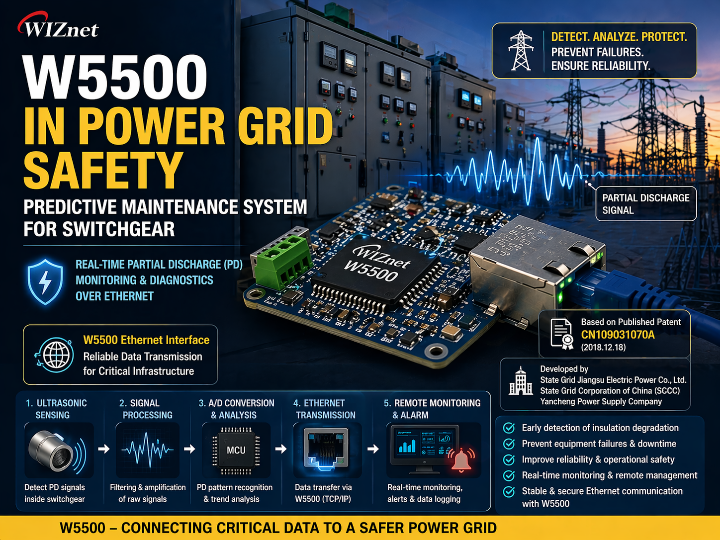
시스템은 부분방전 신호를 수집하고, 처리한 뒤, Ethernet을 통해 상위 시스템으로 전송하는 구조로 이루어져 있습니다.
초음파 센서
   ↓
신호 처리 및 증폭
   ↓
A/D 변환 및 패턴 분석
   ↓
MCU
   ↓
W5500 Ethernet
   ↓
상위 시스템 / 원격 모니터링 서버
이 구조를 통해 현장에서 발생하는 이상 신호를 실시간으로 수집하고, 분석 결과를 원격 서버로 전달하여 설비 상태를 지속적으로 확인할 수 있습니다.
🔑 Key Components
1️⃣ 초음파 센서
배전반 내부에서 발생하는 부분방전 신호를 감지합니다.
2️⃣ 신호 처리 블록
잡음을 줄이고 필요한 신호를 증폭하여 분석 가능한 형태로 만듭니다.
3️⃣ MCU
수집된 데이터를 바탕으로 이상 패턴을 판단하고 상태 정보를 정리합니다.
4️⃣ WIZnet W5500
이 시스템의 핵심 통신 모듈로 다음 역할을 수행합니다.
- Ethernet 기반 데이터 전송
- TCP/IP 하드웨어 오프로딩
- 안정적인 실시간 데이터 전달
즉, 단순한 네트워크 인터페이스가 아니라 산업용 데이터 전송의 핵심 인프라 역할을 합니다.
🎯 Role of WIZnet W5500
이 프로젝트에서 W5500은 단순히 네트워크 연결용 부품으로 쓰이지 않습니다.
산업 현장에서 수집된 중요한 진단 데이터를 상위 시스템으로 안정적이고 지속적으로 전달하는 핵심 인터페이스로 작동합니다.
특히 전력 설비와 같은 환경에서는 통신 안정성이 매우 중요합니다.
W5500은 하드웨어 TCP/IP 기반 Ethernet 통신을 제공하므로, 시스템이 보다 신뢰성 있게 설계될 수 있습니다.
이 점에서 W5500은 IoT용 Ethernet 칩을 넘어 산업용 모니터링 시스템의 기반 부품으로 해석할 수 있습니다.
💡 Why It Is Interesting
일반적으로 W5500은 다음과 같은 용도로 많이 사용됩니다.
- 센서 노드
- 웹서버
- 간단한 IoT 장비
- Ethernet 연결 확장
하지만 이 사례는 그보다 훨씬 더 흥미롭습니다.
이 프로젝트는 W5500이 전력 인프라 안전 시스템에서도 활용될 수 있음을 보여줍니다.
즉, 이 시스템은 단순한 데이터 수집 장치가 아니라,
- 설비 이상을 예측하고
- 고장을 줄이며
- 운영 안정성을 높이기 위한 산업용 시스템
이라는 점에서 차별성이 있습니다.
W5500이 연결한 것은 단순한 Ethernet 라인이 아니라, 현장의 진단 데이터와 원격 유지보수 체계입니다.
🔍 Applications
이러한 구조는 다음과 같은 분야에 적용할 수 있습니다.
- 배전반
- 변전소
- 고압 장비
- 산업 플랜트
- 스마트 그리드
- 원격 자산 관리 시스템
전력 설비뿐 아니라, 지속적인 상태 감시와 예방 정비가 필요한 환경이라면 확장 가능성이 높습니다.
🏢 Organization Behind the Technology
이 기술은 중국의 State Grid 계열 조직에서 공개한 사례로, 단순한 취미 프로젝트가 아니라 실제 전력 인프라 운영 환경을 염두에 둔 산업용 기술이라는 점에서 의미가 있습니다.
전력 공급과 설비 안전을 담당하는 조직에서 이런 구조를 검토했다는 점은, W5500이 실제 산업 현장의 요구에도 충분히 활용될 수 있음을 보여줍니다.
✅ Conclusion
이 프로젝트는 W5500이 단순한 IoT 네트워크 칩을 넘어, 전력 설비의 안전과 신뢰성을 높이기 위한 예지보전 시스템에도 활용될 수 있음을 보여주는 좋은 사례입니다.
부분방전 감지, 신호 분석, Ethernet 기반 원격 전송이 결합된 이 구조는, 산업 현장에서 WIZnet 기술이 어떻게 확장될 수 있는지를 잘 보여줍니다.
✨ One-Line Summary
W5500은 전력 설비의 부분방전 신호를 실시간으로 전달하여, 예지보전과 원격 모니터링을 가능하게 하는 핵심 통신 인터페이스로 활용될 수 있습니다.
❓ FAQ
Q1. 부분방전(Partial Discharge)이란 무엇인가요?
A. 부분방전은 고압 전기 설비의 절연체 내부 또는 표면에서 국부적으로 발생하는 미세한 방전 현상입니다. 초기에는 작은 신호일 수 있지만, 장기간 누적되면 절연 열화와 설비 고장으로 이어질 수 있어 조기 감지가 중요합니다.
Q2. 이 프로젝트에서 W5500은 어떤 역할을 하나요?
A. W5500은 현장에서 수집된 진단 데이터를 Ethernet으로 상위 시스템에 안정적으로 전달하는 통신 인터페이스 역할을 합니다. 이 프로젝트에서는 단순 연결 부품이 아니라 원격 모니터링 구조를 가능하게 하는 핵심 네트워크 엔진으로 볼 수 있습니다.
Q3. 왜 Ethernet이 중요한가요?
A. 전력 설비나 산업 현장에서는 통신의 안정성과 신뢰성이 매우 중요합니다. Ethernet은 비교적 안정적인 유선 통신 환경을 제공하므로, 설비 상태 데이터를 실시간으로 지속적으로 전달하는 데 적합합니다.
Q4. 이 사례가 일반적인 IoT 프로젝트와 다른 점은 무엇인가요?
A. 일반적인 IoT 프로젝트가 센서 데이터 표시나 간단한 제어에 초점을 맞춘다면, 이 사례는 설비 고장을 예방하기 위한 예지보전 목적의 산업용 시스템이라는 점에서 차이가 있습니다.
Q5. 어떤 분야로 확장할 수 있나요?
A. 배전반, 변전소뿐 아니라 산업 설비 상태 감시, 스마트 그리드, 원격 자산 관리, 고압 장비 유지보수 분야로 확장할 수 있습니다.
🇺🇸 English Version
📌 Project Title
W5500-Based Predictive Maintenance System for Power Equipment: Real-Time Partial Discharge Monitoring
🧩 Overview
This project shows how the WIZnet W5500 Ethernet chip can be applied in a real industrial environment, especially in power infrastructure safety systems.
Based on a published technology case from an organization under the State Grid system in China, this system detects partial discharge (PD) signals inside switchgear and transmits the data over Ethernet for real-time diagnostics and predictive maintenance.
The key point of this project is not simple sensor networking. It is a predictive maintenance architecture designed to detect early warning signs in electrical equipment and help prevent failures before they happen. In this system, the W5500 is not just a networking component. It works as a reliable communication interface between field data and upper-level monitoring systems.
🚨 Why This Project Matters
In high-voltage electrical equipment, insulation degradation can lead to partial discharge. Over time, these discharge events may develop into:
- insulation failure
- unexpected shutdowns
- equipment damage
- higher maintenance costs
Traditional maintenance methods are often based on:
- periodic inspection
- reactive response
- limited real-time visibility
That is why it is highly valuable to detect PD signals early, analyze their patterns, and respond before a failure occurs.
This project demonstrates exactly that kind of approach.
Ultrasonic sensing → signal processing → data analysis → Ethernet transmission → remote monitoring are connected in one continuous flow, and the W5500 serves as the key wired communication element in that process.
⚙️ System Architecture
The system is designed to collect PD signals, process them, and transmit the results to an upper-level monitoring platform through Ethernet.
Ultrasonic Sensor
      ↓
Signal Processing and Amplification
      ↓
A/D Conversion and Pattern Analysis
      ↓
MCU
      ↓
W5500 Ethernet
      ↓
Upper-Level System / Remote Monitoring Server
This structure makes it possible to collect abnormal signals in real time, analyze them, and continuously monitor equipment status from a remote location.
🔑 Key Components
1️⃣ Ultrasonic Sensor
Detects partial discharge signals generated inside switchgear.
2️⃣ Signal Processing Block
Filters noise and amplifies the signal so it can be analyzed properly.
3️⃣ MCU
Evaluates abnormal patterns and organizes the collected data.
4️⃣ WIZnet W5500
The key communication module in this system, responsible for:
- Ethernet communication
- hardware TCP/IP offloading
- stable real-time data delivery
In other words, it is not just a networking add-on.
It functions as a core infrastructure component for industrial data transmission.
🎯 Role of the WIZnet W5500
In this project, the W5500 is not used as a simple network interface.
It works as the core communication link that transfers important diagnostic data from the field device to a remote monitoring platform.
In power equipment and industrial environments, communication reliability is critical. Because the W5500 provides hardware-based TCP/IP Ethernet communication, it helps make the overall system more stable and dependable.
That is why the W5500 can be understood not only as an IoT Ethernet chip, but also as a practical building block for industrial monitoring systems.
💡 Why It Is Interesting
The W5500 is commonly associated with:
- sensor nodes
- web servers
- simple Ethernet-enabled IoT devices
- network expansion boards
This case is interesting because it shows that the same chip can also be used in power infrastructure safety systems.
In other words, this is not just a data collection device.
It is part of an industrial system intended to:
- predict equipment problems
- reduce failures
- improve operational reliability
What the W5500 connects here is not only an Ethernet line, but a complete path from field diagnostics to remote maintenance.
🔍 Applications
This kind of structure can be applied to:
- switchgear
- substations
- high-voltage equipment
- industrial plants
- smart grid systems
- remote asset monitoring platforms
It is especially meaningful in environments where continuous condition monitoring and preventive maintenance are required.
🏢 Organization Behind the Technology
This case is based on a published technology from an organization within China’s State Grid system, which makes it very different from a hobby or lab-only demonstration.
It reflects an industrial approach intended for actual power infrastructure operation and equipment safety.
The fact that a power utility organization considered this kind of architecture makes the case especially meaningful, because it shows that the W5500 can be relevant even in demanding industrial environments.
✅ Conclusion
This project demonstrates that the W5500 can go beyond typical IoT networking and be used in predictive maintenance systems that improve the safety and reliability of power equipment.
By combining partial discharge detection, signal analysis, and Ethernet-based remote transmission, this system provides a strong example of how WIZnet technology can be extended into industrial monitoring and infrastructure safety.
✨ One-Line Summary
The W5500 can serve as a key communication interface for transmitting partial discharge data in real time, enabling predictive maintenance and remote monitoring of power equipment.
❓ FAQ
Q1. What is partial discharge?
A. Partial discharge is a localized electrical discharge that occurs inside or on the surface of insulation in high-voltage equipment. It may begin as a small event, but over time it can lead to insulation degradation and equipment failure, so early detection is very important.
Q2. What role does the W5500 play in this project?
A. The W5500 acts as the Ethernet communication interface that transfers diagnostic data from the field device to an upper-level monitoring system. In this case, it is more than a connectivity chip. It is a key network engine for remote monitoring.
Q3. Why is Ethernet important in this system?
A. In power and industrial environments, communication stability and reliability are essential. Ethernet provides a dependable wired communication path, which makes it suitable for continuous transmission of equipment status data.
Q4. How is this different from a typical IoT project?
A. A typical IoT project often focuses on displaying sensor data or basic control. This case is different because it is part of a predictive maintenance system aimed at preventing equipment failures in power infrastructure.
Q5. Where could this kind of system be applied?
A. It could be applied to switchgear, substations, industrial equipment monitoring, smart grid systems, remote asset management, and maintenance of high-voltage electrical systems.