


ESP32 HF QRP FT8 Transceiver
This project combines classic RF design with modern digital signal processing to create a compact HF QRP transceiver platform covering the amateur HF bands.

WIZnet - W5500
x 1

ESP32 HF QRP FT8 Transceiver with WIZnet W5500 Ethernet
Overview
ESP32 HF QRP FT8 Transceiver는 ESP32-S3 하나에서 HF 무선 송수신, DSP, FT8 인코딩·디코딩, QSO 관리까지 처리하고 WIZnet W5500을 이용해 Ethernet 연결까지 지원하는 아마추어 무선 프로젝트입니다.
Guido(IW5ALZ)가 개발한 이 프로젝트는 1.8~28MHz HF 대역을 지원하는 compact QRP transceiver로, 전통적인 RF 회로와 최신 embedded DSP 기술을 결합했습니다.
ESP32-S3는 RF 제어뿐 아니라 LSB, USB, CW, AM demodulation, FT8 decoding/encoding, SWR 측정, 사용자 인터페이스와 Web UI까지 담당합니다.
특히 금속 케이스 내부에서 Wi-Fi 신호가 불안정해지는 실제 문제를 해결하기 위해 W5500 Ethernet option이 추가되었다는 점이 주목할 만합니다.
System Architecture
HF Antenna → RF Front End → ESP32-S3 DSP & FT8 → Wi-Fi or W5500 Ethernet → Web UI / FT8 QSO Management
주요 구성은 다음과 같습니다.
- ESP32-S3: RF control, DSP, FT8 processing, Web UI
- WIZnet W5500: Optional wired Ethernet connectivity
- Tayloe QSD: Quadrature RF detection
- PCM1808: Audio ADC
- SI5351: Frequency generation
- MCP23017: Filter and relay control
- LPF Bank: Harmonic suppression
- RF Power Amplifier: HF transmission
- Web Interface: FT8 QSO management
What Is the ESP32 HF QRP FT8 Transceiver?
이 프로젝트는 1.8~28MHz HF amateur radio band에서 동작하는 ESP32-S3 기반 디지털 QRP transceiver입니다.
ESP32-S3 내부에서 다음 기능을 처리합니다.
- LSB / USB / CW / AM demodulation
- IQ signal processing
- DC removal
- Phase and amplitude correction
- CIC decimation
- Hilbert transform
- FT8 encoding
- FT8 decoding
- FT8 QSO management
- SWR and RF power monitoring
- Display and user-interface control
즉 ESP32를 단순 제어 MCU로 사용하는 것이 아니라 SDR/DSP와 디지털 무선 프로토콜 처리까지 하나의 MCU에서 수행한다는 점이 특징입니다.
Why Is WIZnet W5500 Used?
이 프로젝트에서 W5500이 추가된 이유는 실제 RF 장비 환경에서 발생한 Wi-Fi 안정성 문제 때문입니다.
완성된 transceiver는 RF 간섭을 줄이기 위해 1.5mm 알루미늄 케이스에 장착되었습니다.
하지만 금속 케이스를 닫으면 Wi-Fi 신호가 크게 약해지고 연결이 불안정해지는 문제가 발생했습니다.
개발자는 이를 해결하기 위해 두 가지 방법을 검토했습니다.
- External Wi-Fi antenna
- Wired Ethernet
그리고 최종 프로젝트에 W5500 Ethernet module option을 추가했습니다.
따라서 W5500은 단순히 Ethernet 기능을 추가하기 위한 부품이 아니라, RF shielding이 필요한 실제 장비에서 안정적인 네트워크 연결을 제공하기 위한 대안으로 도입되었습니다.
Wi-Fi or W5500 Ethernet
프로젝트는 Wi-Fi와 W5500 Ethernet을 모두 지원하지만 동시에 사용하는 구조는 아닙니다.
소프트웨어를 빌드할 때 사용자가 다음 중 하나를 선택할 수 있습니다.
- Wi-Fi
- W5500 Ethernet
따라서 이 프로젝트는 엄밀한 의미의 Hybrid Network 프로젝트라기보다는 Wireless 또는 Wired Network를 deployment 환경에 따라 선택할 수 있는 dual-connectivity design으로 보는 것이 정확합니다.
특히 RF shielding이 필요한 금속 enclosure 환경에서는 W5500 Ethernet이 안정적인 대안이 됩니다.
Integrated FT8 on ESP32-S3
FT8은 약한 신호 환경에서도 장거리 통신이 가능하도록 설계된 디지털 amateur radio mode입니다.
이 프로젝트의 특징은 FT8 처리 대부분을 별도의 PC가 아니라 ESP32-S3 자체에서 수행한다는 점입니다.
ESP32-S3는 다음을 처리합니다.
RF Reception → DSP → FT8 Decode → QSO Management → FT8 Encode → RF Transmission
Web UI를 통해 수신된 FT8 station을 확인하고 QSO를 관리할 수도 있습니다.
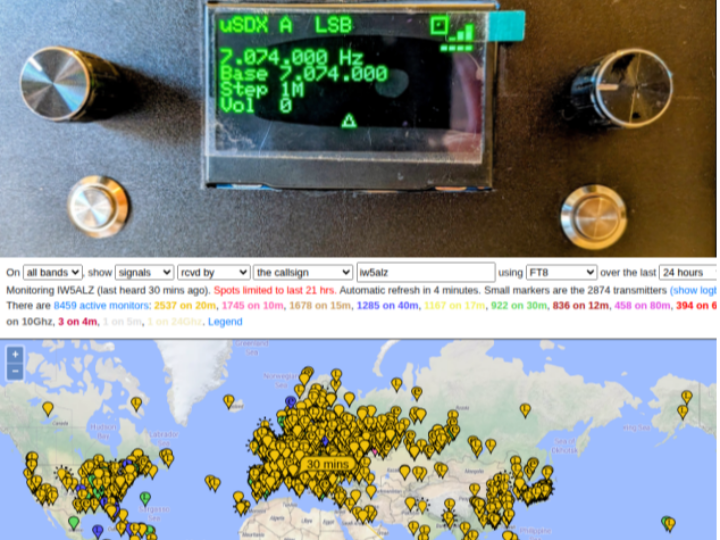
개발자는 실제 FT8 송수신 테스트도 진행했으며, 프로젝트 로그를 통해 수신·송신 및 QSO sequence를 지속적으로 개선하고 있습니다.
RF & DSP Architecture
무선부는 전통적인 RF 설계와 embedded DSP가 결합되어 있습니다.
RX
RF 신호는 Low-Pass Filter와 Tayloe Quadrature Sampling Detector(QSD)를 거쳐 I/Q signal로 변환됩니다.
이후 PCM1808 ADC와 ESP32-S3에서 digital signal processing을 수행합니다.
TX
송신부는 RF Power Amplifier와 switchable LPF bank를 사용하며, SWR과 forward/reflected power도 측정합니다.
DSP
ESP32-S3에서는 다음 DSP 기능을 수행합니다.
- IQ processing
- DC removal
- Phase correction
- Amplitude correction
- CIC decimation
- Hilbert transform
- SSB demodulation
- FT8 encoding / decoding
이는 W5500을 사용하는 일반적인 IoT 프로젝트와 달리 RF + DSP + Ethernet을 결합한 독특한 application입니다.
Web-Based FT8 QSO Management
ESP32-S3는 Web User Interface도 제공합니다.
사용자는 브라우저를 통해 FT8 데이터를 확인하고 QSO를 관리할 수 있습니다.
즉 W5500 Ethernet을 선택하면 다음과 같은 구조가 가능합니다.
HF Radio → ESP32-S3 → W5500 Ethernet → Browser-based FT8 Interface
이 구조는 무선 통신 장비 자체의 RF link와 장비 관리용 IP network를 분리할 수 있다는 점에서도 의미가 있습니다.
Real-World Validation
이 프로젝트는 concept 수준에 머물지 않고 실제 hardware build와 RF test가 진행되었습니다.
개발자는:
- Receiver PCB 제작 및 테스트
- RF amplifier 제작
- Complete enclosure assembly
- FT8 reception
- FT8 transmission
- Actual FT8 QSO sequence
- Web-based QSO management
등을 프로젝트 로그로 지속적으로 공개하고 있습니다.
또한 FT8 decoder 성능 개선 작업도 계속 진행 중인 2026년 ongoing project입니다.
Why It Matters
WIZnet 관점에서 이 프로젝트의 가장 큰 가치는 W5500의 적용 분야가 일반적인 IoT나 산업 자동화를 넘어 Amateur Radio / SDR 영역으로 확장된 사례라는 점입니다.
특히 다음 요소가 주목할 만합니다.
- W5500을 이용한 HF radio의 wired network connectivity
- 금속 RF enclosure에서 Wi-Fi instability를 Ethernet으로 해결
- ESP32-S3 기반 embedded DSP
- Integrated FT8 Encoder / Decoder
- Web-based QSO Management
- 실제 PCB 및 RF 송수신 검증
- Amateur Radio / SDR이라는 새로운 W5500 application
W5500이 프로젝트의 핵심 RF 기능을 담당하는 것은 아니지만, 실제 장비에서 발생한 Wi-Fi 연결 문제를 해결하는 안정적인 wired networking option이라는 명확한 사용 이유가 있습니다.
FAQ
Q1. WIZnet W5500은 이 프로젝트에서 어떤 역할을 하나요?
W5500은 ESP32-S3 기반 HF transceiver에 유선 Ethernet 연결을 제공합니다. 특히 금속 RF enclosure로 인해 Wi-Fi 신호가 약해지는 문제를 해결하기 위한 wired network option으로 추가되었습니다.
Q2. 왜 Wi-Fi 대신 Ethernet이 필요한가요?
RF 간섭을 차단하기 위한 1.5mm 알루미늄 enclosure가 Wi-Fi 신호까지 약화시켰기 때문입니다. W5500 Ethernet은 이런 환경에서 안정적인 네트워크 연결을 제공할 수 있습니다.
Q3. Wi-Fi와 W5500을 동시에 사용하나요?
아니요. 소프트웨어 빌드 시 Wi-Fi 또는 Ethernet 중 하나를 선택합니다. 따라서 엄밀한 의미의 Hybrid Network는 아닙니다.
Q4. W5500의 TOE 기능을 직접 활용하나요?
프로젝트는 W5500 Ethernet module을 사용하지만, 공개된 프로젝트 설명에서는 W5500의 hardware socket 기반 TCP/IP offload를 직접 활용하는지 명확하게 설명하지 않습니다. 따라서 TOE 가산점은 보수적으로 판단하는 것이 적절합니다.
Q5. FT8이란 무엇인가요?
FT8은 weak-signal communication을 위한 amateur radio digital mode입니다. 이 프로젝트는 FT8 encoding, decoding 및 QSO management를 ESP32-S3에 통합합니다.
Q6. ESP32-S3는 어떤 역할을 하나요?
ESP32-S3는 RF control, DSP, FT8 encoding/decoding, SWR measurement, display control, Web UI 등 시스템의 대부분의 digital function을 담당합니다.
Q7. 이 프로젝트는 실제로 동작하나요?
네. 개발자는 실제 PCB와 complete transceiver를 제작했으며 FT8 수신, 송신 및 QSO 테스트 결과를 공개했습니다.
Q8. 상용 제품인가요?
아니요. 개인 개발자가 진행하는 UCC / ongoing open hardware project입니다.
Q9. SPE 확장 가능성이 있나요?
현재 application은 compact amateur radio equipment이므로 SPE와 직접적인 연관성은 낮습니다. 따라서 SPE 가산점은 적용하지 않는 것이 적절합니다.
Author
Guido – IW5ALZ
Guido는 amateur radio callsign IW5ALZ를 사용하는 프로젝트 개발자이며, Hackaday.io에서 이 프로젝트의 hardware, RF, firmware, DSP 및 FT8 기능 개발 과정을 지속적으로 공개하고 있습니다.
Key Features
- WIZnet W5500 Ethernet Option
- ESP32-S3 N16R8
- 1.8–28MHz HF QRP Transceiver
- Integrated FT8 Encoder & Decoder
- FT8 QSO Management
- Web User Interface
- LSB / USB / CW / AM
- Embedded DSP
- SWR & RF Power Monitoring
- Wi-Fi or Ethernet Connectivity
- Custom PCB
- Real RF Transmission & Reception Testing
Overview
The ESP32 HF QRP FT8 Transceiver is a compact 1.8–28MHz amateur radio platform that integrates RF control, DSP, FT8 encoding and decoding, QSO management, and optional WIZnet W5500 Ethernet connectivity on an ESP32-S3-based system.
Developed by Guido (IW5ALZ), the project combines traditional RF circuitry with modern embedded digital signal processing.
The ESP32-S3 handles LSB, USB, CW and AM demodulation, FT8 processing, SWR monitoring, user-interface control, and a browser-based FT8 QSO management interface.
A particularly interesting addition is the W5500 Ethernet option, introduced to solve unstable Wi-Fi connectivity inside the transceiver's RF-shielded aluminum enclosure.
System Architecture
HF Antenna → RF Front End → ESP32-S3 DSP & FT8 → Wi-Fi or W5500 Ethernet → Web UI / FT8 QSO Management
Main components include:
- ESP32-S3: RF control, DSP, FT8 processing and Web UI
- WIZnet W5500: Optional wired Ethernet connectivity
- Tayloe QSD: Quadrature RF detection
- PCM1808: Audio ADC
- SI5351: Frequency generation
- MCP23017: Filter and relay control
- LPF Bank: Harmonic suppression
- RF Power Amplifier: HF transmission
- Web Interface: FT8 QSO management
What Is the ESP32 HF QRP FT8 Transceiver?
The project is an ESP32-S3-based digital QRP transceiver covering the 1.8–28MHz HF amateur radio bands.
The ESP32-S3 handles:
- LSB / USB / CW / AM demodulation
- IQ signal processing
- DC removal
- Phase and amplitude correction
- CIC decimation
- Hilbert transform
- FT8 encoding
- FT8 decoding
- FT8 QSO management
- SWR and RF power monitoring
- Display and user-interface control
Rather than using the ESP32 only as a control MCU, the project performs substantial SDR/DSP and digital radio processing directly on the microcontroller.
Why Is the WIZnet W5500 Used?
The W5500 was introduced to solve a real connectivity problem.
The completed transceiver is installed inside a 1.5mm aluminum enclosure to provide effective EMI and RF shielding.
However, when the enclosure was closed, the Wi-Fi signal became weak and unstable.
The developer considered two solutions:
- An external Wi-Fi antenna
- A wired Ethernet connection
The final project therefore includes a W5500 Ethernet module option.
This makes the W5500 more than an optional networking feature: it provides a practical wired alternative when RF shielding makes wireless connectivity unreliable.
Wi-Fi or W5500 Ethernet
The project supports both Wi-Fi and W5500 Ethernet, but they are not used simultaneously.
The user selects either:
- Wi-Fi, or
- W5500 Ethernet
when building the software.
For this reason, the project should not be classified as a strict Hybrid Network implementation. It is better described as a selectable wired-or-wireless connectivity architecture.
In an RF-shielded enclosure, Ethernet provides a particularly useful alternative to Wi-Fi.
Integrated FT8 on ESP32-S3
FT8 is a digital amateur radio mode designed for reliable communication under weak-signal conditions.
A notable feature of this project is that FT8 processing is integrated directly into the ESP32-S3 rather than relying entirely on an external PC.
The processing flow is:
RF Reception → DSP → FT8 Decode → QSO Management → FT8 Encode → RF Transmission
The browser-based interface can also display received FT8 stations and assist with QSO management.
The developer has demonstrated real FT8 reception, transmission and QSO sequences while continuing to improve decoder performance.
RF & DSP Architecture
The project combines traditional RF design with embedded DSP.
RX
RF signals pass through low-pass filtering and a Tayloe Quadrature Sampling Detector, producing I/Q signals for digital processing.
TX
The transmit path includes an RF power amplifier, selectable low-pass filters, and forward/reflected power measurement for SWR monitoring.
DSP
The ESP32-S3 performs:
- IQ processing
- DC removal
- Phase correction
- Amplitude correction
- CIC decimation
- Hilbert transform
- SSB demodulation
- FT8 encoding and decoding
This makes the project an unusual combination of RF, embedded DSP and Ethernet networking.
Web-Based FT8 QSO Management
The ESP32-S3 also provides a Web User Interface for FT8 operation.
With the W5500 configuration, the architecture can be summarized as:
HF Radio → ESP32-S3 → W5500 Ethernet → Browser-Based FT8 Interface
This allows the radio-frequency communication path and the IP-based management interface to remain separate.
Real-World Validation
The project goes beyond a conceptual design.
The developer has documented:
- Receiver PCB fabrication and testing
- RF amplifier assembly
- Complete enclosure integration
- FT8 reception
- FT8 transmission
- Actual FT8 QSO sequences
- Web-based QSO management
Development is ongoing, with continued work on improving embedded FT8 decoding performance.
Why It Matters
From a WIZnet perspective, this project demonstrates W5500 in an application beyond conventional IoT and industrial automation.
Key points include:
- W5500 Ethernet for an HF amateur radio system
- Ethernet introduced to overcome Wi-Fi instability inside an RF-shielded enclosure
- ESP32-S3 embedded DSP
- Integrated FT8 encoder and decoder
- Browser-based QSO management
- Real PCB and RF transmission/reception validation
A new Amateur Radio / SDR application area for W5500
The W5500 is not responsible for the core RF functions, but it has a clear real-world role as the reliable wired networking option when wireless connectivity is compromised by the equipment enclosure.
FAQ
Q1. What does the WIZnet W5500 do in this project?
The W5500 provides wired Ethernet connectivity for the ESP32-S3-based HF transceiver.
Q2. Why is Ethernet needed instead of Wi-Fi?
The 1.5mm aluminum RF enclosure significantly weakens the Wi-Fi signal. W5500 Ethernet provides a reliable wired alternative.
Q3. Are Wi-Fi and W5500 Ethernet used at the same time?
No. The user selects either Wi-Fi or Ethernet when building the software.
Q4. Does the project directly use the W5500 TOE?
The project clearly uses a W5500 Ethernet module, but the published documentation does not explicitly confirm direct use of the W5500 hardware socket-based TCP/IP offload. TOE credit should therefore be evaluated conservatively.
Q5. What is FT8?
FT8 is a digital amateur radio mode designed for reliable weak-signal communication. This project integrates FT8 encoding, decoding and QSO management into the ESP32-S3.
Q6. What does the ESP32-S3 handle?
It manages RF control, DSP, FT8 processing, SWR measurement, display control and the Web User Interface.
Q7. Has the hardware been tested?
Yes. The developer has built the PCB and complete transceiver and demonstrated real FT8 reception, transmission and QSO operation.
Q8. Is this a commercial product?
No. It is an ongoing UCC / open hardware project developed by an individual maker.
Q9. Is SPE relevant to this project?
Not significantly. The current use case is a compact amateur radio device, so SPE expansion relevance is low.
Author
Guido – IW5ALZ
Guido, amateur radio callsign IW5ALZ, is the developer of the project and documents the hardware, RF, firmware, DSP and FT8 development process on Hackaday.io.
Key Features
- WIZnet W5500 Ethernet Option
- ESP32-S3 N16R8
- 1.8–28MHz HF QRP Transceiver
- Integrated FT8 Encoder & Decoder
- FT8 QSO Management
- Web User Interface
- LSB / USB / CW / AM
- Embedded DSP
- SWR & RF Power Monitoring
- Wi-Fi or Ethernet Connectivity
- Custom PCB
- Real RF Transmission & Reception Testing