


Comparative Analysis of DTLS 1.2 and 1.3 Performance for Security in IoT Environments
compares DTLS 1.2 and DTLS 1.3, and also benchmarks two Ethernet modules, WIZnet W5100 and W5500, integrated with an STM32 Nucleo board running RIOT-OS
WIZnet - W5100
x 1

WIZnet - W5500
x 1
DTLS 1.2 vs 1.3, IoT에서 뭐가 더 빠를까? — RIOT-OS + STM32 Nucleo에서 W5100/W5500 보안 성능 비교
IoT에서 보안은 선택이 아니라 기본이지만, 암호화·핸드셰이크는 성능 저하를 유발할 수 있습니다. 이 연구는 실제 임베디드 환경에서 DTLS 1.2와 DTLS 1.3의 성능을 비교하고, 네트워크 하드웨어 요소로 WIZnet W5100과 W5500을 사용해 보안 적용 시 성능 차이를 정량적으로 보여줍니다. “최신이니까 무조건 좋다”가 아니라, 조건에 따라 더 현실적인 선택이 달라질 수 있다는 점에서 현업 개발자에게 유용한 참고 사례입니다.
논문/저자 정보
- 논문명: Comparative Analysis of DTLS 1.2 and 1.3 Performance for Security in IoT Environments
- 저자: Karol Rzepka, Łukasz Pietraszek, Krzysztof Cabaj, Natan Orzechowski
- 소속: Warsaw University of Technology (Warsaw, Poland)
- 게재: CSCI 2024 / Springer CCIS vol. 2508
- DOI: 10.1007/978-3-031-95133-6_2
1) DTLS와 RIOT-OS, 이 논문이 다루는 기술 배경
DTLS란?
**DTLS(Datagram Transport Layer Security)**는 쉽게 말해 “TLS를 UDP 같은 데이터그램 통신에도 적용할 수 있게 만든 보안 프로토콜”입니다. 즉, TCP 기반 TLS처럼 도청·변조·위조를 막는 보안 기능을 제공하면서도, UDP 특성(패킷 손실/순서 뒤바뀜 등)을 전제로 설계된 방식입니다.
IoT에서는 저전력·저지연 통신을 위해 UDP를 사용하는 경우가 많아, DTLS는 “현장에서 쓰이는 현실적인 보안 선택지”로 자주 등장합니다.
RIOT-OS란?
RIOT-OS는 IoT/임베디드용 **오픈소스 운영체제(마이크로컨트롤러 OS)**입니다. 작은 메모리, 에너지 효율, 실시간성 같은 임베디드 요구사항을 목표로 하며, 다양한 MCU에서 네트워크 스택과 보안 기능을 구현할 수 있는 기반을 제공합니다.
여기서 말하는 RIOT는 게임 회사(Riot Games)가 아니라, IoT 운영체제 RIOT-OS입니다.
2) 이 논문이 말하는 것 (What)
IoT 환경에서는 데이터의 기밀성·무결성·암호화가 필수지만, 장치 자원이 제한적이기 때문에 “보안 적용 비용(성능 오버헤드)”이 설계 의사결정의 핵심이 됩니다. 본 연구는 이 문제를 실제 실험으로 다룹니다.
핵심은 DTLS 버전(1.2/1.3)만 비교한 게 아니라, 임베디드에서 널리 쓰이는 네트워크 모듈까지 포함해 “현실적인 IoT 조건”으로 DTLS 성능을 비교했다는 점입니다.
국제 학술 출판물(Springer)에 수록된 논문에서 WIZnet W5100·W5500이 IoT 보안 성능 벤치마킹 플랫폼으로 채택됐다는 사실 자체도 대외 레퍼런스로 의미가 큽니다. “우리 제품이 실제 학술 실험 환경에서 선택되어 측정되었다”는 메시지는, 기술 마케팅에서 설득력이 강합니다.
3) 프로젝트 관점에서 본 구성 (Project)
이 연구는 “완제품 개발”이라기보다, 메이커/엔지니어에게 실질적으로 도움이 되는 보안 통신 성능 벤치마킹 프로젝트입니다.
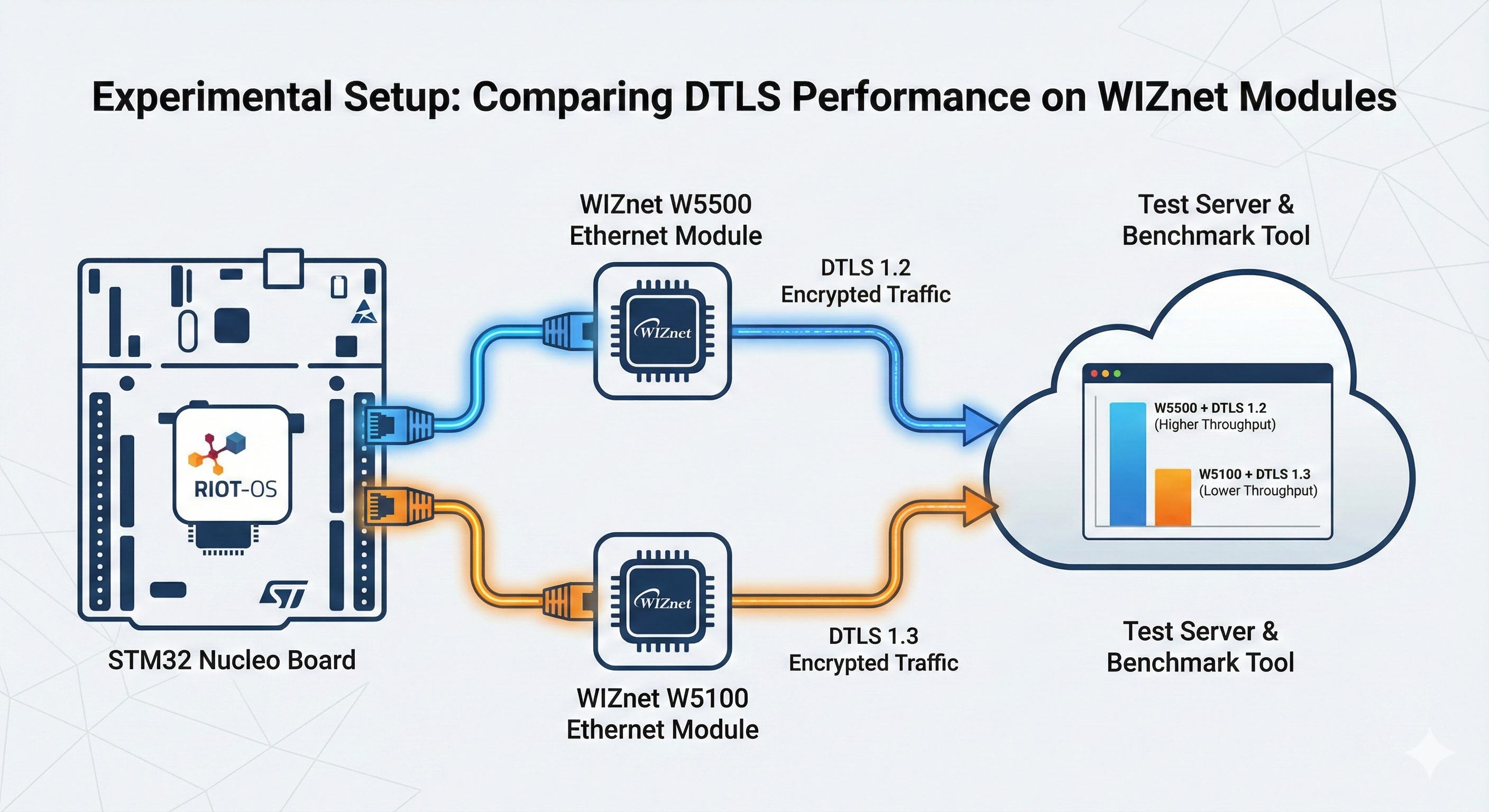
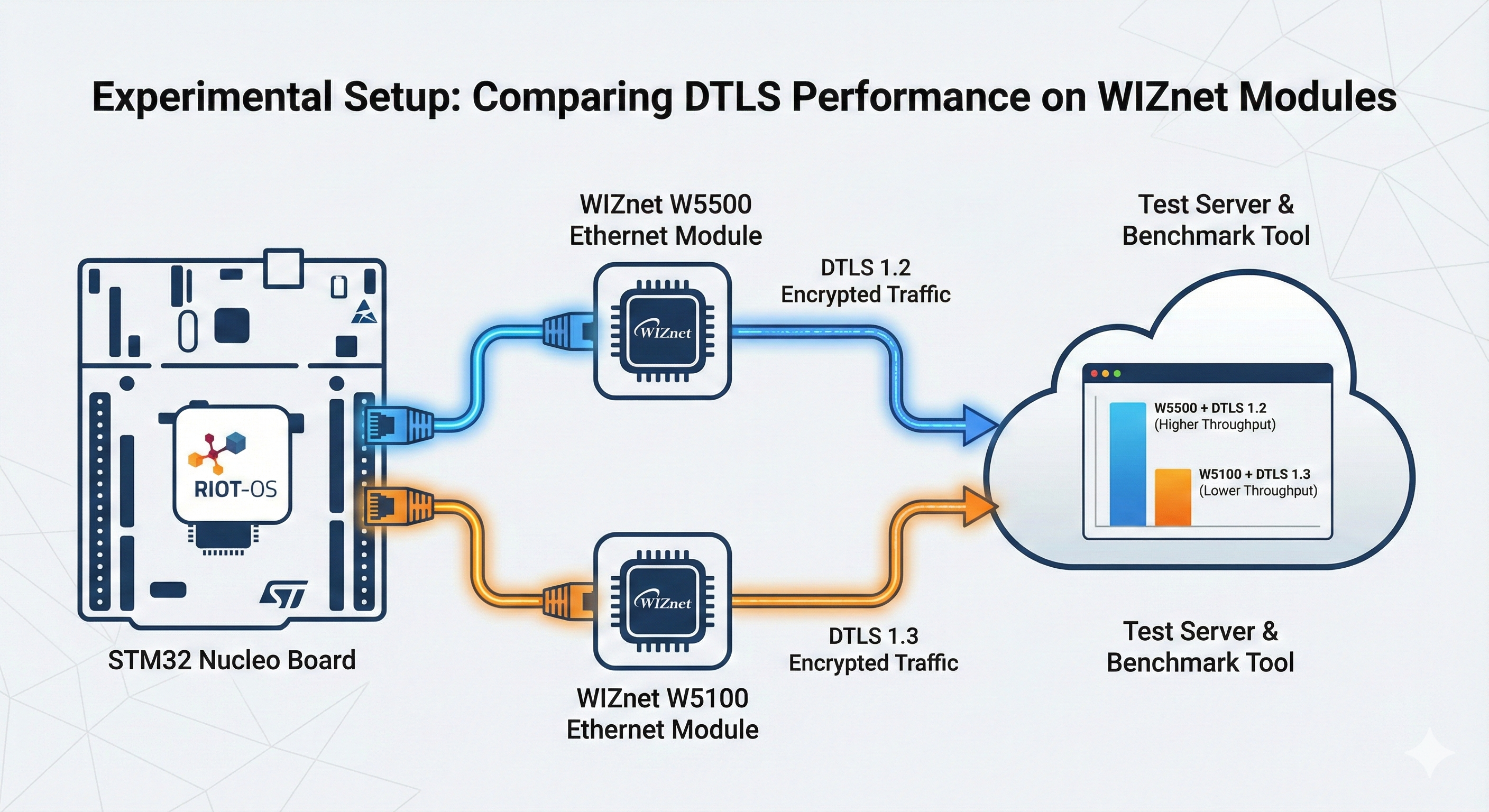
- 실험 플랫폼: STM32 Nucleo + RIOT-OS 기반 임베디드 환경
- 비교 축 1: DTLS 1.2 vs DTLS 1.3
- 비교 축 2: WIZnet W5100 vs WIZnet W5500 (Ethernet 모듈)
즉, “보안 버전을 올렸을 때(1.2→1.3) 성능이 어떻게 변하는가?”를 직감이 아니라 측정 가능한 데이터로 판단할 수 있게 해줍니다.
4) 왜 WIZnet인가 (Why WIZnet)
논문은 실험에서 WIZnet의 W5100과 W5500을 비교 대상으로 사용하며, 제품 문서를 참고문헌으로 인용합니다. 이는 연구진이 WIZnet 모듈을 “IoT 네트워킹에서 현실적으로 널리 쓰이고, 비교 실험에 적합한 대표 모듈”로 보고 채택했다고 해석할 수 있습니다.
또한 W5100과 W5500을 동시에 다룬다는 점은 단일 제품 언급보다 더 강한 메시지를 만듭니다. 같은 조건에서 비교해 실무적 판단 근거를 제시하는 구조이기 때문입니다.
5) 논문이 주는 핵심 인사이트 (Meaning)
이 논문은 “최신 버전이 항상 최선은 아니다”라는 실무 메시지를 던집니다. DTLS 1.3은 최신 표준이지만, 실제 임베디드 조건에서는 구현/설정/하드웨어 조합에 따라 성능 결과가 달라질 수 있습니다.
논문 초록의 결론은, 해당 실험 조건에서는 W5500 기반 구성이 더 높은 성능을 보였고(특히 DTLS 1.2 조합이 유리하게 보고됨), 더 요구가 큰 IoT 환경에서 현실적인 선택지가 될 수 있음을 시사합니다.
6) 앞으로의 확장성 (Scalability)
이 논문을 출발점으로, maker.wiznet.io에서는 다음 확장이 특히 “펜타코드 평가 기준”에 잘 맞습니다.
- 신규 제품 확장(자사 기준 신규성): 같은 벤치마크를 W5100S / W6100(IPv6) / W55RP20 / W6300 계열로 확장해 “보안 프로토콜 × 네트워크 칩” 최적 조합 지도를 만들기
- 신규 애플리케이션 확장(시장 기준 신규성): 산업/빌딩/의료/에너지처럼 보안이 강제되는 IoT 시나리오에서 처리량뿐 아니라 지연, 패킷 손실, 전력까지 포함한 체감 지표로 발전시키기
- 플랫폼 확장: RIOT-OS 외 다른 RTOS/SDK(예: Zephyr)에서 재현해 개발자 선택지를 넓히기
References
- SpringerLink paper record (CSCI 2024 / CCIS vol. 2508)
- DTLS 1.3 specification (IETF RFC 9147): IETF
- RIOT-OS official site (RIOT in a nutshell / security features)
DTLS 1.2 vs 1.3 in Real IoT Setups — Benchmarking on RIOT-OS + STM32 Nucleo with W5100/W5500
Security is mandatory in IoT, but cryptography and handshakes introduce overhead. This paper experimentally compares DTLS 1.2 vs DTLS 1.3 in an embedded setup and includes WIZnet W5100 and W5500 Ethernet modules as part of the testbed to quantify performance impact. The key value is practical: it supports evidence-based decisions rather than assuming the newest protocol always wins.
Paper & Author Information
- Title: Comparative Analysis of DTLS 1.2 and 1.3 Performance for Security in IoT Environments
- Authors: Karol Rzepka, Łukasz Pietraszek, Krzysztof Cabaj, Natan Orzechowski
- Affiliation: Warsaw University of Technology (Warsaw, Poland)
- Venue: CSCI 2024 / Springer CCIS vol. 2508
- DOI: 10.1007/978-3-031-95133-6_2
1) What DTLS and RIOT-OS mean in this context
What is DTLS?
DTLS (Datagram Transport Layer Security) is essentially “TLS for datagram transports such as UDP.” It provides protection against eavesdropping, tampering, and forgery while preserving datagram semantics, which is especially relevant for many IoT deployments that rely on UDP.
What is RIOT-OS?
RIOT-OS is an open-source operating system designed for microcontrollers and IoT devices, focusing on small memory footprint, energy efficiency, and real-time capabilities while offering networking and security building blocks. (This is RIOT-OS for IoT, not Riot Games.)
2) What the paper is about
In resource-constrained IoT devices, security is essential—but performance under encryption often becomes the deciding factor. This study addresses the problem experimentally, comparing DTLS versions in an embedded setting and incorporating common Ethernet module choices to reflect real-world conditions.
From a WIZnet perspective, it is notable that WIZnet W5100 and W5500 were used as part of the benchmarking platform in a Springer-published work—an external signal that the modules are practical and relevant for secure IoT performance evaluation.
3) Project view (maker perspective)
This work is best understood as a benchmarking project:
- Platform: STM32 Nucleo running RIOT-OS
- Axis #1: DTLS 1.2 vs DTLS 1.3
- Axis #2: WIZnet W5100 vs WIZnet W5500
It answers a practical question: what performance trade-offs do we face when moving from DTLS 1.2 to DTLS 1.3, and how does the Ethernet module choice affect the outcome?
4) Why WIZnet
The paper explicitly includes WIZnet modules (W5100 and W5500) and references official documentation, positioning WIZnet as a practical Ethernet connectivity option in IoT security benchmarking.
5) Key takeaway / meaning
A simple takeaway is: “newer does not automatically mean faster in every IoT condition.” While DTLS 1.3 is the newer standard, real performance can vary depending on implementation and hardware combinations. The abstract indicates that under their tested conditions, a W5500-based configuration delivered stronger performance, with DTLS 1.2 reported as the most favorable pairing in that setup.
6) Scalability ideas
- Extend the same benchmark to newer WIZnet devices (e.g., W5100S / W6100 / W55RP20 / W6300 family)
- Move from throughput-only benchmarks to real scenarios: telemetry, command/control, OTA, gateways (latency, loss, power)
- Reproduce across other RTOS ecosystems to broaden relevance