



Particle Industries, Inc. MUON404EA
Particle Industries, Inc. MUON404EA
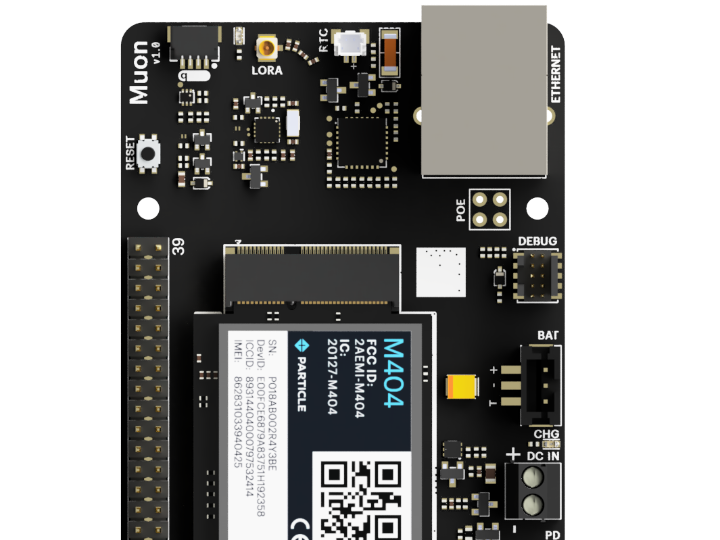
Particle Muon은 Particle의 M-SoM(M-Series System on Module) 을 중심으로 설계된 멀티 라디오 IoT 개발 보드이다. Wi-Fi, BLE, 셀룰러, LoRaWAN, Ethernet을 단일 보드에서 지원하며, Raspberry Pi HAT 호환 확장 커넥터와 다양한 전원 입력 옵션을 제공한다. Muon은 단순한 프로토타이핑 보드라기보다, 실제 IoT 시스템 구성을 검증하기 위한 레퍼런스 플랫폼 성격을 갖는다.
M-SoM 기반 아키텍처
Muon의 핵심은 보드 중앙에 장착되는 M-SoM 모듈이다. M-SoM은 MCU, 무선 기능, 메모리를 하나의 모듈로 통합한 형태이며, Muon은 이를 캐리어 보드 형태로 확장한다.
M-SoM 주요 사양
- MCU: Realtek RTL8722DM (ARM Cortex-M33, 200 MHz)
- 메모리
- 최대 2 MB 사용자 애플리케이션 플래시
- 약 3 MB RAM
- 8 MB 플래시 파일 시스템
- 무선
- Wi-Fi 802.11a/b/g/n (2.4 GHz / 5 GHz)
- Bluetooth 5
셀룰러 기능은 M-SoM 옵션에 따라 달라지며, LTE Cat-M, LTE Cat-1, 2G/3G, 위성 통신을 포함한 다양한 구성이 제공된다. 이 구조 덕분에 동일한 개발 환경에서 통신 구성만 달리한 시스템 검증이 가능하다.
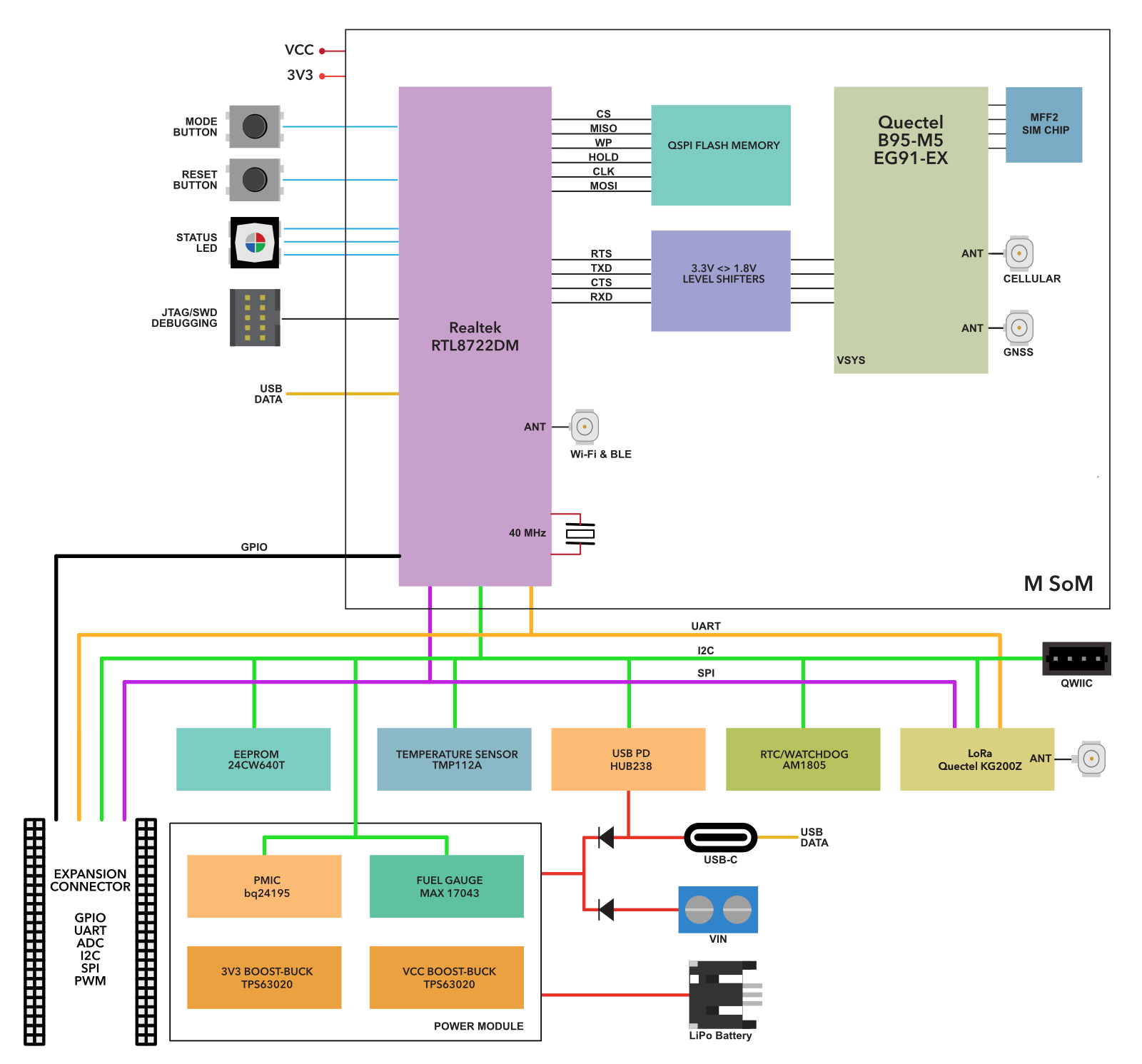
통신 인터페이스 구성
Muon은 다중 통신 환경을 전제로 설계된 보드로, 다음 인터페이스를 지원한다.
- Cellular: M-SoM 옵션에 따라 LTE Cat-M, LTE Cat-1, 2G/3G
- Wi-Fi / BLE: 외부 안테나(U.FL) 사용
- Ethernet: RJ-45 포트 내장, W5500
- LoRaWAN: 온보드 LoRa 모듈 및 전용 안테나 커넥터
- GNSS: 외부 안테나 연결 지원
각 RF 인터페이스는 독립적인 안테나 커넥터를 사용하며, 실환경 테스트를 전제로 한 구성이다.
Ethernet 구성과 W5500
Muon 보드에는 W5500 기반 Ethernet 컨트롤러가 탑재되어 있다. W5500은 하드웨어 TCP/IP 스택을 내장한 Ethernet 컨트롤러로, MCU와는 SPI 인터페이스로 연결된다.
Ethernet 인터페이스는 다음과 같은 특징을 가진다.
- SPI 기반 W5500 컨트롤러 사용
- 하드웨어 TCP/IP 오프로딩 구조
- 최대 8개 하드웨어 소켓 지원
- 인터럽트 및 Chip Select 핀은 보드에서 고정 배선
- MCP23S17 I/O Expander와 SPI 버스 공유
Ethernet 기능은 기본 설정에서는 비활성화되어 있으며, Particle 설정 과정에서 명시적으로 활성화해야 한다. 이는 Ethernet을 사용하지 않는 경우 SPI 및 GPIO 자원을 자유롭게 사용할 수 있도록 하기 위한 설계 선택이다.
전원 입력 및 전원 구조
Muon은 다양한 설치 환경을 고려해 여러 전원 입력 방식을 지원한다.
전원 입력 옵션
- USB-C (PD 지원)
- VIN 6–12 V DC (터미널 입력)
- Li-Po 배터리 (3-핀 JST-PH)
- 확장 커넥터 또는 PoE 어댑터
USB-C 전원은 PD 협상을 전제로 하며, 일반적인 USB-A to C 케이블로는 전원 인가가 되지 않는다. Ethernet, LoRa, QWIIC, HAT 커넥터에 전원을 공급하는 3V3_AUX 전원 레일은 기본적으로 비활성화되어 있으며, 초기 설정 과정에서 활성화된다.
확장 인터페이스와 I/O
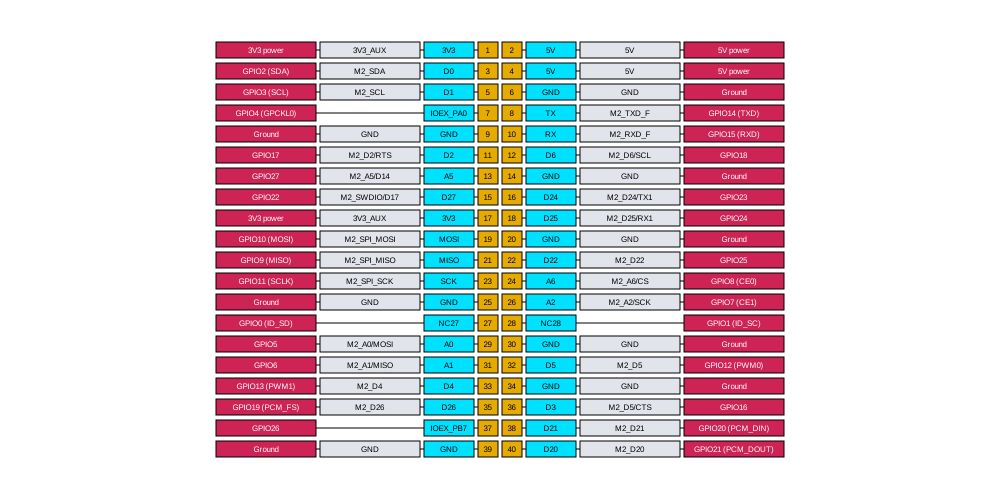
Muon은 Raspberry Pi HAT 호환 40핀(2×20) 확장 커넥터를 제공한다. 이를 통해 다양한 센서와 확장 보드를 직접 연결할 수 있다.
확장 인터페이스 구성
- GPIO, SPI, I2C, UART, PWM
- 3.3 V / 5 V 전원 라인 제공
- 모든 GPIO는 3.3 V 전용(5 V tolerant 아님)
추가로 QWIIC(I2C) 커넥터와 SWD/JTAG 디버그 커넥터가 기본 탑재되어 있다.
온보드 주변장치
Muon 보드는 통신 외에도 운용과 안정성을 위한 여러 주변장치를 포함한다.
- RTC 및 하드웨어 Watchdog (AM1805)
- 온도 센서 (TMP112A)
- 배터리 연료 게이지 (MAX17043)
- PMIC (bq24195)
- USB-C PD 컨트롤러 (STUSB4500)
- 상태 표시용 RGB LED 및 버튼
이 구성은 장시간 무인 운용, 전원 장애, 재부팅 시나리오를 보드 단위에서 검증할 수 있도록 한다.
활용 가능 시나리오
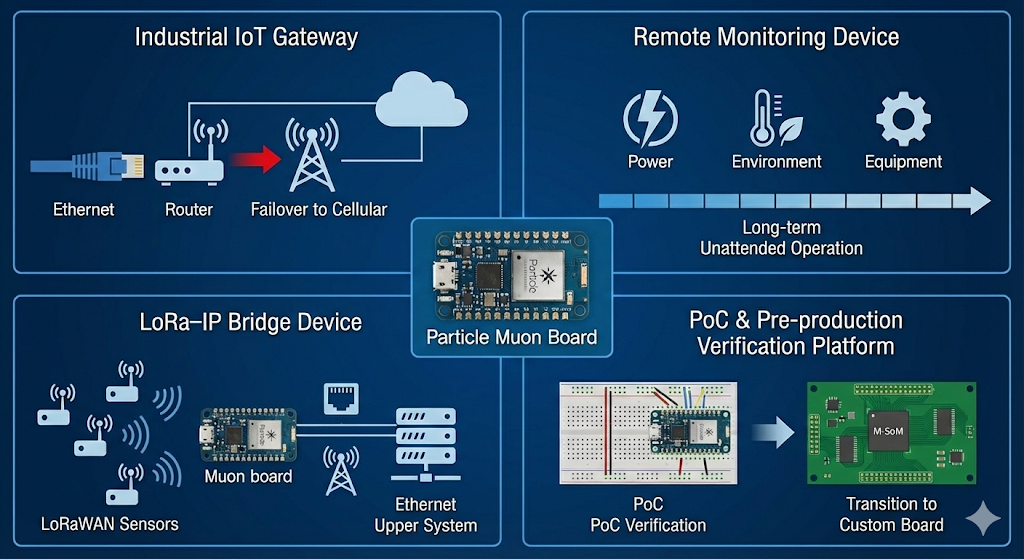
Muon은 단일 센서 노드보다는 네트워크 허브 또는 게이트웨이 성격의 IoT 장비에 적합하다.
- 산업용 IoT 게이트웨이
Ethernet을 기본 통신으로 사용하고, 장애 시 셀룰러로 전환하는 혼합형 구조에 적합하다. - 원격 모니터링 장비
전력, 환경, 설비 모니터링 등 장시간 무인 운용이 필요한 시스템에 활용 가능하다. - LoRa–IP 브리지 장비
LoRaWAN 센서 데이터를 수집해 Ethernet 또는 셀룰러로 상위 시스템에 전달하는 구조에 적합하다. - PoC 및 양산 전 검증 플랫폼
통신, 전원, 펌웨어 구조를 검증한 뒤 동일한 M-SoM을 사용해 커스텀 보드로 전환할 수 있다.
무선 중심 IoT에서 유선 Ethernet의 역할
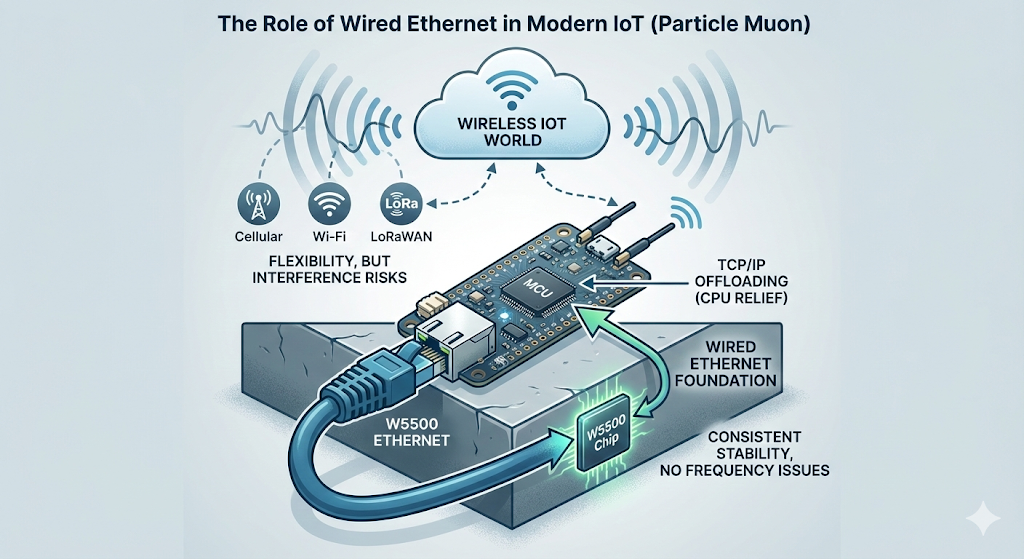
최근 IoT 시스템은 셀룰러, Wi-Fi, LoRaWAN과 같은 무선 통신을 중심으로 설계되는 경우가 많다. 설치 유연성과 초기 구축 비용 측면에서 무선은 분명한 장점을 가진다. 그러나 장기 운용과 시스템 안정성 관점에서 보면, 유선 Ethernet은 여전히 중요한 역할을 유지한다.
Particle Muon에 W5500 기반 Ethernet 인터페이스가 포함된 것은 이러한 현실을 반영한 설계 선택이다. Ethernet은 무선과 달리 주파수 환경, 전파 품질, 통신사 정책 변화의 영향을 거의 받지 않는다. 한 번 설치되면 비교적 일정한 대역폭과 지연 특성을 유지할 수 있으며, 이는 산업 환경이나 고정 설치 장비에서 중요한 요소다.
또한 W5500의 하드웨어 TCP/IP 오프로딩 구조는 MCU가 네트워크 스택 처리에 과도하게 관여하지 않도록 해준다. 다중 통신을 동시에 관리해야 하는 Muon과 같은 보드에서는, 유선 Ethernet을 안정적인 기본 통신 경로로 유지하면서 무선 인터페이스를 보조 수단으로 활용하는 구조가 현실적인 선택이 된다.
정리
적용 환경 및 활용 시나리오
- 공장, 플랜트, 빌딩 자동화 등 유선 Ethernet과 무선 통신이 혼재된 산업 환경
- 전력·환경·설비 모니터링과 같은 장기간 무인 운용 인프라
- LoRaWAN 센서 데이터를 수집·중계하는 엣지 게이트웨이
- PoC 이후 동일 구조를 여러 현장에 반복 배치해야 하는 프로젝트
대상 사용자 및 적용 범위
- 개인 메이커보다는 기업, 시스템 통합 업체, ODM/OEM 개발 조직
- 다양한 통신 옵션을 조합해 고객별 시스템을 구성해야 하는 개발 환경
- 초기 검증 이후 양산 설계로 자연스럽게 전환해야 하는 프로젝트
양산 및 반복 적용 관점의 구조적 특징
- M-SoM 기반 모듈화 구조로 통신·MCU·인증 영역 재사용 가능
- SPI, I2C, UART, Ethernet 등 표준 인터페이스 중심 설계
- Ethernet, 전원, 확장 I/O가 명확히 분리된 보드 구조
시장 확장 가능성
- W5500 기반 Ethernet 구조를 활용한 범용적인 유선 네트워크 구성
- 프로젝트별 네트워크 아키텍처 재설계 부담 감소
- 동일한 Ethernet 구조를 여러 제품·고객·시장에 반복 적용 가능
- 단일 데모가 아닌 기준 설계(reference platform) 로서의 활용 가치
FAQ
Q1. Particle Muon은 단순한 데모용 보드인가요, 아니면 실제 제품 개발에 사용할 수 있나요?
A. Muon은 단발성 데모보드보다는 실제 IoT 시스템 구조를 검증하기 위한 레퍼런스 플랫폼에 가깝습니다. M-SoM 기반 모듈화 구조와 표준 인터페이스를 사용하고 있어, PoC 이후 동일한 구조를 활용한 양산 설계로 전환이 가능합니다.
Q2. 어떤 산업 환경에서 Muon을 사용하는 것이 적합한가요?
A. Muon은 공장·플랜트·빌딩 자동화와 같이 유선 Ethernet과 무선 통신이 함께 사용되는 산업 환경, 장기간 무인 운용이 필요한 인프라 모니터링, LoRaWAN 기반 엣지 게이트웨이 시스템에 적합합니다.
Q3. 개인 개발자나 메이커용 보드로도 사용할 수 있나요?
A. 사용은 가능하지만, Muon은 개인 실험보다는 기업, 시스템 통합 업체, ODM/OEM 개발 조직을 주된 대상으로 설계되었습니다. 다중 통신과 전원 구조, 확장 방식은 제품 개발 및 현장 배치를 전제로 한 구성입니다.
Q4. Ethernet이 포함된 구조는 어떤 장점이 있나요?
A. W5500 기반 Ethernet은 무선 환경의 영향을 받지 않는 안정적인 통신 경로를 제공합니다. 장기 운용 장비에서 기본 통신 수단으로 활용할 수 있으며, 동일한 네트워크 구조를 여러 프로젝트와 제품에 반복 적용할 수 있습니다.
Q5. Muon은 양산 제품으로 바로 사용할 수 있는 보드인가요?
A. Muon 자체는 개발 및 검증용 보드입니다. 그러나 M-SoM을 중심으로 한 구조 덕분에 통신, 전원, 펌웨어 아키텍처를 충분히 검증한 뒤, 동일한 SoM을 사용해 커스텀 보드로 전환하는 것이 전제된 플랫폼입니다.
The Particle Muon is a multi-radio IoT development board built around Particle’s M-SoM (M-Series System on Module). It integrates Wi-Fi, BLE, cellular, LoRaWAN, and Ethernet on a single board, while providing a Raspberry Pi HAT-compatible expansion header and multiple power input options. Rather than a simple prototyping board, Muon is designed as a reference platform for validating real-world IoT system architectures.
M-SoM–Based Architecture
At the core of the Muon is the M-SoM module, which integrates the MCU, wireless connectivity, and memory into a single module. The Muon acts as a carrier board that expands the M-SoM with additional interfaces and peripherals.
M-SoM Key Specifications
- MCU: Realtek RTL8722DM (ARM Cortex-M33, 200 MHz)
- Memory
- Up to 2 MB user application flash
- Approximately 3 MB RAM
- 8 MB flash file system
- Wireless
- Wi-Fi 802.11a/b/g/n (2.4 GHz / 5 GHz)
- Bluetooth 5
Cellular capability depends on the M-SoM variant and includes options such as LTE Cat-M, LTE Cat-1, 2G/3G fallback, and satellite connectivity. This modular approach allows different connectivity configurations to be evaluated within the same hardware platform.
Communication Interfaces
The Muon is designed for multi-network environments and supports the following interfaces:
- Cellular: LTE Cat-M, LTE Cat-1, or 2G/3G depending on M-SoM option
- Wi-Fi / BLE: External antenna via U.FL connector
- Ethernet: On-board RJ-45 port
- LoRaWAN: On-board LoRa module with dedicated antenna connector
- GNSS: External antenna support
Each RF interface uses a dedicated antenna connection, reflecting the board’s focus on real-world deployment and testing.
Ethernet Implementation with W5500
The Muon includes an Ethernet interface based on the W5500 Ethernet controller. The W5500 integrates a hardware TCP/IP stack and connects to the MCU via SPI.
Key characteristics of the Ethernet implementation include:
- SPI-based W5500 Ethernet controller
- Hardware TCP/IP offloading
- Support for up to eight hardware sockets
- Fixed chip-select and interrupt pin assignments
- Shared SPI bus with the MCP23S17 I/O expander
Ethernet functionality is disabled by default and must be explicitly enabled during the Particle setup process. This design prevents unintended SPI and GPIO resource conflicts when Ethernet is not required.
Power Input and Power Architecture
The Muon supports multiple power input methods to accommodate different installation environments.
Power Input Options
- USB-C (Power Delivery supported)
- VIN 6–12 V DC via terminal block
- Li-Po battery (3-pin JST-PH)
- Expansion connector or PoE adapter
USB-C power requires PD negotiation; a standard USB-A to USB-C cable is not sufficient to power the board. The 3V3_AUX power rail, which supplies Ethernet, LoRa, QWIIC, and HAT connectors, is disabled by default and enabled during the initial setup process.
Expansion Interfaces and I/O
The Muon provides a 40-pin (2×20) Raspberry Pi HAT-compatible expansion header, allowing direct connection of a wide range of sensors and expansion boards.
Expansion Interface Features
- GPIO, SPI, I2C, UART, PWM
- 3.3 V and 5 V power rails available
- All GPIOs are 3.3 V only (not 5 V tolerant)
Additional interfaces include a QWIIC (I2C) connector and an SWD/JTAG debug connector for firmware development and debugging.
On-Board Peripherals
In addition to communication interfaces, the Muon integrates several peripherals for system operation and reliability:
- Real-time clock and hardware watchdog (AM1805)
- Temperature sensor (TMP112A)
- Battery fuel gauge (MAX17043)
- PMIC (bq24195)
- USB-C PD controller (STUSB4500)
- RGB status LED and user buttons
These components enable validation of long-term unattended operation, power fault recovery, and reset scenarios at the board level.
Application Scenarios
The Muon is better suited to gateway-class or hub-type IoT devices than to simple sensor nodes.
- Industrial IoT Gateways
Suitable for designs that use Ethernet as the primary connection with cellular as a fallback. - Remote Monitoring Equipment
Applicable to power, environmental, or facility monitoring systems requiring long-term unattended operation. - LoRa-to-IP Bridge Devices
Can aggregate LoRaWAN sensor data and forward it via Ethernet or cellular networks. - PoC and Pre-Production Validation
Enables validation of connectivity, power, and firmware architecture before transitioning to a custom board using the same M-SoM.
The Role of Wired Ethernet in Wireless-Centric IoT Systems
Modern IoT systems are increasingly designed around wireless connectivity such as cellular, Wi-Fi, and LoRaWAN due to their deployment flexibility. However, from a long-term operation and system stability perspective, wired Ethernet continues to play an important role.
The inclusion of a W5500-based Ethernet interface on the Muon reflects this reality. Unlike wireless links, Ethernet is largely unaffected by RF conditions, spectrum congestion, or carrier policy changes. Once installed, it can provide consistent bandwidth and latency over long periods, which is critical for industrial and fixed-location equipment.
In addition, the W5500’s hardware TCP/IP offloading reduces the networking burden on the MCU. For a board like the Muon, which may manage multiple communication interfaces simultaneously, using Ethernet as a stable primary link while treating wireless interfaces as complementary paths is a practical and robust architectural choice.
Summary
The Particle Muon is an IoT development board that combines an M-SoM-based architecture with multi-radio wireless connectivity, W5500-based Ethernet, flexible power input options, and rich expansion interfaces. Rather than serving as a simple MCU evaluation board, it functions as a reference platform for validating real-world IoT system designs. Its ability to address connectivity, power, expansion, and long-term operation within a single platform defines the core value of the Muon.