



RP2040にW5500とTM1637を接続する(NTPサーバ)
RP2040にW5500とTM1637を接続する(NTPサーバ)
산업 환경이나 폐쇄망에서는 외부 인터넷에 의존하지 않는 시간 동기화 인프라가 필요합니다. 그러나 일반적인 NTP 서버는 리눅스 기반 시스템을 요구하는 경우가 많아 비용과 유지 관리 측면에서 부담이 존재합니다.
본 프로젝트는 이러한 문제를 해결하기 위해 소형 MCU인 RP2040을 기반으로 NTP 서버 기능을 구현합니다. 시스템은 기동 시 외부 NTP 서버에서 시간을 획득하여 내부 RTC에 저장하고, 이후에는 독립적으로 시간 서비스를 제공합니다. 동시에 TM1637 LED를 통해 현재 시간을 표시하여 현장에서도 즉시 상태를 확인할 수 있도록 설계되었습니다.
아키텍처
시스템은 초기 동기화 단계와 지속 운영 단계로 나뉘며, RTC를 중심으로 네트워크와 디스플레이가 연결되는 구조를 갖습니다.
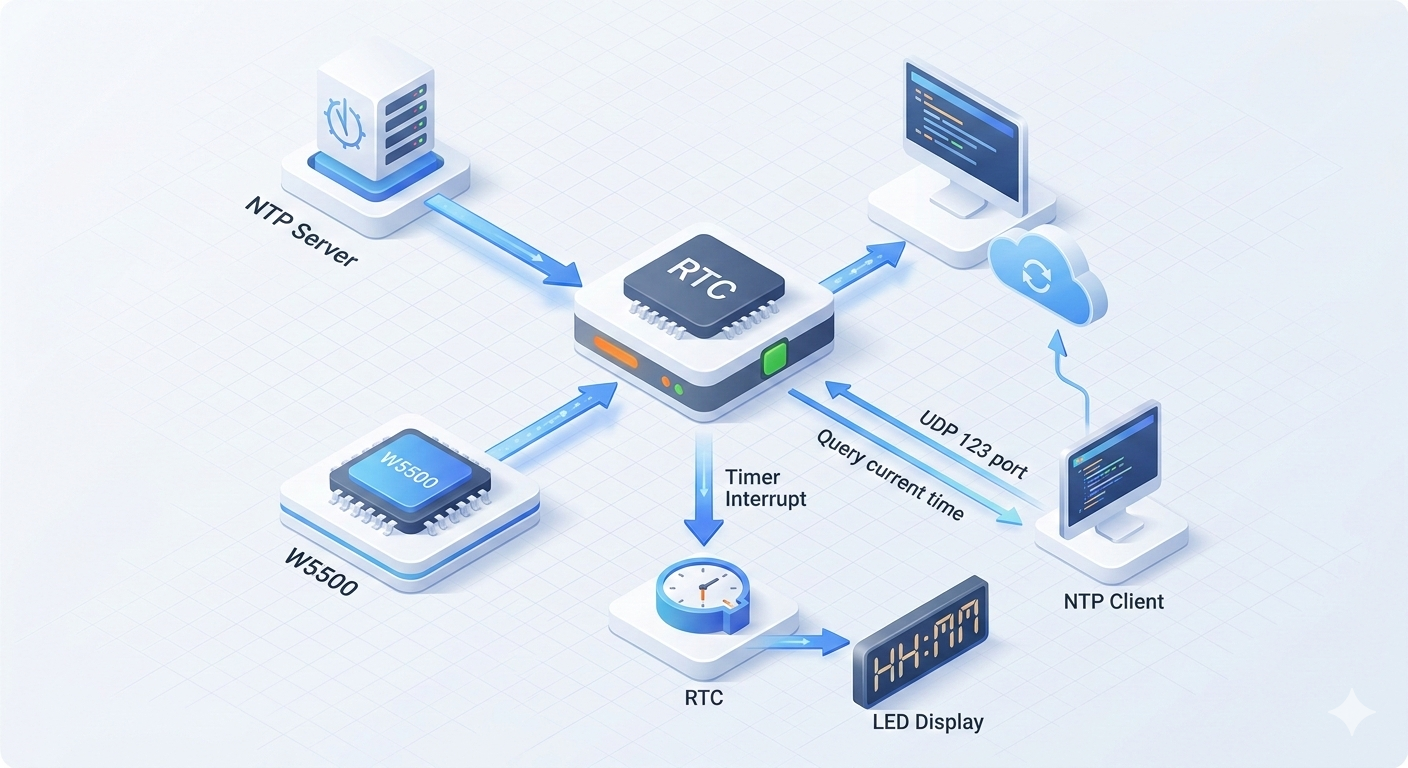
- 부팅 시 외부 NTP 서버에 요청을 보내 시간 획득
- 내부 RTC에 시간 저장 (Local Time 기준)
- Timer Interrupt를 통해 1초 주기로 시간 갱신
- W5500을 통해 UDP 123 포트에서 NTP 요청 수신
- 요청에 대해 UTC 기준 timestamp를 구성하여 응답
- TM1637을 통해 HH:MM 형식으로 시간 표시
핵심 흐름은 다음과 같습니다:
- External NTP → 초기 동기화 → RTC 저장
- RTC → 인터럽트 → LED 표시
- RTC → NTP 응답 → 클라이언트 동기화
이 구조는 네트워크 처리와 시간 표시 로직을 분리하여 안정성과 응답성을 동시에 확보합니다.
기술 특징
본 프로젝트는 경량 MCU 환경에서도 안정적인 시간 서버 기능을 구현하기 위해 다음과 같은 기술적 선택을 적용했습니다.
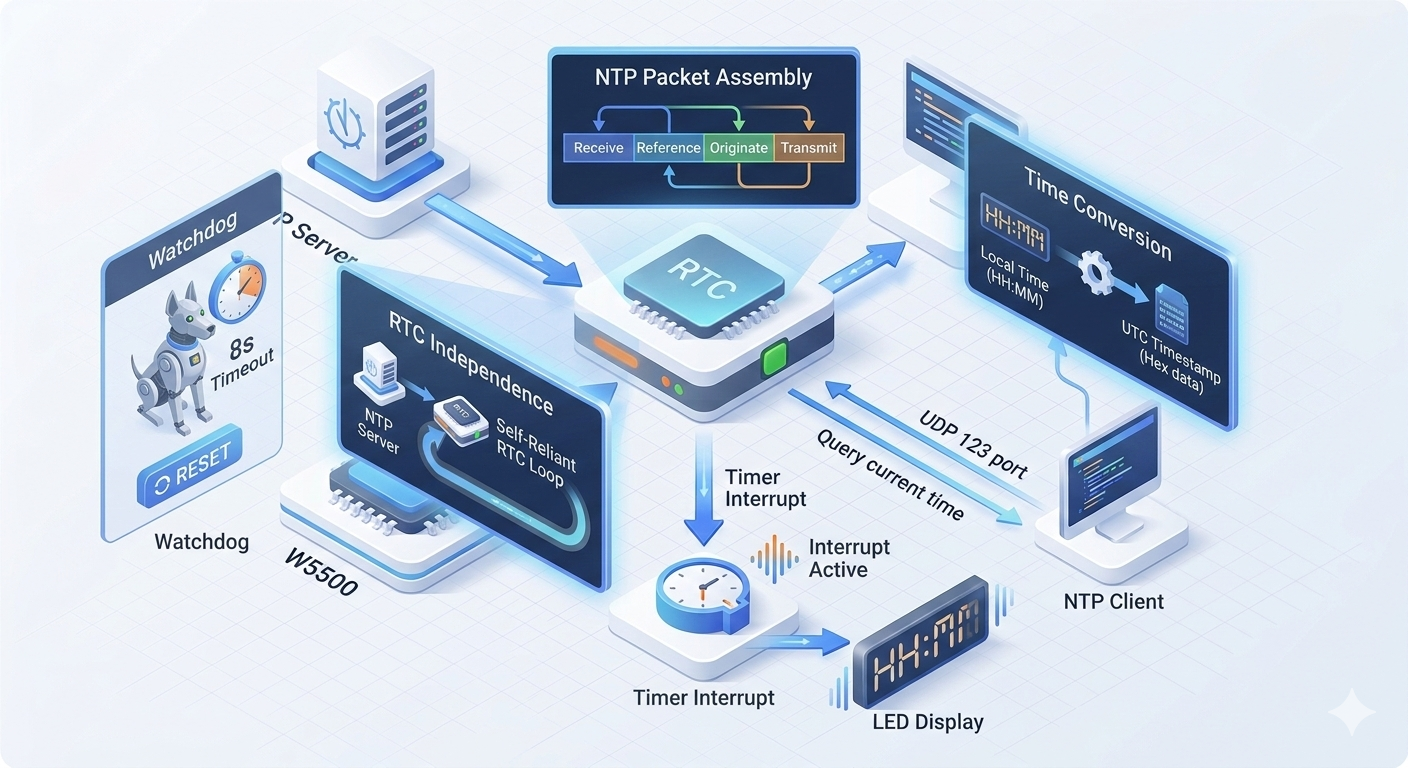
RTC 기반 시간 유지 구조
- 외부 동기화 이후에는 내부 RTC만으로 시간 유지
- 네트워크 의존성 최소화
NTP 패킷 직접 구성
- Receive / Reference / Originate / Transmit timestamp를 직접 생성
- 프로토콜 동작을 명확히 제어 가능
Local Time → UTC 변환 구조
- 내부는 지역 시간 기준으로 유지
- 응답 시 NTP 표준에 맞게 UTC 변환
Timer Interrupt 기반 디스플레이
- 메인 루프와 독립적으로 동작
- 안정적인 주기 유지
Watchdog 기반 안정성 확보
- 8초 타임아웃 기반 자동 리부트
- 장시간 운용 환경 대응
WIZnet Insight
본 프로젝트의 핵심은 WIZnet의 W5500 Ethernet 컨트롤러를 활용한 네트워크 구조입니다. W5500은 하드웨어 TCP/IP 오프로딩 기능을 제공하여 RP2040과 같은 소형 MCU에서도 복잡한 네트워크 스택을 소프트웨어로 처리할 필요 없이 안정적인 Ethernet 통신을 구현할 수 있도록 합니다.
특히 본 사례에서는 UDP 기반 NTP 서버를 구현하면서도 별도의 TCP/IP 스택 부담 없이 단순한 구조로 설계가 가능했습니다. 이는 MCU가 시간 처리, RTC 관리, 디스플레이 제어와 같은 핵심 로직에 집중할 수 있게 하며, 전체 시스템의 안정성과 구현 난이도를 동시에 낮추는 효과를 제공합니다. 결과적으로 W5500은 단순한 네트워크 인터페이스를 넘어, 임베디드 인프라 서비스 노드를 구현하는 데 최적의 솔루션임을 보여줍니다.
비즈니스 가치
이 구조는 단순한 데모를 넘어 다양한 실제 환경에 적용될 수 있습니다.
산업 제어 시스템
- PLC 및 센서 네트워크의 시간 기준 제공
- 폐쇄망 환경에서 안정적인 동기화 가능
테스트 및 검증 환경
- 장비 간 시간 동기화 테스트용 기준 노드
- 네트워크 프로토콜 디버깅 장비로 활용
IoT Edge 인프라
- 로컬 게이트웨이에서 시간 서비스 제공
- 클라우드 의존도 감소
교육 및 연구
- NTP 프로토콜 구조 학습
- 임베디드 네트워크 설계 실습
FAQ
Q1. RP2040 내부 RTC만으로 정확한 NTP 서버 운영이 가능한가요?
초기 동기화 이후에는 RTC 정확도에 의존합니다. 장기 정확도가 필요한 경우 주기적 재동기화 또는 GPS 기반 확장이 필요합니다.
Q2. 왜 내부 시간은 Local Time으로 저장하고 UTC로 변환하나요?
사용자 표시(LED)는 지역 시간이 직관적이며, NTP 프로토콜은 UTC 기준이기 때문에 분리된 구조를 사용합니다.
Q3. W5500을 사용하면 어떤 장점이 있습니까?
하드웨어 TCP/IP 오프로딩으로 MCU 부하가 감소하며, 안정적인 Ethernet 통신을 단순한 구조로 구현할 수 있습니다.
Q4. DHCP 대신 고정 IP를 사용하는 이유는 무엇인가요?
NTP 서버는 네트워크에서 항상 동일한 주소로 접근 가능해야 하므로 고정 IP가 적합합니다.
Q5. 다수의 클라이언트 요청도 처리할 수 있습니까?
UDP 기반 구조이므로 기본적인 다중 요청 처리는 가능하지만, 성능은 MCU 처리 능력과 네트워크 부하에 따라 제한됩니다.
In industrial or closed-network environments, reliable time synchronization is essential, but deploying a full Linux-based NTP server can be costly and complex.
This project addresses that challenge by implementing an NTP server on a low-cost RP2040 MCU. Upon boot, the device retrieves the current time from an external NTP server and initializes its internal RTC. From that point onward, it serves time independently to other devices on the network.
Additionally, a TM1637-based 4-digit display provides real-time visual feedback, making it suitable for field deployment and debugging scenarios.
Architecture
The system is structured around two main phases: initialization and continuous operation, with the RTC acting as the core reference.
- On boot, the device queries an external NTP server
- The received time is stored in the internal RTC (Local Time)
- A timer interrupt updates the system every second
- The W5500 listens for incoming NTP requests on UDP port 123
- Upon request, timestamps are generated and returned in UTC format
- The TM1637 display continuously shows the current time (HH:MM)
Core data flow:
- External NTP → Initial synchronization → RTC
- RTC → Timer interrupt → LED display
- RTC → NTP response → Client devices
This separation between timekeeping, networking, and display ensures both stability and responsiveness.
Technical Features
RTC-Based Timekeeping
- Time is maintained locally after initial synchronization
- Reduces dependency on continuous network access
Manual NTP Packet Construction
- Full control over Receive, Reference, Originate, and Transmit timestamps
- Enables precise protocol-level implementation
Local Time to UTC Conversion
- Internal RTC stores local time for usability
- NTP responses comply with UTC standards
Interrupt-Driven Display
- Timer-based updates independent of the main loop
- Stable and consistent display behavior
Watchdog-Based Reliability
- Automatic reboot mechanism (8-second timeout)
- Ensures long-term operational stability
WIZnet Insight
The W5500 Ethernet controller plays a critical role in simplifying the overall system architecture. By providing hardware TCP/IP offloading, it eliminates the need for a full software network stack on the RP2040.
This allows the MCU to focus on application-level tasks such as RTC management, timestamp generation, and display control. In this project, UDP-based NTP communication is implemented with minimal complexity, demonstrating how W5500 enables reliable Ethernet services even on resource-constrained microcontrollers.
As a result, W5500 is not just a connectivity component—it acts as an enabler for building embedded infrastructure nodes such as time servers, monitoring devices, and control endpoints.
Business Value
Industrial Control Systems
- Provides a reliable time reference for PLCs and sensor networks
- Suitable for closed or isolated network environments
Testing and Validation Environments
- Acts as a local time reference node for system verification
- Useful for network protocol debugging
IoT Edge Infrastructure
- Enables local time services at the edge
- Reduces dependency on cloud-based synchronization
Education and Research
- Ideal for learning NTP protocol internals
- Demonstrates embedded Ethernet system design
FAQ
Q1. Is the RP2040 RTC accurate enough for an NTP server?
It is sufficient for short-term operation. For long-term accuracy, periodic resynchronization or a GPS-based reference is recommended.
Q2. Why store time as Local Time and convert to UTC?
Local Time is more intuitive for display, while NTP protocol requires UTC. This separation ensures both usability and compliance.
Q3. What are the advantages of using W5500?
It provides hardware TCP/IP offloading, reducing MCU load and enabling stable Ethernet communication with minimal software complexity.
Q4. Why use a static IP instead of DHCP?
An NTP server must be consistently reachable at a fixed address, making static IP more suitable.
Q5. Can it handle multiple client requests?
Yes, basic handling is possible due to UDP-based communication, but performance depends on MCU and network load.