



Raspberry Pi RP2350 dev board features Ethernet RJ45 port with WIZNet W5500 or W5100S
Raspberry Pi RP2350 dev board features Ethernet RJ45 port with WIZNet W5500 or W5100S Ethernet controller
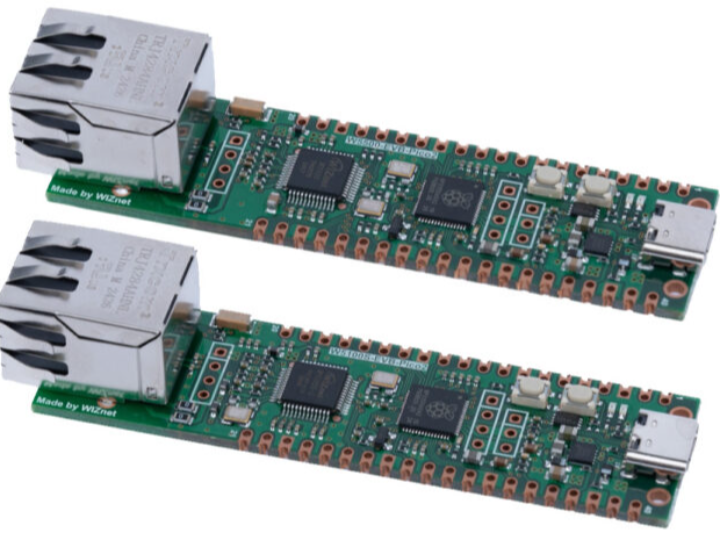
With the recent launch of the Raspberry Pi Pico 2, the embedded world is buzzing about the new RP2350 microcontroller. However, while the performance has jumped significantly, developers still face the classic challenge: how to get reliable, wired network connectivity?
WIZnet has answered this call by releasing two new development boards that combine the power of the RP2350 with their signature hardwired Ethernet technology: the W5100S-EVB-Pico2 and the W5500-EVB-Pico2.
In this article, we’ll break down what makes these boards special and how to choose the right one for your next IoT project.
1. The Engine: Powered by Raspberry Pi RP2350A
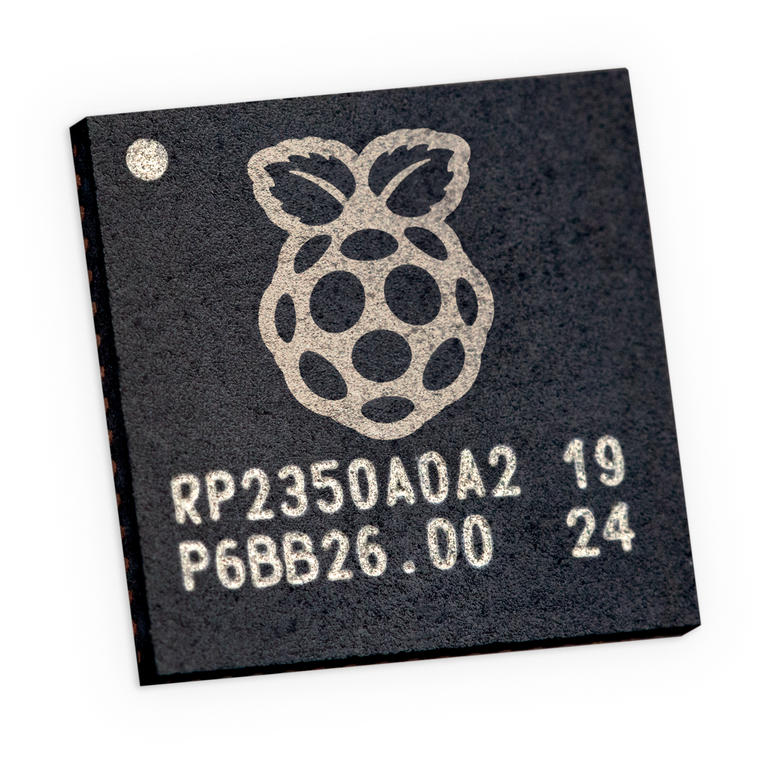
Both boards are built around the highly anticipated RP2350A MCU. This means you get all the benefits of the new silicon:
- Core: Dual-core Arm Cortex-M33 running at 150MHz.
- Memory: 520KB internal SRAM and 16Mbit external SPI Flash.
- Security: Enhanced security features including Arm TrustZone and Signed Boot.
This upgrade offers significantly more processing power and security compared to the previous RP2040, making these boards ideal for professional and industrial applications.
2. The WIZnet Advantage: Hardwired TCP/IP
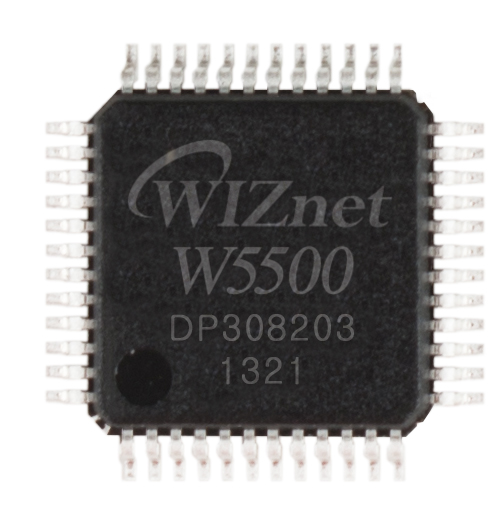
The standout feature of these boards is the built-in RJ45 Ethernet port driven by WIZnet’s proprietary Ethernet controller chips.
Unlike software-based network stacks that eat up CPU cycles, WIZnet chips use a Hardwired TCP/IP Offload Engine. This handles the network traffic independently, allowing the RP2350 MCU to dedicate its resources entirely to your application logic. This architecture is crucial for projects requiring real-time performance and stability.
3. Which One Should You Choose?
WIZnet offers two variants tailored to different needs:
| Feature | W5100S-EVB-Pico2 | W5500-EVB-Pico2 |
|---|---|---|
| Target Use | Entry-Level / General IoT | High-Performance / Industrial |
| Controller | W5100S | W5500 |
| Hardware Sockets | 4 Independent Sockets | 8 Independent Sockets |
| Buffer Memory | 16KB | 32KB |
| Best For... | Cost-effective projects, basic sensor nodes. | High-traffic environments, complex gateways. |
If you are building a simple data logger, the W5100S is a cost-effective choice. However, for an industrial gateway or a device that needs to handle multiple simultaneous connections, the W5500 is the robust winner.
4. Key Technical Notes for Developers
Before you start wiring, here are a few critical details to keep in mind:
- Improved Power Efficiency: These boards utilize a built-in Switch-mode DC-DC converter instead of a traditional LDO. This results in much better power efficiency and lower heat generation.
- Pinout Constraints: To support Ethernet, GPIO pins 16 through 21 are dedicated to the WIZnet chip. Be sure to check your pin compatibility if you plan to use existing Pico expansion boards (HATs).
- Form Factor: Due to the RJ45 jack, the board is slightly longer (80 x 20mm) than the standard Pico.
5. Conclusion
While Wi-Fi is convenient, it often lacks the reliability required for critical industrial or home automation systems.
The W5100S/W5500-EVB-Pico2 series offers the perfect compromise: the ease of use of the Raspberry Pi ecosystem, the raw power of the RP2350, and the rock-solid stability of wired Ethernet. With a price point under $20, these boards are likely to become the new standard for connected microcontroller projects.