



PLC Training Center
Forget the Commercial PLC Trainer: Building an Industrial Automation Training Rig with Arduino and the W5500
요약
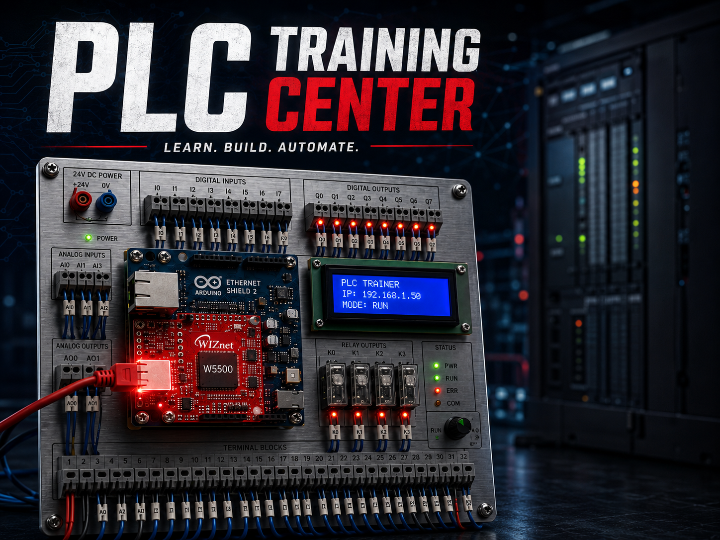
PLC Training Center는 상용 PLC 트레이너 없이도 래더 로직, Modbus TCP/IP, PID 튜닝을 한 보드에서 익힐 수 있도록 설계된 Arduino 기반 실습 키트입니다. 통신을 담당하는 CU2 유닛은 Arduino Ethernet Shield 2를 사용하며, 이 보드의 핵심은 WIZnet W5500 하드웨어 TCP/IP 칩입니다. 41,000회 이상의 조회수가 보여주듯 산업자동화 입문자들 사이에서 꾸준히 참고되는 프로젝트입니다.
개요
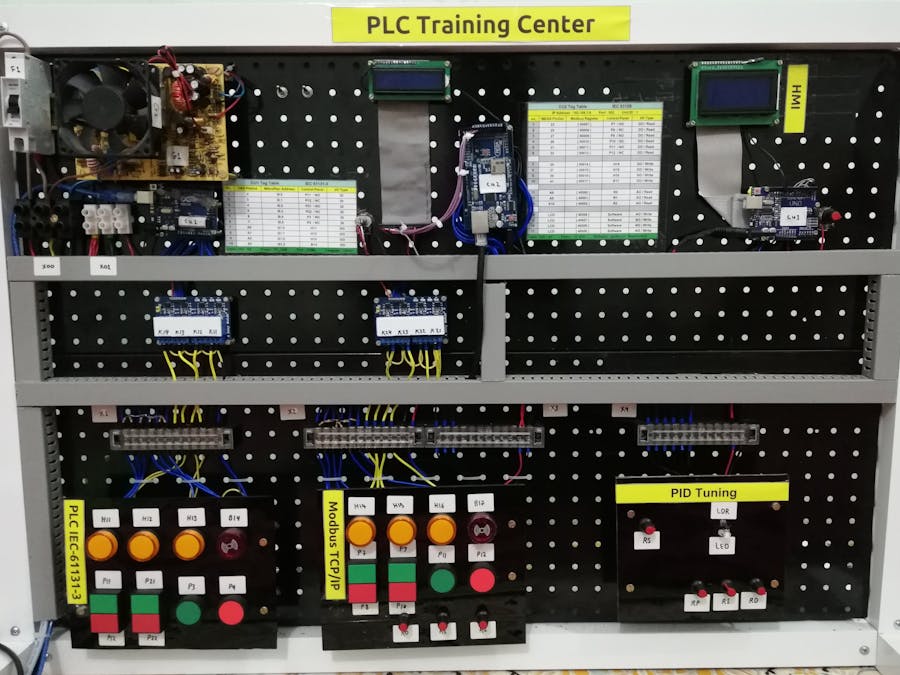
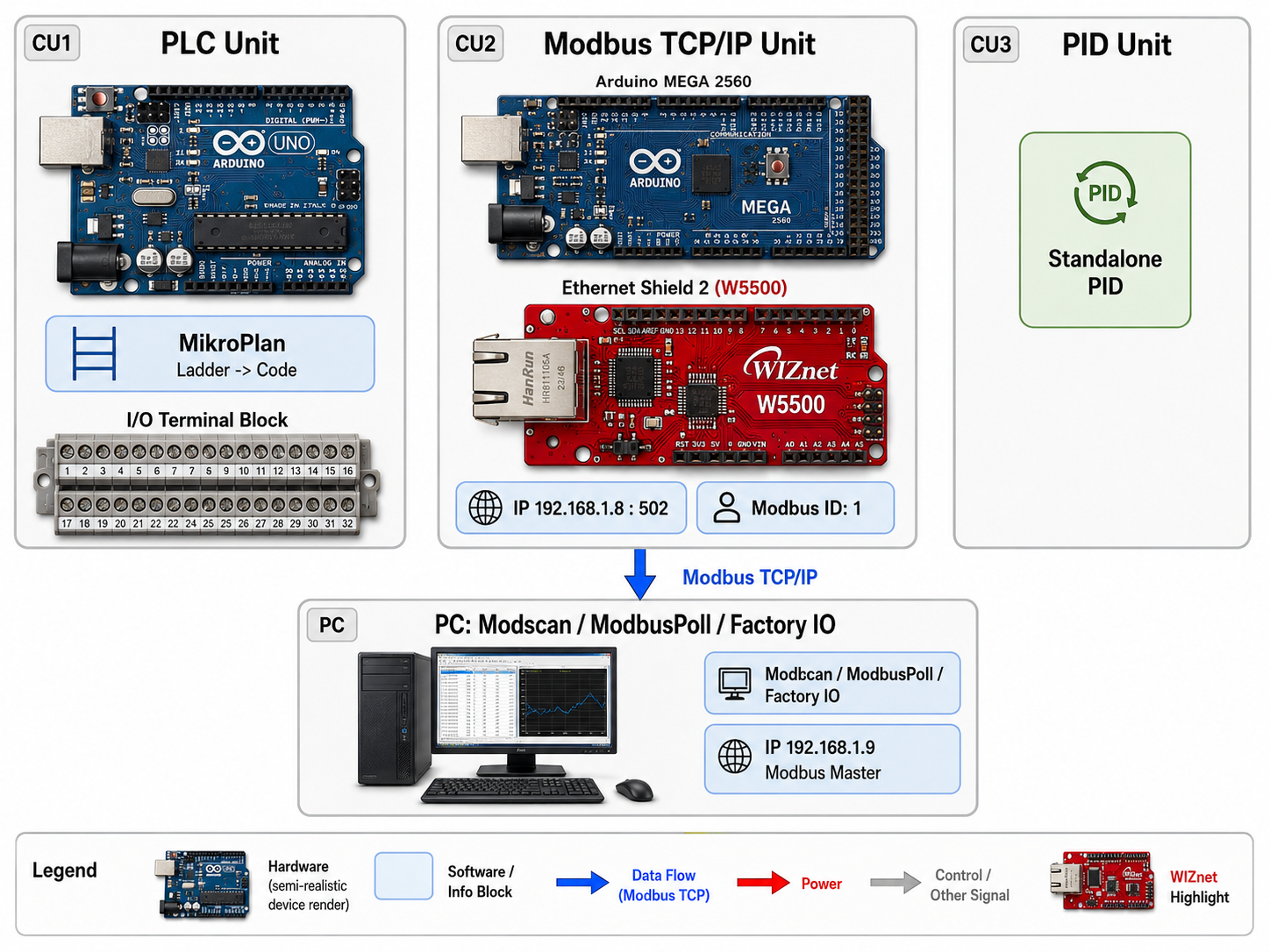
산업자동화를 배우려는 학생이나 아마추어에게 상용 PLC 트레이너는 여전히 비싼 진입장벽입니다. 저자 saifalikabi는 이 문제를 Arduino UNO와 MEGA로 대체하는 방식으로 풀었습니다. 보드는 CU1(PLC/래더 로직), CU2(Modbus TCP/IP), CU3(PID 튜닝) 세 개의 독립 유닛으로 나뉘어 있어, 학습자가 개념별로 하나씩 붙잡고 익힐 수 있게 구성되어 있습니다.
이 구성에서 눈에 띄는 부분은 CU2입니다. Modbus TCP/IP 통신을 실제로 구현하려면 하드웨어 수준의 네트워크 처리가 필요한데, 여기서 Arduino Ethernet Shield 2, 즉 WIZnet W5500 칩이 등장합니다.
도입 배경 / 왜 필요한가
산업적·정책적 필요성은 확인됩니다. Arduino는 2023년 Opta 기반 공식 **"PLC Starter Kit"**를 출시하며 IEC 61131-3 5개 언어(래더 다이어그램 포함)를 지원하는 교육용 제품을 내놓았습니다. 이는 본 프로젝트가 다루는 문제, 즉 저비용 산업자동화 교육 도구의 시장 수요가 실재함을 뒷받침합니다.
→ 참고: Arduino PLC Starter Kit, Hackster News
반면 이 저장소 자체의 기관·산업 도입 사례는 확인되지 않습니다. GitHub(saifalikabi/PLC_TRAINING_CENTER)는 Star 2, Fork 2에 그치고 언론 보도도 없어, 개인 메이커의 튜토리얼 프로젝트로 보는 것이 타당합니다. 즉 산업적 필요성은 확인되지만, 이 특정 구현체가 실제 교육 현장에 채택되었다는 근거는 없습니다.
더 넓은 흐름: 오픈소스 하드웨어의 산업 진출
이 문제의식은 Arduino 한 제품에 국한되지 않습니다. Arduino는 2020년 Arduino Pro 라인(Portenta H7)을 출시하며 취미 시장 중심에서 기업·산업 시장으로 축을 옮기기 시작했고, 2022년 Opta(Finder와 공동 개발한 "마이크로 PLR/PLC")를 발표한 데 이어 2023년 PLC Starter Kit까지 내놓으며 산업자동화 교육이라는 영역을 명시적으로 공략했습니다. Arduino는 2024년 기준 3만 개 이상의 기업이 Arduino Pro 하드웨어·클라우드·교육 키트를 사용 중이라고 밝혔습니다.
→ 참고: Arduino at Automate 2024 (Businesswire)
이런 흐름은 Arduino만의 이야기가 아닙니다. Raspberry Pi 역시 2024년 기준 판매된 보드·모듈의 72%가 산업·임베디드 고객으로 흘러갔다고 밝혔고, 최근에는 컴퓨트 모듈 등 반도체 물량이 일반 보드 물량을 넘어서는 수준까지 산업 비중이 커졌습니다. 오픈소스 하드웨어 진영 전반이 "취미용 개발보드"에서 "저비용 산업 자동화·임베디드 플랫폼"으로 무게중심을 옮기고 있다는 신호로 읽을 수 있습니다.
→ 참고: Raspberry Pi 산업 비중 확대 (The Register), Eben Upton 인터뷰 (IEEE Spectrum)
흥미로운 지점은 시점입니다. 본 프로젝트는 2019년에 게시되어, Arduino가 산업용 라인을 공식화하기 이전(Pro 2020년, Opta 2022~2023년)에 이미 "Arduino로 상용 PLC를 대체한다"는 아이디어를 개인 메이커 수준에서 구현한 셈입니다. 회사가 뒤늦게 같은 문제의식을 제품화했다는 점에서, 이 프로젝트는 커뮤니티 수요가 기업의 공식 로드맵보다 먼저 움직인 사례로 볼 수 있습니다.
아키텍처
기술 배경
Modbus TCP/IP
Modbus TCP/IP는 Modbus RTU의 메시지 구조를 TCP/IP 위에 얹은 산업 통신 표준으로, 포트 502를 통해 마스터-슬레이브 방식으로 레지스터를 주고받습니다. 이 프로젝트의 CU2는 Arduino MEGA를 Modbus 슬레이브로 동작시켜, PC의 Modscan·ModbusPoll·Factory IO가 마스터로서 접속하는 구조입니다.
→ 참고: Modbus Application Protocol Specification
IEC 61131-3 래더 다이어그램
IEC 61131-3은 PLC 프로그래밍 언어를 표준화한 국제 규격으로, 래더 다이어그램(LD)·구조화 텍스트(ST) 등 5개 언어를 정의합니다. CU1은 MikroPlan이라는 도구로 래더 로직을 Arduino 코드로 변환하는 방식을 취하며, 이는 실제 산업 현장의 PLC 프로그래밍 경험을 저비용으로 재현하려는 시도입니다.
PID 제어 (Proportional-Integral-Derivative)
PID 제어는 목표값과 현재값의 오차를 비례(P)·적분(I)·미분(D) 세 항으로 계산해 출력을 보정하는 자동제어 이론으로, 온도·압력·속도 제어 등 산업 공정 전반에서 가장 널리 쓰이는 제어 기법입니다. 오차 크기에 비례해 반응하는 P항, 누적 오차를 없애는 I항, 오차 변화율에 반응해 오버슈트를 억제하는 D항이 함께 작동합니다. CU3는 포텐셔미터와 HMI 지표를 통해 이 게인 조정을 직접 체험하도록 설계되어 있어, 학습자가 수식이 아닌 손끝 감각으로 제어 개념을 익히게 합니다.
→ 참고: The PID Controller & Theory Explained (NI)
기술 특징
- 분리형 구조: CU1/CU2/CU3을 물리적으로 나눈 덕분에 학습자는 개념 하나씩 독립적으로 이해할 수 있음. 다만 통합 제어 로직이 없어 실제 산업 PLC의 "단일 CPU 통합" 방식과는 거리가 있음
- MEGA 선택 이유: 저자는 UNO 사용 시 일부 크래시 가능성을 언급하며 MEGA를 권장 — Modbus TCP 스택 처리에 필요한 메모리·핀 자원 확보 목적으로 추정
- 터미널 기반 배선: 브레드보드 대신 터미널 단자대와 태그를 사용해 실제 산업 배전반과 유사한 형태로 구성, 실습 현실감 강화
WIZnet 적용 구조
이 프로젝트에서 W5500이 실제로 하는 일
- PC의 Modscan/ModbusPoll이
192.168.1.8:502로 접속을 시도 - W5500이 TCP 3-way handshake, ARP, 소켓 관리를 전담 — MEGA는 이 과정에 전혀 관여하지 않음
- TCP로 도착한 Modbus 요청(레지스터 읽기/쓰기 명령)만 SPI를 통해 W5500이 MEGA로 전달
- MEGA는 스케치에서 해당 레지스터 값(디지털 I/O 상태 등)을 읽고 응답값을 다시 W5500에 넘김
- W5500이 이 응답을 TCP 패킷으로 재포장해 PC로 회신
비유하자면 W5500은 물류센터처럼 패킷의 포장·주소 처리·배송을 전담하고, MEGA는 "상자 안에 무엇을 넣을지"— 즉 레지스터 값만 결정합니다.
기존 구조라면: MEGA가 소프트웨어 스택 기반 이더넷 칩(예: ENC28J60)을 썼을 경우, 제한된 SRAM의 상당 부분을 TCP/IP 스택 처리에 소모 → 앞서 언급한 "UNO 크래시" 문제가 MEGA에서도 재현될 위험이 있습니다.
W5500 적용 구조: 32KB 내장 버퍼로 TCP/IP 스택 전체를 하드웨어에서 처리하므로, MEGA의 연산 자원은 오직 Modbus 레지스터 매핑 로직에만 집중됩니다.
기대 효과: 소켓 프로그래밍이 필요 없어 코드 복잡도 감소, Modbus 응답 지연시간 안정화. CU1·CU3와 달리 CU2에만 "MEGA 필수" 조건이 붙는 이유도 여기서 설명됩니다 — 통신 오프로딩 이후 남은 MCU 자원이 UNO에서는 부족하기 때문입니다.
WIZnet Makers 유사 사례
- Ethernet Shields V2.0 and Modbus TCP Communication(WIZnet 공식): 동일한 Shield 계열과 Modbus TCP 통신 목적을 공유하지만, 이쪽은 칩 스펙 설명에 집중한 공식 예제이고 본 프로젝트는 완제품 교육 트레이너로 확장 구현했다는 차이가 있습니다.
→ 프로젝트 링크: https://maker.wiznet.io/WIZnet/projects/ethernet-shields-v2-0-and-modbus-tcp-communication/ - Arduino-compatible PLC CONTROLLINO, part 1: Arduino 호환 PLC에 WIZnet W5100이 탑재된 상용 완제품으로, 본 프로젝트가 DIY로 구현한 것을 이미 DIN 레일 상용화한 사례입니다. W5100(구세대)과 W5500(신세대)의 세대 차이도 드러납니다.
→ 프로젝트 링크: https://maker.wiznet.io/teddy/projects/arduino-compatible-plc-controllino,-part-1/ - Siemens S7-1200 to Arduino Modbus TCP/IP Communications Part 3~5: Arduino가 실제 상용 PLC(Siemens)와 Modbus TCP로 상호운용하는 사례로, 조회수 6,202로 유사 주제 중 가장 높은 관심도를 보입니다. 본 프로젝트가 PLC를 자체 대체하는 것과 달리, 이쪽은 상용 PLC와의 연동 검증에 초점을 둡니다.
→ 프로젝트 링크: https://maker.wiznet.io/scarlet/projects/siemens-s7-1200-to-arduino-modbus-tcp-ip-communications-part-3-5/
세 사례 모두 Arduino + WIZnet 칩 조합이 산업자동화 통신(Modbus TCP)의 저비용 구현 수단으로 반복 채택되고 있음을 보여줍니다.
| 항목 | 본 프로젝트 | Ethernet Shields V2.0 | CONTROLLINO | Siemens↔Arduino |
|---|---|---|---|---|
| MCU | UNO + MEGA | 미상 | ATmega2560 | 미상 |
| 네트워크 칩 | W5500 | W5500 계열 | W5100 | 미상 |
| 대상 규모 | 개인/교육용 1대 | WIZnet 공식 예제 | 상용 완제품(DIN 레일) | 산업 현장 연동 사례 |
| 주요 기능 | PLC+Modbus+PID 통합 실습 | Modbus TCP 데모 | 산업 I/O+Ethernet+RS-485 PLC | Siemens PLC 연동 |
| 저장소 | GitHub(Star 2) | 미상 | 미상 | 미상 |
표에서 드러나듯, 본 프로젝트는 가장 저비용·교육 특화 구성인 반면 CONTROLLINO는 이미 상용화 단계, Siemens 연동 사례는 실제 산업 PLC와의 호환성 검증에 무게를 둡니다.
비즈니스 가치
외부 관점 (고객/시장)
- 교육기관 실습장: 직업훈련원·공대 자동화 실습실의 저비용 트레이너 대체
- 기업 사내 교육: 자동화 엔지니어 신규 채용자 대상 Modbus TCP·래더 로직 온보딩 도구
- 개인 학습: 상용 PLC 구매 전 IEC 61131-3 개념을 저비용으로 먼저 체험
- 원격 모니터링 확장: CU2 구조를 확장하면 SCADA 연동 실습으로도 발전 가능
- 커리큘럼 내구성: 앞서 짚었듯 Arduino·Raspberry Pi 모두 산업 시장으로 무게중심을 옮기는 중이라, 이런 저비용 PLC/Modbus 트레이너 수요는 일시적 유행이 아니라 구조적으로 커지는 시장입니다. 특정 보드사가 아니라 "Modbus TCP + 하드웨어 이더넷 칩"이라는 조합 자체를 가르치기 때문에, 향후 어떤 OSHW 플랫폼이 산업 표준으로 자리잡든 교육기관이 이미 확보한 커리큘럼·장비의 재사용성이 높습니다.
내부 관점 (WIZnet)
- "곡괭이와 삽" 포지션: Arduino Ethernet Shield 2(W5500)와 CONTROLLINO(W5100) 사례에서 보듯, OSHW 진영이 저마다 산업용 라인을 내놓는 경쟁 구도에서 정작 네트워크 계층은 WIZnet 칩으로 수렴하는 패턴이 반복됩니다. 어떤 보드사가 산업자동화 교육 시장의 승자가 되든, Modbus TCP·EtherCAT 같은 산업 프로토콜을 얹으려면 결국 하드웨어 TCP/IP 오프로딩 칩이 필요하기 때문입니다.
- 콘텐츠 전략 시사점: 이번 사례처럼 "OSHW + 산업자동화 교육"이라는 교차점은 여러 벤더(Arduino, CONTROLLINO 등)에 걸쳐 반복적으로 나타나는 니치입니다. WIZnet이 특정 보드사에 종속되지 않는 Modbus TCP 교육용 레퍼런스 디자인·콘텐츠를 선제적으로 축적하면, 향후 어느 보드가 시장을 주도하더라도 "산업 프로토콜을 가르치려면 결국 WIZnet 문서를 본다"는 포지션을 확보할 수 있습니다.
한계 및 개선 방향
현재 구조는 UNO 사용 시 크래시 가능성을 저자 스스로 인정할 만큼 리소스 여유가 크지 않고, CU1/CU2/CU3이 완전히 분리되어 통합 제어 로직이 없습니다. 또한 CU1의 MikroPlan 소프트웨어는 출처·버전이 명확하지 않아 재현성이 떨어지고, 2019년 이후 업데이트가 없어 Ethernet Shield 2도 사실상 단종 단계에 접어들었습니다.
개선 기회로는 세 유닛을 하나의 MEGA+W5500 조합으로 통합해 Modbus 레지스터로 CU1·CU3 상태까지 함께 노출시키는 방향을 고려할 수 있습니다. 이렇게 하면 SCADA나 HMI 소프트웨어에서 PLC·통신·PID를 하나의 화면으로 모니터링하는 실습으로 확장할 수 있습니다. 네트워크 칩도 최신 W6100으로 교체하면 IPv6 등 추가 기능을 다루는 심화 실습이 가능해집니다.
FAQ
Q1. Arduino 경험이 없어도 따라 만들 수 있나요? 난이도는 Hackster 기준 "Advanced"로 표기되어 있습니다. 배선·솔더링·Modbus 개념을 모두 다루므로 Arduino 기초는 사전에 익히는 것을 권장합니다.
Q2. 네트워크 설정에서 주의할 점은? CU2는 고정 IP(192.168.1.8)를 코드에 하드코딩하며, PC측 IP를 192.168.1.9로 맞춰야 합니다. DHCP가 아니므로 사내망 IP 대역과 충돌하지 않는지 사전 확인이 필요합니다.
Q3. UNO 대신 MEGA를 꼭 써야 하나요? 저자는 UNO 사용 시 일부 크래시가 발생할 수 있다고 언급합니다. Modbus TCP 스택이 메모리를 상당히 사용하므로 MEGA를 권장합니다.
Q4. Ethernet Shield 2가 단종되면 대체 가능한가요? 같은 W5500 기반의 다른 보드나 최신 W6100 기반 모듈로 대체 가능합니다. 다만 라이브러리 호출 방식이 일부 다를 수 있어 코드 수정이 필요합니다.
Q5. 유지보수/비용 측면에서 상용 PLC 대비 이점은? 초기 BOM 비용은 상용 트레이너 대비 크게 낮지만, 문서화가 부족해 문제 발생 시 자체 디버깅 역량이 필요합니다.
Summary
PLC Training Center is an Arduino-based training kit that lets learners practice ladder logic, Modbus TCP/IP, and PID tuning on a single board, without buying a commercial PLC trainer. The communication unit, CU2, runs on an Arduino Ethernet Shield 2, and at the heart of that shield sits WIZnet's W5500 hardwired TCP/IP chip. With over 41,000 views, it remains a frequently referenced reference project for people getting started in industrial automation.
Overview
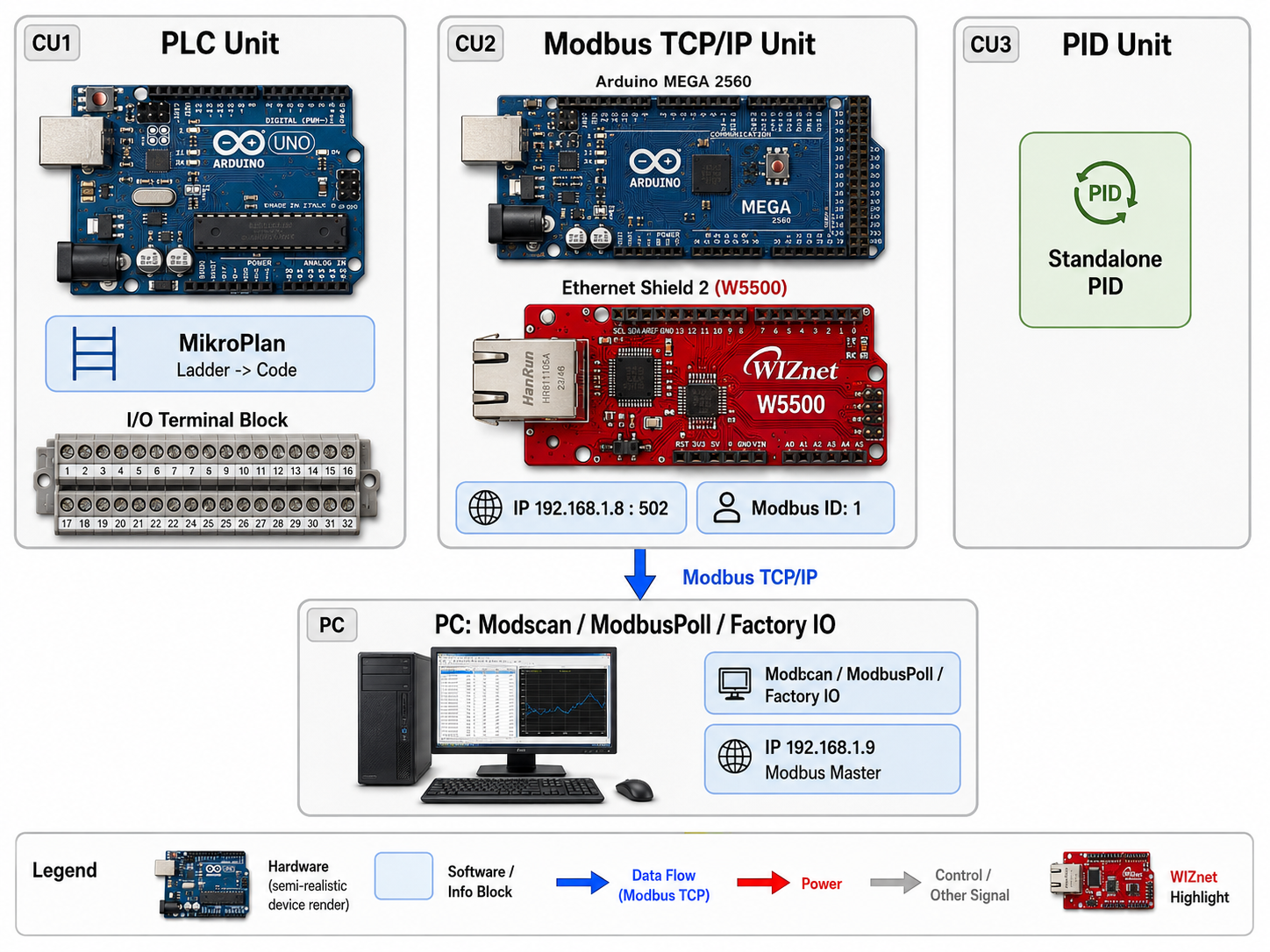
For students and hobbyists trying to learn industrial automation, a commercial PLC trainer is still an expensive barrier to entry. Creator saifalikabi solved this by replacing it with Arduino UNO and MEGA boards. The rig is split into three independent control units — CU1 (PLC / ladder logic), CU2 (Modbus TCP/IP), and CU3 (PID tuning) — so learners can tackle one concept at a time.
The standout piece is CU2. Implementing Modbus TCP/IP communication requires hardware-level network processing, and that's exactly where the Arduino Ethernet Shield 2 — and the WIZnet W5500 chip inside it — comes in.
Why This Matters
The industry-level need here is confirmed. In 2023, Arduino released its official Opta-based "PLC Starter Kit," supporting all five IEC 61131-3 languages including Ladder Diagram. That's solid evidence that the market genuinely needs low-cost industrial-automation training tools — the exact problem this project addresses.
→ Reference: Arduino PLC Starter Kit, Hackster News
What's not confirmed is any institutional or industrial adoption of this specific repository. The GitHub repo (saifalikabi/PLC_TRAINING_CENTER) has only 2 stars and 2 forks, with no press coverage — this reads as an individual maker's tutorial project rather than something adopted by a school or company. In short: the industry-level need is real, but there's no evidence this particular build was ever formally adopted.
The bigger picture: open-source hardware's push into industry
This isn't just an Arduino story. Arduino launched its Arduino Pro line (starting with the Portenta H7) in 2020, shifting its center of gravity from hobbyists toward enterprise and industrial customers. That was followed by Opta in 2022 — a "micro PLR/PLC" co-developed with Finder — and the PLC Starter Kit in 2023, explicitly targeting industrial-automation education. By 2024, Arduino reported that more than 30,000 companies were using Arduino Pro hardware, Arduino Cloud, and its education kits.
→ Reference: Arduino at Automate 2024 (Businesswire)
The same trend shows up at Raspberry Pi: as of 2024, the company reported that 72% of the boards and modules it sold went to industrial and embedded customers, and its Compute Module / semiconductor volumes have started to outpace standard board sales. Read together, this looks like a broader signal — open-source hardware as a whole is shifting its center of gravity from "hobbyist dev boards" toward "low-cost industrial automation and embedded platforms."
→ Reference: Raspberry Pi's industrial shift (The Register), Eben Upton interview (IEEE Spectrum)
The timing is worth noting. This project was published in 2019 — before Arduino had formalized its industrial line (Pro in 2020, Opta in 2022–2023). In other words, an individual maker had already implemented the idea of "replacing a commercial PLC with Arduino" at the hobbyist level, years before the company caught up with an official product addressing the same problem. Seen this way, the project is a case where community demand moved ahead of the corporate roadmap.
Architecture
Technology Background
Modbus TCP/IP
Modbus TCP/IP layers the Modbus RTU message structure on top of TCP/IP, exchanging registers in a master-slave model over port 502. In this project, CU2 runs Arduino MEGA as a Modbus slave, while PC-side tools — Modscan, ModbusPoll, Factory IO — act as the master.
→ Reference: Modbus Application Protocol Specification
IEC 61131-3 Ladder Diagram
IEC 61131-3 is the international standard that defines PLC programming languages, including Ladder Diagram (LD) and Structured Text (ST) among five total languages. CU1 uses a tool called MikroPlan to convert ladder logic into Arduino code — an attempt to reproduce real-world PLC programming experience at low cost.
PID Control (Proportional-Integral-Derivative)
PID control is a feedback-control theory that computes an error between a setpoint and the current value, then corrects the output using three terms — Proportional (P), Integral (I), and Derivative (D). It's the most widely used control technique across industrial processes such as temperature, pressure, and speed control. The P term reacts in proportion to the size of the error, the I term eliminates accumulated steady-state error, and the D term dampens overshoot by responding to the rate of change. CU3 is built so learners adjust these gains directly via a potentiometer and HMI indicator — letting them internalize control concepts by feel rather than formula.
→ Reference: The PID Controller & Theory Explained (NI)
Technical Highlights
- Split-unit design: Separating CU1/CU2/CU3 physically lets learners grasp each concept independently — though it also means there's no integrated control logic, unlike a real industrial PLC's single-CPU design.
- Why MEGA: The creator notes that UNO can occasionally crash, recommending MEGA instead — likely to free up the memory and pins needed for the Modbus TCP stack.
- Terminal-based wiring: Terminal blocks and wire tags replace breadboards, giving the rig a look and feel closer to a real industrial panel and reinforcing the hands-on training experience.
Where WIZnet Fits
What the W5500 actually does in this project
- The PC-side Modscan/ModbusPoll tool attempts a connection to
192.168.1.8:502 - The W5500 handles the TCP three-way handshake, ARP, and socket management entirely on its own — the MEGA never touches this process
- Once a TCP-carried Modbus request (a register read/write command) arrives, only that payload is passed to the MEGA over SPI
- The MEGA reads or writes the relevant register value (a digital I/O state, for example) in its sketch and hands the response back to the W5500
- The W5500 repackages that response into a TCP packet and sends it back to the PC
Think of the W5500 as a logistics center: it handles all the packaging, addressing, and delivery of the "packages" (packets), while the MEGA only decides what goes inside the box — the register values.
Without it: if the MEGA instead used a software-stack Ethernet chip (like an ENC28J60), a large share of its limited SRAM would go toward processing the TCP/IP stack — reintroducing the same crash risk mentioned earlier for the UNO.
With the W5500: its 32KB onboard buffer handles the entire TCP/IP stack in hardware, so the MEGA's compute budget stays focused purely on Modbus register-mapping logic.
Payoff: no socket programming required, lower code complexity, and more stable Modbus response latency. This is also why CU2 — unlike CU1 or CU3 — specifically requires a MEGA: once communication is offloaded, whatever MCU resources remain are simply too tight on a UNO.
Similar Projects on WIZnet Makers
- Ethernet Shields V2.0 and Modbus TCP Communication (official WIZnet): shares the same shield family and Modbus TCP goal, but this one is an official example focused on explaining the chip's specs, while our project extends that into a full teaching rig.
→ Project link: https://maker.wiznet.io/WIZnet/projects/ethernet-shields-v2-0-and-modbus-tcp-communication/ - Arduino-compatible PLC CONTROLLINO, part 1: a commercial, Arduino-compatible PLC built around WIZnet's W5100 — essentially a DIN-rail-mounted, commercialized version of what our project builds as a DIY rig. It also highlights the generational gap between W5100 (older) and W5500 (newer).
→ Project link: https://maker.wiznet.io/teddy/projects/arduino-compatible-plc-controllino,-part-1/ - Siemens S7-1200 to Arduino Modbus TCP/IP Communications Part 3~5: a case where Arduino interoperates with a real commercial PLC (Siemens) over Modbus TCP, with 6,202 views — the highest engagement among comparable topics. Where our project replaces the PLC outright, this one focuses on verifying interoperability with one.
→ Project link: https://maker.wiznet.io/scarlet/projects/siemens-s7-1200-to-arduino-modbus-tcp-ip-communications-part-3-5/
All three cases show the same pattern: Arduino + a WIZnet chip keeps getting adopted as the low-cost way to implement industrial-automation communication (Modbus TCP).
| Item | This Project | Ethernet Shields V2.0 | CONTROLLINO | Siemens ↔ Arduino |
|---|---|---|---|---|
| MCU | UNO + MEGA | Not disclosed | ATmega2560 | Not disclosed |
| Network chip | W5500 | W5500 family | W5100 | Not disclosed |
| Scale | Single unit, personal/educational | Official WIZnet example | Commercial product (DIN rail) | Field-integration case |
| Key function | Integrated PLC + Modbus + PID training | Modbus TCP demo | Industrial I/O + Ethernet + RS-485 PLC | Siemens PLC integration |
| Repository | GitHub (2 stars) | Not disclosed | Not disclosed | Not disclosed |
The table makes the positioning clear: this project is the most affordable, education-focused build, CONTROLLINO is already a commercialized product, and the Siemens integration case is weighted toward verifying compatibility with a real industrial PLC.
Business Value / Use Cases
External view (customers/market)
- Training institutions: a low-cost substitute for commercial trainers in vocational schools and university automation labs
- Corporate training: an onboarding tool for new automation engineers to learn Modbus TCP and ladder logic
- Individual learning: a way to experience IEC 61131-3 concepts cheaply before investing in a commercial PLC
- Remote-monitoring extension: CU2's structure can be extended into SCADA-integration exercises
- Curriculum durability: as noted above, both Arduino and Raspberry Pi are shifting weight toward industrial markets, so demand for this kind of low-cost PLC/Modbus trainer isn't a passing trend — it's structurally growing. Because the curriculum teaches "Modbus TCP + a hardware Ethernet chip" rather than any single board brand, whichever OSHW platform ends up dominating industrial use, the equipment and curriculum institutions have already built stay reusable.
Internal view (WIZnet)
- A "picks and shovels" position: as seen with Arduino Ethernet Shield 2 (W5500) and CONTROLLINO (W5100), even as OSHW vendors compete to release their own industrial lines, the networking layer keeps converging on WIZnet chips. Whichever board wins the industrial-education market, adding a protocol like Modbus TCP or EtherCAT still requires a hardware TCP/IP offload chip.
- Content strategy implication: the "OSHW + industrial-automation education" intersection keeps showing up across multiple vendors (Arduino, CONTROLLINO, and others). If WIZnet proactively builds vendor-agnostic Modbus TCP reference designs and educational content, it can secure a lasting position — "whichever board ends up leading, you still end up reading WIZnet's documentation to teach industrial protocols."
Limitations and Future Improvements
The current design isn't especially resource-generous — the creator himself notes that UNO can crash — and because CU1/CU2/CU3 are fully separated, there's no integrated control logic. The CU1 software, MikroPlan, also has an unclear source and version, hurting reproducibility, and the project hasn't been updated since 2019, by which point the Ethernet Shield 2 itself is effectively end-of-life.
One improvement path worth considering: consolidate the three units around a single MEGA + W5500 combo, exposing CU1 and CU3 status through the same Modbus registers. That would let SCADA or HMI software monitor PLC, communication, and PID all from one screen. Swapping the network chip for a newer W6100 would also open the door to deeper exercises involving features like IPv6.
FAQ
Q1. Can I build this without prior Arduino experience? Hackster rates this "Advanced." It touches wiring, soldering, and Modbus concepts all at once, so some Arduino basics beforehand are recommended.
Q2. What should I watch out for in the network setup? CU2 hardcodes a static IP (192.168.1.8) into the code, and the PC side needs to be set to 192.168.1.9. Since it's not DHCP, check in advance that it doesn't collide with your existing network's IP range.
Q3. Do I really need a MEGA instead of a UNO? The creator mentions that the UNO can occasionally crash. Since the Modbus TCP stack uses a fair amount of memory, MEGA is recommended.
Q4. If the Ethernet Shield 2 gets discontinued, is there a replacement? Yes — other W5500-based boards, or newer W6100-based modules, can substitute. Library calls may differ slightly, so some code changes would be needed.
Q5. How does this compare to a commercial PLC in terms of maintenance and cost? Upfront BOM cost is far lower than a commercial trainer, but documentation is thin, so you'll need your own debugging skills when something goes wrong.