



How to Add W5500 Ethernet to ESP32 on Zephyr: A Mender.io Case Study
How to Add W5500 Ethernet to ESP32 on Zephyr: A Mender.io Case Study
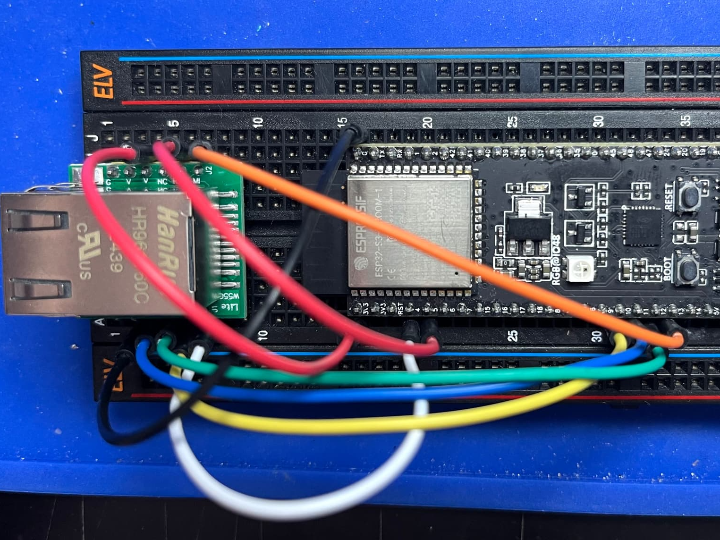
임베디드 시장의 판도가 바뀌고 있습니다. 리눅스 재단이 주관하는 Zephyr RTOS가 급성장하며, MCU 기반의 산업용 IoT(IIoT) 개발의 표준으로 자리 잡고 있습니다.
최근 Mender Hub에 게시된 "Adding a W5500 Ethernet adapter to Zephyr (ESP32)" 프로젝트는 이러한 트렌드를 상징적으로 보여줍니다. 전 세계 개발자들은 이미 ESP32와 Zephyr 환경에서 안정적인 네트워크 연결을 위해 WIZnet의 W5500을 선택하고 있습니다.
이 글에서는 해당 프로젝트의 성공 요인을 분석하고, 역설적으로 드러난 기술적 한계(MACRAW 모드)를 통해 WIZnet이 글로벌 시장 리더십을 확보하기 위해 나아가야 할 방향을 제언하고자 합니다.
1. 현황 분석: Mender 프로젝트의 구현 방식과 MACRAW의 함정
(1) 프로젝트 개요: "코드 없이 설정만으로"
Mender Hub에 공개된 이 프로젝트(TheYoctoJester 작성)는 ESP32-S3 기반 Zephyr 시스템에서 Wi-Fi의 불안정성을 극복하기 위해 W5500 유선 이더넷을 도입한 사례입니다.
가장 돋보이는 점은 구현의 간결함입니다. 복잡한 C 코드를 한 줄도 작성하지 않고, Zephyr의 표준 빌드 시스템인 Device Tree와 Kconfig 설정만으로 네트워크를 활성화했습니다.
- Device Tree:
compatible = "wiznet,w5500"(하드웨어 정의) - Kconfig: 드라이버 로드 및 네트워크 스택 활성화
(2) 기술적 실체: 하드웨어를 끄고 소프트웨어를 켜다
설정 파일(my_w5500.conf)을 분석해보면 이 프로젝트의 동작 방식이 명확히 드러납니다.
CONFIG_NET_L2_ETHERNET=y
이 설정은 Zephyr 커널이 이더넷 프레임(Layer 2)을 직접 생성하고 해석하겠다는 선언입니다. 즉, W5500의 내부 하드웨어 스택(Hardwired TCP/IP)을 끄고, 칩을 단순한 '데이터 통로(Pass-through)'로만 사용하는 MACRAW 모드를 선택한 것입니다.
(3) 반쪽짜리 활용의 함정 (The Trap)
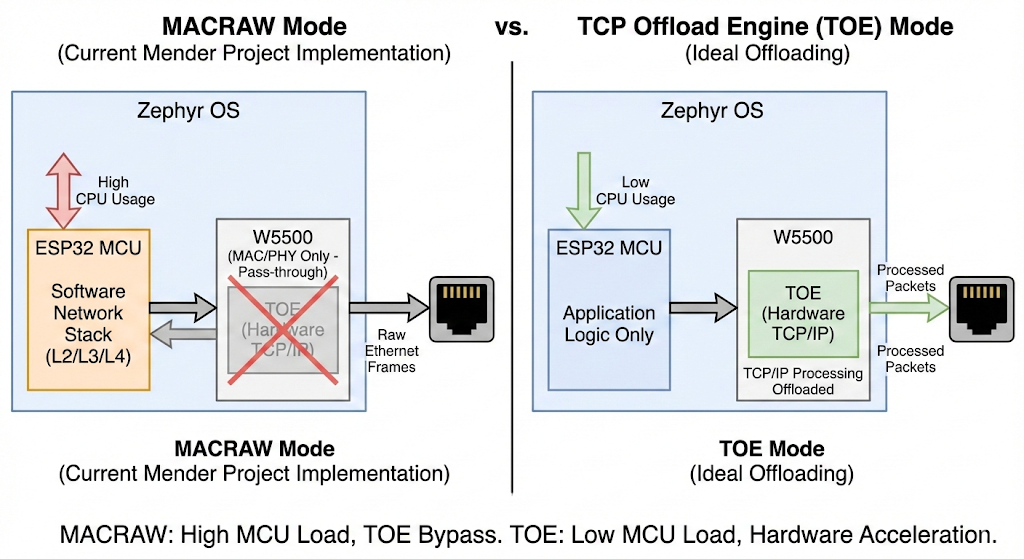
이 방식은 겉보기엔 Zephyr의 표준 소켓과 완벽하게 호환되어 Mender OTA나 MQTT가 잘 동작하는 것처럼 보입니다. 하지만 여기에는 치명적인 숨겨진 비용이 존재합니다.
- TOE(TCP Offload Engine) 비활성화: W5500의 핵심 무기인 하드웨어 가속 엔진이 꺼져 있습니다(Bypass).
- MCU 과부하: 체크섬 계산, 패킷 재전송, 버퍼 관리 등 네트워크 통신의 모든 부하를 호스트 MCU(ESP32)가 온전히 감당해야 합니다.
결국, 이 프로젝트는 연결에는 성공했으나 W5500의 성능을 100% 활용하지 못한, 기술적으로는 반쪽짜리 성공에 불과합니다.
2. 왜 ESP32에서 Zephyr인가? (Why Zephyr is Hot?)
그럼에도 불구하고 왜 개발자들은 Zephyr를 고집할까요?
- "MCU계의 리눅스": Zephyr는 리눅스 스타일의 개발 환경(Device Tree, Kconfig)을 제공하여 하드웨어 추상화와 코드 재사용성이 압도적입니다. 인텔, NXP, 노르딕 등 반도체 거인들이 주도하는 가장 강력한 생태계입니다.
- 산업 표준화: 단순 펌웨어를 넘어 보안, 네트워킹, 파일 시스템, 그리고 OTA까지 표준화된 모듈로 제공됩니다. 이제 산업용 장비 개발에서 Zephyr 지원 여부는 선택이 아닌 필수가 되었습니다.
3. 전략적 과제: 왜 Zephyr 전용 Offloading 드라이버인가?
여기서 WIZnet의 기회와 과제가 명확해집니다.
현재의 한계
기존 Zephyr 생태계의 드라이버는 소프트웨어 스택 중심입니다. 따라서 W5500을 쓰더라도 MACRAW 모드로 동작하며, 이는 ESP32 같은 고사양 MCU가 아니면 네트워크 기능을 원활히 돌리기 어렵게 만듭니다. 리소스가 적은 Cortex-M0/M3 급 MCU에서는 '그림의 떡'인 셈입니다.
W5500의 기회 (Solution)
우리는 Zephyr 호환 Offloading 드라이버를 개발해야 합니다. W5500 내부의 하드웨어 TCP/IP 엔진(TOE)이 Zephyr의 소켓 통신 요청을 대신 처리하도록 드라이버 레벨에서 매핑해 주는 것입니다.
기대 효과
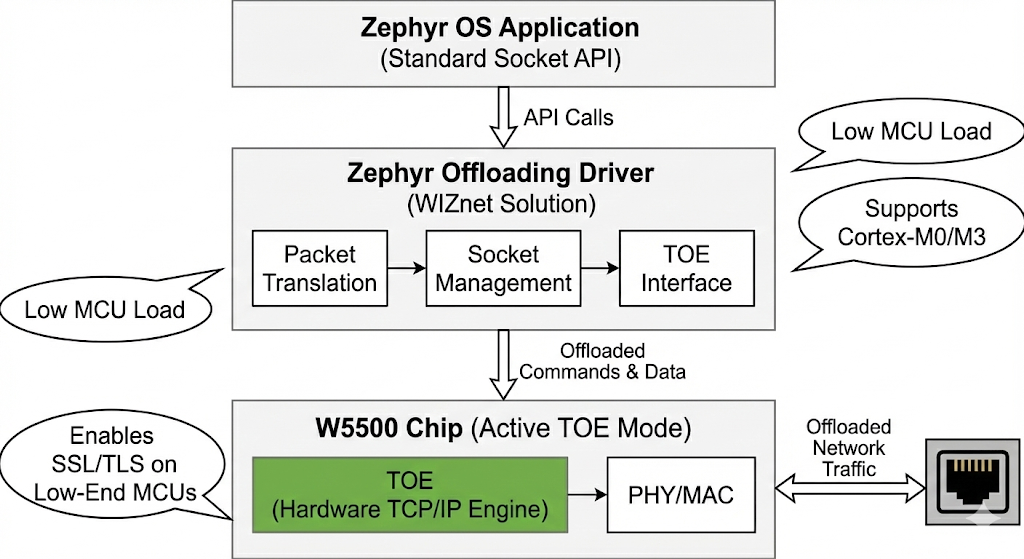
- MCU 리소스 해방: TCP/IP 처리를 칩에 일임하여, 저사양 MCU에서도 Zephyr 기반의 고성능 네트워킹과 보안(SSL/TLS) 구현이 가능해집니다.
- 압도적 경쟁 우위: 단순 MAC/PHY 칩셋들은 흉내 낼 수 없는, MCU 부하 없는 순수 하드웨어 기반의 Zephyr 솔루션으로 시장 내 독보적인 위치를 점유할 수 있습니다.
4. Mender와 W5500이 만드는 "ESP32를 위한 벽돌 방지 OTA""
단순히 "업데이트가 된다"는 것과 "현장에서 사고 없이 업데이트된다"는 것은 차원이 다른 이야기입니다. 이 섹션에서는 Mender와 W5500의 결합이 어떻게 벽돌(Brick) 공포를 원천 차단하는지 기술적으로 분석합니다.
(1) Mender의 핵심: A/B 파티션 아키텍처와 원자성(Atomicity)
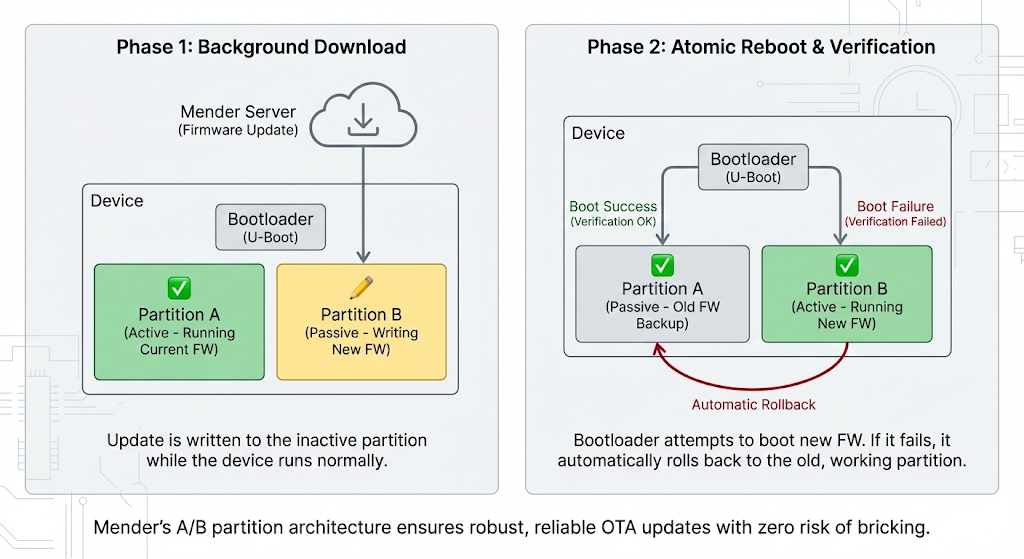
Mender는 파일 시스템을 'Active(현재 구동 중)'와 'Passive(대기 중)' 두 개의 파티션으로 나눕니다.
- 업데이트 과정: 새로운 펌웨어는 비어 있는 Passive 파티션에 백그라운드로 다운로드됩니다.
- 원자적 전환: 다운로드가 완벽히 검증(Checksum)된 후에만 부트로더가 부팅 순서를 바꿔 Passive 파티션으로 진입합니다.
- 자동 롤백: 만약 새 펌웨어 부팅 중 오류가 발생하면, 즉시 이전 파티션으로 복귀(Rollback)하여 장비 불통 사태를 막습니다.
(2) W5500의 역할: 무선이 넘볼 수 없는 "데이터 파이프라인의 신뢰성"
이러한 Mender의 안전장치도 '네트워크 연결' 자체가 불안하면 무용지물입니다. 수십 MB의 이미지를 전송하는 도중 Wi-Fi가 끊기면 재전송(Retry)이 반복되고, 이는 배터리 소모와 업데이트 시간 지연, 심한 경우 데이터 오염으로 이어집니다.
- 노이즈 내성: 모터와 인버터가 돌아가는 공장 환경에서 W5500의 유선 이더넷은 전파 간섭(EMI)의 영향을 받지 않는 가장 확실한 데이터 파이프라인을 제공합니다.
- OTA 성공률 99.9%: Mender가 소프트웨어적으로 '벽돌'을 막는다면, W5500은 하드웨어적으로 '전송 실패'를 막아 OTA 성공률을 엔터프라이즈 수준으로 끌어올립니다.
(3) Offloading 드라이버가 필요한 이유: "업데이트 중에도 기계는 돌아야 한다"
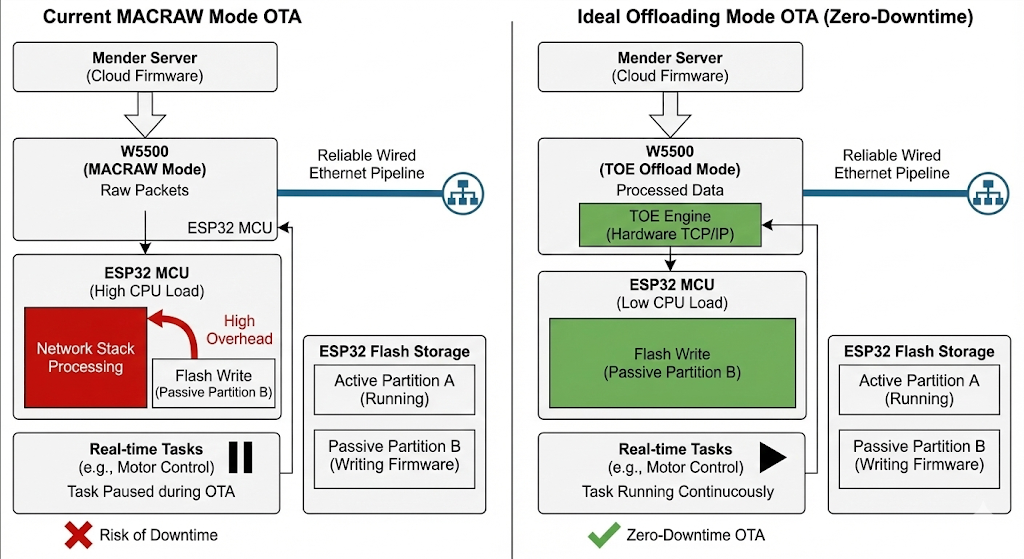
현재의 MACRAW 모드에서는 OTA 수행 시 ESP32의 CPU가 '패킷 수신'과 '플래시 메모리 쓰기'를 동시에 처리하느라 부하가 100%에 육박합니다. 이로 인해 업데이트 중에는 센서 수집이나 모터 제어가 일시 중단될 위험이 있습니다.
만약 Offloading 드라이버가 적용된다면?
- 역할 분담: W5500이 펌웨어 데이터 패킷을 받아 버퍼에 쌓아두면(TOE), MCU는 오직 플래시 메모리에 데이터를 쓰는 작업에만 집중하면 됩니다.
- Zero-Downtime: 이를 통해 OTA가 진행되는 동안에도 로봇 팔은 멈추지 않고, 센서 데이터는 유실 없이 수집되는 진정한 실시간성(Real-time)을 보장할 수 있습니다.
5. 전문가의 시선: TheYoctoJester의 선택이 갖는 무게
이 프로젝트를 단순한 '사용기'로 치부해선 안 되는 결정적인 이유는 바로 작성자의 권위(Authority)와 위치(Position) 때문입니다.
(1) Who is TheYoctoJester?
작성자 Josef Holzmayr는 닉네임처럼 'The Yocto Jester', 즉 임베디드 리눅스 빌드 시스템의 표준인 Yocto Project의 핵심 메인테이너이자, Mender.io(Northern.tech)의 Developer Relations 총괄(Head)입니다. 그는 전 세계 수천 개의 기업 고객이 겪는 임베디드 문제를 상담하고 해결책을 제시하는 위치에 있는 인물입니다.
(2) 그의 선택은 "표준 레퍼런스"다
그런 그가 수많은 네트워크 옵션 중 'Zephyr + W5500' 조합을 선택하여 가이드를 작성했다는 것은 다음과 같은 메시지를 담고 있습니다.
- 검증된 안정성: "내가 직접 테스트해 보니, 내 고객(엔터프라이즈 기업)들에게 추천해도 될 만큼 안정적이다."
- 사실상의 표준(De Facto Standard): Mender와 같은 고급 솔루션을 구동하기 위한 '최소 요구 사양'으로서 W5500을 인정한 것입니다.
(3) WIZnet을 향한 시그널
그의 프로젝트는 WIZnet에 중요한 신호를 보내고 있습니다. 글로벌 오픈소스 리더들은 이미 W5500을 준비된 하드웨어로 인식하고 있으며, 이제 남은 것은 그 하드웨어의 성능을 극대화해 줄 소프트웨어(Offloading Driver)뿐이라는 점입니다.
6. 결론 (Conclusion)
Mender 프로젝트를 통해 W5500은 Zephyr 생태계 진입에 성공했습니다. 호환성은 증명되었습니다.
이제는 '호환성(MACRAW)' 단계를 넘어 **'최적화(Offloading)'**로 나아가야 할 때입니다. 급부상하는 Zephyr 생태계에서 W5500의 하드웨어 가속 기능을 온전히 사용할 수 있는 전용 드라이버를 제공하는 것, 그것이 WIZnet이 글로벌 기술 리더십을 증명하고 시장을 선도할 수 있는 열쇠가 될 것입니다.
7. FAQs (자주 묻는 질문)
Q1. MACRAW 모드가 정확히 무엇인가요?
A. MACRAW 모드는 W5500의 TCP/IP 처리 기능(TOE)을 끄고, 단순히 랜선에서 들어오는 신호를 MCU로 전달하고, MCU가 보낸 신호를 랜선으로 내보내는 역할(MAC/PHY)만 수행하는 모드입니다. 이 경우 네트워크 패킷 처리는 전적으로 MCU(Zephyr SW Stack)가 담당합니다.
Q2. 왜 Zephyr에서는 기본적으로 MACRAW 모드를 사용하나요?
A. 리눅스나 Zephyr 같은 범용 OS는 네트워크 패킷을 OS 커널이 직접 제어하고 관리하는 것을 선호하는 구조를 가지고 있기 때문입니다. 따라서 표준 드라이버들도 하드웨어 가속보다는 호환성이 좋은 소프트웨어 스택 방식을 기본으로 채택하고 있습니다.
Q3. Offloading 드라이버를 개발하면 무엇이 좋아지나요?
A. 네트워크 처리를 MCU가 아닌 W5500 칩이 전담하게 됩니다. 따라서 MCU의 메모리(RAM)와 CPU 사용량이 획기적으로 줄어들어, 저사양 MCU에서도 복잡한 네트워크 기능을 구현할 수 있고 전력 소모도 줄일 수 있습니다.
Q4. 이 솔루션을 ESP32 외에 다른 칩에서도 쓸 수 있나요?
A. 네, 가능합니다. 그것이 바로 Zephyr OS의 장점입니다. Device Tree 설정만 변경하면 STM32, Nordic nRF 시리즈, RP2040 등 Zephyr가 지원하는 수백 종의 MCU에서 동일한 코드로 W5500을 사용할 수 있습니다.
Q5. Mender는 유료인가요?
A. Mender는 오픈소스 프로젝트로 기본 기능은 무료로 사용할 수 있습니다. 다만, 대규모 장치 관리나 고급 보안 기능이 필요한 기업을 위한 엔터프라이즈(유료) 플랜도 별도로 제공하고 있습니다.
Here is the English version of the article, optimized with ESP32 keywords to align with the AEO (Answer Engine Optimization) strategy, based on the Korean content we just finalized.
The landscape of the embedded market is shifting. Zephyr RTOS, hosted by the Linux Foundation, is rapidly growing and establishing itself as the standard for MCU-based Industrial IoT (IIoT) development.
A recent project on Mender Hub, "Adding a W5500 Ethernet adapter to Zephyr (ESP32)," symbolizes this trend. Developers worldwide are already choosing WIZnet’s W5500 for reliable network connectivity within the ESP32 and Zephyr environment.
This article analyzes the success factors of this project and, conversely, highlights the technical limitations revealed (specifically the MACRAW mode). Furthermore, it proposes the strategic direction WIZnet must take to secure leadership in the global market.
1. Status Analysis: The Mender Project Implementation and the "MACRAW Trap"
(1) Project Overview: "Configuration Over Code"
The project shared on Mender Hub (authored by TheYoctoJester) aims to build a reliable wired network using the W5500 Ethernet on an ESP32-S3-based Zephyr system, overcoming the instability of Wi-Fi.
The most notable feature is the simplicity of implementation. Without writing a single line of complex C code, the network was activated solely through Zephyr’s standard build system: Device Tree Overlay (compatible = "wiznet,w5500") and Kconfig.
(2) Technical Reality: The Choice of MACRAW Mode
A closer look at the configuration file reveals an interesting point. The core setting, CONFIG_NET_L2_ETHERNET=y, declares that the Zephyr kernel will directly generate and interpret Ethernet frames (Layer 2).
In other words, this project disables the W5500's internal hardware TCP/IP stack (Socket Mode) and operates the chip purely as an Ethernet pass-through device, widely known as MACRAW mode.
(3) The Trap of Half-Utilization
On the surface, this approach seems perfect. Upper-layer applications like the Mender OTA client or MQTT work seamlessly through Zephyr's standard sockets.
However, there is a hidden cost. The W5500's most powerful weapon, the TOE (TCP Offload Engine), is bypassed. Consequently, the host MCU (ESP32) is forced to shoulder the entire burden of TCP/IP processing, including checksum calculations, packet retransmission, and buffer management. This is a technically "half-baked" success that fails to utilize 100% of the W5500's potential.
2. Why Zephyr on ESP32? (Why is this Combo Hot?)
Despite these limitations, why do developers insist on running Zephyr on the ESP32?
- The "Linux of the MCU World": Zephyr offers a Linux-style development environment (Device Tree, Kconfig), providing overwhelming hardware abstraction and code reusability. The combination of cost-effective ESP32 hardware and enterprise-grade Zephyr software is ideal.
- Industrial Standardization: Beyond simple firmware, Zephyr provides standardized modules for security, networking, file systems, and OTA. For industrial ESP32 product development, Zephyr support is no longer an option but a necessity.
3. Strategic Task: Why We Need a Zephyr-Native Offloading Driver
Here, WIZnet's opportunity and challenge become clear.
The Current Limitation
The drivers in the existing Zephyr ecosystem are software stack-centric. Therefore, even when using the W5500, it operates in MACRAW mode. While the high-performance ESP32 can handle this, it causes resource wastage, and for resource-constrained MCUs (like Cortex-M0/M3), it becomes a significant bottleneck.
The Solution: W5500 Offloading
We need to develop a "Zephyr-Compatible Offloading Driver." This involves mapping the W5500’s internal Hardware TCP/IP Engine (TOE) to handle socket communication requests at the driver level, effectively bypassing the software stack overhead.
Expected Benefits
MCU Resource Liberation: By offloading TCP/IP processing to the chip, high-performance networking and security (SSL/TLS) become possible even on low-end MCUs. Additionally, the ESP32 can free up resources to focus on Edge AI or complex computations.
Overwhelming Competitive Edge: This creates a "Pure Hardware-based Zephyr Solution with Zero MCU Load," a unique position that simple MAC/PHY chipsets cannot mimic.
4. Use Case: "Brick-Proof" OTA for ESP32 with Mender and W5500
The best example where this technical advancement can be applied is Mender OTA.
(1) The Core of Mender: A/B Partition and Atomicity
Mender utilizes a dual-partition architecture ('Active' and 'Passive') to ensure system stability.
- Update Process: The new firmware is downloaded to the empty Passive partition in the background.
- Atomic Transition: The bootloader switches the boot order to the Passive partition only after the download is fully verified (Checksum).
- Automatic Rollback: If an error occurs during the boot of the new firmware, it immediately reverts (Rollback) to the previous partition, preventing the device from becoming unresponsive.
(2) The Role of W5500: Reliability of the Data Pipeline
Even Mender's safety mechanisms are useless if the network connection itself is unstable. When transferring firmware images of tens of megabytes, if the Wi-Fi drops, retries repeat, leading to battery drain and delayed updates.
- Noise Immunity: In factory environments with motors and inverters, the W5500's wired Ethernet provides powerful noise immunity that the ESP32's built-in Wi-Fi cannot match.
- 99.9% OTA Success Rate: While Mender prevents "bricking" via software, W5500 prevents "transmission failure" via hardware, elevating OTA success rates to an enterprise level.
(3) Why Offloading is Crucial: "Zero-Downtime"
In the current MACRAW mode, the ESP32's CPU load peaks near 100% during OTA as it handles both 'packet reception' and 'flash memory writing.' This risks interrupting critical tasks like sensor data collection or motor control.
If an Offloading Driver is applied?
- Role Division: The W5500 receives and buffers the firmware data packets (TOE), allowing the ESP32 to focus solely on writing data to the flash memory.
- Zero-Downtime: This ensures true Real-time performance, meaning robotic arms don't stop and sensor data isn't lost, even while the OTA update is in progress.
5. Expert Perspective: The Authority of TheYoctoJester
The author of the original project, Josef Holzmayr (TheYoctoJester), is not just a blogger. He is the Head of Developer Relations at Mender.io and a key maintainer of the Yocto Project.
The fact that a global embedded authority chose and validated the 'Zephyr + ESP32 + W5500' combination for industrial reliability serves as a powerful endorsement.
(1) Validated Stability
"I tested it myself, and it is stable enough to recommend to my customers (enterprise companies)."
(2) De Facto Standard
He has recognized the W5500 as the 'minimum requirement' for running advanced solutions like Mender in industrial settings.
(3) A Signal to WIZnet
His project sends a crucial signal to WIZnet. Global open-source leaders already recognize the W5500 as ready hardware. What remains is the 'Software (Offloading Driver)' to maximize that hardware's performance.
6. Conclusion
Through the Mender project, the W5500 has successfully entered the ESP32-based Zephyr ecosystem. Compatibility has been proven.
Now, it is time to move beyond 'Compatibility (MACRAW)' and towards 'Optimization (Offloading).' Providing a dedicated driver that fully utilizes the W5500's hardware acceleration capabilities within the Zephyr environment is the key for WIZnet to prove its technological leadership and lead the global market.
7. FAQs
Q1. What exactly is MACRAW mode?
A. MACRAW mode disables the W5500's TCP/IP processing function (TOE) and uses the chip simply to pass signals between the Ethernet cable and the MCU (MAC/PHY role). In this case, the network packet processing is entirely handled by the MCU (in this case, the ESP32 running the Zephyr SW Stack).
Q2. Why does Zephyr default to MACRAW mode?
A. General-purpose OSs like Linux or Zephyr rely on an architecture where the OS kernel directly controls and manages network packets. Therefore, standard drivers prioritize compatibility via the software stack approach over hardware acceleration.
Q3. What are the benefits of developing an Offloading driver?
A. Network processing is dedicated to the W5500 chip rather than the MCU. This drastically reduces the MCU's memory (RAM) and CPU usage, allowing complex network functions on low-spec MCUs, and in the case of powerful chips like the ESP32, it reduces power consumption and allows resources to be allocated to other tasks.
Q4. Can this solution be used with chips other than the ESP32?
A. Yes, absolutely. That is the beauty of Zephyr RTOS. By simply changing the Device Tree configuration, the same code can be used to run the W5500 on hundreds of different MCUs supported by Zephyr, such as STM32, Nordic nRF series, and RP2040.
Q5. Is Mender free?
A. Mender is an open-source project, and its basic features are free to use. However, they also offer separate Enterprise plans (paid) for companies requiring large-scale device management or advanced security features.