


ESP32-Artnet-Node-receiver
ESP32-Artnet-Node-receiver

WIZnet - W5500
x 1

For stage lighting engineers and media artists, an Art-Net Node is an essential piece of equipment. However, commercial Art-Net hardware often comes with a steep price tag, costing hundreds of dollars.
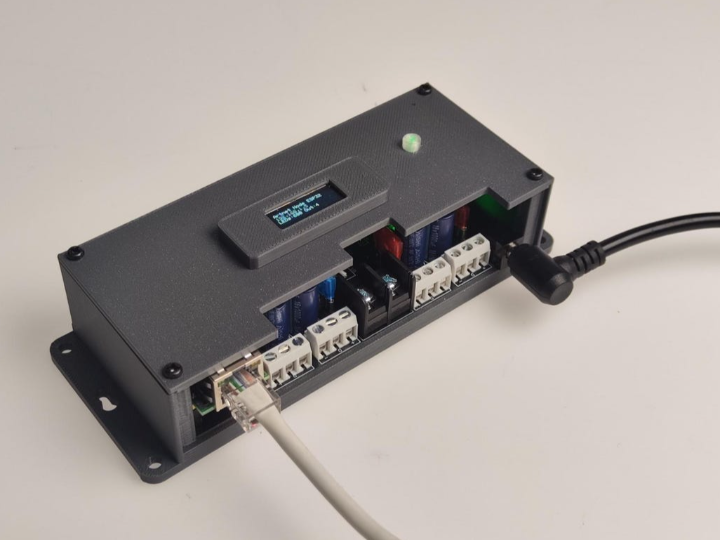
Today, we are introducing a project that allows you to build a stable, powerful Art-Net receiver using a simple ESP32 and an Ethernet module for just a few dollars: ESP32-Artnet-Node-receiver.
💡 Core Summary
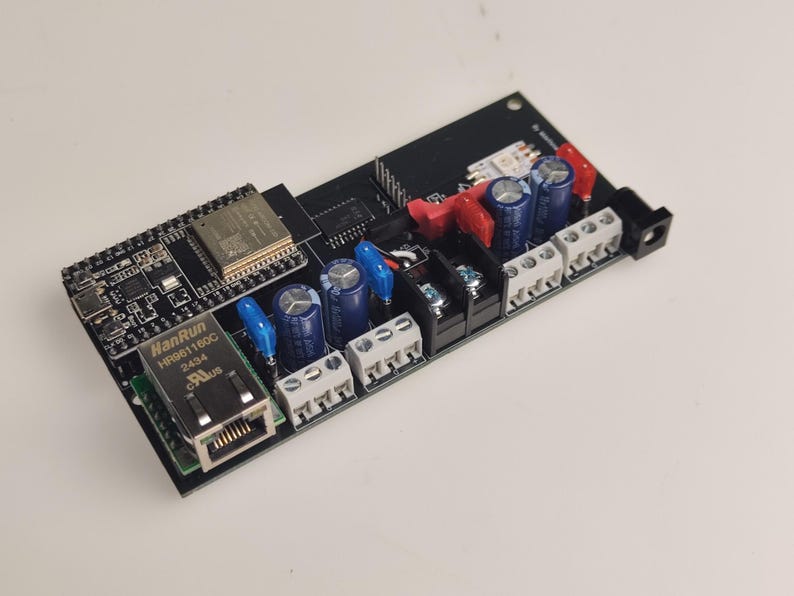
This open-source solution utilizes an ESP32 microcontroller to receive Art-Net (DMX over IP) data from a PC or lighting console and convert it into control signals for addressable LED strips like WS2812B or SK6812.
While it supports Wi-Fi, its standout feature is the support for Ethernet modules (like the W5500), enabling seamless, low-latency wired data transmission.
🚀 Why is this project special?
1. Unbeatable Cost-Performance Ratio
While commercial Art-Net to SPI (LED) controllers are expensive, this project requires only an ESP32 board, an Ethernet module, and some basic wiring. It integrates immediately with professional VJ and mapping software such as MadMapper, Resolume, and TouchDesigner.
2. Stability via Wired Ethernet
Many DIY ESP32 lighting projects rely solely on Wi-Fi. However, in environments with heavy interference or when controlling thousands of LEDs, Wi-Fi latency and packet loss can be fatal. This project supports PHY modules like the W5500 or LAN8720, guaranteeing fast and stable data processing via Wired LAN (Ethernet).
3. High-Performance Multi-Universe Handling
Leveraging the ESP32's dual-core architecture, this node can handle massive amounts of data. It goes beyond a single Universe (512 channels), capable of receiving and processing multiple Universes simultaneously to smoothly control hundreds or thousands of LED pixels.
🛠️ How It Works
The system workflow is as follows:
- Source: Lighting software on a PC (e.g., Madrix, Jinx!) broadcasts lighting pattern data via the Art-Net protocol.
- Network: The data travels through an Ethernet cable (or Wi-Fi) via a router/switch to the ESP32.
- Receive & Convert (Node):
- The ESP32 listens for UDP packets on its assigned IP address.
- When an Art-Net packet arrives, it parses the header and extracts the DMX data.
- The extracted color data (RGB/RGBW) is immediately converted into the correct waveform for the LED strip (often using libraries like FastLED).
Tech Tip: For stable 5V LED control, it is highly recommended to use a Logic Level Shifter (e.g., 74HCT245) to boost the ESP32's 3.3V logic signal to 5V.
🎯 Use Cases
- Media Facades & Interiors: Mapping LEDs on building walls or indoor spaces to create music-reactive lighting.
- Stage & Events: Installing custom pixel LED setups in DJ booths or stage props and syncing them with the main lighting console.
- DIY Smart Home: Creating complex, high-speed lighting effects that off-the-shelf smart bulbs cannot achieve.
🏁 Conclusion
The ESP32-Artnet-Node-receiver project lowers the barrier to entry for hardware costs, allowing anyone to build a professional-grade lighting control system. If you want to fill your desk or studio with brilliant, synchronized light, it's time to pick up your soldering iron.
-
Project

-
EasyEDA Editor
-
LichtBit Shop