



Cloud RAM
Cloud RAM
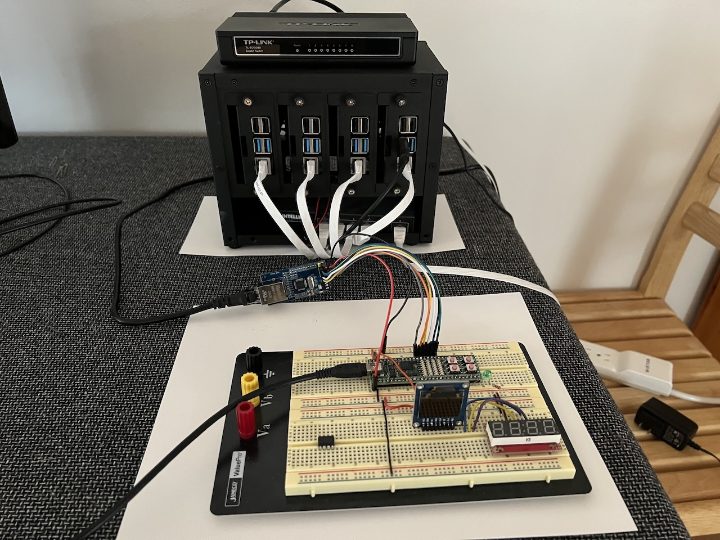
최근 데이터센터용 서버 수요가 급격히 증가하면서, DRAM은 구조적인 공급 부족 상태에 들어갔고 RAM 가격은 빠르게 상승했습니다.
이로 인해 개인 개발자와 소규모 하드웨어 프로젝트는 메모리 확보 자체가 부담이 되는 상황에 놓였습니다.
Cloud RAM 프로젝트는 이 현실적인 문제에서 출발합니다.
▶ Cloud RAM 소개 영상
RAM은 부족해졌고, 가격은 올랐다
이 프로젝트의 저자는 명확한 전제를 깔고 시작합니다.
- 데이터센터 서버가 RAM을 대량으로 구매
- 전체 시장의 DRAM 공급이 타이트해짐
- 결과적으로 RAM 가격 급등
즉, RAM 부족은 개별 보드의 문제가 아니라 시장 구조의 문제입니다.
“이렇게 비싸진 RAM을 모든 장치가 각각 가져야 할까?”
RAM을 ‘소유’하지 말고 ‘접속’하자
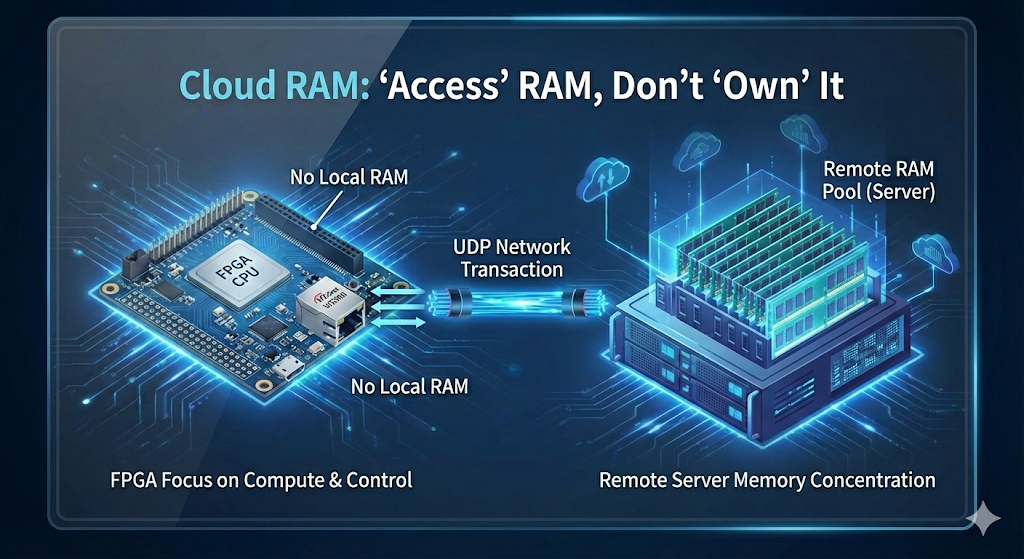
Cloud RAM은 FPGA 기반 CPU가 자신의 로컬 RAM 대신 네트워크를 통해 원격 RAM에 접근하는 구조입니다.
- FPGA는 연산과 제어에 집중
- 메모리는 원격 서버에 집중 배치
- 메모리 접근은 UDP 기반 네트워크 트랜잭션
- 네트워크 인터페이스로 WIZnet W5500 Ethernet 칩 사용
즉, RAM을 부품이 아니라 네트워크 리소스로 재정의하는 아키텍처입니다.
Cloud RAM 전체 구조
Cloud RAM의 핵심 구성은 다음과 같습니다:
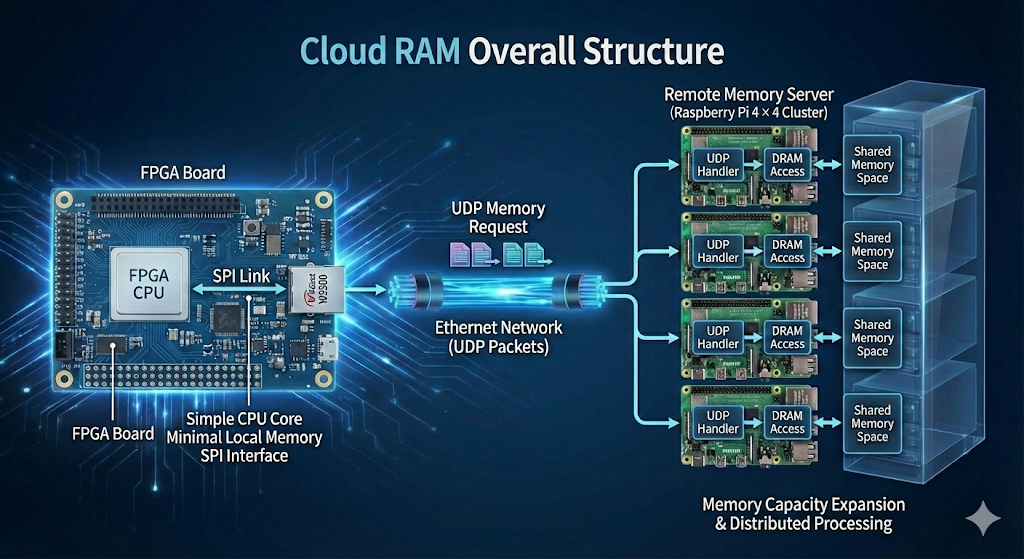
FPGA 보드
- 내부에 간단한 CPU 코어 구현
- 최소한의 로컬 메모리만 사용
- SPI 통해 W5500과 연결
Ethernet 네트워크
- FPGA는 메모리 요청을 UDP 패킷으로 전송
원격 메모리 서버
- Raspberry Pi 4 × 4대로 구성된 클러스터
- 각 Pi가 메모리 공간 일부를 담당
- UDP로 요청 수신 → DRAM 접근 → 응답
여러 대의 Raspberry Pi를 활용한 이유는
메모리 용량 확장과 분산 처리 실험을 동시에 수행하기 위함입니다.
성능보다 구조에 대한 실험
Cloud RAM은 “고성능 메모리”를 목표로 하지 않습니다.
네트워크 기반 메모리 접근에는 명확한 지연이 있으며, 실제 성능은 로컬 DRAM보다 떨어집니다.
그러나 이 프로젝트의 목적은 성능이 아니라 구조적 가능성 탐색입니다.
- RAM 가격 상승에 대한 대응 구조 제시
- 메모리 자원 중앙 집중화
- 네트워크 기반 하드웨어 아키텍처 실험
즉, “가능한가?”에 대한 실험입니다.
저자 소개 — Mike Kohn
Cloud RAM 프로젝트의 저자는 Mike Kohn입니다. 그는 미국 미주리주 Ballwin 지역에 거주하며, 오랜 기간 소프트웨어와 전자·마이크로컨트롤러·FPGA 관련 개인 프로젝트를 지속적으로 진행해 온 엔지니어입니다.
- 다양한 소프트웨어 프로젝트를 직접 설계·구현하며 공개해 왔고
- 마이크로컨트롤러, FPGA, 네트워크, 저수준 시스템을 다루는 전자 실험 프로젝트를 장기간 축적해 왔습니다.
- 그의 웹사이트에는 단발성 데모가 아니라, 아이디어 → 구현 → 기록으로 이어지는 프로젝트들이 정리되어 있습니다.
- Software 프로젝트: https://www.mikekohn.net/software
- Micro / Hardware 프로젝트: https://www.mikekohn.net/micro/
이러한 배경은 Cloud RAM처럼
시장 변화에서 출발해 하드웨어 구조 자체를 다시 묻는 실험으로 자연스럽게 이어집니다.
이 프로젝트가 던지는 메시지
Cloud RAM은 다음과 같은 질문을 던집니다.
- 메모리는 반드시 로컬이어야 하는가?
- 시장 변화는 하드웨어 설계에 어떤 영향을 주는가?
- 네트워크는 아키텍처의 일부가 될 수 있는가?
RAM 부족 시대에, 이 프로젝트는 하드웨어 설계에 대한 사고 실험을 분명히 제시합니다.
결론
Cloud RAM 프로젝트는
RAM 공급 부족과 가격 상승이라는 시장 변화를 배경으로
하드웨어 구조 자체를 재고하게 만드는 실험입니다.
실용성 여부와 관계없이,
이 프로젝트의 가치는 질문을 정확히 짚었다는 점에 있습니다.
RAM이 희소해지는 시대,
우리는 하드웨어를 어떻게 설계해야 하는가?
Cloud RAM은 그 질문에 대한 하나의 답변입니다.
FAQ — Cloud RAM 프로젝트
Cloud RAM이란 무엇인가요?
Cloud RAM은 FPGA 기반 CPU가 로컬 RAM 대신 네트워크를 통해 원격 메모리에 접근하는 구조입니다.
RAM을 보드에 장착하지 않고 네트워크 리소스로 사용하는 것이 핵심 개념입니다.
왜 이런 프로젝트를 만들었나요?
데이터센터 서버 수요 증가로 DRAM 공급이 부족해지고 RAM 가격이 급등했기 때문입니다.
저자는 RAM을 소유하는 방식 대신 접속하는 구조가 가능한지 실험했습니다.
원격 메모리는 어떻게 구성되어 있나요?
이 프로젝트에서는 Raspberry Pi 4 네 대가 원격 메모리 서버 역할을 합니다.
각 Pi가 메모리 공간의 일부를 나눠 담당합니다.
FPGA는 원격 RAM에 어떻게 접근하나요?
FPGA는 UDP 기반 네트워크 패킷으로 메모리 읽기·쓰기 요청을 전송합니다.
네트워크 인터페이스로 WIZnet W5500이 사용되었습니다.
Cloud RAM은 실제로 쓸 수 있는 기술인가요?
고성능을 목표로 한 구조는 아닙니다.
이 프로젝트의 목적은 실용성보다 하드웨어 아키텍처에 대한 가능성 검증입니다.
In recent years, demand for data-center and AI servers has surged. As a result, DRAM supply has tightened and RAM prices have risen sharply.
Large server operators are absorbing massive amounts of memory, and the impact is being felt across the entire market—including individual developers and small hardware projects.
The Cloud RAM project starts from this very 현실.
▶ Cloud RAM Video
The Problem: RAM Is Scarce—and Expensive
The author of this project begins with a clear observation:
- Data-center servers are purchasing RAM at scale
- DRAM supply has become constrained
- RAM prices have increased significantly
This is no longer a board-level limitation.
It is a market-level problem.
That leads to a simple but fundamental question:
If RAM is scarce and expensive, does every device really need to own it locally?
The Idea: Don’t Own RAM—Access It
The result of that question is Cloud RAM.
Cloud RAM is an experimental architecture in which an FPGA-based CPU accesses remote memory over a network, instead of relying on local RAM.
- The FPGA focuses on computation and control
- Memory is centralized on remote servers
- Memory accesses are handled via UDP-based network transactions
- The network interface uses the WIZnet W5500 Ethernet chip
In this model, RAM is no longer treated as a fixed hardware component, but as a network resource.
Overall Architecture of Cloud RAM
The structure of Cloud RAM is intentionally simple.
1. FPGA Board
- Implements a lightweight CPU core
- Uses minimal local memory
- Communicates with the network via SPI connected to a W5500
2. Ethernet Network
- Memory read/write requests are sent as UDP packets
- Requests include address and data information
3. Remote Memory Servers
- Implemented using four Raspberry Pi 4 boards
- Each Raspberry Pi manages a portion of the memory space
- Receives UDP requests, performs DRAM access, and sends responses back
By using multiple Raspberry Pi boards, the project also explores distributed memory composition, not just remote access.
This Is Not About Performance
Cloud RAM does not aim to compete with local DRAM in speed.
Network-based memory access introduces unavoidable latency, and the author is explicit about this limitation.
The goal is different:
- To explore alternatives in an era of rising RAM prices
- To rethink how memory resources are allocated
- To test whether network-based memory architectures are feasible at all
This is a structural experiment, not a performance benchmark.
About the Author: Mike Kohn
The Cloud RAM project was created by Mike Kohn, an engineer based in Ballwin, Missouri, USA.
He has spent many years working on and publishing a wide range of software and electronics projects, spanning:
- Software tools, emulators, and low-level systems
- Microcontrollers, FPGA designs, and networking experiments
- Hands-on projects documented with code and technical explanations
His work is publicly available on his website:
- Software projects: https://www.mikekohn.net/software/
- Microcontroller & hardware projects: https://www.mikekohn.net/micro/
This breadth of experience provides the foundation for projects like Cloud RAM, which sit at the intersection of software thinking, hardware design, and system architecture.
What This Project Ultimately Asks
Cloud RAM raises questions that go beyond this single implementation:
- Must memory always be local?
- How do market forces shape hardware architecture?
- Can networks become first-class components of hardware design?
In a world where RAM is no longer cheap or abundant, these questions matter.
Conclusion
The Cloud RAM project is a response to real market pressure: memory scarcity and rising prices.
Rather than optimizing existing designs, it challenges the underlying assumption that RAM must always live next to the CPU.
Whether or not this approach becomes practical is secondary.
Its value lies in asking the right question at the right time.
When memory becomes scarce, hardware architecture must adapt.
Cloud RAM is one possible answer.
FAQ — Cloud RAM Project
What is Cloud RAM?
Cloud RAM is an experimental architecture where an FPGA-based CPU accesses remote memory over a network instead of using local RAM.
Why was this project created?
Because data-center demand has reduced DRAM availability and driven RAM prices up.
The project explores whether memory can be treated as a shared network resource.
How is the remote memory implemented?
The remote memory servers are built using four Raspberry Pi 4 boards, each handling part of the memory space.
How does the FPGA access remote memory?
The FPGA sends UDP-based memory requests over Ethernet.
A WIZnet W5500 Ethernet chip is used as the network interface.
Is Cloud RAM a practical solution?
It is not designed for high performance.
The project focuses on architectural feasibility and experimentation, not production use.
-
Homepage
