


Artnet Node for WS2812B (RP2040 Based, 4 Universe)
Artnet Node for WS2812B (RP2040 Based, 4 Universe)
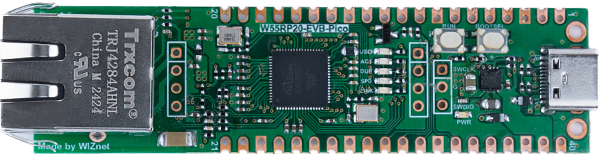
WIZnet - W55RP20-EVB-Pico
x 1

요약
이 프로젝트는 W5500-EVB-Pico(RP2040 + W5500 온보드)를 핵심으로, Art-Net 프로토콜을 수신해 4개 WS28xx LED 스트립을 동시에 실시간 제어하는 DIY 이더넷 노드입니다. 단일 보드로 680 RGB 픽셀을 약 120fps로 구동하며, 실제 공연·설치 현장에서 검증된 완결형 하드웨어입니다. W5500의 하드웨어 TCP/IP 오프로딩 덕분에 RP2040은 네트워크 처리 부담 없이 LED 신호 생성에 전념할 수 있으며, 이것이 고속 갱신의 핵심 구조적 이유입니다.
개요
공연 무대나 LED 인스톨레이션 현장에서 수백 개 이상의 픽셀을 정밀하게 제어하려면, PC의 조명 소프트웨어와 LED 스트립 사이를 연결하는 신뢰성 있는 하드웨어 노드가 필요합니다. 가장 널리 쓰이는 방식이 Art-Net입니다. Art-Net은 DMX512 조명 데이터를 표준 이더넷 UDP 패킷으로 전송하는 오픈 프로토콜로, 1개 유니버스는 512채널, RGB LED 기준으로 최대 170픽셀을 담을 수 있습니다.
상용 Art-Net 노드는 안정적이지만 가격이 높고 커스터마이징이 어렵습니다. 이 프로젝트의 제작자는 Resolume Arena 기반의 라이브 퍼포먼스와 커스텀 LED 설치 작업을 직접 수행하면서, 현장 요구에 맞는 4유니버스 노드를 직접 설계했습니다. 핵심 부품으로 WIZnet의 W5500-EVB-Pico를 선택해, 복잡한 외장 이더넷 모듈 없이 단일 보드에서 네트워크 수신과 LED 제어를 모두 처리합니다.
핵심 하드웨어: W5500-EVB-Pico
이 프로젝트의 성능을 결정하는 핵심은 W5500-EVB-Pico입니다. 이 보드는 Raspberry Pi Pico와 동일한 폼팩터에 WIZnet W5500 이더넷 컨트롤러를 온보드로 탑재한 평가 보드입니다.
W5500-EVB-Pico 주요 스펙
- MCU: RP2040, Dual-core ARM Cortex M0+ @ 최대 133MHz
- SRAM: 264KB / Flash: 2MB
- 이더넷: W5500 (SPI 연결, GPIO16~21 전용)
- W5500 스펙: 하드웨어 TCP/IP 스택, 10/100 Ethernet MAC+PHY, 8 독립 소켓, 32KB 내부 버퍼
- 핀아웃: Raspberry Pi Pico 완전 호환 (이더넷 전용 핀 6개 제외)
왜 W5500인가
W5500은 TCP/IP 스택 전체를 하드웨어로 처리합니다. RP2040은 SPI를 통해 완성된 UDP 페이로드만 받아오면 되기 때문에, 소프트웨어 네트워크 스택을 전혀 실행하지 않아도 됩니다. 덕분에 두 코어 모두를 Art-Net 파싱과 LED PIO 신호 생성에 온전히 투입할 수 있으며, 이것이 120fps 갱신의 구조적 근거입니다.
74AHCT125 버퍼 IC의 역할
WS2812B LED는 5V 로직 레벨 신호를 요구합니다. RP2040은 3.3V GPIO를 출력하므로, 74AHCT125 쿼드 버퍼 IC를 통해 신호를 레벨 시프팅하고 4채널 출력을 안정적으로 구동합니다. 단순한 레벨 변환기가 아니라 신호 무결성 보호 역할도 겸합니다.
시스템 아키텍처
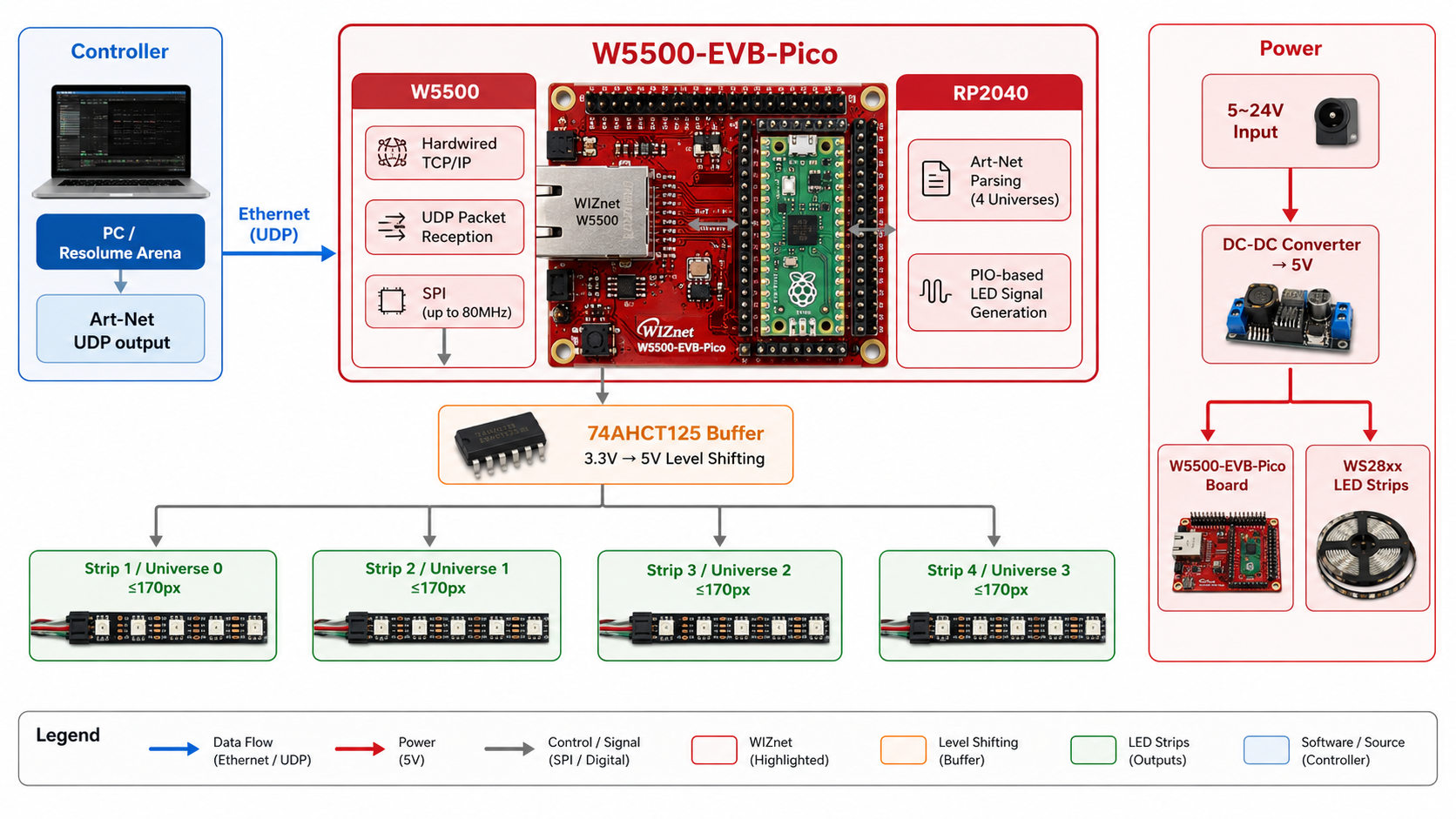
전원 설계에서 주목할 점은 5~24V 광범위 입력입니다. DC-DC 컨버터가 5V로 강압해 보드와 LED를 동시에 공급하며, LED 동작 전압을 입력 전압과 일치시키는 방식으로 WS2811(12V), WS2815(12V), WS2812B(5V) 등 다양한 시리즈를 동일 회로로 지원합니다. 전원 안정화를 위해 메인 공급단에 47μF, 각 LED 출력단에 470μF 커패시터를 배치합니다.
기술 특징
하드웨어 TCP/IP 오프로딩으로 MCU 부하 분리
일반적인 Wi-Fi 기반 구현에서는 MCU가 Wi-Fi 스택, TCP/IP 처리, Art-Net 파싱, LED 제어를 모두 담당합니다. W5500은 이 중 네트워크 계층 전체를 독립 처리하므로, RP2040의 연산 자원이 애플리케이션 로직에만 집중됩니다.
RP2040 PIO 기반 정밀 타이밍
WS2812B는 800kHz 고속 타이밍 신호를 요구합니다. RP2040의 PIO(Programmable I/O) 는 CPU 개입 없이 정밀한 비트 타이밍을 생성할 수 있어, 4채널 동시 출력 시에도 타이밍 지터 없이 안정적인 LED 구동이 가능합니다.
광범위 입력 전압 및 LED 호환성
- 지원 입력: 5~24V
- 호환 LED: WS2812B(5V), WS2811(5/12V), WS2813, WS2815(12V) 등 WS28xx 전 시리즈
- 전압 변경만으로 LED 종류 교체 가능 → 현장 유연성 확보
완결형 하드웨어 구성
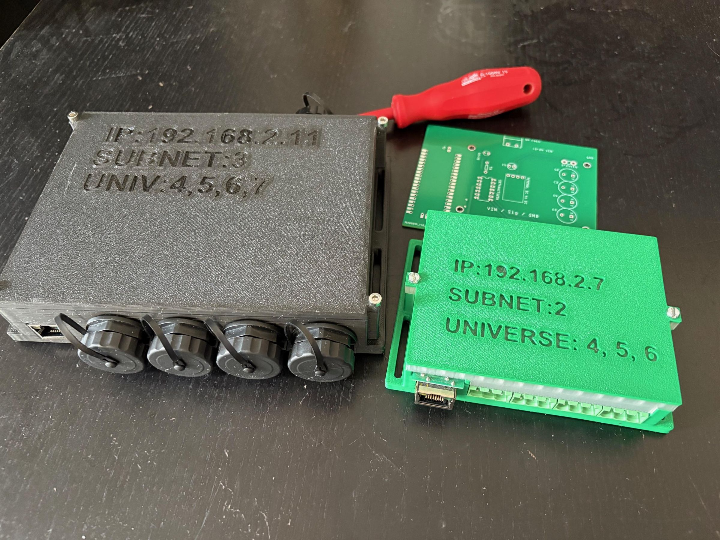
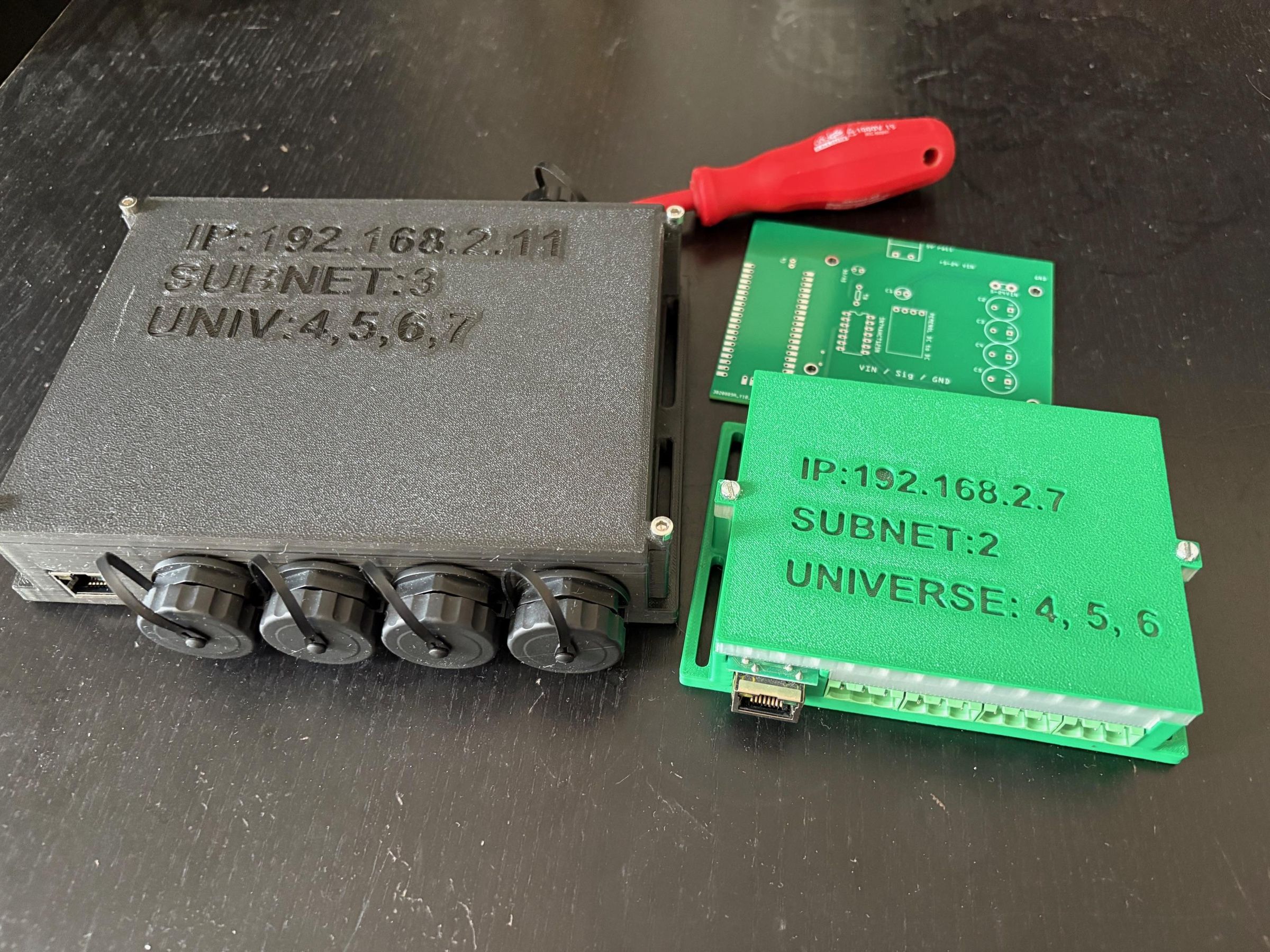
- 소형 버전: PCB 터미널 커넥터 + 소형 3D 프린팅 인클로저 (데스크탑/소규모 설치)
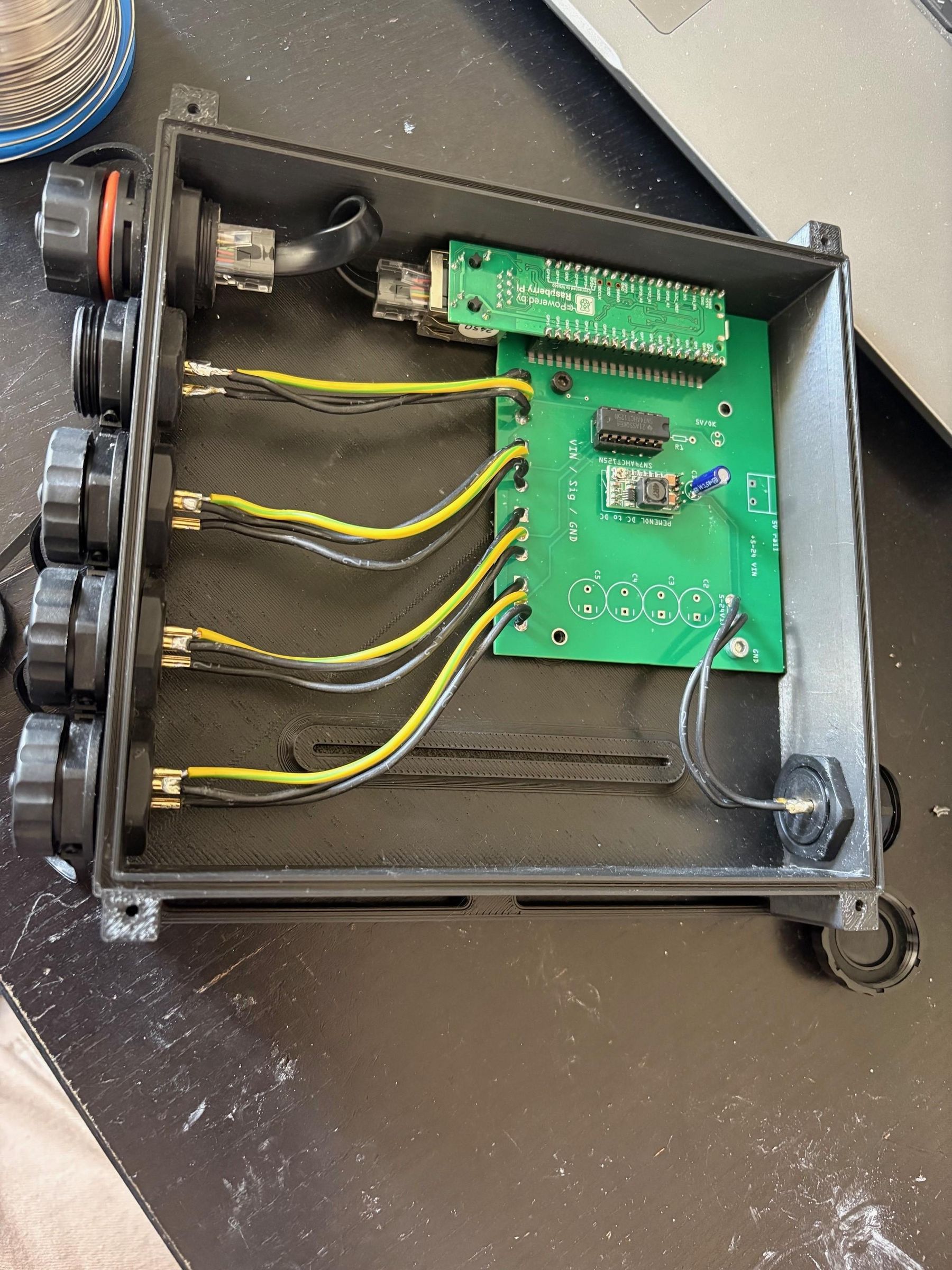
- 대형 버전: SP20/SD20 3핀 IP 방수 커넥터 + 대형 인클로저 (현장 투입형)
- Gerber 파일 및 Fritzing 데이터 공개 → 직접 PCB 제작 가능
WIZnet 적용 구조
이 프로젝트에서 W5500은 단순한 이더넷 모듈이 아니라, 시스템 성능 전체를 결정하는 핵심 아키텍처 요소입니다.
Art-Net 노드에서 W5500이 하는 일
Art-Net은 UDP 기반 프로토콜입니다. 수신 노드는 네트워크로부터 끊임없이 유입되는 UDP 패킷을 놓침 없이 받아내야 합니다. 소프트웨어 TCP/IP 스택을 사용하는 구성(예: ESP32 Wi-Fi)에서는 MCU가 네트워크 인터럽트 처리, 패킷 버퍼 관리, IP/UDP 헤더 파싱을 직접 수행하면서 동시에 LED 출력도 담당해야 합니다.
W5500은 이 네트워크 처리 전체를 하드웨어로 수행하고, RP2040에는 완성된 UDP 페이로드만 전달합니다. 결과적으로 다음 구조가 완성됩니다.
| 역할 | 담당 |
|---|---|
| Ethernet 물리 계층 (MAC/PHY) | W5500 |
| IP/UDP 패킷 처리 | W5500 |
| Art-Net 페이로드 수신 버퍼링 | W5500 (32KB 내부 버퍼) |
| Art-Net 프레임 파싱 | RP2040 |
| 4채널 LED PIO 신호 생성 | RP2040 |
W5500-EVB-Pico가 가진 추가 이점
외장 이더넷 모듈을 별도로 연결하지 않아도 됩니다. W5500이 보드에 온보드로 탑재되어 있으므로 배선 복잡성이 없고, SPI 연결의 신뢰성이 보드 설계 단계에서 보장됩니다. 공연 현장처럼 진동·충격이 잦은 환경에서 외장 모듈의 접촉 불량 리스크를 원천 제거합니다.
비즈니스 가치 및 활용 시나리오
외부 고객 가치
상용 4유니버스 Art-Net 노드의 시장 가격은 $200 이상에서 시작합니다. W5500-EVB-Pico 기반 DIY 구성은 이를 대폭 낮은 비용으로 대체하면서도, Gerber 공개 덕분에 PCB를 직접 발주해 수량 확장이 용이합니다. 또한 소스코드 수정으로 유니버스 할당, 픽셀 수, 출력 핀을 자유롭게 조정할 수 있어 상용 노드보다 높은 유연성을 제공합니다.
실제 적용 시나리오
- 공연 무대 픽셀 맵: Resolume Arena와 직접 연동, VJ 퍼포먼스의 LED 배경·무대 장치 실시간 제어
- 건축 및 공간 조명: 갤러리, 쇼룸, 이벤트 공간의 WS28xx 기반 앰비언트 조명 인스톨레이션
- 인터랙티브 설치 예술: 센서 데이터나 외부 이벤트를 Resolume에서 처리 후 LED로 출력하는 반응형 설치물
- 테마파크 및 이벤트 데코: 다수 노드를 네트워크 스위치로 묶어 수천 픽셀 규모의 동기 제어
WIZnet 기술 인사이트
W5500-EVB-Pico는 이 프로젝트에서 단순 평가 보드를 넘어 현장 투입 가능한 양산 컴포넌트로 기능합니다. Art-Net/DMX 도메인은 WIZnet의 기존 산업 자동화·IoT 레퍼런스와 결이 다른 엔터테인먼트 기술(Entertainment Technology) 영역으로, W5500의 적용 레퍼런스를 무대조명·인터랙티브 미디어 분야로 확장하는 사례입니다.
한계 및 개선 방향
현재 한계
- 유니버스 수 제한: 4유니버스(최대 680 RGB 픽셀)는 소규모 설치에는 충분하나, 수천 픽셀 규모의 대형 설치에는 복수 노드 병렬 운용이 필요합니다.
- 노드 간 동기화: 현재 구조에는 멀티 노드 동기화 메커니즘이 없어, 여러 노드를 동시 운용할 때 픽셀 타이밍 차이가 발생할 수 있습니다. [추정]
- 브로드캐스트 의존성: Art-Net 브로드캐스트 환경에서 노드 수가 늘어날수록 네트워크 부하가 증가합니다. 30개 이상 노드 운용 시 유니캐스트 전환이 권장됩니다.
- 라이브러리 의존성: 커스텀 파라미터화 이더넷 라이브러리에 의존하므로, 장기적인 유지보수 및 Arduino IDE 버전 호환성 관리가 필요합니다.
개선 방향
- 유니버스 확장: RP2040의 PIO 채널(최대 8개)과 DMA를 활용하면 이론적으로 8채널 출력까지 확장 가능합니다. W5500의 8 소켓 구조도 멀티 유니버스 소켓 할당으로 활용 여지가 있습니다.
- 멀티 노드 동기화: Art-Net의 ArtSync 패킷을 활용한 노드 간 동기화 구현으로 대규모 설치 품질을 높일 수 있습니다.
- PoE 지원: W5500-EVB-Pico-PoE 보드로 교체하면 이더넷 케이블 단선으로 전원 공급이 가능해져, 현장 배선이 대폭 단순화됩니다.
- 웹 기반 설정 UI: W5500의 TCP 소켓을 활용해 IP 주소, 유니버스 할당, 픽셀 수를 웹 브라우저에서 설정하는 인터페이스를 추가하면 현장 운용 편의성이 크게 향상됩니다.
FAQ
Q1. Resolume Arena 외에 다른 소프트웨어와도 연동되나요? Art-Net은 오픈 프로토콜이므로 QLC+, MadMapper, MADRIX, TouchDesigner 등 Art-Net UDP 출력을 지원하는 모든 소프트웨어와 호환됩니다. 소프트웨어에서 IP 주소와 유니버스 번호만 올바르게 설정하면 됩니다.
Q2. WS2812B 외 다른 LED도 사용할 수 있나요? WS2811, WS2813, WS2815 등 WS28xx 시리즈 전반을 지원합니다. 5V 동작 LED는 5V 입력을, 12V 동작 LED(WS2811, WS2815 등)는 12V 입력을 선택하면 됩니다. 단, LED 동작 전압에 맞게 DC-DC 컨버터 입력 전압도 조정해야 합니다.
Q3. Wi-Fi 대신 이더넷을 선택한 이유는 무엇인가요? 공연·설치 현장은 다수의 무선 기기가 동시에 동작하는 전파 혼잡 환경입니다. 이더넷은 간섭 없이 안정적인 저지연 전송을 보장하며, W5500의 하드웨어 TCP/IP 오프로딩 덕분에 소프트웨어 Wi-Fi 스택 대비 MCU 부하도 현저히 낮습니다. 실시간 LED 제어처럼 지연과 패킷 손실에 민감한 용도에는 이더넷이 압도적으로 적합합니다.
Q4. 노드를 여러 대 운용할 때 어떻게 설정하나요? 각 노드에 고유한 IP 주소를 할당하고, Resolume(또는 다른 소프트웨어)에서 각 노드 IP로 유니캐스트 전송 설정을 하면 됩니다. 동일 네트워크 스위치에 연결하는 것만으로 다수 노드 병렬 운용이 가능합니다. 30개 이상 노드에서는 브로드캐스트 대신 유니캐스트를 권장합니다.
Q5. PCB 없이 브레드보드로 구성할 수 있나요? 원리적으로는 가능하나, 고전류 LED 구동 시 브레드보드의 접촉 저항과 불안정한 전원 연결이 문제가 될 수 있습니다. 프로토타입 단계에서는 브레드보드로 회로 검증 후, 실제 운용에는 공개된 Gerber 파일로 PCB를 제작하는 것을 권장합니다.
TL;DR
This project builds a wired Art-Net node using the W5500-EVB-Pico (RP2040 + onboard W5500) to drive 4 WS28xx LED strips simultaneously in real time. A single board handles 680 RGB pixels at ~120 fps, and the hardware has been validated in actual live performance and installation environments. W5500's hardwired TCP/IP offloading frees the RP2040 to focus entirely on LED signal generation — and that is the structural reason behind the high refresh rate.
Overview
Controlling hundreds of pixels with precision in a live performance or LED installation requires a reliable hardware node between the lighting software on a PC and the physical LED strips. Art-Net is the standard solution for this. It is an open protocol that transports DMX512 lighting data over standard Ethernet UDP packets. One universe carries 512 channels — enough for up to 170 RGB pixels.
Commercial Art-Net nodes are stable but expensive and difficult to customize. The creator of this project runs live performances and custom LED installations with Resolume Arena, and needed a 4-universe node tailored to their own requirements. They chose WIZnet's W5500-EVB-Pico as the core component, handling both network reception and LED control on a single board — no external Ethernet module required.
Core Hardware: W5500-EVB-Pico
The performance of this project comes down to one thing: the W5500-EVB-Pico. It is a microcontroller evaluation board in the Raspberry Pi Pico form factor, with a WIZnet W5500 Ethernet controller integrated directly on the board.
W5500-EVB-Pico Key Specs
- MCU: RP2040, Dual-core ARM Cortex M0+ up to 133MHz
- SRAM: 264KB / Flash: 2MB
- Ethernet: W5500 via SPI (GPIO16–21 dedicated)
- W5500: Hardwired TCP/IP stack, 10/100 Ethernet MAC+PHY, 8 independent sockets, 32KB internal buffer
- Pinout: Fully Raspberry Pi Pico-compatible (except 6 Ethernet-dedicated pins)
Why W5500?
The W5500 handles the entire TCP/IP stack in hardware. The RP2040 only needs to retrieve the completed UDP payload over SPI — no software network stack required. This means both cores are available for Art-Net parsing and LED PIO signal generation, which is the structural basis for achieving 120 fps.
The Role of the 74AHCT125 Buffer IC
WS2812B LEDs require 5V logic-level signals, but the RP2040 outputs 3.3V GPIO. The 74AHCT125 quad buffer IC handles level shifting on all four channels and also protects signal integrity between the MCU and the LED strips.
Architecture
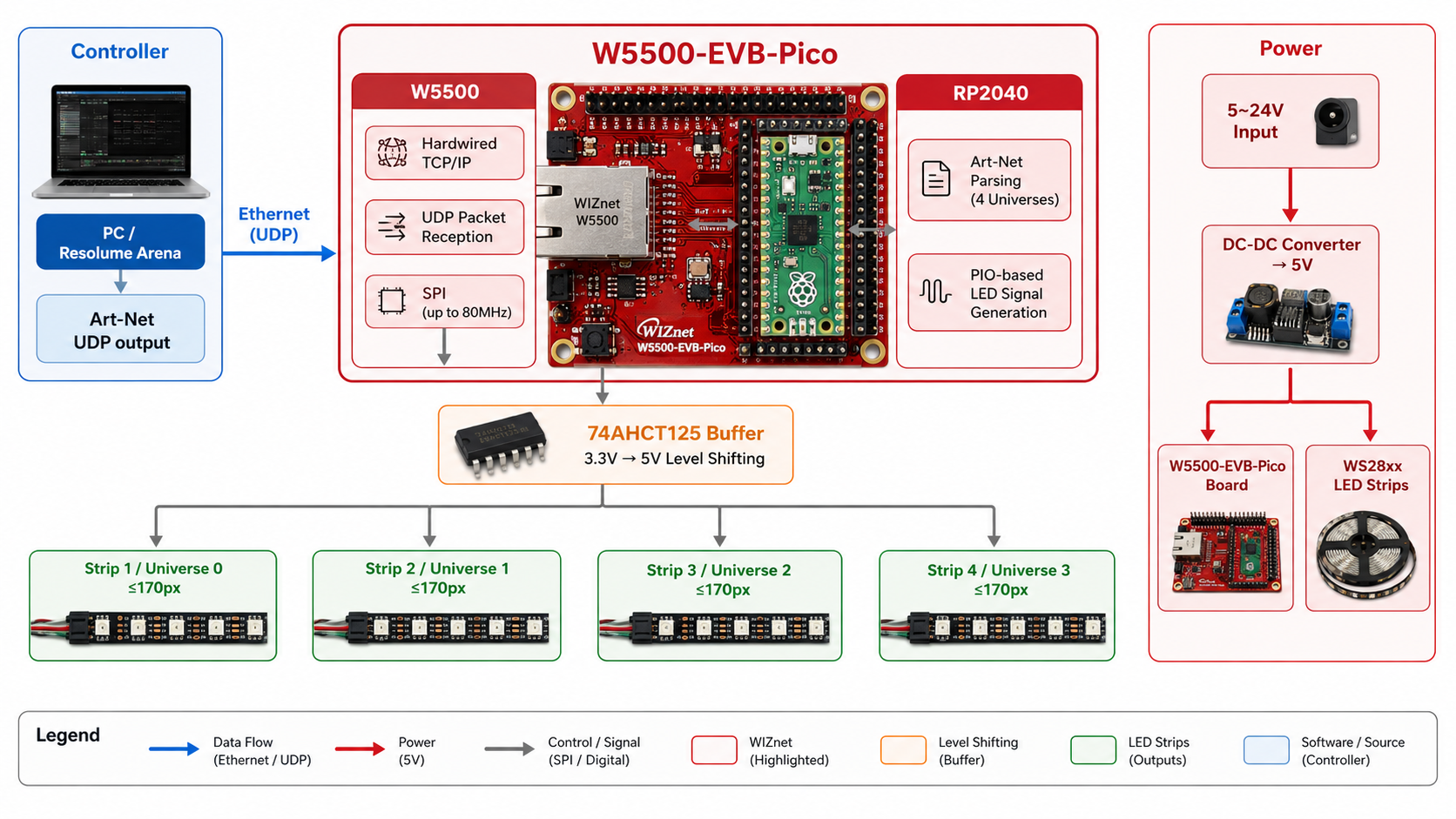
One notable design choice is the 5–24V wide-range input. The DC-DC converter steps down to 5V to power both the board and the LEDs. By matching the input voltage to the LED's operating voltage, the same circuit supports WS2811 (12V), WS2815 (12V), WS2812B (5V), and other variants without any hardware changes. A 47μF capacitor stabilizes the main supply, and 470μF capacitors are placed at each LED output for additional decoupling.
Technical Highlights
TCP/IP Offloading Separates Network Load from Application Logic
In a typical Wi-Fi-based implementation, the MCU handles the Wi-Fi stack, TCP/IP processing, Art-Net parsing, and LED output all at once. W5500 takes over the entire network layer in hardware, so the RP2040's compute resources go entirely to application logic — parsing and pixel output.
RP2040 PIO for Precise LED Timing
WS2812B requires 800kHz high-speed timing signals. The RP2040's PIO (Programmable I/O) generates precise bit timing without CPU involvement, enabling stable 4-channel simultaneous output with no timing jitter.
Wide Voltage Range and LED Compatibility
- Supported input: 5–24V
- Compatible LEDs: WS2812B (5V), WS2811 (5/12V), WS2813, WS2815 (12V), and the full WS28xx series
- Switching LED types requires only a voltage change — no circuit modification needed
Production-Ready Hardware Form Factor
- Compact version: PCB screw terminals + small 3D-printed enclosure (desktop or small-scale installs)
- Full version: SP20/SD20 3-pin IP-rated connectors + large enclosure (field-deployment ready)
- Gerber files and Fritzing project data published — ready for direct PCB fabrication
Where WIZnet Fits
In this project, the W5500 is not just an Ethernet module — it is the architectural component that makes the system's performance possible.
What W5500 Does in an Art-Net Node
Art-Net runs over UDP. A receiver node must capture a continuous stream of incoming UDP packets without dropping any. In a software TCP/IP configuration (e.g., ESP32 over Wi-Fi), the MCU handles network interrupts, packet buffer management, and IP/UDP header parsing — all while simultaneously driving LED output.
W5500 performs all of that network processing in hardware and delivers only the completed UDP payload to the RP2040. The result is a clean division of responsibility:
| Role | Handled By |
|---|---|
| Ethernet physical layer (MAC/PHY) | W5500 |
| IP/UDP packet processing | W5500 |
| Art-Net payload receive buffering | W5500 (32KB internal buffer) |
| Art-Net frame parsing | RP2040 |
| 4-channel LED PIO signal generation | RP2040 |
Additional Advantage of W5500-EVB-Pico
No external Ethernet module wiring is needed. W5500 is integrated directly on the board, so there is no wiring complexity, and SPI reliability is guaranteed by the board design itself. In performance environments with vibration and physical stress, this eliminates the contact failure risk that comes with plug-in modules.
Business Value and Use Cases
Value for End Users
Commercial 4-universe Art-Net nodes start at $200 or more. A W5500-EVB-Pico-based DIY build substantially reduces that cost, and with Gerber files openly published, PCB fabrication scales easily for multi-unit deployments. Source code access also means universe assignments, pixel counts, and output pins can be freely adjusted — flexibility no commercial black-box node offers.
Application Scenarios
- Live stage pixel mapping: Direct integration with Resolume Arena for real-time LED backdrop and stage element control during VJ performances
- Architectural and spatial lighting: Ambient WS28xx installations in galleries, showrooms, and event venues
- Interactive art installations: Reactive LED environments where sensor data or external events are processed in Resolume and output to physical LEDs
- Theme parks and event décor: Multiple nodes on a single network switch for synchronized control of thousands of pixels
Technical Insight for WIZnet
W5500-EVB-Pico functions here not as a prototype tool but as a field-deployable production component. The Art-Net/DMX domain represents an expansion of W5500 references into Entertainment Technology — distinct from WIZnet's established industrial automation and IoT use cases — covering stage lighting, interactive media, and architectural lighting applications.
Limitations and Future Improvements
Current Limitations
- Universe count ceiling: 4 universes (up to 680 RGB pixels) works well for small-to-medium installations, but large-scale deployments with thousands of pixels require multiple nodes in parallel.
- No inter-node synchronization: The current design has no built-in synchronization mechanism across nodes. When running multiple units simultaneously, pixel timing differences may occur. [Inferred]
- Broadcast dependency: In Art-Net broadcast mode, network load increases as node count grows. Unicast is recommended for setups with 30 or more nodes.
- Library dependency: The custom parameterized Ethernet library requires long-term maintenance and Arduino IDE version compatibility management.
Future Improvements
- More universes: The RP2040 has up to 8 PIO state machines and DMA support, making an 8-channel output expansion theoretically feasible. W5500's 8 independent sockets also offer room for multi-universe socket allocation.
- Inter-node sync: Implementing Art-Net's ArtSync packet support would enable synchronized output across multiple nodes for large-scale installations.
- PoE support: Swapping in the W5500-EVB-Pico-PoE board enables power delivery over the Ethernet cable, dramatically simplifying field wiring.
- Web-based configuration UI: Using W5500's TCP sockets to serve a browser-accessible settings page for IP address, universe assignment, and pixel count would significantly improve on-site operability.
FAQ
Q1. Does this work with software other than Resolume Arena? Yes. Art-Net is an open protocol, so any software with Art-Net UDP output support works — including QLC+, MadMapper, MADRIX, and TouchDesigner. Configure the correct IP address and universe numbers in the software, and the node will respond.
Q2. Can I use LED strips other than WS2812B? The full WS28xx series is supported: WS2811, WS2813, WS2815, and more. For 5V LEDs, use a 5V supply; for 12V LEDs (WS2811, WS2815), use a 12V input. Just make sure the DC-DC converter input voltage matches the LED's operating voltage.
Q3. Why Ethernet instead of Wi-Fi? Live performance and installation environments are typically congested with wireless signals from multiple devices. Ethernet delivers stable, low-latency transmission without interference. W5500's hardware TCP/IP offloading also keeps MCU load far lower than a software Wi-Fi stack. For latency-sensitive, packet-loss-intolerant applications like real-time LED control, wired Ethernet is the clear choice.
Q4. How do I set up multiple nodes on one network? Assign a unique IP address to each node, then configure the controller software (e.g., Resolume) to send unicast packets to each node's IP address. Connecting all nodes to a single Ethernet switch is sufficient for parallel operation. For 30 or more nodes, switch from broadcast to unicast to reduce network load.
Q5. Can I build this on a breadboard without a PCB? Technically yes, but high-current LED driving exposes the contact resistance and unstable power connections typical of breadboards. Use a breadboard for circuit verification during prototyping, then fabricate a PCB from the published Gerber files for any real deployment.