


大丸300周年記念インスタレーション「Flower Mirror」
Flower Mirror: Large-Scale Kinetic Interaction Powered by 3,000 Flowers and WIZnet W5500
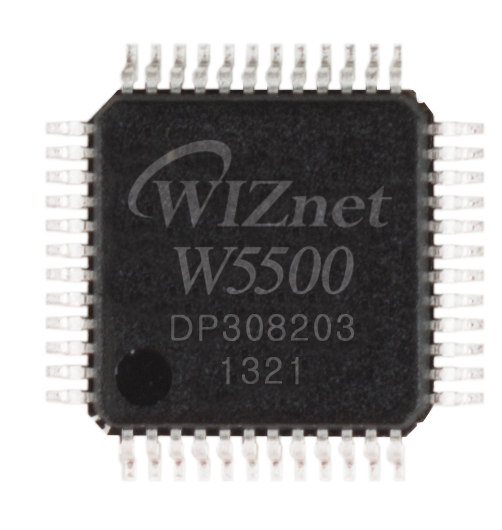
WIZnet - W5500
x 1

Summary
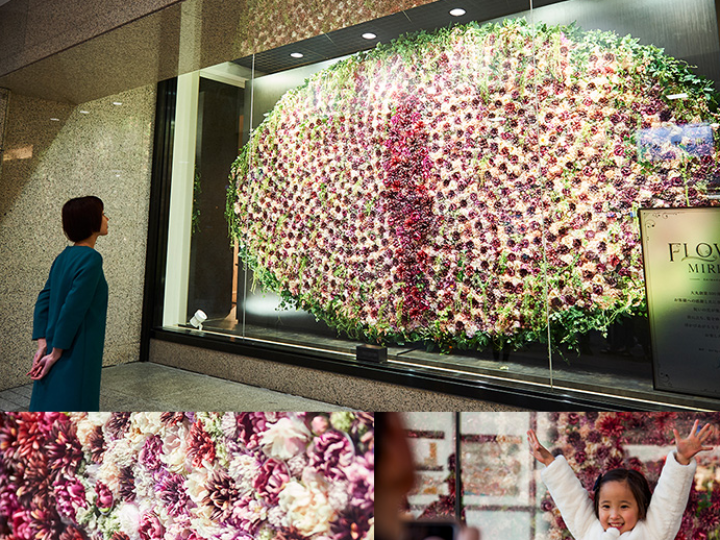
Flower Mirror is an interactive kinetic installation created to celebrate the 300th anniversary of Daimaru, a major Japanese department store chain. Mounted in an oval structure measuring approximately 16 × 10 feet, 3,000 artificial flowers open and close in response to the silhouettes of passersby, forming a "mirror made of flowers." At the core of this system, 100 STEP800 boards — each equipped with a WIZnet W5500 Ethernet controller — are connected via an Ethernet network to control 800 stepper motors in real time. This project demonstrates, at an extreme scale, how W5500's hardware TCP/IP offloading delivers real value in resource-constrained MCU environments for large-scale distributed motion control.
Overview
In 2017, Daimaru unveiled a special installation in the shop windows of its Tokyo and Kyoto stores. Planned by dot by dot Inc. with control hardware developed by Ponoor Experiments, Flower Mirror reflected the movements of pedestrians passing by the shop window through 3,000 flowers that opened and closed in real time.
What visitors see is simply the beautiful motion of flowers blooming and closing. Behind this elegant experience, however, lies a precise system where 100 boards communicate over an Ethernet network to control 800 motors at millisecond intervals.
This is exactly why this project is worth analyzing. It doesn't look like "network technology" from the outside, yet Ethernet infrastructure plays a critical role at its core. By examining projects like Flower Mirror, we aim to provide concrete architectural insights and practical ideas for creators and engineers who want to build kinetic art, interactive installations, media facades, and similar large-scale physical interactions — showing them how Ethernet-based distributed control serves as the foundation for these experiences.
The project initially considered air cylinders for actuation, but they were unable to dynamically control acceleration and deceleration. This limitation led to the decision to use stepper motors, which in turn drove the development of the STEP800 board prototype and ultimately gave rise to the W5500-based Ethernet distributed control architecture.
Architecture
The system consists of four layers: sensing, computation, communication, and actuation.
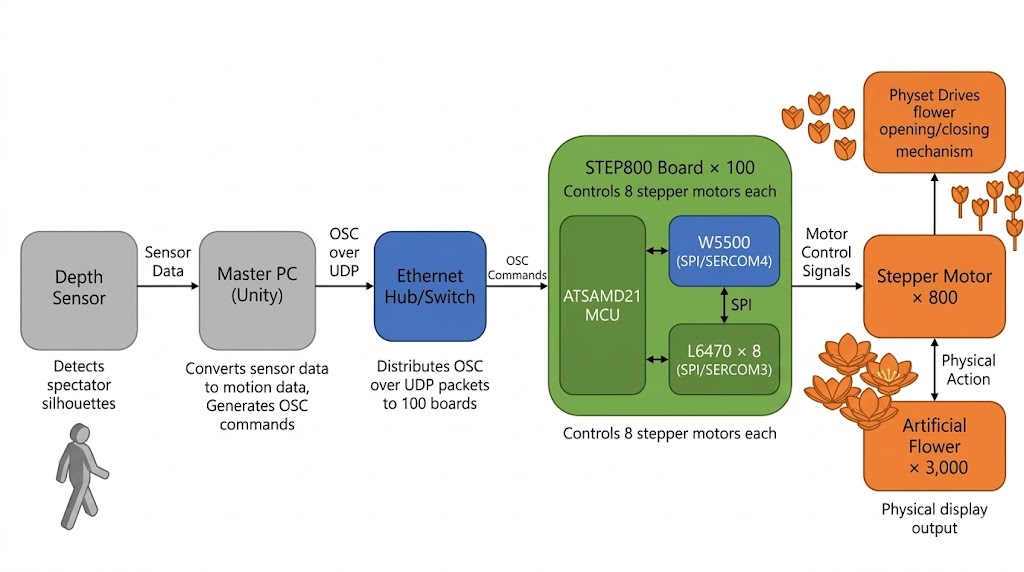
A depth sensor detects visitors' silhouettes [inferred], and the Unity program on the Master PC converts this into motion data. The data is transmitted as UDP packets using the OSC (Open Sound Control) protocol over Ethernet, distributed through a hub to 100 STEP800 boards.
The data flow inside each STEP800 board:
- ATSAMD21G18A MCU receives OSC commands via W5500 (SPI/SERCOM4)
- Control signals are sent to 8 L6470 motor driver chips through a separate SPI port (SERCOM3)
- W5500 and motor drivers are placed on different SPI ports → prevents communication-actuation interference and simplifies firmware
STEP800 — An 8-Axis Stepper Motor Driver for Creative Coding
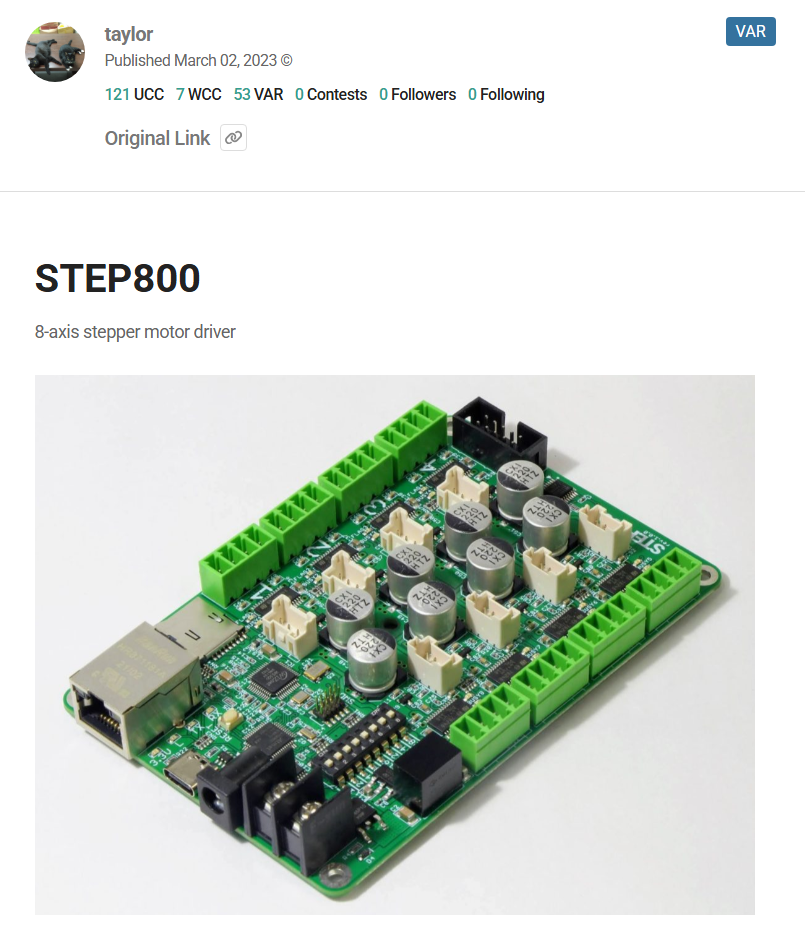
The physical actuation of Flower Mirror is handled by STEP800, an 8-axis stepper motor driver board developed by Ponoor Experiments in Tokyo for art and design projects. The STEP800 prototype was born during the creation of Flower Mirror itself, and has since been productized and used in numerous kinetic projects.
STEP800 is registered as a product on the WIZnet Maker site, where detailed specs and related documents are available. → https://maker.wiznet.io/taylor/resellers/step800/
Key Specifications
| Item | Specification |
|---|---|
| MCU | Microchip ATSAMD21G18A (ARM Cortex-M0+, Arduino Zero compatible) |
| Ethernet Controller | WIZnet W5500 (SPI/SERCOM4) |
| Motor Driver | STMicroelectronics L6470 × 8 axes (SPI/SERCOM3) |
| Microstepping | 1/128 (25,600 steps/rev, 0.014° resolution) |
| Max Phase Current | 2A per axis |
| Communication Protocol | OSC (Open Sound Control) over UDP/Ethernet |
Core Design Features
What sets STEP800 apart from conventional motor drivers is that communication, control, and actuation are all integrated into a single board.
- Arduino compatible: Firmware can be modified directly in Arduino IDE or PlatformIO
- W5500 Ethernet on-board: Hardware TCP/IP offloading handles OSC packet reception (firmware also compatible with W5100)
- L6470 motor drivers on-board: Position control, constant-speed rotation, and acceleration profiles managed at the hardware level. Near-silent operation at low speeds
- Direct integration with creative coding tools: Controllable via OSC from openFrameworks, Processing, Max, Unity, and TouchDesigner — no additional drivers needed
- Standard Ethernet: Compatible with general-purpose network equipment, not dependent on industrial protocols
- Additional features: DIP switch for board ID, microSD for configuration files, 8-channel HOME/LIMIT sensor inputs, electromagnetic brake support
STEP Series Product Comparison
| Model | Axes | Motor Driver | Max Current | Current Control Mode | Best For |
|---|---|---|---|---|---|
| STEP800 | 8 | L6470 | 2A/axis | Not supported | Controlling many small motors |
| STEP400 | 4 | PowerSTEP01 | 5A/axis | Supported | Precision control of larger motors |
| STEP100/200 | 1–2 | L6470/PowerSTEP01 | Chip dependent | Chip dependent | Prototyping |
All products in the series share W5500-based Ethernet and the OSC protocol, so you can select a board based on project scale and motor specifications while using the same software environment.
Technical Features
OSC over UDP — Direct Link to Creative Coding
The choice of OSC (Open Sound Control) over industrial Ethernet protocols was deliberate.
- Standard protocol in media art and electronic music
- Directly compatible with openFrameworks, Processing, Max, Unity, and TouchDesigner
- Motion data generated in Unity can be sent to motor drivers with no protocol conversion
Air Cylinders → Stepper Motors
| Comparison | Air Cylinders | Stepper Motors (STEP800) |
|---|---|---|
| Control states | Open/close (2 states) | Continuous position control |
| Acceleration control | Not possible | Dynamic profile configuration |
| Noise | Pneumatic noise | Near-silent with microstepping |
| Expressiveness | Simple open/close | Varied speeds and acceleration create organic motion — graphics appear to float naturally over the flowers |
Ethernet-Based Distributed Control
- 1 STEP800 = 8 motors → scale by simply adding boards to the Ethernet hub
- Single PC sends simultaneous OSC commands to 100 boards → 800 motors controlled in real time
- Dramatically reduced wiring complexity while achieving synchronized control
The Role and Technical Contribution of WIZnet W5500
The STEP800's MCU, the ATSAMD21G18A, is a low-power ARM Cortex-M0+ processor. Running a software TCP/IP stack on this MCU while simultaneously controlling 8 motors in real time would be extremely difficult in practice. Because W5500 handles the TCP/IP stack in hardware, the MCU can focus entirely on motor control logic.
The specific roles W5500 plays in this system:
| Role | Description |
|---|---|
| Hardware TCP/IP offloading | UDP packet reception, parsing, and socket management are all processed inside W5500. The MCU only reads the OSC payload via SPI |
| 8 independent hardware sockets | Enables parallel processing of multiple UDP streams |
| Separate SPI port design | W5500 (SERCOM4) and L6470 (SERCOM3) on separate buses → eliminates communication-actuation interference |
| Integrated MAC + PHY | No external PHY chip needed → simpler board design, reduced BOM cost |
With 100 STEP800 boards simultaneously connected to the network receiving real-time OSC commands, this project demonstrates at extreme scale that W5500 can serve as the network infrastructure for large-scale distributed control systems in resource-constrained MCU environments.
Extending the Same Architecture — Sun and Moon Room
The W5500 + STEP800 architecture proven in Flower Mirror has also demonstrated its value in an entirely different domain.
Sun and Moon Room, created by media art group anno lab, is a permanently installed kinetic work at the "Museum of Inhomogeneous Nature and Humans (不均質な自然と人の美術館)" in Oita Prefecture, Japan. Hundreds of circular shutters on the walls are opened and closed by stepper motors, selectively controlling where sunlight or moonlight passes through to reshape the distribution of light within the space in real time.
This work, too, presents only an artistic experience of light and space on the surface. Visitors see no network cables or controller boards. Yet underneath, the same distributed control architecture — W5500 Ethernet → STEP800 → Motors → Shutters — is at work.
| Comparison | Flower Mirror | Sun and Moon Room |
|---|---|---|
| Created by | dot by dot Inc. | anno lab |
| Installation type | Temporary exhibition (several weeks) | Permanent installation (continuous operation for years) |
| Actuated element | Artificial flower open/close | Circular shutter open/close |
| Core experience | Reflecting visitor silhouettes with flowers | Controlling natural light as a physical matrix |
| Control infrastructure | W5500 + STEP800 + OSC | Same |
The same architecture extends from a "mirror of flowers" to a "system that designs where light is allowed to exist." In particular, Sun and Moon Room must operate continuously for years in a museum setting, making W5500's wired Ethernet stability and STEP800's repetitive motion durability even more critical.
Sun and Moon Room is already registered as a project on the WIZnet Maker site, with detailed architecture analysis and WIZnet technology application. → https://maker.wiznet.io/scott/projects/-sun-and-moon-room/
Business Value
Rediscovering "Invisible Ethernet"
Many creators planning kinetic art or interactive installations are not aware that their project requires Ethernet. By showcasing projects like Flower Mirror, we can reveal that Ethernet-based distributed control exists behind large-scale physical interactions — and provide concrete architectural insights and technical decision-making guidance for those looking to build similar projects.
Market and Technology Perspective
- Creative coding ecosystem reference: Control physical motors with a single OSC command from Unity or Max → lowers the hardware entry barrier for software developers
- Standard architecture for large-scale kinetic systems: 800 motors controlled with standard Ethernet + OSC alone, no industrial protocols → a reusable architectural pattern
- Expanding W5500's market reach: From industrial automation and IoT into media art, commercial space design, and exhibition systems
Application Scenarios
| Scenario | Description | Reference |
|---|---|---|
| Commercial interactive displays | Visitor-responsive kinetic installations in retail stores, hotel lobbies | Flower Mirror |
| Smart architecture / media facades | Active control of daylighting elements in building envelopes | Sun and Moon Room |
| Stage / performance kinetic devices | Precision motion control for stage equipment, shop window displays | Studio Ghibli exhibitions, WOW Inc. |
| Smart exhibition operations | Remote monitoring, scheduled control, status diagnostics | Common to network-based architecture |
Limitations and Improvement Opportunities
Flower Mirror is a pioneering project that demonstrated the potential of large-scale kinetic systems. Several improvement opportunities can be identified from its architecture.
| Current Limitation | Improvement Direction |
|---|---|
| UDP-based OSC does not guarantee packet order or delivery → potential timing mismatches across 100 boards | Introduce timestamp-based synchronization or shared reference clock across boards |
| Single Ethernet hub as a single point of failure → entire system stops if the hub fails | Hierarchical switch topology, network redundancy. Use W5500 link status detection for early fault detection |
| Power consumption and heat management across 100 boards × 8 motors | Dedicated power distribution design and thermal management strategy |
| Managing individual configuration and firmware updates for 100 boards | Add network-based remote configuration/update capability (currently DIP switch + microSD) |
FAQ
Q1. What level of technical knowledge is needed to use STEP800?
STEP800 is Arduino-compatible hardware controlled via the OSC protocol. If you're familiar with creative coding environments like Unity, Processing, or Max, you can get started relatively easily. A dedicated Configuration Tool and example code are available on GitHub. Product information is also registered on the WIZnet Maker site. → https://maker.wiznet.io/taylor/resellers/step800/
Q2. What's the difference if you use a software TCP/IP stack instead of W5500?
Running a software TCP/IP stack on the ATSAMD21 (Cortex-M0+) consumes significant CPU resources and RAM, making it difficult to simultaneously control 8 motors in real time. W5500 handles TCP/IP in hardware, allowing the MCU to dedicate itself to motor control. This is the key reason a distributed control system of 100 boards was achievable on a Cortex-M0+ class MCU.
Q3. How should the network be configured when scaling beyond 100 boards?
STEP800 uses standard Ethernet, so it can be scaled with general-purpose network switches. Key considerations:
- Use switches, not routers
- For large-scale deployments, use a hierarchical switch topology to separate broadcast domains
- Also consider the Master PC's network interface bandwidth
Q4. How do I choose between STEP400 and STEP800?
- Many small motors (e.g., Flower Mirror) → STEP800 (8 axes, 2A/axis)
- Precision control of larger motors → STEP400 (4 axes, 5A/axis, current control mode supported)
- Both share W5500-based Ethernet + OSC protocol → can be used together in the same software environment
Q5. What should I consider for long-term operation in permanent installations like Sun and Moon Room?
Key considerations for long-term operation:
- Mechanical motor wear → periodic homing operations to correct positional drift
- Power supply stability → sufficient voltage margin to prevent board resets during voltage drops
- Network reliability → W5500's wired Ethernet provides higher stability than wireless
- Safe stop → STEP800's electromagnetic brake option holds loads securely during power loss
Detailed operational insights are available on the WIZnet Maker Sun and Moon Room project page. → https://maker.wiznet.io/scott/projects/-sun-and-moon-room/
요약
Flower Mirror는 일본 백화점 다이마루(Daimaru)의 창립 300주년을 기념하여 제작된 인터랙티브 키네틱 설치 작품입니다. 약 16×10피트 크기의 타원형 구조물에 3,000개의 인조 꽃이 배치되어 있으며, 관람객이 다가서면 실루엣에 맞춰 꽃이 개폐하며 "꽃으로 이루어진 거울"을 만들어냅니다. 이 시스템의 핵심은 WIZnet W5500 Ethernet 컨트롤러를 탑재한 Ponoor Experiments의 STEP800 보드 100대가 Ethernet 네트워크로 연결되어 800개의 스테퍼 모터를 실시간으로 제어하는 분산 아키텍처입니다. 크리에이티브 코딩 환경에서 대규모 물리적 인터랙션을 구현한 이 프로젝트는, 저사양 MCU 환경에서 W5500의 하드웨어 TCP/IP 오프로딩이 어떤 가치를 발휘하는지를 극한의 스케일로 입증한 사례입니다.
개요
일본의 대표적 백화점 체인 다이마루는 창립 300주년을 맞아 도쿄와 교토 매장 쇼윈도에 특별한 설치 작품을 선보였습니다. dot by dot Inc.가 기획하고 Ponoor Experiments가 제어 하드웨어를 담당한 "Flower Mirror"는, 쇼윈도 앞을 지나는 보행자의 모습을 3,000개의 꽃으로 실시간 반영하는 인터랙티브 거울입니다.
관람객의 눈에 보이는 것은 꽃이 열리고 닫히는 아름다운 움직임뿐입니다. 그러나 이 우아한 경험의 이면에는 100대의 보드가 Ethernet 네트워크로 연결되어 800개의 모터를 밀리초 단위로 제어하는 정밀한 시스템이 작동하고 있습니다.
이처럼 겉으로는 전혀 "네트워크 기술"로 보이지 않는 프로젝트 안에 Ethernet 인프라가 핵심적으로 사용되고 있다는 점이, 이 사례를 분석하는 가장 큰 이유입니다. 키네틱 아트, 인터랙티브 설치, 미디어 파사드 등을 구현하고자 하는 크리에이터와 엔지니어에게, Ethernet 기반 분산 제어가 어떻게 대규모 물리적 인터랙션의 기반이 되는지에 대한 구체적인 아이디어와 인사이트를 제공하고자 합니다.
초기에는 에어 실린더 기반 구동이 검토되었으나, 가속과 감속을 동적으로 제어할 수 없다는 한계가 있어 스테퍼 모터 방식으로 전환되었습니다. 이 결정이 STEP800 보드의 프로토타입 개발로 이어졌고, 결과적으로 W5500 기반의 Ethernet 분산 제어 아키텍처가 탄생했습니다.
아키텍처
Flower Mirror의 시스템은 센싱, 연산, 통신, 구동의 네 계층으로 구성됩니다.
뎁스 센서가 관람객의 실루엣을 감지하면 [추정], Master PC의 Unity 프로그램이 이를 모션 데이터로 변환합니다. 이 데이터는 OSC(Open Sound Control) 프로토콜을 통해 UDP 패킷으로 Ethernet 네트워크에 전송되고, 허브를 거쳐 100대의 STEP800 보드에 분배됩니다.
각 STEP800 보드 내부의 데이터 흐름은 다음과 같습니다.
- ATSAMD21G18A MCU가 W5500(SPI/SERCOM4)을 통해 OSC 명령 수신
- 별도 SPI 포트(SERCOM3)를 통해 L6470 모터 드라이버 칩 8개에 제어 신호 전달
- W5500과 모터 드라이버가 서로 다른 SPI 포트에 배치 → 통신-구동 간 간섭 방지, 펌웨어 처리 단순화
STEP800 — 크리에이티브 코딩을 위한 8축 스테퍼 모터 드라이버
Flower Mirror의 물리적 구동을 담당하는 STEP800은, 도쿄의 Ponoor Experiments가 아트·디자인 프로젝트를 위해 개발한 8축 스테퍼 모터 드라이버 보드입니다. STEP800의 프로토타입은 바로 이 Flower Mirror 프로젝트를 제작하는 과정에서 탄생했으며, 이후 제품화되어 현재까지 다양한 키네틱 프로젝트에 활용되고 있습니다.
STEP800은 WIZnet Maker 사이트에 제품으로 등록되어 있으며, 상세 스펙과 관련 문서를 확인할 수 있습니다. → https://maker.wiznet.io/taylor/resellers/step800/
주요 사양
| 항목 | 사양 |
|---|---|
| MCU | Microchip ATSAMD21G18A (ARM Cortex-M0+, Arduino Zero 호환) |
| Ethernet 컨트롤러 | WIZnet W5500 (SPI/SERCOM4) |
| 모터 드라이버 | STMicroelectronics L6470 × 8축 (SPI/SERCOM3) |
| 마이크로스테핑 | 1/128 (1회전당 25,600스텝, 분해능 0.014°) |
| 최대 위상 전류 | 2A / 축 |
| 통신 프로토콜 | OSC (Open Sound Control) over UDP/Ethernet |
핵심 설계 특징
STEP800이 기존 모터 드라이버와 구별되는 점은 "하나의 보드에 통신부터 구동까지 모든 것이 통합되어 있다"는 것입니다.
- Arduino 호환: Arduino IDE 및 PlatformIO에서 직접 펌웨어 수정 가능
- W5500 Ethernet 내장: 하드웨어 TCP/IP 오프로딩으로 OSC 패킷 수신 처리 (W5100과도 호환되는 펌웨어 구조)
- L6470 모터 드라이버 내장: 위치 결정, 정속 회전, 가감속 프로파일을 하드웨어 레벨에서 관리. 저속 구간에서 거의 무소음
- 크리에이티브 코딩 직접 연동: openFrameworks, Processing, Max, Unity, TouchDesigner에서 별도 드라이버 없이 OSC로 제어
- 표준 Ethernet 사용: 산업용 프로토콜이 아닌 일반 네트워크 장비와 호환
- 기타: DIP 스위치 보드 ID 설정, microSD 설정 파일 관리, HOME/LIMIT 센서 입력 8ch, 전자기 브레이크 제어 지원
STEP 시리즈 제품 비교
| 모델 | 축 수 | 모터 드라이버 | 최대 전류 | 전류 제어 모드 | 적합 용도 |
|---|---|---|---|---|---|
| STEP800 | 8축 | L6470 | 2A/축 | 미지원 | 소형 모터 다수 제어 |
| STEP400 | 4축 | PowerSTEP01 | 5A/축 | 지원 | 대형 모터 정밀 제어 |
| STEP100/200 | 1~2축 | L6470/PowerSTEP01 | 칩 의존 | 칩 의존 | 프로토타이핑 |
모든 제품이 W5500 기반 Ethernet과 OSC 프로토콜을 공유하므로, 프로젝트 규모와 모터 사양에 따라 보드를 선택하되 동일한 소프트웨어 환경에서 제어할 수 있습니다.
기술 특징
OSC over UDP — 크리에이티브 코딩과의 직접 연결
통신 프로토콜로 산업용 Ethernet이 아닌 OSC(Open Sound Control)를 채택한 이유는 명확합니다.
- 미디어 아트·전자 음악 분야 표준 프로토콜
- openFrameworks, Processing, Max, Unity, TouchDesigner와 직접 호환
- Unity에서 생성한 모션 데이터를 프로토콜 변환 없이 곧바로 모터 드라이버에 전달 가능
에어 실린더 → 스테퍼 모터 전환
| 비교 항목 | 에어 실린더 | 스테퍼 모터 (STEP800) |
|---|---|---|
| 제어 상태 | 열림/닫힘 2단계 | 연속 위치 제어 |
| 가감속 제어 | 불가 | 동적 프로파일 설정 가능 |
| 소음 | 공압 노이즈 | 마이크로스테핑으로 거의 무소음 |
| 표현력 | 단순 개폐 | 다양한 속도·가감속으로 그래픽이 꽃 위에 자연스럽게 떠오르는 표현 가능 |
Ethernet 기반 분산 제어
- STEP800 1대 = 8모터 제어 → Ethernet 허브에 보드 추가만으로 시스템 확장
- 단일 PC → 100대 보드에 동시 OSC 명령 전송 → 800개 모터 실시간 제어
- 배선 복잡도 획기적 감소 + 동기 제어 실현
WIZnet W5500의 역할과 기술적 기여
STEP800의 MCU인 ATSAMD21G18A는 ARM Cortex-M0+ 기반의 저사양 프로세서입니다. 이 MCU가 소프트웨어 TCP/IP 스택을 직접 처리하면서 동시에 8개 모터의 실시간 제어까지 수행하는 것은 현실적으로 매우 어렵습니다. W5500이 TCP/IP 스택을 하드웨어로 처리함으로써, MCU는 모터 제어 로직에만 집중할 수 있게 됩니다.
W5500이 이 시스템에서 수행하는 구체적인 역할은 다음과 같습니다.
| 역할 | 설명 |
|---|---|
| 하드웨어 TCP/IP 오프로딩 | UDP 패킷 수신·파싱·소켓 관리를 W5500 내부에서 처리. MCU는 SPI로 OSC 페이로드만 수신 |
| 8개 독립 하드웨어 소켓 | 복수의 UDP 스트림 병렬 처리 가능 |
| SPI 포트 분리 설계 | W5500(SERCOM4)과 L6470(SERCOM3) 분리 배치 → 통신-구동 간 간섭 제거 |
| MAC + PHY 내장 | 별도 PHY 칩 불필요 → 보드 설계 단순화, BOM 비용 절감 |
100대의 STEP800이 동시에 네트워크에 연결되어 실시간 OSC 명령을 수신하는 이 프로젝트는, W5500이 저사양 MCU 환경에서 대규모 분산 제어 시스템의 네트워크 인프라로 작동할 수 있음을 극한의 스케일로 입증한 사례입니다.
동일 아키텍처의 확장 — Sun and Moon Room
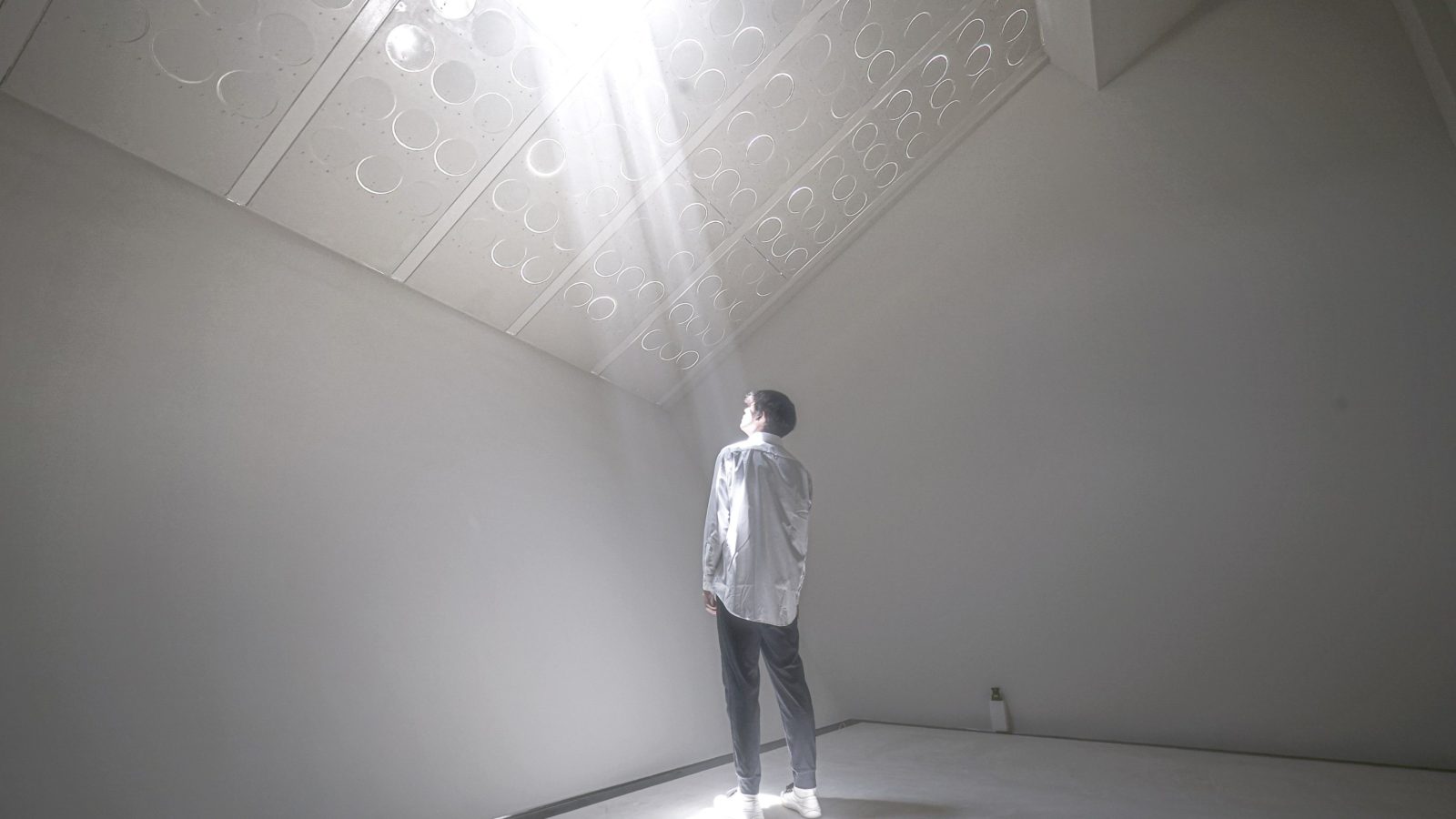
Flower Mirror에서 검증된 W5500 + STEP800 아키텍처는 전혀 다른 도메인에서도 그 가치를 입증하고 있습니다.
미디어 아트 그룹 anno lab이 제작한 Sun and Moon Room은 일본 오이타현 '불균질한 자연과 인간 미술관(不均質な自然と人の美術館)'에 상설 설치된 키네틱 작품입니다. 벽면에 배치된 수백 개의 원형 셔터가 스테퍼 모터에 의해 개폐되며, 태양광이나 달빛이 통과하는 위치를 선택적으로 제어하여 공간 내 빛의 분포를 실시간으로 재구성합니다.
이 작품 역시 겉으로 보면 빛과 공간의 예술적 경험만이 존재합니다. 관람객은 네트워크 케이블도, 컨트롤러 보드도 볼 수 없습니다. 그러나 그 내부에는 Flower Mirror와 동일한 W5500 Ethernet → STEP800 → 모터 → 셔터의 분산 제어 아키텍처가 작동하고 있습니다.
| 비교 항목 | Flower Mirror | Sun and Moon Room |
|---|---|---|
| 제작 | dot by dot Inc. | anno lab |
| 설치 유형 | 한정 전시 (수주간) | 상설 설치 (수년간 연속 운영) |
| 구동 대상 | 인조 꽃 개폐 | 원형 셔터 개폐 |
| 핵심 경험 | 관람객 실루엣을 꽃으로 반영 | 자연광을 물리적 매트릭스로 제어 |
| 제어 인프라 | W5500 + STEP800 + OSC | 동일 |
동일한 아키텍처가 "꽃의 거울"에서 "빛이 통과할 공간을 설계하는 시스템"으로 확장된 것입니다. 특히 Sun and Moon Room은 미술관에서 장기간 연속 운영되어야 하므로, W5500의 유선 Ethernet 안정성과 STEP800의 반복 동작 내구성이 더욱 중요한 요소로 작용합니다.
Sun and Moon Room은 이미 WIZnet Maker 사이트에 프로젝트로 등록되어 있으며, 아키텍처 상세 분석과 WIZnet 기술 적용 내용을 확인할 수 있습니다. → https://maker.wiznet.io/scott/projects/-sun-and-moon-room/
비즈니스 가치
"보이지 않는 Ethernet"의 재발견
키네틱 아트나 인터랙티브 설치를 기획하는 크리에이터 중 상당수는 자신의 프로젝트에 Ethernet이 필요하다는 것을 인식하지 못합니다. Flower Mirror와 같은 사례를 소개함으로써, 대규모 물리적 인터랙션의 이면에 Ethernet 기반 분산 제어가 존재한다는 것을 알리고, 유사한 프로젝트를 구현하고자 하는 분들에게 구체적인 아키텍처 인사이트와 기술 선택의 근거를 제공할 수 있습니다.
시장·기술 관점의 가치
- 크리에이티브 코딩 생태계 레퍼런스: Unity, Max 등에서 OSC 명령 하나로 물리적 모터 제어 → 소프트웨어 개발자의 하드웨어 진입 장벽 해소
- 대규모 키네틱 시스템 표준 아키텍처: 산업용 프로토콜 없이 표준 Ethernet + OSC만으로 800개 모터 제어 → 반복 적용 가능한 패턴 제시
- W5500 시장 영역 확장: 산업 자동화·IoT 중심에서 미디어 아트, 상업 공간 연출, 전시 시스템으로 도메인 확장
적용 시나리오
| 시나리오 | 설명 | 참고 사례 |
|---|---|---|
| 상업 공간 인터랙티브 디스플레이 | 리테일 매장, 호텔 로비의 관람객 반응형 키네틱 설치 | Flower Mirror |
| 스마트 건축 / 미디어 파사드 | 건축 외피 채광 요소의 능동적 제어 | Sun and Moon Room |
| 무대·공연 키네틱 장치 | 무대 장치, 쇼윈도 연출의 정밀 모션 제어 | Studio Ghibli 전시, WOW Inc. |
| 스마트 전시 운영 자동화 | 원격 모니터링, 스케줄 제어, 상태 진단 | 네트워크 기반 구조 공통 |
한계 및 개선 방향
Flower Mirror는 대규모 키네틱 시스템의 가능성을 보여준 선구적인 프로젝트이며, 그 구조에서 몇 가지 개선 기회를 도출할 수 있습니다.
| 현재 한계 | 개선 방향 |
|---|---|
| UDP 기반 OSC는 패킷 순서·도착 미보장 → 100대 보드 간 꽃 개폐 타이밍 불일치 가능 | 타임스탬프 기반 동기화 메커니즘, 보드 간 기준 시간 공유 도입 |
| Ethernet Hub 단일 장애점 → 허브 장애 시 전체 시스템 정지 리스크 | 계층형 스위치 구조, 네트워크 이중화. W5500 링크 상태 감지로 장애 조기 탐지 |
| 100대 보드 × 8모터의 전력 소모·발열 관리 복잡 | 전원 분배 설계 및 열 관리 전략 수립 |
| 100대 보드의 개별 설정·펌웨어 업데이트 운영 부담 | 네트워크 기반 원격 설정·업데이트 기능 추가 (현재는 DIP 스위치 + microSD) |
FAQ
Q1. STEP800을 도입하려면 어떤 수준의 기술 지식이 필요합니까?
Arduino 호환 하드웨어이며 OSC 프로토콜로 제어됩니다. Unity, Processing, Max 등 크리에이티브 코딩 환경에 익숙하다면 비교적 쉽게 시작할 수 있습니다. Configuration Tool과 예제 코드가 GitHub에 공개되어 있으며, WIZnet Maker 사이트에도 제품 정보가 등록되어 있습니다. → https://maker.wiznet.io/taylor/resellers/step800/
Q2. W5500 대신 소프트웨어 TCP/IP 스택을 사용하면 어떤 차이가 있습니까?
ATSAMD21(Cortex-M0+)에서 소프트웨어 TCP/IP 스택을 구동하면 네트워크 처리에 상당한 CPU 자원과 RAM이 소모되어, 8개 모터의 실시간 제어와 병행하기 어렵습니다. W5500은 TCP/IP를 하드웨어로 처리하므로 MCU는 모터 제어에 전념할 수 있으며, 이것이 Cortex-M0+ 급 MCU에서 100대 규모의 분산 제어를 실현할 수 있었던 핵심 이유입니다.
Q3. 100대 이상으로 확장할 때 네트워크는 어떻게 구성해야 합니까?
표준 Ethernet을 사용하므로 일반 네트워크 스위치로 확장 가능합니다. 주의할 점은 다음과 같습니다.
- 라우터가 아닌 스위치 사용 필수
- 대규모 환경에서는 계층형 스위치 토폴로지로 브로드캐스트 도메인 분리
- Master PC의 네트워크 인터페이스 대역폭도 함께 고려
Q4. STEP400과 STEP800 중 어떤 것을 선택해야 합니까?
- 소형 모터 다수 제어 (Flower Mirror 등) → STEP800 (8축, 2A/축)
- 대형 모터 정밀 제어 → STEP400 (4축, 5A/축, 전류 제어 모드 지원)
- 두 제품 모두 W5500 기반 Ethernet + OSC 프로토콜 공유 → 동일 소프트웨어 환경에서 혼용 가능
Q5. Sun and Moon Room처럼 상설 환경에서 장기 운용 시 유의점은 무엇입니까?
장기 운용의 핵심 고려사항은 다음과 같습니다.
- 모터 기계적 마모 → 정기적 호밍(homing) 동작으로 위치 오차 보정
- 전원 공급 안정성 → 전압 강하 시 보드 리셋 방지를 위한 충분한 전압 마진 확보
- 네트워크 신뢰성 → W5500의 유선 Ethernet이 무선 대비 높은 안정성 제공
- 안전 정지 → STEP800의 전자기 브레이크 옵션으로 전원 차단 시 부하 고정
상세 운용 사례는 WIZnet Maker의 Sun and Moon Room 프로젝트 페이지에서 확인할 수 있습니다. → https://maker.wiznet.io/scott/projects/-sun-and-moon-room/
-
Ponoor Site
