



Ethernet Protocol Explained: Physical & Data‑Link Layers Overview
It covers Ethernet’s physical layer and data‑link layer core knowledge.
Ethernet is the most widely‑used wired local‑area‑network standard in internet technology. Many people equate Ethernet with the Internet itself. In fact, ETH Ethernet is only one type of local area network. Ethernet is based on the IEEE 802.3 standard, which mainly covers the Physical Layer and the MAC sub‑layer of the Data Link Layer. Apart from ETH Ethernet, IEEE has also defined other local‑area‑network standards:
IEEE 802.11‑ Wireless Local Area Network Wi‑Fi
Wi‑Fi Wireless‑LAN technology that defines Physical‑Layer and Data‑Link‑Layer protocols for wireless networks, including variants such as 802.11a/b/g/n/ac/ax
IEEE 802.15‑ Wireless Personal Area Network WPAN
Bluetooth Personal‑Area‑Network PAN technology for short‑range wireless communication
ZigBee Low‑power, low‑data‑rate wireless‑communication technology based on IEEE 802.15.4, widely deployed for IoT Internet of Things applications
IEEE 802.17‑ Resilient Packet Ring
Defines technology for wireless broadband access
IEEE 802.16‑ Broadband Wireless Access WiMAX
Defines Ethernet standard for ring‑shaped network architectures, delivering high‑reliability and low‑latency data transmission
Common Ethernet types under the IEEE 802.3 standard are listed below:
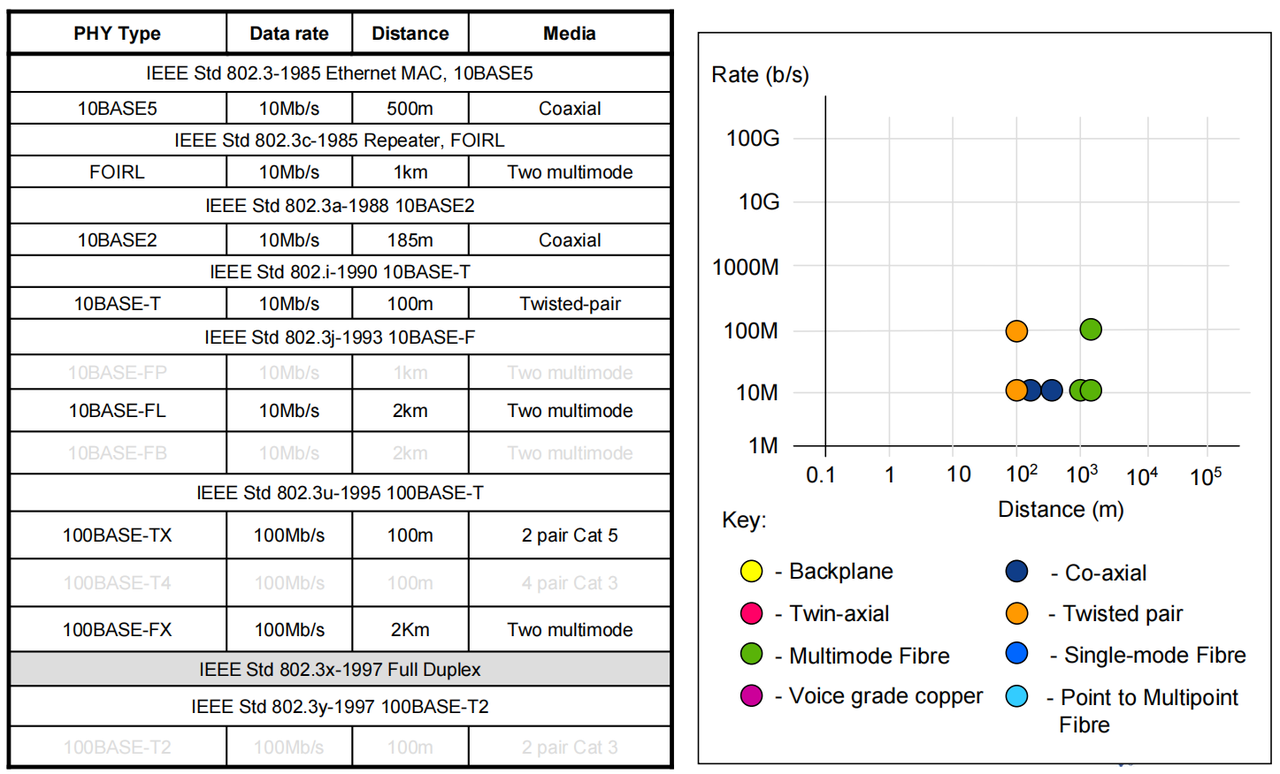
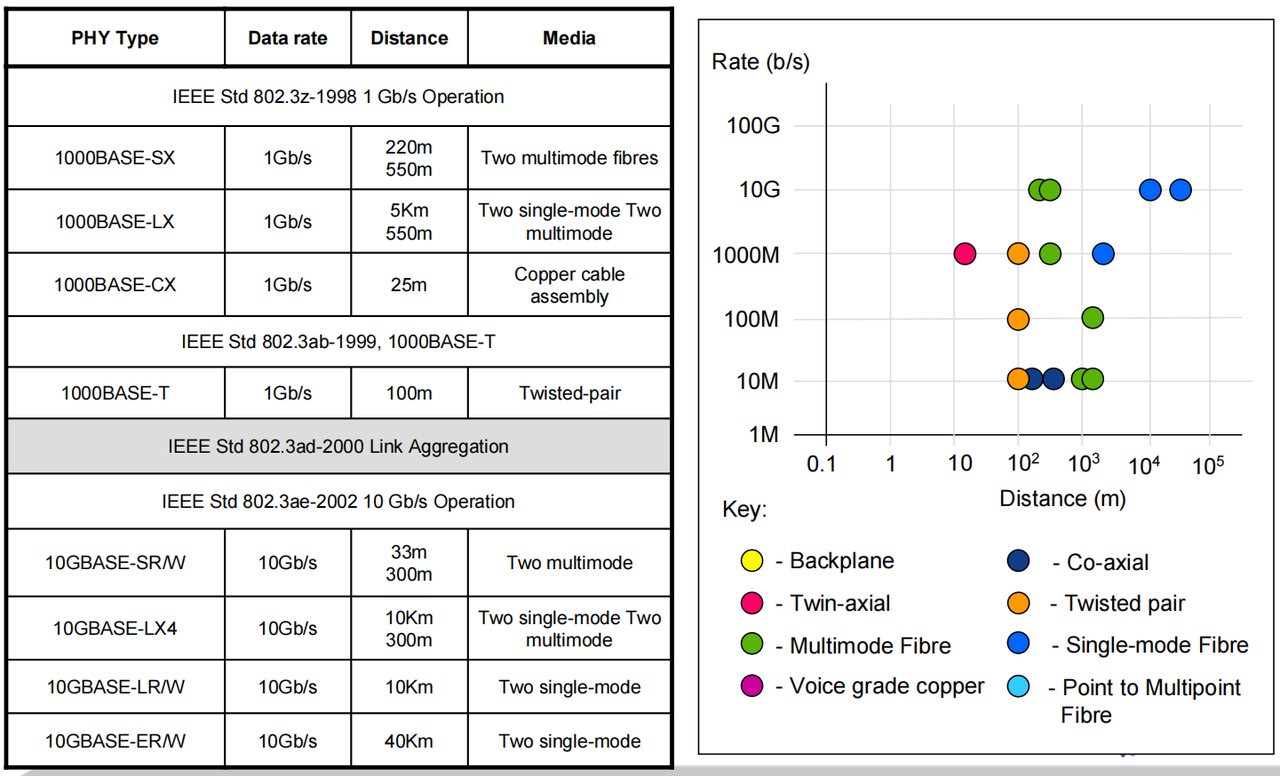
10BASE‑T/100BASE‑TX These are the most common Ethernet standards using twisted‑pair copper cables. 10BASE‑T delivers 10 Mbps transmission speed, while 100BASE‑TX delivers 100 Mbps.
Gigabit Ethernet 1000BASE‑T Provides high‑speed Ethernet transmission at 1000 Mbps 1 Gbps, also using twisted‑pair copper cable as physical medium.
10 Gigabit Ethernet 10GBASE‑T Achieves ultra‑high‑speed 10 Gbps Ethernet transmission and requires high‑performance twisted‑pair cables or optical fiber.
Fast Ethernet Includes fiber‑optic Ethernet standards such as 100BASE‑FX and 100BASE‑SX, offering 100 Mbps transfer rate and suitable for long‑distance networking scenarios.