



Embedded Network Development Basics: Analyzing the TCP/IP Model
It introduces four‑layer TCP/IP model and core protocols for embedded network development.
TCP/IP Model
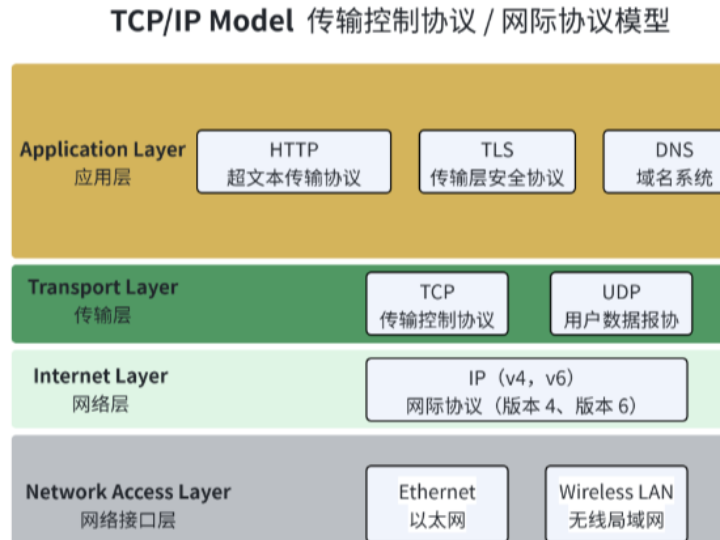
The TCP/IP model is the standard model for the Internet protocol suite, commonly used to describe protocol structures in modern networks. It is a more simplified model with fewer layers compared to the OSI model and is closer to practical applications.
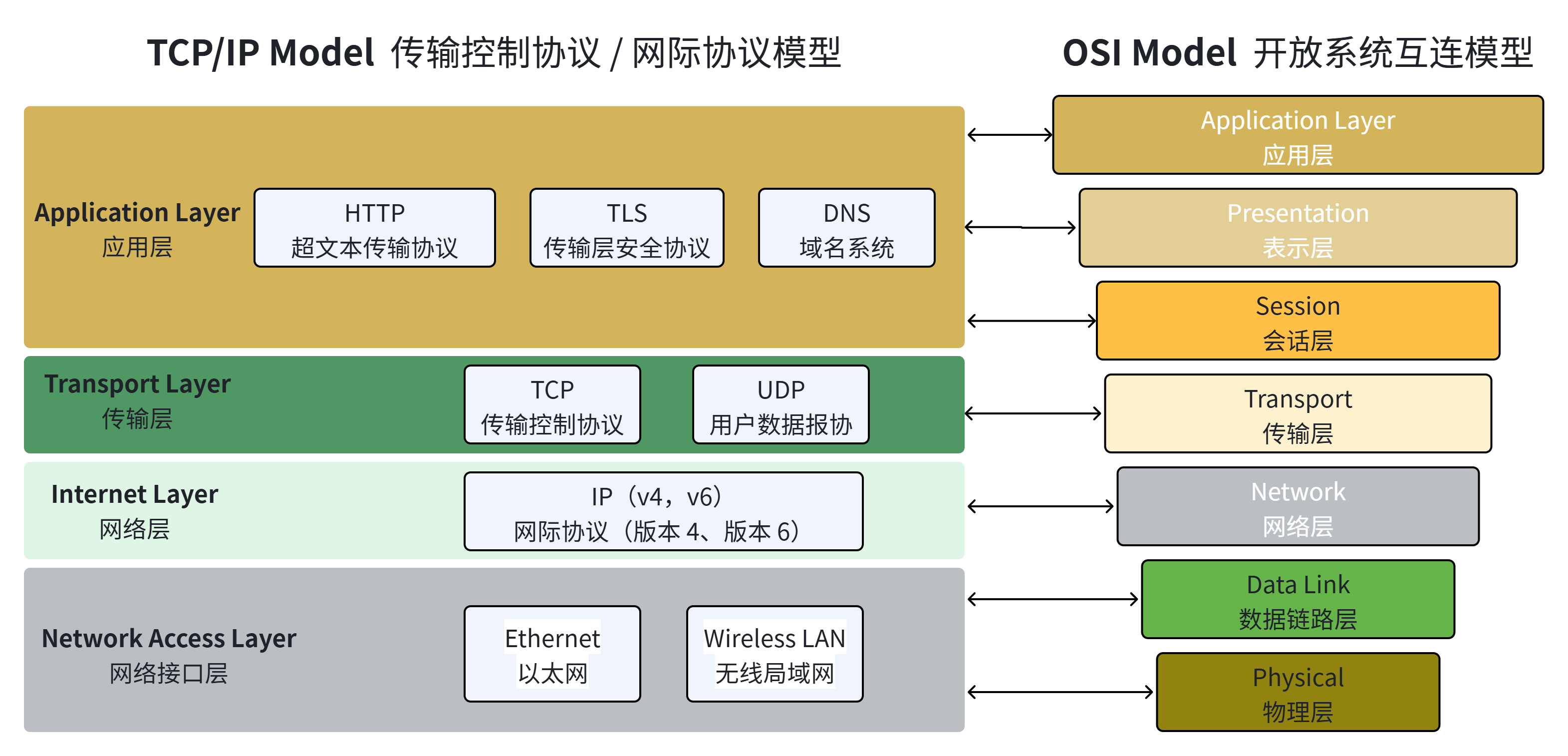
Layer architecture comparison between TCP/IP model and OSI model
The TCP/IP model contains four main layers:
Network Access Layer Responsible for transmitting data frames within local area networks Included protocols and standards:
Ethernet Frame‑transmission standard for local area networks
Wi‑Fi (IEEE 802.11) Standard for wireless local area networks
PPP Point‑to‑Point Protocol For point‑to‑point connections such as dial‑up networks
ARP Address Resolution Protocol Maps IP addresses to physical MAC addresses
VLAN Virtual Local Area Network Used for logical network division and isolation
Internet Layer Responsible for packet routing and forwarding, managing IP addresses and cross‑network communication. Included protocols:
IP Internet Protocol Defines packet addressing and routing, including IPv4 and IPv6
ICMP Internet Control Message Protocol Sends control messages and error reports, used by Ping and Traceroute
IGMP Internet Group Management Protocol Manages multicast communication for host groups
RARP Reverse Address Resolution Protocol Maps physical MAC addresses back to IP addresses
Transport Layer Provides end‑to‑end communication services to guarantee reliable data transmission across networks. Included protocols:
TCP Transmission Control Protocol Connection‑oriented reliable data transfer, handles flow control and error recovery
UDP User Datagram Protocol Connectionless data transmission for latency‑sensitive applications
SCTP Stream Control Transmission Protocol Multi‑stream data transmission for multi‑traffic‑control scenarios
Application Layer Offers protocols for direct interaction with users and applications, supporting diverse network application services Included protocols:
HTTP/HTTPS Hypertext Transfer Protocol / Secure For web browsing and data transfer
FTP/FTPS File Transfer Protocol / Secure For file transfer
SMTP Simple Mail Transfer Protocol For sending emails
IMAP Internet Message Access Protocol and POP3 For receiving and managing emails
DNS Domain Name System Converts domain names to IP addresses
Telnet and SSH Secure Shell For remote login and system administration
SNMP Simple Network Management Protocol For network device management and monitoring
Within the TCP/IP model, the Network Access Layer encapsulates data into frames for local‑network transmission, and handles network interfaces, error detection and physical addressing. The Internet Layer segments data into packets, attaches IP addresses, and manages routing and forwarding across different networks. The Transport Layer completes end‑to‑end data delivery via TCP or UDP. The Application Layer delivers concrete application services and protocols, processes user requests and ensures proper network‑based communication for applications.
From the above introduction of the OSI model and TCP/IP model, we can see that layered architecture is adopted to reduce network‑design complexity. Hardware and software functions are encapsulated. Each layer carries its own tasks and interfaces. Upper layers invoke services provided by lower layers, while internal implementation details inside each layer remain independent without mutual interference.