


WIZnet Port Module Series Selection Guide
WIZnet 5 port modules convert serial to Ethernet with encryption, dual ports, and cost-effective options for industrial to IoT applications.
Preface
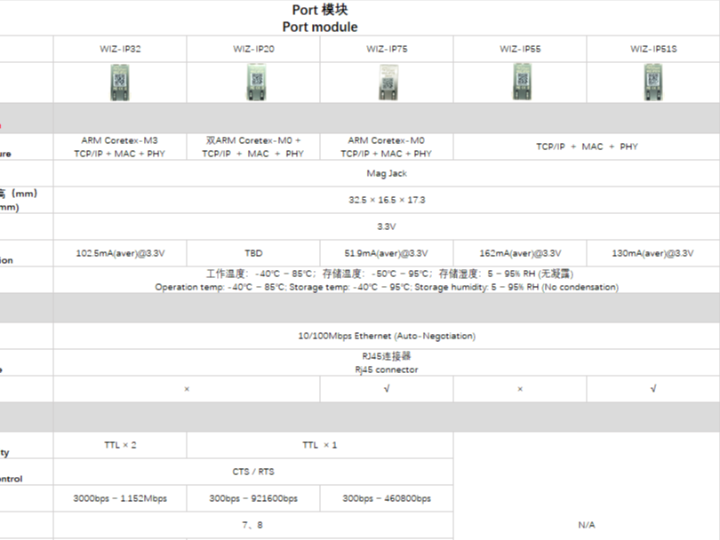
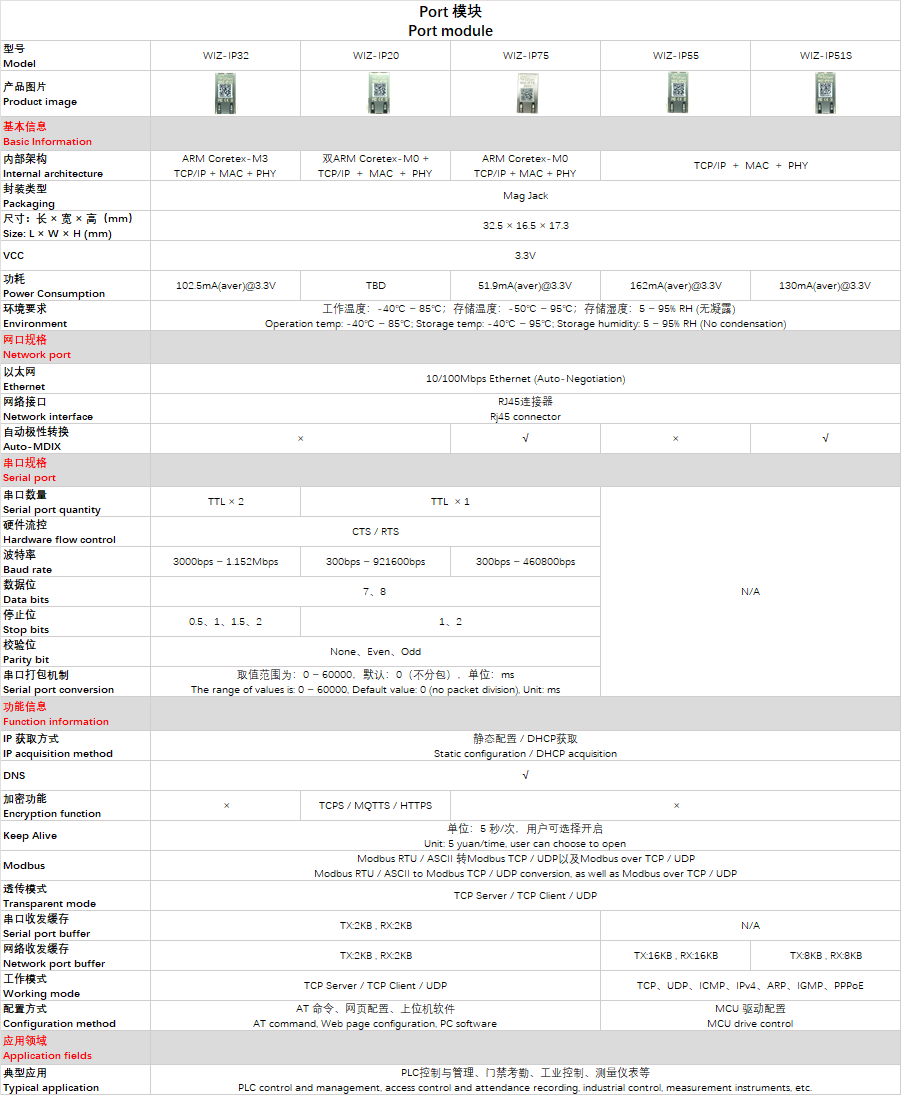
This article focuses on WIZnet's 5 core port modules (WIZ-IP32, WIZ-IP20, WIZ-IP75, WIZ-IP55, WIZ-IP51S). Each model has its own emphasis on interface specifications, speed performance, and functional configurations, covering full-dimensional needs from basic serial-to-Ethernet scenarios to high-speed communication scenarios and multi-protocol compatibility scenarios. They meet diverse hardware design requirements from low-cost embedded devices to industrial-grade high-speed networking terminals, helping users quickly identify suitable solutions and reduce selection and development costs.
Core Features of Each Module
WIZ-IP32
ARM Cortex-M3, integrates TCP/IP + MAC + PHY
Dual serial ports, baud rate supports up to 1.152Mbps
Supports Keep Alive, password authentication, Modbus protocol
Applications: Dual-PLC gateways, multi-channel temperature/humidity collection terminals, dual-device data synchronization gateways
WIZ-IP20
Dual ARM Cortex-M0+, integrates TCP/IP + MAC + PHY
Supports encrypted protocols like HTTPS, MQTTS
Applications: Encrypted cloud gateways, financial security devices, safe remote monitoring systems
WIZ-IP75
ARM Cortex-M0, integrates TCP/IP + MAC + PHY
Cost-effective, supports three configuration methods and 2048-byte dual buffer
Applications: Home smart lock gateways, civilian temperature/humidity collection modules, small building lighting controllers
WIZ-IP55
8 Sockets + SPI high-speed interface, integrates TCP/IP + MAC + PHY
Integrated network port and protocol stack in single package
Applications: Industrial precision pressure measurement and control terminals, machine tool PLC cluster gateways, automation testing instrument networking modules
WIZ-IP51S
4 Sockets + SPI high-speed interface, integrates TCP/IP + MAC + PHY
Integrated network port and protocol stack in single package, cost-effective
Applications: Low-power IoT sensor gateways, portable smart monitoring terminals, miniature embedded data acquisition modules
Quick Selection Guide
| Decision Dimension | Criteria | Recommended Models |
|---|---|---|
| Communication Performance | Need high-speed serial port? | WIZ-IP32 |
| Protocol Compatibility | Need encryption/multiple IoT protocols? | WIZ-IP20 |
| Interface & Flow Control | Need dual serial ports? | WIZ-IP32 |
| Cost-effectiveness | Low-cost, lightweight networking needs? | WIZ-IP75 |
| Rapid Integration | Need to connect with other MCUs for quick Ethernet access? | WIZ-IP55, WIZ-IP51S |
Core Parameters & Feature Comparison Table
| Model | Core Configuration | Key Features | Typical Applications |
| WIZ-IP32 | Cortex-M3, dual serial ports, hardware TCP/IP | Dual serial port transmission, full Modbus support, industrial grade | Power/chemical/metallurgy automation gateways |
| WIZ-IP20 | W55RP20 chip, supports encrypted communication | Encrypted communication, OTA, full-link security | Medical/financial/government encrypted cloud gateways |
| WIZ-IP75 | Cortex-M0, serial port with flow control | Cost-effective, stable without redundancy | Smart buildings/civilian industrial control gateways |
| WIZ-IP55 | W5500, 8 Sockets, SPI | High-speed concurrency, easy embedded development | Precision manufacturing/industrial inspection controllers |
| WIZ-IP51S | W5100S, 4 Sockets, SPI | Low cost, energy efficient, compact package | IoT low-power nodes/mass production modules |
Common Selection Q&A
Q1: What are the core advantages of network offload modules?
A1: They integrate chips, network transformers, and RJ45 connectors, enabling plug-and-play operation without additional Ethernet circuit design. This simplifies hardware development while leveraging hardware TCP/IP protocol stacks to enhance communication stability, making them suitable for rapidly implementing networking requirements.
Q2: What scenarios are serial port flow control functions suitable for?
A2: When serial port data transmission rates are high and data volumes are large, CTS/RTS flow control can coordinate the timing between transmitter and receiver to prevent data loss. This is commonly used in industrial high-speed serial port devices and large-volume continuous transmission scenarios.
Q3: Are encrypted protocols (SSL/MQTTS) necessary to choose?
A3: For public network transmission and scenarios involving sensitive data (such as medical, financial, or security data), encrypted protocols can ensure data transmission security and prevent theft or tampering.
Q4: What is the relationship between Socket quantity and concurrent communication?
A4: The number of Sockets determines how many simultaneous network connections the module can establish. 8 Sockets are suitable for multi-device/multi-server concurrent connections, while 4 Sockets meet single-connection or limited concurrent scenarios. Selection should be based on the actual networking architecture.
Q5: What is the core value of dual-serial port design?
A5: Dual serial ports enable simultaneous connection of multiple devices without requiring additional interface expansion. Combined with high baud rates up to 1.152Mbps, they can meet parallel transmission requirements for multi-channel data, making them suitable for dual-PLC gateways, multi-node data collection, and similar scenarios.
Typical Application Case References
WIZ-IP32: Factory production line dual-PLC gateway (dual serial ports for multi-device access + industrial-grade stability + Modbus compatibility)
WIZ-IP20: Financial security encrypted cloud gateway (MQTTS encrypted communication + OTA upgrade + multi-protocol adaptation, ensuring sensitive data security)
WIZ-IP75: Smart building low-cost data collection module (cost-effective + serial port flow control, suitable for civilian batch applications)
WIZ-IP55: Precision manufacturing measurement and control terminal networking module (high concurrency + plug-and-play + industrial wide temperature range, shortening development cycles)
WIZ-IP51S: IoT low-power sensor gateway (energy-saving mode + compact package + low cost, suitable for batch low-power nodes)