


WIZnet Ethernet Microcontroller (MCU) Selection Guide
WIZnet's 5 Ethernet MCUs: From Cortex-M3 with hardware TCP/IP/crypto to compact dual-core options for industrial, secure POS, and IoT applications.
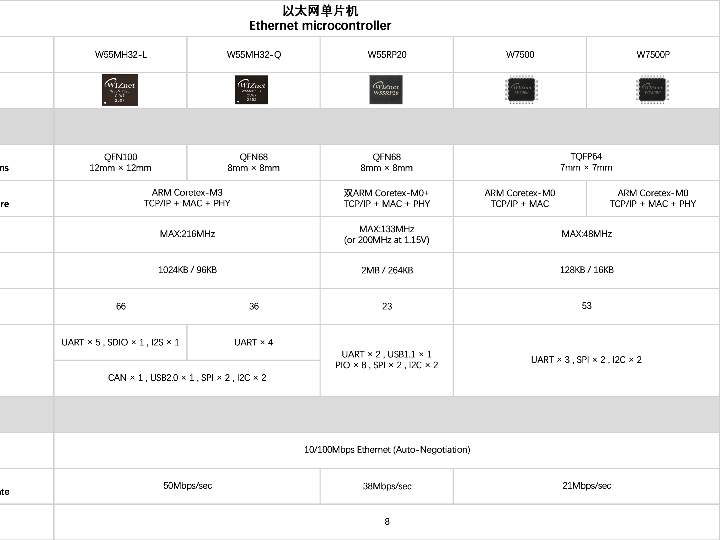
Preface
This article focuses on WIZnet's 5 core Ethernet microcontrollers (W55MH32, W55MH32-L, W55MH32-Q, W55RP20, W7500P). Each model has distinct emphases on computing power, package size, interface expansion, and security features, covering a full spectrum of needs including industrial multi-device control, compact handheld terminals, high-security encrypted communication, and lightweight networking nodes. They precisely match diverse hardware design requirements, from simple peripheral connectivity to high-load multitasking, helping you quickly identify suitable solutions and reduce selection and development costs.
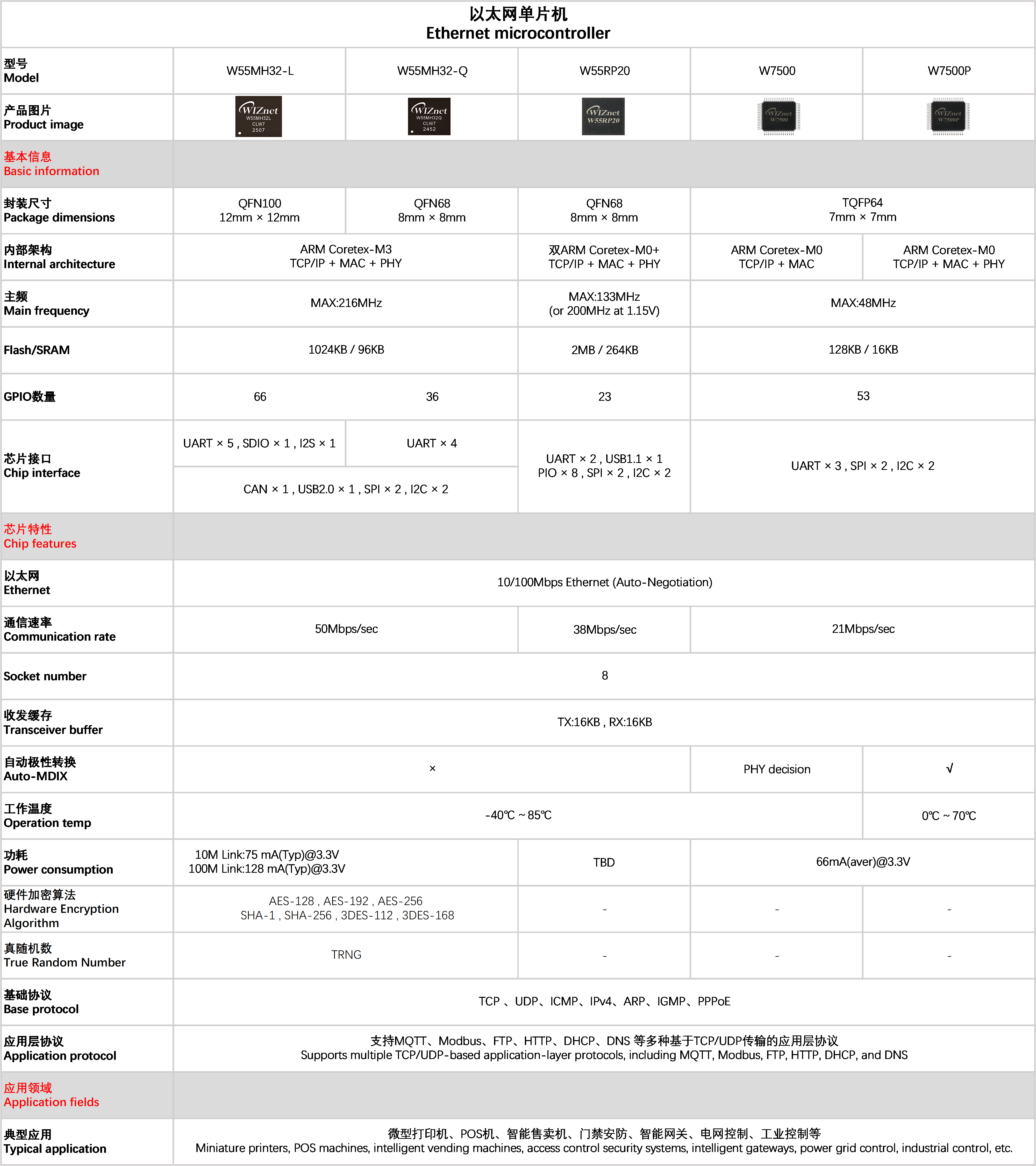
Core Features of Each Chip
W55MH32-L
Architecture: Cortex-M3 @ 216MHz + Hardware TCP/IP Stack
Memory: 1024KB Flash / 96KB RAM
Interfaces: UART × 5, CAN, USB 2.0 (Comprehensive multi-interface coverage)
Security: Hardware Encryption (DES, SHA, AES) + True Random Number Generator (TRNG)
Specs: Industrial temperature range, suitable for complex industrial environments.
Applications: Multi-interface industrial control terminals, encrypted POS systems, PLC data gateways.
W55MH32-Q
Architecture: Same core as W55MH32-L + Hardware TCP/IP Stack + 32KB dedicated Ethernet buffer
Package: QFN68 small package (8×8mm), saves 55% PCB space.
Interfaces: UART × 4, CAN, USB 2.0 (Core interfaces retained, balancing miniaturization and practicality).
Applications: Handheld ticket printers, small vending machines, space-constrained terminals.
W55RP20
Architecture: Dual Cortex-M0+ @ 133MHz (Supports parallel task processing)
Memory: 2MB Flash / 264KB RAM
Performance: 38Mbps throughput + 16 PWM channels.
Networking: Hardware TCP/IP Stack + 32KB dedicated buffer (Network communication doesn't consume core CPU resources).
Applications: Power grid data acquisition, lighting dimming systems, industrial multi-actuator control.
W7500
Architecture: Cortex-M0 @ 48MHz
Memory: 128KB Flash / 16KB RAM (Basic configuration)
Interfaces: UART × 3, PWM × 8 (Expansion requires additional chips).
Networking: Hardware TCP/IP Stack.
W7500P
Architecture: Same computing power as W7500.
Specs: Operating temperature range 0°C to 70°C.
Networking: Hardware TCP/IP Stack.
Quick Selection Guide
| Decision Dimension | Criteria | Recommended Model(s) |
|---|---|---|
| Core Architecture Need | Need High Performance? | W55MH32 / W55RP20 |
| Package Size Need | Need Small Package? | W55MH32-Q / W55RP20 |
| Security Feature Need | Need Hardware Encryption (DES/AES/SHA) + TRNG? | W55MH32 |
| UART Quantity Need | Need 5, 4, or 2 UARTs for multi-device comms? | 5 → W55MH32-L; 4 → W55MH32-Q; 2 → W55RP20 |
| GPIO Expansion Need | Need extensive GPIO for peripherals? (66, 36, or 23 pins) | 66 → W55MH32-L; 36 → W55MH32-Q; 23 → W55RP20 |
| Code Compatibility | Compatible with STM32F103 code? | W55MH32 |
Core Parameters & Feature Comparison
| Model | Core / Freq. | Memory | Package / Key Interfaces | Core Features | Typical Applications |
| W55MH32-L | Cortex-M3 / 216MHz | 1024KB/96KB | QFN100 / UART×5, CAN, USB2.0 | High power + HW TCP/IP + Multi-I/F + HW Crypto + TRNG | Industrial Control, Encrypted POS, PLC Gateways |
| W55MH32-Q | Cortex-M3 / 216MHz | 1024KB/96KB | QFN68 / UART×4, CAN, USB2.0 | Compact + HW TCP/IP + High Freq + Industrial Temp | Handheld Printers, Small Vending Machines |
| W55RP20 | Dual Cortex-M0+ / 133MHz | 2MB/264KB | QFN68 / UART×2, PWM×16 | Dual-core + HW TCP/IP + Large Memory + Parallel Comm | Data Acquisition, Dimming Systems, Multi-Actuator Control |
| W7500 | Cortex-M0 / 48MHz | 128KB/16KB | TQFP64 / UART×3, PWM×8 | Basic Ethernet + HW TCP/IP Stack | Minimalist Scenarios |
| W7500P | Cortex-M0 / 48MHz | 128KB/16KB | TQFP64 / UART×3, PWM×8 | Basic Config + Commercial Temp Range + HW TCP/IP Stack | Minimalist Scenarios |
Common Selection Q&A
What's the advantage of a Hardware TCP/IP Stack?
→ It processes network data independently, freeing the MCU's core resources. It's more stable than software stacks and supports smoother multi-protocol operation.
Does the small W55MH32-Q package reduce performance?
→ No! Only the package and some pins are reduced. The core configuration and HW TCP/IP functionality are identical to the W55MH32-L.
Is hardware encryption necessary?
→ It's essential for payment systems and industrial sensitive data scenarios. It doesn't consume CPU resources and effectively prevents data tampering.
Typical Application Case References
W55MH32-L: Industrial PLC Data Gateway (Parallel protocols + CAN interface + HW encryption + Stable HW TCP/IP networking).
W55MH32-Q: Wired Handheld POS Terminal (Compact + Multi-interface + HW TCP/IP + High frequency for fast transaction processing).
W55RP20: Distributed Lighting Dimming System (Dual-core parallelism + 16-channel PWM dimming + HW TCP/IP for high-speed data sync).