


WIZnet Ethernet Chip Selection Guide
WIZnet's 5 Ethernet chips: W5100S & W5500 for cost/space efficiency, W5300 for high throughput, W6100 & W6300 for IPv6 & high-speed IoT/industrial applications.
Preface
This article focuses on WIZnet's 5 core Ethernet chips (W5100S, W5500, W5300, W6100, W6300). Each model has distinct emphases on interface type, data rate, and functional configuration, covering a full spectrum of scenarios from low-cost lightweight IoT devices and small universal equipment to high-throughput industrial systems and IPv6-compatible network terminals. They match diverse hardware design requirements, from minimalist connected devices to high-bandwidth industrial terminals, helping you quickly identify suitable solutions and reduce selection and development costs.
Core Features of Each Chip
W5500
Package: Small (LQFP48 7mm×7mm) + SPI Interface, ideal for compact devices.
Performance: 50Mbps interface speed + 32KB buffer + 8 Sockets, suitable for basic Ethernet data transmission.
Best For: Portable thermal ticket printers, handheld inventory scanners, portable POS auxiliary networking units, compact industrial sensor gateways, embedded printer units in delivery lockers.
W5100S
Package: Small size, supports dual interface: 8-bit Parallel Bus / SPI.
Performance: Low cost + lightweight configuration (25Mbps speed, 16KB buffer, 4 Sockets), includes Socket-less function.
Best For: Lightweight Industrial Modbus RTU-to-TCP gateways, access control log upload units, smart water meter reading terminals.
W5300
Interface: Supports 8/16-bit Parallel Bus.
Performance: High interface speed up to 80Mbps, paired with large 128KB buffer.
Features: Built-in Auto-MDIX, DMA engine, strong data throughput capability.
Best For: PLC data acquisition gateways, main POS terminals in retail, multi-sensor cluster terminals on production lines, data transmission units for logistics sorting equipment, wired networking modules for medical monitors.
W6100
Protocol: Supports IPv4/IPv6 dual-stack, adapting to modern network environments.
Performance: 50Mbps speed + 32KB buffer + 8 Sockets.
Interface: Compatible with 8-bit Parallel Bus / SPI.
Best For: IPv6 smart streetlight nodes in campuses, IPv6 public network gas leak detectors, enterprise IPv6 attendance check-in terminals.
W6300
Protocol: Supports IPv4/IPv6 dual-stack.
Interface & Speed: Features QSPI interface with speeds up to 91Mbps.
Features: Socket-less function, high-speed transmission.
Best For: Vending machines, power grid data acquisition terminals, commercial LED displays, parking lot space detection sensors, high-definition cameras on production lines.
Quick Selection Guide
| Decision Dimension | Criteria | Recommended Models |
|---|---|---|
| Core Network Requirement | Need IPv6 support? | W6300, W6100 |
| Data Transmission Performance | Need high-speed communication? | W6300, W5300 |
| Interface Versatility | Need SPI interface support? | W5100S, W5500, W6100 |
| Cost-Effectiveness | Low-cost requirement? | W5100S, W5500 |
Core Parameters & Feature Comparison
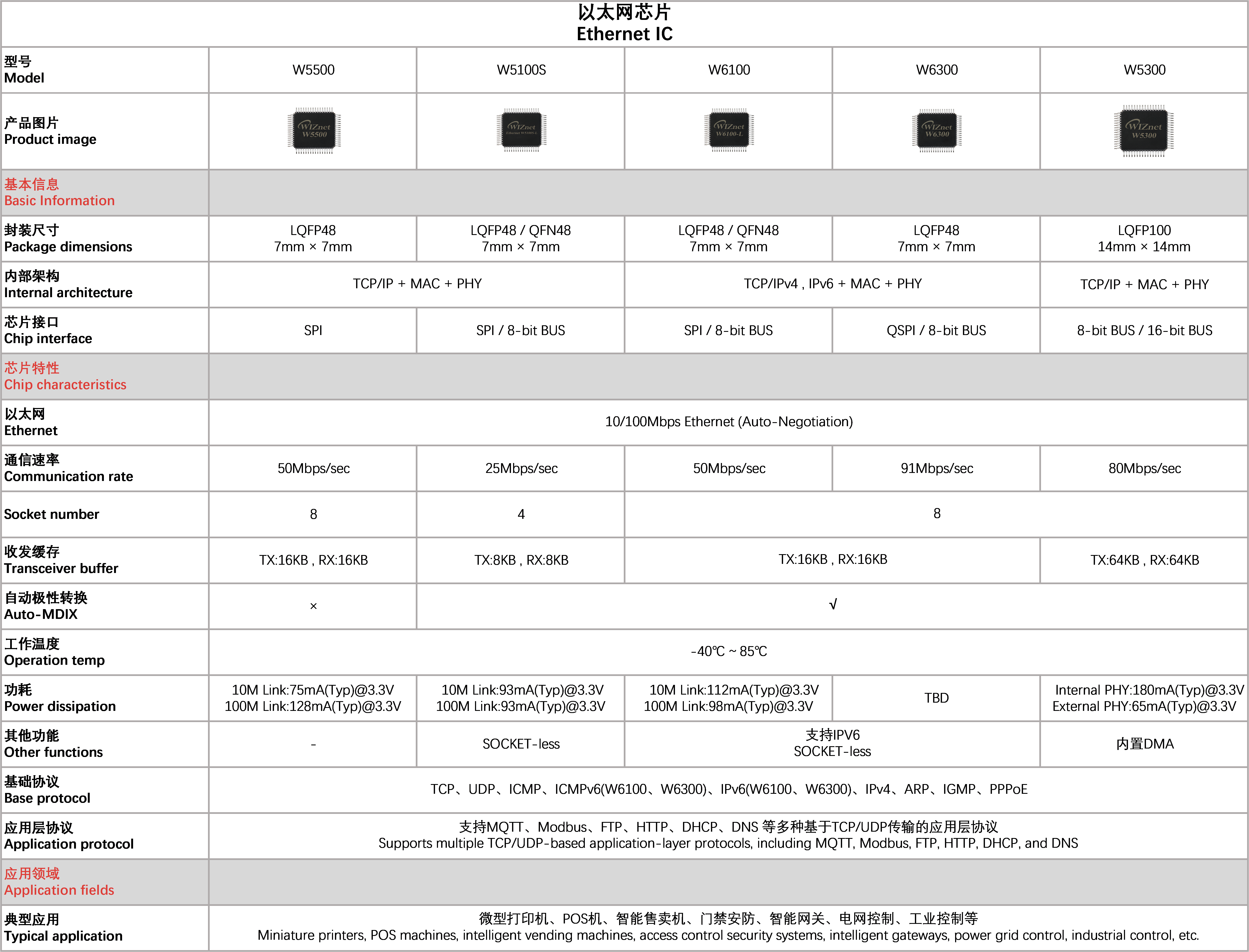
| Model | Package | Core Specs (Speed/Buffer/Sockets) | Key Features | Typical Applications |
| W5500 | LQFP48 (7×7) | 50Mbps / 32KB / 8 | General-purpose | Mini printers, handheld scanners |
| W5100S | LQFP48/QFN48 (7×7) | 25Mbps / 16KB / 4 | Low cost + Socket-less | Access control units, smart meters |
| W5300 | LQFP48/QFN48 (7×7) | 80Mbps / 128KB / 8 | Large buffer + DMA + Auto-MDIX | Industrial control, high-data POS |
| W6100 | LQFP48/QFN48 (7×7) | 50Mbps / 32KB / 8 | IPv4/IPv6 Dual-stack | Smart security, IPv6 network terminals |
| W6300 | LQFP48 (7×7) | 91Mbps / 32KB / 8 | IPv4/IPv6 + QSPI high-speed | Grid control, high-bandwidth vending machines |
Common Selection Q&A
What's the advantage of a dual interface (8-bit BUS/SPI)?
→ It adapts to the interface types of different host controller chips, reducing hardware design constraints (e.g., older controllers with only BUS interfaces can directly use W5100S/W6100).
In what scenarios is IPv6 essential?
→ Newly deployed public network IoT devices, network environments required by ISPs to support IPv6, and products needing long-term compatibility with future networks.
What does Socket quantity affect?
→ It determines the number of network devices/services the chip can connect to simultaneously (e.g., 8 Sockets support connecting to multiple servers, while 4 Sockets are suitable for single-connection scenarios).
What is Auto-MDIX?
→ It is an adaptive communication matching mechanism built into the Ethernet chip. It automatically recognizes and adapts to the connected device's network parameters (like speed, duplex mode) without manual configuration, ensuring data transmission stability and compatibility.
Typical Application Case References
W5500: Portable Thermal Receipt Printer (Basic Networking)
W5100S: Smart Locker Compartment Status Monitoring Node (Low-cost + Minimalist Communication)
W5300: Industrial PLC Data Acquisition Terminal (Large Buffer + High Throughput)
W6100: Campus IPv6 Smart Access Control System (Dual-stack for modern networks)
W6300: Vending Machine Multimedia Data Upload (High-speed QSPI + Dual-stack)