



W55MH32L Single-Chip Ethernet Solution: Achieving High-Quality, Low-Latency Network
W55MH32L Single-Chip Ethernet Solution: Achieving High-Quality, Low-Latency Network Audio Transmission
Introduction
When smart speakers frequently disconnect, multi-room audio systems malfunction, and industrial intercoms experience voice delays; when developers struggle with porting network protocol stacks and spend countless nights debugging audio timing jitter; and when insufficient memory limits functional expansion and cumbersome peripheral compatibility lengthens development cycles—traditional MCU solutions are increasingly unable to keep pace with the upgrade rhythm of IoT audio devices. Driven by market demands for high fidelity, low latency, high reliability, and rapid mass production, WIZnet has launched the W55MH32L chip. With its full-stack hardware architecture of "large memory + high clock speed + hardware TCP/IP protocol stack + I2S + multiple peripherals," coupled with rich circuit design and comprehensive example documentation, it achieves multi-dimensional optimization breakthroughs from the underlying technology to development support, precisely alleviating various industry pain points and providing a high-performance core reference design for high-performance network audio solutions.
1. Addressing Three Major Industry Pain Points: Network Audio Technology Bottlenecks Faced by Traditional MCU Solutions
The explosive growth of IoT audio devices has increasingly highlighted the shortcomings of the traditional "MCU + software protocol stack" architecture. In particular, performance bottlenecks caused by limited memory and insufficient clock speed, compatibility challenges due to a scarcity of peripherals and non-native audio interfaces, and inefficiencies caused by a lack of development resources all contribute to a multi-dimensional industry dilemma. From consumer electronics to industrial applications, developers and enterprises generally face a triple obstacle of "insufficient performance, poor compatibility, and slow development," becoming the core factors restricting product upgrades.
1.1 Network processing bottlenecks cause audio transmission to stutter easily.
Traditional solutions rely on software to parse the TCP /IP protocol. When processing network data and audio streams simultaneously, CPU resource utilization increases significantly, easily leading to three major problems:
- High latency : Network audio transmission latency is difficult to control, making it hard to meet the industry's basic requirements for a smooth experience;
- Significant jitter : Audio data transmission jitter is quite prominent, which may result in a "discontinuous" playback effect;
- Limited concurrent processing capability : When faced with multiple device connections (such as multi-room audio synchronization), the stability of the software protocol stack is prone to decline, which may affect the connection success rate; in harsh industrial IoT scenarios, it may even lead to failures such as loss of monitoring audio and interruption of intercom.
1.2 I2S timing is difficult to control, making it hard to achieve a high-fidelity experience.
The I2S interface is the core of audio transmission and has extremely high timing precision requirements. Traditional general-purpose MCUs lack native I2S hardware support and mostly implement the function through software simulation or complex DMA configuration, which not only prolongs the development cycle but also makes it difficult to overcome performance bottlenecks.
- Software simulation solutions typically struggle to achieve high audio sampling rates, making it difficult to meet the demands of high-fidelity audio devices.
- Even with DMA configuration, timing jitter may still occur due to system load and other reasons, resulting in audio noise, popping and other problems.
- Timing debugging is difficult, and developers need to invest a lot of project time to solve audio stability issues.
1.3 Limited memory resources restrict functional expansion.
The functional iterations of smart audio devices (such as multi-channel audio stream processing, local sound effect algorithms, and speech recognition integration) have led to a continuous increase in the demand for memory resources. However, traditional MCUs are generally limited by cost and architectural design, resulting in a small memory capacity, which restricts the improvement of product competitiveness.
- Multitasking is limited : Limited RAM space makes it difficult to support concurrent tasks such as network data caching, audio stream processing, and application logic execution, which can easily lead to memory overflow, causing device lag and restarts.
- Functional expansion is hindered : It is difficult to load complex audio algorithms such as noise reduction and echo cancellation, as well as value-added functions such as local speech models. The product may remain at the basic playback level and cannot meet the market's demand for intelligence and high quality.
- Hardware design redundancy : To compensate for insufficient memory, additional external storage chips are often required, which increases BOM cost, occupies PCB space, prolongs hardware development and debugging cycle, and may reduce mass production yield.
2. W55MH32L's Core Advantages Across All Dimensions: Alleviating Multi-Dimensional Industry Challenges Through Full-Stack Hardware Innovation
Addressing the core pain points of traditional solutions in three dimensions—performance, compatibility, and development—the W55MH32L constructs a full-stack advantage system encompassing "core computing power, network processing, audio transmission, peripheral expansion, and development support." With large memory and high clock speeds forming a solid foundation for performance, a hardware TCP/IP protocol stack overcoming network bottlenecks, an I2S interface (reusing SPI3) ensuring audio quality, and multiple peripherals expanding compatibility boundaries, coupled with rich circuit design and comprehensive example documentation, each advantage forms a technological closed loop, empowering product upgrades from multiple dimensions.
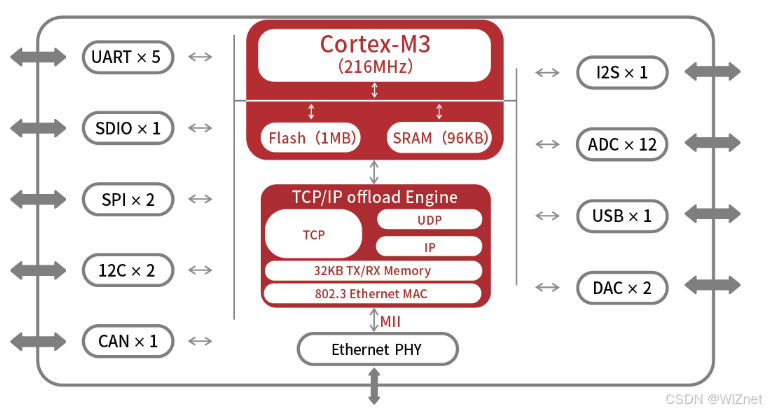
System Architecture
2.1 Hardware TCP/IP protocol stack + high-frequency kernel, constructing a high-efficiency and stable core foundation
The W55MH32L adopts a collaborative architecture of "hardware TCP/IP protocol stack + high-frequency computing core," which reduces the CPU's workload on network processing while providing sufficient computing power to support complex applications, forming a synergistic performance advantage: On the one hand, the integrated hardware TCP/IP protocol stack allows core network protocol processing such as TCP, UDP, IPv4, and ARP to be primarily handled by hardware, effectively freeing up MCU resources; on the other hand, the Cortex-M3 core, with a maximum clock speed of 216MHz, provides strong computing power support for audio algorithm operation and multi-task scheduling. Specific advantages include:
- Highly efficient computing power release : The network protocol is processed entirely in hardware, and the high-frequency core can focus on complex algorithm operations such as audio noise reduction and echo cancellation, as well as application logic execution. Compared with traditional solutions, the task processing efficiency is significantly improved, and it can better meet the needs of concurrent processing of multiple audio streams.
- Ultra-low network latency : The hardware TCP/IP protocol stack greatly enhances MCU performance and significantly reduces network data transmission latency, making it more suitable for latency-sensitive scenarios such as real-time audio transmission and industrial intercom.
- High concurrency stability : Supports multiple independent hardware sockets, which can stably handle multiple concurrent network connections at the same time. The connection stability is significantly enhanced when multiple devices are working together (such as multi-room audio synchronization). In the case of network fluctuations, it can also better ensure the continuity of audio transmission and data integrity.
- Lowered development threshold : Without the need for complex protocol stack porting and in-depth debugging and optimization, developers can skip the underlying network details and focus directly on application layer development, which helps to shorten the R&D cycle.
2.2 Native Hardware I2S and DMA: Laying a Solid Foundation for High-Quality Audio Transmission
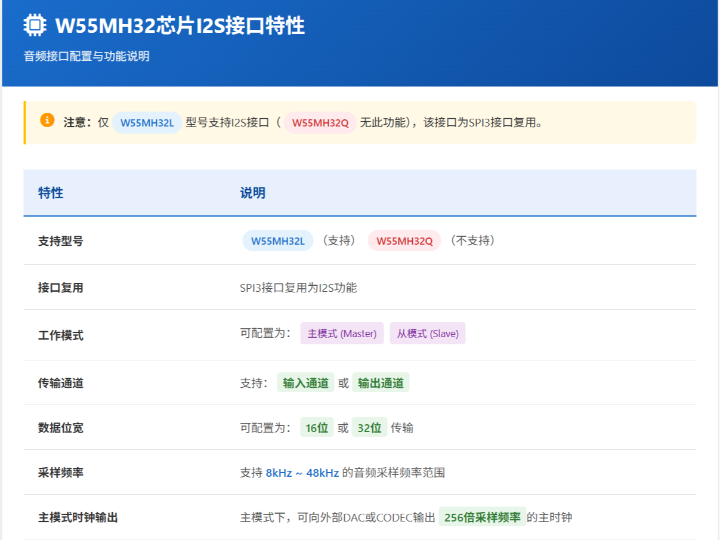
Addressing the core requirements of timing accuracy and sound quality assurance in audio transmission, the W55MH32L integrates an SPI3 multiplexed I2S interface and is paired with a 12-channel hardware DMA controller. This underlying hardware architecture ensures high stability and high quality in audio data transmission, effectively resolving pain points in traditional solutions such as audio stuttering, noise, and complex development and adaptation. Specific advantages are as follows:
- More stable timing : The hardware I2S interface automatically generates precise timing signals, achieving strict alignment of clock, frame synchronization, and data lines, thus fundamentally avoiding timing jitter issues caused by software-simulated interfaces. Simultaneously, the hardware-level DMA transfer mechanism eliminates the need for frequent CPU intervention in audio data interrupt handling, significantly reducing the risk of audio stream interruptions. This effectively reduces noise, pops, and stuttering during audio playback, ensuring consistent audio output.
- Professional-grade audio quality support : The hardware I2S interface supports the standard I2S protocol, configurable for 16-bit or 32-bit transmission, and supports professional audio sampling frequencies from 8kHz to 48kHz, meeting the basic requirements of high-fidelity audio equipment for sampling accuracy and dynamic range. DMA independently handles data transfer, avoiding data transmission distortion caused by CPU intervention, providing reliable hardware protection for the original fidelity of the audio signal.
- Flexible and convenient adaptation : The I2S interface can directly connect to mainstream audio codec chips without the need for additional logic conversion devices, simplifying hardware circuit design. This interface supports both master/slave operating modes and input/output channel configurations. Combined with flexible DMA channel parameter settings, it can easily adapt to different audio system architectures, significantly shortening the development and debugging cycle of audio subsystems.
- Efficient resource utilization : Hardware I2S and DMA work together to completely offload audio data transmission tasks to the hardware module, significantly reducing the CPU's computational burden. The freed-up CPU computing power can then focus on complex algorithms such as audio noise reduction and echo cancellation, as well as the execution of upper-layer application logic, achieving a dual improvement in overall system performance and responsiveness.
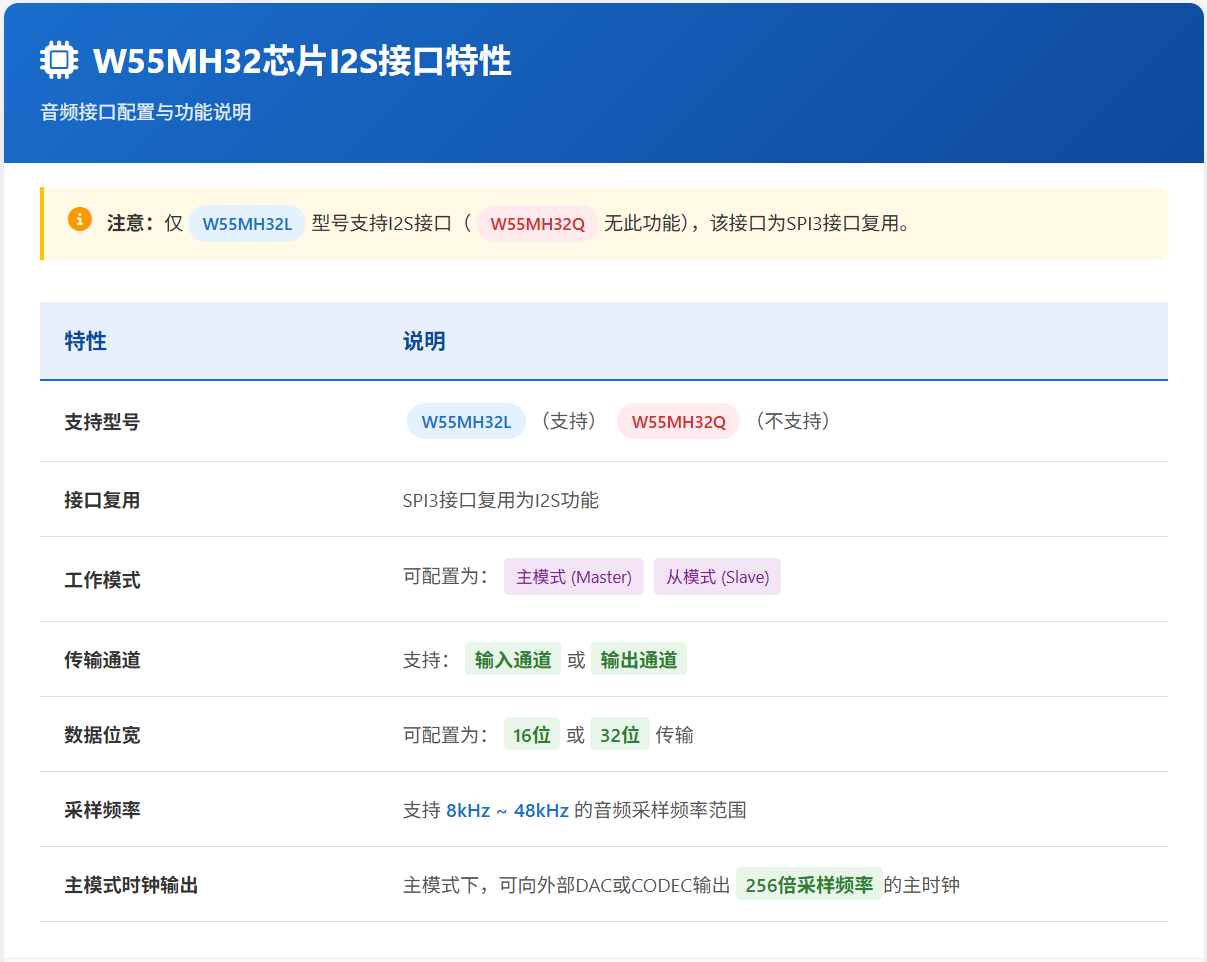
Features of the I2S interface in W55MH32L
2.3 Large memory + multiple peripherals expand the boundaries of functional expansion and scenario adaptation.
The W55MH32L integrates 1024KB Flash and 96KB RAM, along with a rich set of peripheral interfaces. It breaks through the functional limitations of traditional solutions from both "storage support" and "interface expansion" perspectives, helping products better cope with complex application scenarios and improving functional scalability and scenario adaptability.
- Large memory enables complex applications : Ample memory space provides strong support for multi-task concurrent operation, loading of complex audio algorithms, and caching of large amounts of audio data. It can not only realize the synchronous processing of multiple audio streams, but also integrate value-added functions such as speech recognition and local sound effects. In most cases, no additional external storage chip is required, simplifying hardware design.
- Multi-Peripheral Coverage for All Scenarios : Equipped with a rich combination of peripheral interfaces, including 66 configurable external interrupt GPIOs, 5 USART serial ports, 2 SPI interfaces (SPI3 can be reused as a professional I2S audio interface, directly connecting to the codec chip for high-quality audio transmission), 2 I2C interfaces, 1 full-speed USB, 1 CAN bus, 1 SDIO interface, and a 10/100M adaptive Ethernet supporting 8 concurrent connections. Combined with a full hardware TCP/IP protocol stack, it ensures low-latency and high-reliability transmission of network audio data. The diverse interfaces easily connect to various peripherals, whether consumer-grade smart home hubs, portable audio players, or industrial-grade audio monitoring terminals and intercom devices, enabling rapid adaptation and functional expansion without the need for additional external adapter chips, significantly simplifying hardware design.
- Hardware-level security protection : Built-in hardware encryption algorithm unit (supports mainstream encryption algorithms such as DES, AES, and SHA), encryption operations consume almost no CPU resources, and the computing efficiency is significantly higher than software encryption; coupled with an independent true random number generator, voltage anomaly monitoring, and overheat protection and other multiple mechanisms, while ensuring functional expansion, it enhances the device's ability to operate stably and ensure data security in harsh environments, further expanding the adaptability of the device to harsh scenarios such as industrial and automotive applications.
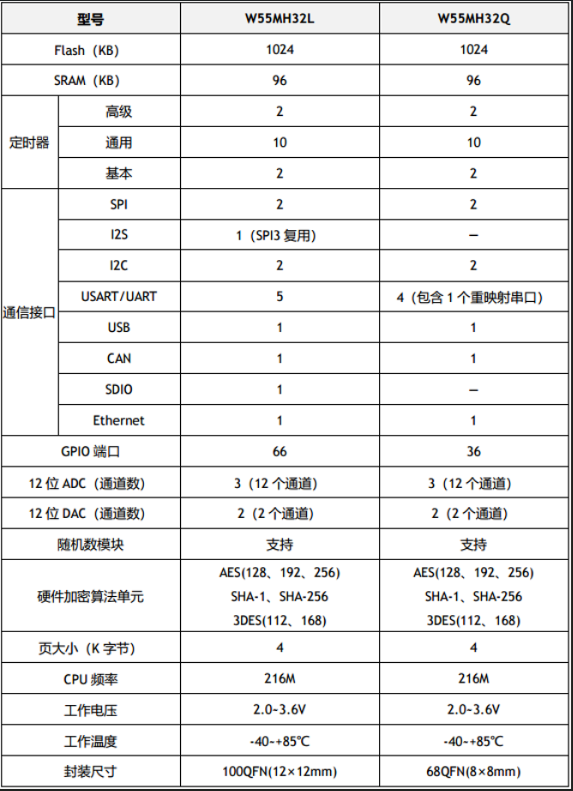
Device Function Configuration Table
3. Full-Scenario Empowerment: Multi-Dimensional Advantages Drive Upgrades Across All Domains
Leveraging its advantages in hardware TCP/IP protocol stack, up to 216MHz CPU frequency, large memory, I2S, DMA, multiple peripherals, and comprehensive development support, the W55MH32L can flexibly adapt to the needs of smart audio devices in various fields such as consumer electronics, industrial IoT, and automotive electronics, helping products achieve comprehensive improvements in performance, user experience, and development efficiency.
- In the consumer electronics field : In multi-room audio systems, the low latency and high concurrency advantages of the hardware TCP/IP protocol stack help achieve accurate synchronous playback across multiple devices; in smart speakers and portable audio players, large memory supports value-added functions such as voice recognition, I2S ensures high-fidelity sound quality, and supports three low-power modes—sleep, stop, and standby—standardized by the Cortex-M3 core, allowing for flexible power switching based on device operating status to meet the basic battery life requirements of portable audio devices; for extended battery life, it is recommended to use an external power management chip for collaborative power management, and multiple peripherals facilitate integration with various sensors and control modules;
- In the Industrial Internet of Things (IIoT) field : Industrial intercom terminals enable real-time communication through low-latency network transmission and clear audio quality; audio monitoring equipment relies on stable network connections and multi-peripheral compatibility to achieve synchronous acquisition and analysis of audio and sensor data, large memory can cache key audio data, and industrial-grade design considerations and security protection mechanisms help improve the stability of equipment operation in harsh environments.
- Professional audio equipment : Wired networked recording workstations, audio interfaces, and other devices rely on a full hardware Ethernet TCP/IP protocol stack to achieve low-latency wired transmission, ensuring synchronous transmission and reception of multi-track audio and control commands; the I2S+DMA mechanism supports high-fidelity audio processing, and 96KB RAM enables real-time data buffering of network audio streams, meeting the real-time processing needs of professional audio equipment. It features a rich array of peripherals compatible with professional modules, an industrial-grade operating temperature range of -40℃ to +85℃, and multiple hardware safety protection mechanisms, directly adapting to the stable operation requirements of harsh environments such as recording studios and industrial sites. Simultaneously, high-bandwidth wired transmission and remote management of materials are achieved, improving the efficiency of professional workflows.
4. Choosing W55MH32L: Comprehensive Value Reconstruction, Cost Reduction, Efficiency Improvement, and Quality Enhancement
For businesses and developers, choosing the W55MH32L is not just about a simple performance upgrade, but about leveraging the synergy of multiple core advantages to help optimize overall cost, development efficiency, and product quality, thereby building core competitiveness.
- Performance Enhancement : Full-Stack Hardware Advantages Enhance Product Competitiveness – Hardware TCP/IP protocol stack, high clock speed computing power, SPI3 multiplexed I2S hardware interface audio interface, and large memory support enable products to achieve significant improvements in latency, sound quality, stability, and feature richness compared to traditional solutions, better meeting the market's demand for high-quality smart audio devices.
- Development cost reduction : A comprehensive support system helps shorten the R&D cycle - abundant routines, comprehensive technical documentation and professional technical support lower the development threshold, reduce the workload of underlying software and hardware debugging, help shorten the R&D cycle, and help products quickly seize the market window.
- Mass production efficiency improvement : Mature design reduces mass production risks - Standardized circuit design, rich peripheral compatibility and full-process technical support help improve mass production yield, reduce after-sales maintenance costs and promote efficient transformation from R&D to mass production.
- Cost optimization : Single-chip integration reduces hardware costs—a single chip integrates core functions such as networking, audio, security, and multiple peripherals, while large memory reduces the need for external storage, reduces the number of peripheral components, and simplifies hardware design;
- Future Scalability : Multi-dimensional advantages adapt to long-term development - Large memory and multiple peripherals reserve ample room for functional upgrades, and a complete development system facilitates subsequent iteration and optimization, which helps to extend the product life cycle and adapt to dynamic changes in market demand.
5. Project schedule and delivery guarantee
5.1 Comprehensive technical support
- It provides high-quality examples of TCP protocol and its MQTT protocol , I2S, and various peripherals;
- A professional technical team provides full support throughout the process;
- Comprehensive technical documentation and design guidelines;
- Timely technical updates and iteration support.
5.2 Stable supply chain guarantee
- Complete documentation, stable and controllable supply;
- A rigorous quality control system ensures product consistency.
Link to W55MH32L specifications : https://www.w5500.com/w55mh32.html
6. Summary
In the wave of smart audio devices pursuing "higher fidelity, lower latency, more stable connectivity, and richer functionality," the single-dimensional upgrades of traditional solutions are no longer sufficient to meet market demands. The W55MH32L, with its core multi-dimensional hardware architecture of "hardware TCP/IP protocol stack + high clock speed + large memory + I2S + multiple peripherals," coupled with rich circuit design and comprehensive example documentation, builds a closed-loop advantage across the entire process of performance, adaptation, development, and mass production. It comprehensively addresses industry pain points and has become one of the high-quality solutions for upgrading smart audio devices.
Choosing the W55MH32L is not just about selecting a high-performance chip, but also about choosing a comprehensive product upgrade solution that provides all-dimensional empowerment and end-to-end support. Start your collaboration now, leveraging its multi-dimensional core advantages to accelerate the deployment of high-performance network audio solutions and gain a competitive edge in the fierce market!
————————————————
Copyright Notice: This article is an original work by CSDN blogger "Playing with Ethernet" and is licensed under CC 4.0 BY-SA. Please include the original source link and this statement when reprinting.
Original Link: https://blog.csdn.net/2301_81684513/article/details/155932442