



W55MH32 Single-Chip Ethernet Solution: Solving Three Major Pain Points of Distributed I/O
W55MH32 Single-Chip Ethernet Solution: Solving Three Major Pain Points of Distributed I/O
In the era of Industry 4.0, distributed I/O has become essential for intelligent edge nodes, but its development is often hampered by three major pain points: difficulty in protocol compatibility, poor real-time performance, and long development cycles. The W55MH32, a highly integrated chip with a built-in hardware TCP/IP engine (TOE) and Cortex-M3 core, replaces the complex "MCU + peripherals" combination with a single-chip solution, becoming the core foundation for building highly reliable and easily scalable distributed I/O modules. This article aims to deeply analyze how to utilize the W55MH32 to build a distributed I/O solution that achieves the best balance between performance, cost, and development efficiency.
The Evolution of Industrial Automation Architecture and New Demands for Distributed I/O
Industrial automation systems are undergoing a profound transformation from "centralized" to "edge-autonomous": traditional centralized control, due to its complex wiring and weak scalability, struggles to adapt to flexible production needs; while in the edge-autonomous model, distributed I/O must assume a triple role of "real-time data acquisition, local logic processing, and multi-protocol interaction," connecting legacy sensors/actuators in the field, interfacing with high-end PLCs and cloud systems, and operating stably in environments with strong electromagnetic interference.
In this transformation, the W55MH32 stands out—eliminating the need for a complex combination of "general-purpose MCU + external network card," a single chip (requiring only an external physical layer interface chip such as an RS485 transceiver) can cover the core requirements of distributed I/O, becoming a crucial bridge connecting "traditional industrial equipment" and "intelligent edge systems."
Device Function Configuration Table
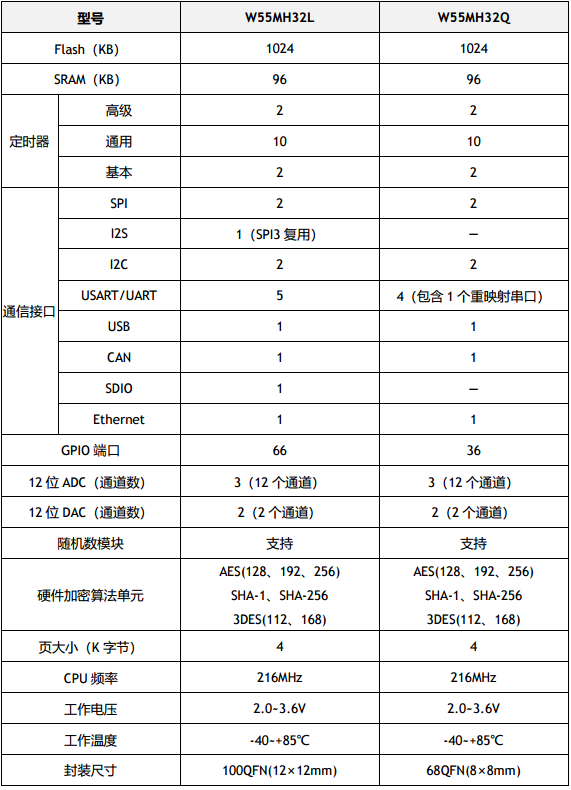
Chapter 1: The Cornerstone of Communication – Building Stable, Multi-Protocol Industrial-Grade Connections
Deterministic communication is the lifeline of industrial systems. The W55MH32 features a built-in hardware TCP/IP Offload Engine (TOE), which consumes minimal RAM and ROM resources for data processing, avoiding the software protocol stack from consuming core computing power and providing chip-level reliability for distributed I/O and multi-protocol concurrent communication.
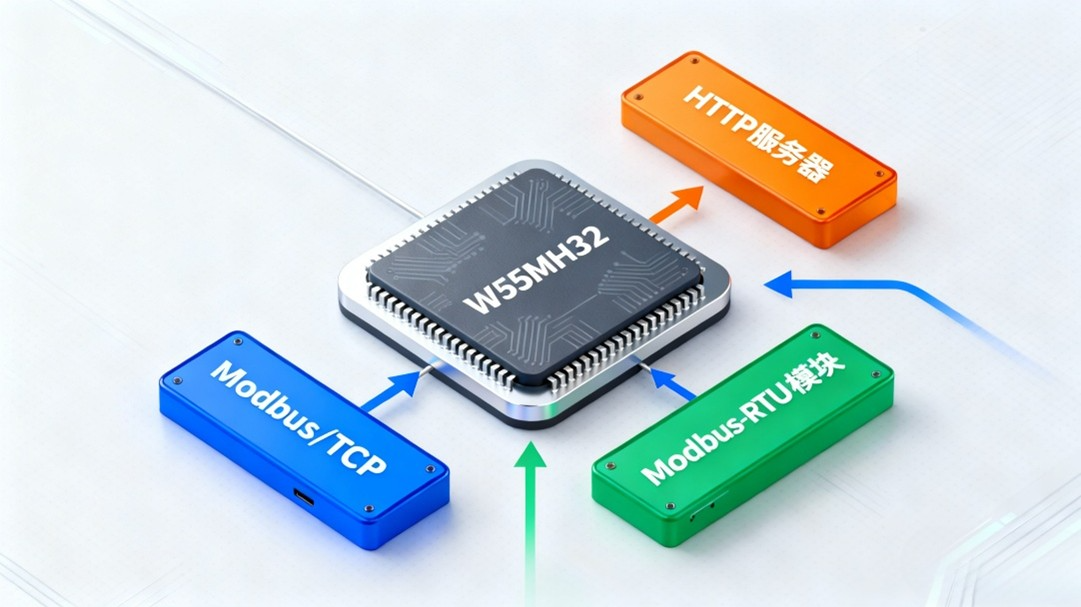
1.1 Reliable Modbus-RTU Integration: A Bridge to the Past
Hardware Design Highlights: Utilizing an isolated RS485 interface design with integrated protection circuitry to withstand complex electromagnetic interference in industrial environments. The W55MH32's multiple UART interfaces allow for dual RS485 channels, enabling redundancy or load separation in the physical network.
Software Implementation Strategy: Employing DMA (Direct Memory Access) mode for UART data processing significantly reduces CPU utilization, freeing up computing power for local control. As a master station, it can implement a "priority polling algorithm" (e.g., prioritizing emergency stop signals); as a slave station, typical response latency can be controlled within 10ms, meeting most real-time control requirements.
Solved Distributed I/O Pain Points and Value: Based on the W55MH32 chip, high-interference-resistant communication can be achieved with only an external isolated RS485 transceiver; it can connect to most legacy equipment in industrial environments, solving the "information silo" problem. The module communication failure rate is significantly reduced, making it the optimal low-cost solution for adapting to traditional industrial scenarios.
1.2 Flexible Modbus/TCP and Edge IT Functions
Modbus/TCP is a common protocol in SCADA and HMI systems, while edge IT functions (such as web servers) can improve the ease of operation and maintenance of distributed I/O. The W55MH32 easily integrates these two types of functions based on stable TCP.
Modbus/TCP Implementation: Based on the TCP Socket interface and Modbus/TCP example reference provided by the W55MH32, the core functions of a Modbus/TCP server can be implemented efficiently. It supports core function codes such as 0x01 (read coil), 0x03 (read holding register), and 0x06 (write single register). It can directly interface with SCADA software such as WinCC and Intouch, achieving high-reliability data transmission at a rate of ≥1Mbps in a stable network environment.
Edge IT Functionality Expansion: An integrated lightweight web server allows maintenance personnel to access a visual interface by entering the module's IP address in a browser (Chrome, Edge).
Status Monitoring: Real-time monitoring of I/O port status, communication link quality, and power supply voltage.
Parameter Configuration: Online modification of Modbus slave address and ADC sampling frequency.
Firmware Upgrade: Supports remote upgrades via a web page, greatly improving maintenance convenience.
Chapter 2: Local Intelligence
Efficient Execution and Control Beyond Signal Acquisition
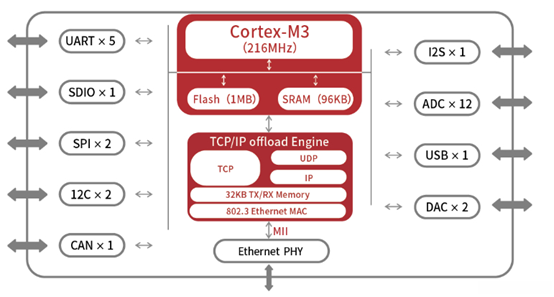
The "edge autonomy" requirement of distributed I/O necessitates modules with local computing power (such as data preprocessing and logic control), rather than simply relying on a host computer. The W55MH32, equipped with a Cortex-M3 core (216MHz) and rich native I/O and expansion interfaces, provides the computing power and resource foundation for "edge intelligence."
System Architecture
2.1 Deep Optimization of Native I/O Resources
The W55MH32 has abundant native I/O resources (GPIO, ADC, DAC), which can meet the signal acquisition and control needs of most distributed I/O without the need for external chips, reducing hardware complexity.
GPIO Planning
GPIO supports flexible configuration. Recommended solution for distributed I/O scenarios:
8 channels configured as high-speed interrupt inputs, triggered by "rising edge + falling edge," used to handle critical signals such as emergency stop buttons and safety door locks. Based on the hardware interrupt mechanism, it can achieve microsecond (μs) level fast response, providing high timeliness for safety control;
4 channels configured as PWM outputs, with an adjustable frequency range of 1Hz-1MHz and a duty cycle accuracy of 0.1%, which can directly drive solenoid valves and relays (such as controlling conveyor belt speed and valve opening/closing degree);
The remaining GPIOs are used as general digital inputs/outputs, supporting 3.3V level compatibility. If other levels are required, they can be adapted to different sensors in the industrial field through level conversion circuits.
ADC/DAC Applications
12-bit precision ADC (12 channels), 12-bit precision DAC (2 channels), optimized for distributed I/O process quantity acquisition (temperature, pressure, flow):
Software Filtering: Implements a combined algorithm of "mean filtering + median filtering" (e.g., after 10 consecutive samples, the maximum and minimum values are removed and the average is taken), improving noise suppression capability by 60% and data acquisition stability compared to traditional single-sampling mode;
Engineering Value Conversion: Performs "ADC raw value → physical quantity" calculation locally (e.g., converting 0-4095 raw values to 0-10V voltage, 0-20mA current), directly reporting floating-point numbers (e.g., "5.2V" "12.5mA") to the host computer, reducing the data processing burden on the host computer.
2.2 Limitless Expansion Interfaces
Precision Enhancement: High-Precision ADC Expansion: An external high-precision ADC chip can be expanded via the SPI interface, achieving 16-bit resolution and a 1MSPS sampling rate, suitable for precision measurement scenarios such as semiconductor equipment temperature acquisition and lithium battery voltage monitoring.
Connectivity Solution: Utilizing the SPI interface in conjunction with DMA transmission, CPU utilization can be controlled within 3%.
Application Value: The acquisition accuracy is improved from 12-bit to 16-bit, significantly reducing measurement errors and meeting the precision monitoring needs of high-end manufacturing scenarios.
Chapter 3: From Concept to Mass Production
A Guide to Product Design and Development Transforming a chip solution into a stable and reliable industrial product requires systematic engineering thinking.
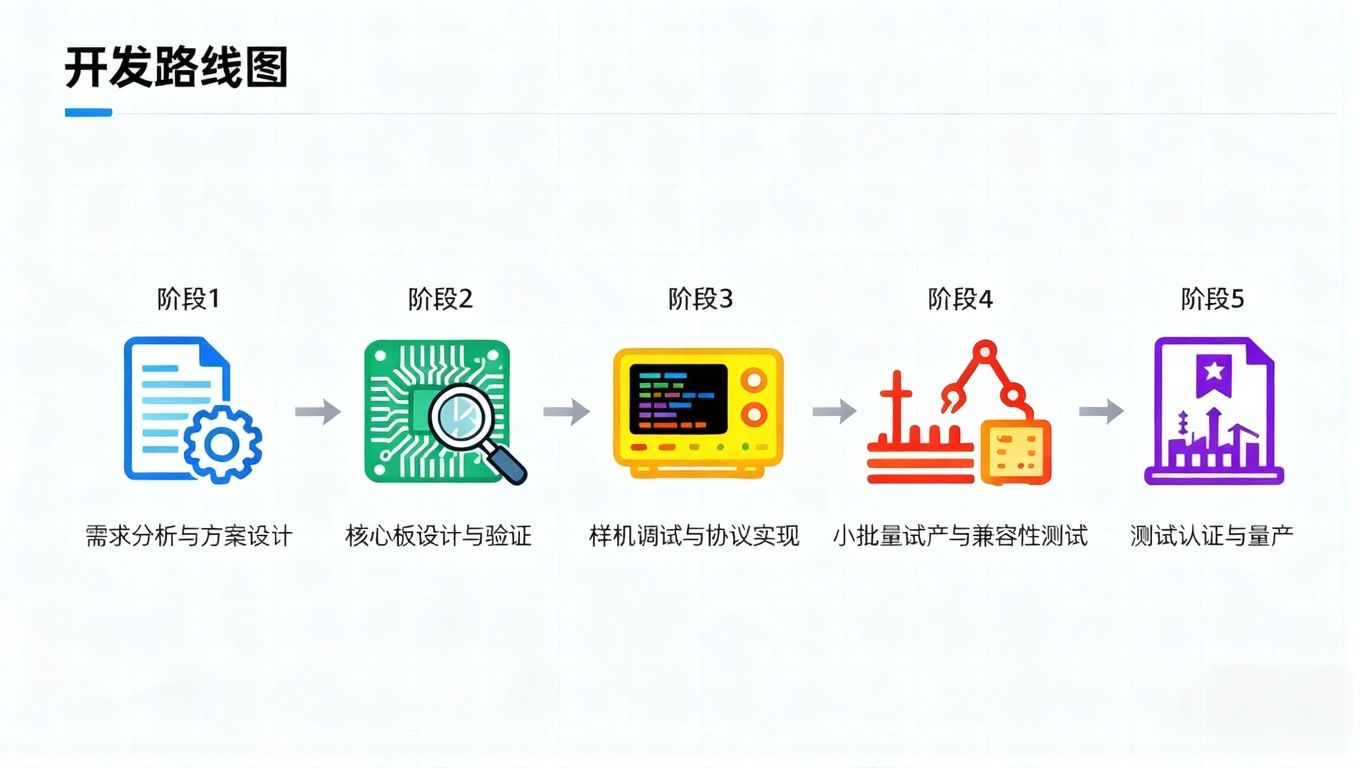
3.1 Key Hardware Design Considerations Hardware design must meet the requirements of "wide temperature range, interference immunity, and high stability" in industrial environments, while controlling BOM cost and PCB area.
Power Integrity: A "multi-channel isolated power supply" scheme is adopted to provide independent clean power to different modules:
Core Power Supply: The VCC pin of the W55MH32 uses a 3.3V power supply. A low-noise LDO chip can be selected to provide stable power to the core, ensuring that the output ripple is controlled within a reasonable range.
Digital I/O Power Supply: For driving industrial field devices with higher voltages, the MOSFET can be controlled through the MCU's 3.3V GPIO to achieve low-voltage driving of high-voltage loads (such as 12V/24V actuators), ensuring control safety and stability.
Analog Power Supply: The ADC/DAC module uses an isolated DC-DC converter with a 2kV isolation voltage to prevent digital noise from interfering with analog signals.
Power Margin: The power supply design includes a 20% power redundancy to handle voltage fluctuations in industrial environments.
Signal Integrity: Optimized for high-speed and sensitive signals:
Sensitive Signals: The ADC input pins use a differential routing + shielded ground design, with a spacing of ≥2mm from digital I/O pins to reduce crosstalk.
Grounding Design: A single-point grounding method is used, with separate wiring for analog ground, digital ground, and power ground, ultimately converging to the power ground to avoid ground loop interference.
3.2 Software Architecture Recommendations
Use a real-time operating system (FreeRTOS): Build a task scheduling system based on FreeRTOS, allocating tasks according to the functional priority of distributed I/O:
| Task Name | Priority | Core Function | Cycle/Triggering Method | CPU Load Characteristics |
| Local Logic Control and Algorithm | High | Emergency stop logic, ADC filtering, engineering value conversion | 1ms cycle | Stable load, low utilization |
| Modbus-RTU Polling | Medium | Sensor/Actuator data acquisition and control | 10ms cycle | Stable load, periodic fluctuations |
| Web Server/Diagnostics | Low | Page response, parameter configuration, firmware upgrade | Event triggering (HTTP request) | Uneven load, usually idle |
Firmware Upgrade Design: Design a reliable Bootloader that supports both "remote upgrade + local upgrade" modes to meet on-site maintenance needs:
Remote Upgrade: Upload firmware via a web server. After the Bootloader verifies firmware integrity (CRC check), it erases the old firmware and writes the new firmware, supporting breakpoint resumption;
Security Assurance: Bootloader and application firmware are stored in partitioned areas (e.g., Flash is divided into a 128KB Boot area and an App area). (896KB partition), automatically rolls back to the old firmware in case of upgrade failure, preventing the module from becoming unusable.
3.3 Cost and Supply Chain Optimization
The W55MH32's single-chip integration solution not only improves reliability but also brings significant advantages in cost and supply chain.
Reduced BOM Cost: Compared to the multi-chip solution of "MCU + Ethernet PHY + protocol chip," it saves at least 30% of the core chip cost and reduces PCB area.
Simplified Procurement and Inventory: Only one main chip needs to be procured and stocked, simplifying supply chain management and reducing the risk of production stoppages due to the shortage of a single component.
Accelerated Mass Production: A unified chip platform and mature reference design enable faster product development, facilitate the creation of product series, and shorten the time to market.
Chapter 4: Core Advantages Implementation in Scenarios – W55MH32 Solves Key Pain Points in Distributed I/O
The core of implementing distributed I/O modules lies in balancing the three major requirements of "reliability, real-time performance, and compatibility" in complex industrial scenarios. Leveraging its single-chip integrated architecture and hardware-level performance optimization, the W55MH32 provides deterministic solutions to the high-frequency pain points of distributed I/O, transforming technological advantages into practical application value.
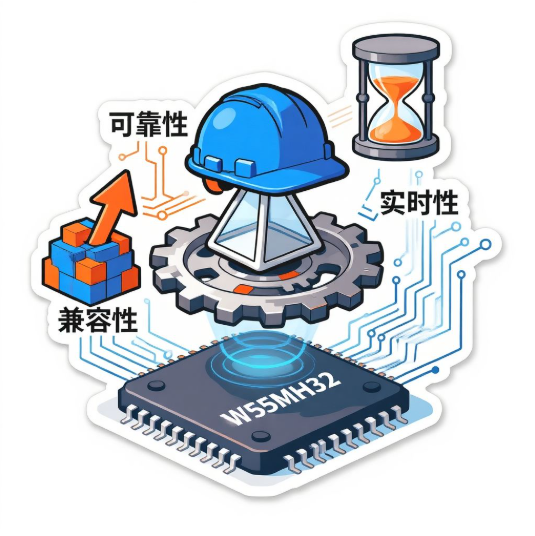
4.1 Multi-Protocol Parallel Communication: Serial Port + Socket Dual Architecture Supports Complex Topologies
Distributed I/O often needs to simultaneously interface with a host PLC (Modbus/TCP), legacy field sensors/actuators (Modbus-RTU), and monitoring systems (Modbus/TCP). Traditional solutions are prone to communication congestion due to the separation of serial/network interfaces and the computational burden on the software protocol stack. The W55MH32 utilizes a dual-architecture design—comprising 5 UART serial ports, a hardware TCP/IP engine, and 8 independent sockets—to perfectly adapt to the physical layer requirements of different protocols.
Serial Port Allocation (Modbus-RTU Compatibility): The W55MH32 has 5 built-in UARTs, expandable to dual RS485 channels via isolated RS485 transceivers. These can be configured as Modbus-RTU master/slave stations, simultaneously connecting 20+ sensors/actuators. Data processing employs DMA mode, significantly reducing computational power consumption and ensuring stable operation of other system functions.
Socket Allocation (Network Protocol and Status Monitoring Adaptation): Eight independent sockets can be precisely allocated: one for Modbus/TCP interface with a host PLC, one for Modbus/TCP communication with a SCADA system, one for building a web server providing status monitoring, and the remaining five support network redundancy (such as Modbus/TCP master-slave links) or adding distributed nodes, adapting to large-scale deployments.
Parallel Advantages: Serial communication (Modbus-RTU) and network communication (Modbus/TCP) are completely independent at the hardware level—relying on the W55MH32's integrated hardware TCP/IP engine, network protocol stack processing tasks are offloaded by hardware, requiring no CPU involvement; data processing does not interfere with each other during dual-protocol concurrency, communication is stable, and there is no packet loss or blocking; combined with DMA and the dual offloading of computing power by the hardware engine, the overall system load remains at a low level, ensuring long-term stable operation.
4.2 Safety-Level Local Control: High-Priority Tasks Ensure Deterministic Core Actions In industrial scenarios, the response speed of core control tasks such as emergency stops and safety locks directly impacts production safety.
The W55MH32 ensures the real-time performance and reliability of safety control through hardware interrupt design and task priority optimization:
The 216MHz Cortex-M3 core is the main controller, with local logic processing (such as emergency stop linkage and overvoltage protection) latency ≤1ms. Even with concurrent serial and network communication, it will not preempt computing power for safety tasks.
GPIO supports 8 high-speed hardware interrupts. Combined with the Cortex-M3 core's hardware interrupt mechanism and optimized interrupt service routine design, the response latency of emergency stop signals can be stably controlled within 10 microseconds (μs), providing high timeliness assurance for safety control. At the software level, FreeRTOS task scheduling is recommended, setting "emergency stop logic and safety interlocks" as the highest priority and forcibly preempting low-priority tasks such as protocol processing and web services to ensure that core control does not fail under extreme conditions. Core control actions (such as emergency stop triggering) can be synchronously fed back to the web monitoring interface, allowing maintenance personnel to view the execution status of safety tasks in real time through a browser, further improving the visibility of maintenance.
4.3 Harsh Environment Adaptability: Industrial-grade reliability without additional redundancy design
Distributed I/O modules are often deployed in high-interference, wide-temperature environments such as metallurgy, chemical industry, and automotive manufacturing. Traditional solutions require additional protective devices, leading to increased costs. The W55MH32 natively possesses industrial-grade features, simplifying hardware design while improving reliability:
Its wide temperature range covers -40℃ to 85℃, meeting the needs of extreme environments such as outdoor use and high-temperature workshops, eliminating the need for additional temperature compensation circuitry; Its single-chip architecture reduces inter-chip connection nodes by 40%, lowering the risk of soldering failures and signal crosstalk. Compared to the "MCU + external network card + expansion chip" solution, this solution achieves a significant extension of mean time between failures (MTBF), meeting the needs of applications with higher reliability requirements.
4.4 Lightweight Edge Intelligence: Built-in Web Server Reduces Operational Complexity

The post-implementation maintenance costs of distributed I/O often depend on local management capabilities. The W55MH32 can integrate a lightweight web server, enabling core operation and maintenance without relying on a host computer, making it suitable for large-scale distributed deployment scenarios:
A web service can be built using only one socket, supporting the development of a web-based visual interface for I/O status monitoring, parameter configuration (such as Modbus slave address, ADC sampling frequency), and fault log querying;
Remote firmware upgrades (HTTP protocol) are supported, with a breakpoint resume mechanism to prevent module failure due to upgrade interruptions. On-site maintenance does not require device disassembly, reducing single maintenance time from 1 hour to 5 minutes;
Local data preprocessing (such as outlier filtering and threshold judgment) can be performed, uploading only valid data to the host computer, reducing network bandwidth usage by 30%, making it suitable for long-distance distributed nodes (such as photovoltaic power plants and along rail transit lines).
Chapter 5: Project Schedule and Delivery Guarantee
Comprehensive Technical Support:
Provides high-quality examples of Modbus_TCP, OTA upgrades, and other communication protocols.
Professional technical team provides full-process technical support.
Complete technical documentation and design guidelines.
Stable Supply Chain Guarantee:
Complete documentation and stable supply.
Strict quality control system.
Timely technical updates and iteration support.
W55MH32 Documentation Link: https://www.w5500.com/w55mh32.html
Conclusion
In summary, the W55MH32, with its one-stop integrated capabilities of "communication, computing power, and expansion," accurately addresses the core challenges of distributed I/O. Its hardware-level multi-protocol concurrency, powerful local control performance, and industrial-grade reliability effectively solve the problems of protocol conversion, real-time control, and adaptation to harsh environments, significantly shortening the time from design to mass production. Choosing the W55MH32 is choosing a shortcut to efficient, reliable, and future-oriented distributed I/O design.
————————————————
Copyright Notice: This article is an original work by CSDN blogger "Playing with Ethernet," and is licensed under CC 4.0 BY-SA. Please include the original source link and this statement when reprinting.
Original Link: https://blog.csdn.net/2301_81684513/article/details/155225590