



W55MH32 Single-Chip Ethernet Solution: Achieving Stable Distribution of CAN to Multiple Terminals
W55MH32 Single-Chip Ethernet Solution: Achieving Stable Distribution of CAN Data to Multiple Terminals
Introduction
In today's rapidly developing Industry 4.0 and smart manufacturing landscape, real-time data acquisition and efficient distribution from production lines have become core resources for optimizing production decisions and improving operational efficiency. As one of the most widely used communication protocols in industrial settings, the quality of concurrent data transmission to multiple terminals (including local HMIs, industrial PCs, cloud platforms, and mobile diagnostic tools) directly impacts the overall system's intelligence level.
However, traditional master control solutions often face three major challenges in achieving this goal:
- Insufficient socket resources
- Difficulty in guaranteeing real-time data transmission
- Excessively long system development and debugging cycles
These bottlenecks restrict the effectiveness of industrial IoT implementation at the edge.
The W55MH32, a highly integrated single-chip solution, precisely addresses these challenges with its built-in 1-channel CAN 2.0B and 8 independent sockets supported by a hardware TCP/IP protocol stack. It not only provides powerful data processing capabilities but also lays a simple yet robust hardware foundation for building highly reliable, real-time multi-terminal data distribution nodes.
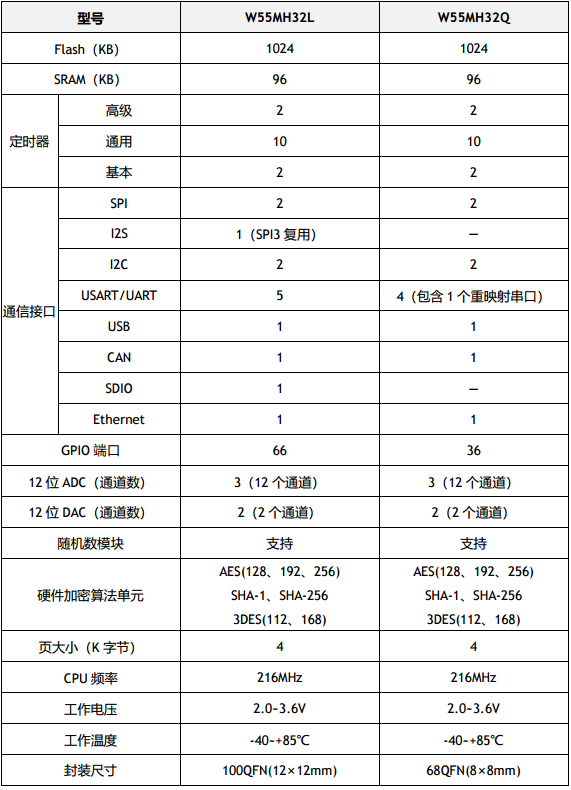
Device Function Configuration Table
1. New Data Distribution Requirements and Chip Value
In Edge Architecture Industrial automation systems are undergoing a profound transformation from "centralized processing" to "edge intelligence." The traditional model of controllers uniformly collecting, processing, and distributing data piecemeal is limited by network bandwidth and the processing power of the main control chip, making it difficult to meet the stringent requirements of real-time data performance, synchronization, and reliability from multiple terminals in modern industrial scenarios.
In the new edge computing architecture, data acquisition nodes need to undertake three responsibilities: accurate data acquisition, protocol conversion, and multi-channel concurrent data delivery.
Accurate Data Acquisition: Directly connects to various CAN bus devices (sensors, actuators, controllers, etc.) in the field.
Protocol Conversion: Seamlessly converts protocols using code editing.
Multi-channel Concurrent Data Delivery: Simultaneously provides data services to multiple heterogeneous systems. The W55MH32 demonstrates unique value in this industry transformation:
| Features | Traditional Solution | W55MH32 Solution | Advantages |
| Architectural Complexity: MCU + Multi-NIC Combination | Single-chip Integration | Simplified Design | Reduced Costs |
| System Reliability | Multi-chip Collaboration Issues | Single-chip Solution | Improved System Stability |
2. Core Architecture: Stable and Concurrent Data Distribution Engine
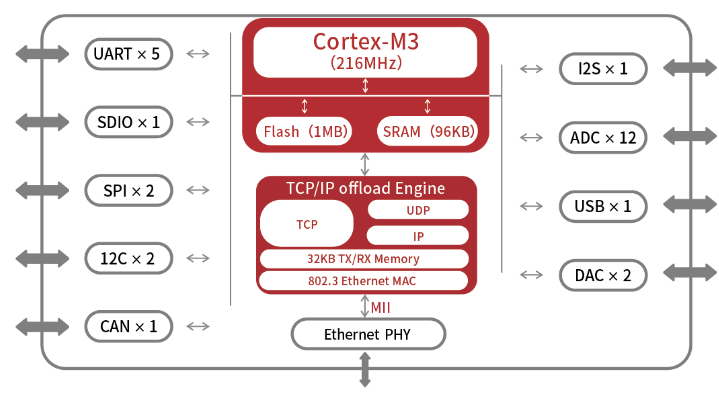
W55MH32L Chip System Block Diagram
2.1 Hardware Architecture Optimization
Detailed Explanation of Core Communication Features:
- Hardware TCP/IP Protocol Stack: Employs a dedicated network processing engine to implement the protocol stack in hardware, minimizing CPU usage for network data processing and ensuring absolute determinism and reliability in communication.
- 8-Way Hardware-Level Parallel Socket Connections: Each socket has an independent hardware buffer and state machine, supporting true hardware-level concurrent communication and completely eliminating resource contention issues when multiple connections are involved.
- 216MHz Arm Cortex-M3 Core: The powerful processing core provides ample computing power for complex data protocol conversions and business logic processing, ensuring timely system response.
- CAN 2.0B Controller: Supports standard and extended CAN frame formats, configurable DMA channels, and can quickly build stable and reliable CAN network nodes.
Performance Comparison and Advantages Analysis:
| Features | Traditional MCU Solution | W55MH32 Hardware Solution | Advantages |
| Maximum Connections | Limited by memory and CPU performance, typically 2-4 channels | 8 channels hardware-level concurrency, stable support | 2-4 times increase in connection count |
| Communication Real-Time Performance | Affected by system load, large fluctuations in response time | Hardware-guaranteed, stable latency | Deterministic low latency |
| Development Complexity | Requires porting and optimizing the protocol stack, complex debugging | Native hardware support, simple interface | Development cycle shortened by more than 60% |
| System Reliability | Software anomalies may cause the entire network to be interrupted | Hardware-level stability, strong anti-interference capability | Industrial-grade reliability |
2.2 Flexible Socket Resource Configuration
Typical Industrial Application Configuration Scheme:
Core Service Channel Configuration:
🖥️ TCP Server × 2 → Provides real-time data push to local monitoring screens + Provides management interface for administrator computers
☁️ TCP Client × 2 → Establishes secure connection with cloud platform + Connect to a remote device diagnostic system for status monitoring.
🌐 Web Server × 1 → Provides a browser-based local operation and maintenance interface, supporting parameter configuration and status viewing.
Expansion and Redundancy Channel Planning:
🔄 Network Redundancy Backup → Establishes backup connection channels, automatically switching in case of primary link failure, improving system reliability.
🔧 Diagnostic Terminal Access → Provides a dedicated temporary access channel for on-site debugging and maintenance, without affecting normal operation.
🚀 Protocol Extension Reservation → Reserves interfaces for future function upgrades and new communication protocols, protecting investment.
2.3 Real-time Task Scheduling System
A FreeRTOS-based priority scheduling system ensures timely responses to critical tasks:
| Task Name | Priority | Core Function Description | Performance Characteristics |
| CAN Data Acquisition and Preprocessing | High (Real-time) | CAN data reception, parsing, filtering, timestamp addition, data verification | Deterministic response, extremely low latency |
| Protocol Conversion and Multiplexing | Medium (Critical) | Data encapsulation format conversion, connection status management, intelligent disconnection and reconnection, flow control | Stable load, periodic fluctuations, controllable CPU usage |
| Web Service and System Diagnostics | Low (Normal) | HTTP request processing, status monitoring, log recording, system parameter configuration | Event-triggered, usually idle, flow-limited during bursts |
2.4 Architecture Value Demonstration
System Performance:
Multi-terminal Concurrency Capability: Stably supports 8 terminals simultaneously performing full-duplex data transmission and reception, exhibiting low latency and high stability in typical industrial application scenarios. Superior Characteristics:
Guaranteed Communication Reliability: Stable and efficient network throughput with robust error detection and recovery mechanisms, meeting the stringent reliability requirements of industrial scenarios.
Engineering Implementation Advantages:
Eliminating resource contention at the hardware layer, ensuring stable performance under multiple connections.
Deterministic communication performance, meeting the needs of real-time control applications.
Simplified software development process, reducing technical barriers and labor costs.
Reliable industrial-grade stability, adaptable to harsh industrial environments.
3. Core Technology Analysis: W55MH32's Concurrent Communication Mechanism
In industrial communication systems, achieving stable and reliable multi-channel data distribution is a key challenge. The W55MH32 chip's 8-channel Socket support provides an effective hardware foundation for solving this problem.
3.1 Architectural Basis of Concurrent Communication
Limitations of Traditional Solutions
In common single-chip solutions, although multiple Socket connections can be created, their underlying implementation typically relies on a software protocol stack. When multiple data streams need to be processed simultaneously, these connections actually share limited system resources, achieving "pseudo-concurrency" through time-sharing multiplexing. Under high load, this architecture is prone to:
- Increased data processing latency
- Resource contention between different connections
- Impact on system real-time performance
W55MH32 Hardware Advantages
The W55MH32 demonstrates significant advantages in multi-channel communication processing through hardware-level optimizations:
The hardware-integrated network protocol stack reduces the CPU's burden when processing network packets
Independent Socket context management provides dedicated resource guarantees for each connection
Dedicated data processing channels reduce mutual interference between multiple data streams
3.2 Technical Path to Concurrency Resource
Isolation Mechanism
The chip maintains an independent state machine and buffer resources for each socket connection. This architecture ensures that:
- Fluctuations in the connection state of a single socket will not directly affect the stability of other connections.
- Data congestion on one channel will not cause communication blockage in the entire system.
- Data streams of different priorities can be processed in an orderly manner according to preset strategies.
Load Balancing Characteristics
In practical applications, the 8-socket configuration can be flexibly adapted to different communication needs:
- High-priority real-time data (such as control commands) can be allocated to dedicated sockets to ensure timeliness.
- Large-volume data transmissions (such as historical data uploads) can use independent channels to avoid blocking critical data.
- Diagnostic and maintenance channels are isolated from other service channels, ensuring system maintainability.
3.3 Practical Application Results
Based on its hardware-supported concurrent communication mechanism, the W55MH32 exhibits the following characteristics in industrial environments:
Improved Reliability
- Fault isolation between multiple connections: An anomaly in a single connection will not affect other normal connections.
- Deterministic Communication Quality: Hardware-guaranteed resource allocation makes performance more predictable.
- System Fault Tolerance: Interruptions in some network paths do not affect the normal operation of other channels.
Performance
In actual testing, this solution can:
- Stable maintain long-term concurrent data transmission across multiple connections.
- Maintain connection reliability in complex network environments.
- Effectively reduce data transmission jitter caused by resource contention.
Engineering Value
This concurrent communication capability brings significant advantages to industrial applications:
- Simplified System Architecture: Single-chip replacement of multi-chip solutions reduces design complexity.
- Increased System Integration: Reduces the number of external components and improves overall reliability.
- Optimized Resource Utilization: Sufficient socket resources reserve space for system expansion.
The W55MH32's concurrent communication mechanism, through hardware-level optimized design, provides a reliable technical foundation for multi-terminal data distribution in industrial automation systems, enabling the system to maintain stable communication performance in complex network environments.
4. Project Schedule and Delivery Guarantee
Comprehensive Technical Support:
Provides high-quality examples of TCP Server, TCP Client, UDP, HTTP Server, HTTP Client, and other communication protocols.
Professional technical team provides full-process technical support.
Complete technical documentation and design guidelines.
Stable Supply Chain Guarantee:
Complete documentation and stable supply.
Strict quality control system.
Timely technical updates and iteration support.
W55MH32 Documentation Link: https://www.w5500.com/w55mh32.html
5. Summary
The W55MH32, with its unique ability to achieve concurrent data distribution from CAN to multiple networks using a single chip, precisely solves the core pain point of multi-terminal data synchronization in industrial automation systems. Its hardware TCP/IP protocol stack provides deterministic network performance, 8-channel hardware sockets ensure stable multi-connection support, and high reliability matched to industrial environments, effectively overcoming the three major technical challenges of insufficient socket resources, poor data real-time performance, and long development cycles.
This solution provides strong technical support for building highly reliable and real-time edge data nodes, helping equipment manufacturers gain a first-mover advantage in the Industry 4.0 competition. Whether for traditional industrial automation upgrades or the construction of emerging intelligent manufacturing systems, the W55MH32 provides an ideal technological platform, offering crucial infrastructure support for industrial digital transformation and intelligent upgrading.
———————————————— Copyright Notice: This article is an original work by CSDN blogger "Playing with Ethernet," licensed under CC 4.0 BY-SA. Please include the original source link and this statement when reprinting.
Original Link: https://blog.csdn.net/2301_81684513/article/details/155494913