



W5500 Chip: Hardwired TCP/IP Ethernet Controller for Embedded Systems
Discover the W5500, a hardwired TCP/IP Ethernet controller with integrated 10/100 Mbps MAC & PHY.
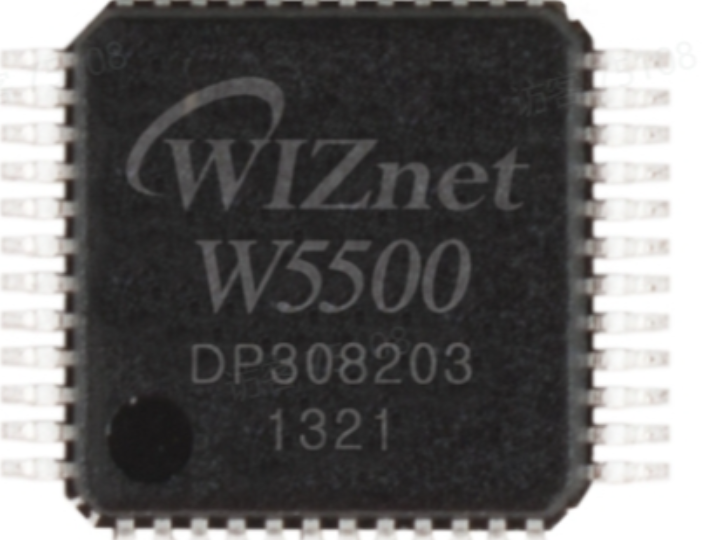
Ethernet Fundamentals and the W5500: A Hardware-Centric Approach
The evolution of Ethernet from a 10 Mbps shared-bus system to modern, full-duplex Gigabit networking has cemented it as the backbone of reliable local area networks (LANs). As outlined in the IEEE 802.3 standard, Ethernet's success is rooted in its Physical Layer (PHY)—utilizing twisted-pair cabling and differential signaling for superior noise immunity—and its Data Link Layer (MAC), which uses unique 48-bit addressing to ensure precise data delivery. While these theoretical layers provide the architecture for stable, low-latency communication, implementing them in embedded systems often requires significant processing overhead.
The Wiznet W5500 chip represents a sophisticated hardware realization of these Ethernet principles. It bridges the gap between complex network protocols and resource-constrained microcontrollers (MCUs) by integrating a hardwired TCP/IP stack. Unlike traditional software-based stacks that consume an MCU’s RAM and CPU cycles, the W5500 handles the Transport, Network, and Data Link layers entirely on-silicon. This includes native support for TCP, UDP, IPv4, ICMP, ARP, and IGMP. By offloading these tasks, the W5500 allows even simple MCUs, such as the Raspberry Pi Pico, to maintain high-speed connectivity without the risk of software crashes or buffer overflows.
At its core, the W5500 features an integrated 10/100 Ethernet MAC and PHY, supporting auto-negotiation and "Wake on LAN" functionality. A standout feature is its internal memory architecture: 32KB of buffer memory that can be flexibly allocated across 8 independent hardware sockets. This allows a single device to manage multiple simultaneous connections—such as acting as a web server while concurrently communicating with a cloud database—without cross-socket interference.
Communication between the host MCU and the W5500 occurs via a high-speed Serial Peripheral Interface (SPI), supporting speeds up to 80MHz. This interface simplifies the physical design of the PCB, requiring fewer pins while maintaining the performance necessary for industrial IoT and automation. In conclusion, the W5500 transforms the high-level concepts of Ethernet theory into a "plug-and-play" hardware solution. It provides the stability and performance of a wired connection with minimal development complexity, making it an essential component for any project where wireless interference or software overhead is a concern.
For more detials, Please Visit: https://f1829ryac0m.feishu.cn/wiki/VshDwrYx3iWL6KkihfsctUy0nwc