



How to Evaluate W5500 for Commercial MCU Ethernet Designs?
This documentation project provides a Chinese-language overview of the WIZnet W5500 for commercial MCU-based Ethernet products.
How to Evaluate W5500 for Commercial MCU Ethernet Designs?
Summary
This documentation project provides a Chinese-language overview of the WIZnet W5500 for commercial MCU-based Ethernet products. The W5500 connects to a host MCU through SPI and handles TCP/IP protocols, Ethernet MAC/PHY operation, socket state, and packet buffering in hardware. This architecture reduces the amount of networking software and packet memory that must be implemented on the host processor.
What the Project Does
The repository is a documentation resource rather than a firmware application. Its contents consist of a README and a downloadable archive containing a Chinese W5500 datasheet. No application source code, MCU driver, schematic, or production reference design is exposed in the repository interface.
The material introduces the W5500 as an SPI-controlled Ethernet device with:
Hardware support for TCP, UDP, ICMP, IPv4, ARP, IGMP, and PPPoE
Eight independent hardware sockets
32 KB of internal transmit and receive buffer memory
SPI modes 0 and 3
Power-down and Wake-on-LAN functions
For a commercial engineering team, the repository is therefore useful as an introductory Chinese-language reference. Device selection, schematic review, firmware implementation, and compliance work should still use the latest official WIZnet datasheet and design documentation as the controlling references.
A typical system based on this material has the following data path:
Sensors or application logic → host MCU → SPI → W5500 hardware sockets → Ethernet PHY → wired network
Incoming packets follow the reverse path. The host MCU exchanges payload data and socket commands with the W5500 instead of processing every Ethernet and TCP/IP layer directly.
Where WIZnet Fits
The relevant product is the WIZnet W5500, a hardwired TCP/IP Ethernet controller integrating a 10/100 Ethernet MAC, PHY, protocol engine, socket controller, and 32 KB packet buffer. It communicates with an external MCU through an SPI interface supporting clock rates up to 80 MHz.
In a commercial product, the W5500 acts as the boundary between application firmware and the wired network. The MCU remains responsible for application protocols, device state, security policy, configuration, and payload generation. The W5500 manages supported transport and network-layer operations through eight hardware socket contexts.
This separation is particularly relevant when the selected MCU has limited RAM or when the engineering team wants to reduce dependence on a large software TCP/IP stack. Packet memory is held in the W5500’s internal buffer and divided among its sockets, reducing the amount of host RAM required for Ethernet traffic. It can also make execution timing more predictable because protocol processing is not scheduled alongside the application on the MCU.
Commercial adoption still requires system-level engineering. The W5500 does not provide application-layer security, certificate handling, MQTT logic, HTTP parsing, device provisioning, or cloud connectivity by itself. Those functions remain in the host firmware or an external security component.
Implementation Notes
The repository does not provide verifiable firmware from which real initialization code can be quoted. It supplies a datasheet archive and a short feature summary, so implementation should be treated as an architecture exercise rather than a reusable code example.
A production integration normally contains these layers:
Electrical interface
Connect the MCU’s SCLK, MOSI, MISO, and chip-select signals to the W5500. The reset and interrupt pins should also be routed to GPIOs when firmware-controlled reset and event-driven socket handling are required. The Ethernet side requires the magnetics, connector, termination network, clock source, and power-decoupling arrangement defined by the official reference design.
SPI adaptation layer
The firmware must provide byte or burst transfers, chip-select control, reset sequencing, and optional interrupt handling. The SPI mode and maximum clock must satisfy both the MCU and W5500 timing specifications.
Device initialization
After hardware reset, firmware configures the 32 KB internal memory allocation across the eight sockets. Buffer allocation should follow actual traffic requirements rather than assigning equal capacity automatically. A telemetry socket carrying small periodic messages may need less memory than a firmware-update or file-transfer connection.
Network configuration
Firmware writes the MAC address, IPv4 address, subnet mask, and gateway into the W5500. Static configuration is straightforward, while DHCP requires application-side DHCP logic using a UDP socket.
Socket operation
The host selects a socket, configures TCP or UDP mode, opens the socket, and then issues connect, listen, send, receive, disconnect, and close commands as required. The application must monitor socket status and interrupt registers to detect connection changes, received data, timeouts, and transmission completion.
Application recovery
Production firmware should detect link loss, stalled sockets, failed DHCP renewal, unreachable servers, and incomplete transfers. Recovery should occur at the smallest effective scope: reopen the socket first, reset the W5500 only when necessary, and reset the complete product only as a final fallback.
W5500 Compared with ENC28J60
The W5500 and ENC28J60 both connect to a host MCU through SPI, but they divide networking responsibilities differently.
The W5500 contains a hardwired TCP/IP stack, eight hardware sockets, 32 KB of packet memory, and a 10/100 Ethernet MAC and PHY. The ENC28J60 is a 10BASE-T Ethernet controller containing a MAC, PHY, packet filtering logic, DMA assistance, and 8 KB of packet RAM. Microchip documents it as an external MAC/PHY used with a host-side driver and TCP/IP library.
Consequently, an ENC28J60 design normally places more protocol processing and network-state management in the MCU firmware. This provides software-stack flexibility, but consumes host CPU time, RAM, flash, and integration effort. The W5500 is generally more suitable when the commercial requirement favors bounded MCU resource usage, simpler socket-oriented firmware, and 10/100 Ethernet support.
The ENC28J60 can remain appropriate when 10 Mbps is sufficient, the existing product already uses a proven software TCP/IP stack, or the application requires protocol behavior outside the W5500’s supported hardware socket model. The choice should be based on total software and validation cost rather than controller unit price alone.
Practical Tips / Pitfalls
Verify SPI signal integrity at the intended clock rate. Long traces, weak grounding, level translators, and ribbon cables can cause intermittent register or payload corruption.
Follow the official reset timing and confirm the PHY link before opening application sockets. A valid SPI response does not prove that the Ethernet link is established.
Allocate the 32 KB buffer according to traffic patterns. Large transfers, burst traffic, and asymmetric send/receive workloads may require unequal socket memory.
Define a clear policy for DHCP failure, lease renewal, duplicate IP addresses, and fallback static configuration.
Treat eight sockets as a fixed hardware limit. Reserve sockets for DHCP, DNS, diagnostics, updates, and primary application traffic before finalizing the protocol architecture.
Add watchdog handling for socket timeouts and link transitions. Recovery logic should close and reopen failed sockets without unnecessarily restarting healthy services.
Review magnetics placement, return paths, ESD protection, connector shielding, and common-mode noise early in the PCB design. Stable firmware cannot compensate for a marginal Ethernet interface.
FAQ
Q: Why use the W5500 in a commercial MCU product?
The W5500 executes supported TCP/IP protocols in hardware and provides dedicated socket state and packet memory. This reduces host-side networking workload and makes MCU RAM, flash, and execution-time requirements easier to bound. Its eight sockets and 10/100 Ethernet interface are also better aligned with multi-service products than a basic 10 Mbps MAC/PHY controller.
Q: How does the W5500 connect to the host platform?
It uses a four-signal SPI bus consisting of SCLK, MOSI, MISO, and chip select. Practical designs generally add reset and interrupt connections, then connect the integrated PHY to an Ethernet connector through the required magnetics and passive components. The W5500 supports SPI modes 0 and 3 with a clock of up to 80 MHz, subject to board and MCU timing constraints.
Q: What role does the W5500 play in this documentation project?
The W5500 is the sole technical subject of the repository. The project packages a Chinese datasheet and summarizes the device’s hardware TCP/IP protocols, socket count, SPI interface, internal memory, Wake-on-LAN, and power-down capabilities. It is not a complete commercial reference implementation.
Q: Can beginners use this material?
A developer with basic SPI, IPv4, TCP, and UDP knowledge can use it to understand the W5500 architecture. Building a commercial product additionally requires experience with Ethernet magnetics, PCB layout, network recovery, application protocols, security, manufacturing test, and regulatory validation. Because the repository contains no verified driver example, beginners should pair it with WIZnet’s official documentation and maintained software libraries.
Q: How does the W5500 compare with the ENC28J60?
The ENC28J60 supplies a 10BASE-T MAC/PHY, 8 KB packet buffer, SPI interface, filtering, and hardware-assisted checksum features, while the host still runs the broader TCP/IP software stack. The W5500 integrates supported TCP/IP protocols, 32 KB of buffer memory, eight hardware sockets, and 10/100 Ethernet. ENC28J60 offers greater host-stack control; W5500 generally reduces MCU resource use and firmware integration scope.
Source
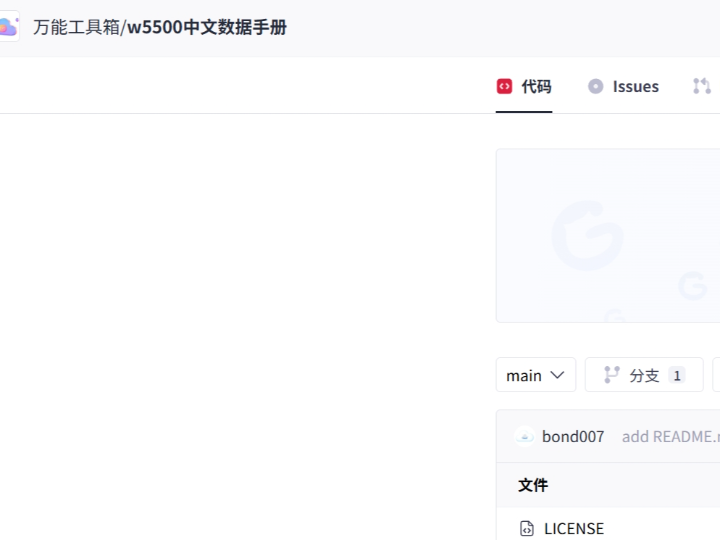
Original project: Universal-Tool, w5500 Chinese Datasheet, hosted on GitCode. The repository page identifies a README, a downloadable datasheet archive, three commits, and an MIT license.
Technical reference: WIZnet W5500 official product documentation and datasheet.
Comparison reference: Microchip ENC28J60 product page, datasheet, and driver documentation.
License: The GitCode repository is marked MIT. The included manufacturer datasheet may carry separate copyright and redistribution terms, so commercial users should verify the notice inside the downloaded document before republishing it.
Tags
#W5500 #WIZnet #Ethernet #HardwareTCPIP #SPI #EmbeddedSystems #CommercialIoT #MCU #ENC28J60 #NetworkOffload
상용 MCU 이더넷 설계에서 W5500을 어떻게 평가할 수 있을까?
요약
이 문서 프로젝트는 상용 MCU 기반 이더넷 제품에서 WIZnet W5500을 검토할 수 있도록 중국어 데이터시트와 주요 기능을 정리한 자료입니다. W5500은 SPI를 통해 호스트 MCU와 연결되며 TCP/IP 프로토콜, 이더넷 MAC/PHY 동작, 소켓 상태, 패킷 버퍼를 하드웨어에서 처리합니다. 이를 통해 호스트 프로세서가 구현해야 하는 네트워크 소프트웨어와 패킷 메모리 요구량을 줄일 수 있습니다.
프로젝트가 제공하는 내용
이 저장소는 펌웨어 애플리케이션이 아니라 문서 자료입니다. 공개된 구성은 README와 중국어 W5500 데이터시트가 포함된 다운로드용 압축 파일이며, 애플리케이션 소스 코드, MCU 드라이버, 회로도, 양산용 레퍼런스 설계는 저장소 화면에서 확인되지 않습니다.
자료에서는 W5500의 주요 기능을 다음과 같이 소개합니다.
TCP, UDP, ICMP, IPv4, ARP, IGMP, PPPoE 하드웨어 지원
독립적으로 동작하는 하드웨어 소켓 8개
송수신용 내부 버퍼 메모리 32 KB
SPI 모드 0 및 모드 3 지원
전원 절감 모드와 Wake-on-LAN 기능
상용 제품을 개발하는 엔지니어링 팀에는 이 저장소가 중국어 기반의 입문 참고 자료로 유용할 수 있습니다. 다만 부품 선정, 회로 검토, 펌웨어 구현, 인증 작업에는 최신 WIZnet 공식 데이터시트와 설계 문서를 기준 자료로 사용해야 합니다.
일반적인 데이터 흐름은 다음과 같습니다.
센서 또는 애플리케이션 로직 → 호스트 MCU → SPI → W5500 하드웨어 소켓 → 이더넷 PHY → 유선 네트워크
수신 데이터는 반대 방향으로 전달됩니다. 호스트 MCU는 이더넷과 TCP/IP의 각 계층을 직접 처리하는 대신, W5500에 소켓 명령을 전달하고 송수신 데이터만 교환합니다.
WIZnet이 적용되는 위치
이 프로젝트에서 다루는 제품은 WIZnet W5500입니다. W5500은 10/100 이더넷 MAC, PHY, 프로토콜 엔진, 소켓 제어기, 32 KB 패킷 버퍼를 통합한 하드와이어드 TCP/IP 이더넷 컨트롤러입니다. 외부 MCU와는 최대 80 MHz의 SPI 인터페이스를 통해 통신합니다.
상용 제품에서 W5500은 애플리케이션 펌웨어와 유선 네트워크 사이의 경계 역할을 합니다. MCU는 애플리케이션 프로토콜, 장치 상태, 보안 정책, 설정 관리, 페이로드 생성을 담당합니다. W5500은 지원되는 전송 계층 및 네트워크 계층 처리를 8개의 하드웨어 소켓 컨텍스트를 통해 수행합니다.
이 구조는 MCU의 RAM이 제한적이거나 대규모 소프트웨어 TCP/IP 스택에 대한 의존성을 줄이고 싶을 때 특히 유용합니다. 패킷 데이터는 W5500의 내부 버퍼에 저장되고 각 소켓에 분배되므로, 이더넷 통신을 위해 필요한 호스트 RAM 사용량을 줄일 수 있습니다. 프로토콜 처리가 애플리케이션 코드와 동일한 MCU 스케줄링 환경에서 실행되지 않기 때문에 실행 시간도 비교적 예측하기 쉽습니다.
그러나 W5500이 애플리케이션 계층 기능까지 제공하는 것은 아닙니다. TLS와 같은 보안 기능, 인증서 처리, MQTT 로직, HTTP 파싱, 장치 프로비저닝, 클라우드 연결은 호스트 펌웨어 또는 별도의 보안 부품에서 구현해야 합니다.
구현 시 참고 사항
이 저장소에는 실제 초기화 코드를 인용할 수 있는 검증 가능한 펌웨어가 없습니다. 데이터시트 압축 파일과 간단한 기능 설명만 제공되므로, 구현은 재사용 가능한 코드 예제가 아니라 시스템 아키텍처 관점에서 접근해야 합니다.
일반적인 양산 설계는 다음 계층으로 구성됩니다.
1. 전기적 인터페이스
MCU의 SCLK, MOSI, MISO, 칩 선택 신호를 W5500에 연결합니다. 펌웨어에서 리셋을 제어하거나 인터럽트 기반으로 소켓 상태를 처리하려면 RESET과 INT 신호도 GPIO에 연결하는 것이 일반적입니다.
이더넷 측에는 공식 레퍼런스 설계에 따라 마그네틱스, 커넥터, 종단 저항, 클럭 소스, 전원 디커플링 회로를 구성해야 합니다.
2. SPI 추상화 계층
펌웨어는 바이트 또는 버스트 단위의 SPI 전송, 칩 선택 제어, 리셋 시퀀스, 필요 시 인터럽트 처리를 제공해야 합니다. SPI 모드와 최대 동작 속도는 MCU와 W5500 양쪽의 타이밍 조건을 모두 만족해야 합니다.
3. 장치 초기화
하드웨어 리셋 이후 32 KB 내부 메모리를 8개 소켓에 나누어 할당합니다. 모든 소켓에 동일한 버퍼를 기계적으로 배정하기보다 실제 트래픽 특성에 맞게 설정해야 합니다.
소량의 데이터를 주기적으로 전송하는 텔레메트리 소켓은 적은 메모리로 충분할 수 있지만, 펌웨어 업데이트나 파일 전송 연결은 더 큰 버퍼가 필요할 수 있습니다.
4. 네트워크 설정
펌웨어는 MAC 주소, IPv4 주소, 서브넷 마스크, 게이트웨이를 W5500에 설정합니다. 고정 IP는 직접 설정할 수 있지만, DHCP를 사용하려면 UDP 소켓을 이용하는 DHCP 클라이언트 로직을 애플리케이션에서 구현해야 합니다.
5. 소켓 동작
호스트는 사용할 소켓을 선택하고 TCP 또는 UDP 모드를 설정한 뒤 소켓을 엽니다. 이후 요구 사항에 따라 connect, listen, send, receive, disconnect, close 명령을 수행합니다.
애플리케이션은 소켓 상태 레지스터와 인터럽트 레지스터를 확인하여 연결 상태 변화, 데이터 수신, 타임아웃, 전송 완료를 감지해야 합니다.
6. 장애 복구
양산용 펌웨어는 링크 단절, 멈춘 소켓, DHCP 갱신 실패, 서버 접근 실패, 미완료 전송을 감지해야 합니다.
복구는 가능한 한 작은 범위에서 수행하는 것이 좋습니다. 우선 문제가 발생한 소켓만 닫고 다시 열고, 필요한 경우에만 W5500을 리셋하며, 전체 시스템 리셋은 마지막 복구 수단으로 사용해야 합니다.
W5500과 ENC28J60 비교
W5500과 ENC28J60은 모두 SPI를 통해 호스트 MCU에 연결되지만, 네트워크 처리 책임을 나누는 방식이 다릅니다.
W5500은 하드와이어드 TCP/IP 스택, 8개 하드웨어 소켓, 32 KB 패킷 메모리, 10/100 이더넷 MAC과 PHY를 통합합니다.
ENC28J60은 10BASE-T 이더넷 컨트롤러로 MAC, PHY, 패킷 필터, DMA 보조 기능, 8 KB 패킷 RAM을 제공합니다. TCP/IP 스택과 네트워크 상태 관리는 일반적으로 호스트 MCU의 드라이버와 소프트웨어 라이브러리에서 처리합니다.
따라서 ENC28J60 기반 설계에서는 프로토콜 처리와 네트워크 상태 관리가 MCU 펌웨어에 더 많이 배치됩니다. 이 방식은 소프트웨어 스택을 자유롭게 구성할 수 있지만, MCU의 CPU 시간, RAM, 플래시, 통합 및 검증 비용이 증가합니다.
W5500은 MCU 자원 사용량을 예측 가능하게 유지하고, 소켓 기반 펌웨어를 단순화하며, 10/100 이더넷을 사용해야 하는 상용 제품에 더 적합할 수 있습니다.
반면 10 Mbps 속도로 충분하고, 이미 검증된 소프트웨어 TCP/IP 스택을 보유하고 있거나, W5500의 하드웨어 소켓 모델에서 지원하지 않는 프로토콜 동작이 필요한 경우에는 ENC28J60도 적절한 선택이 될 수 있습니다.
부품 단가만 비교하기보다 펌웨어 개발, 메모리 요구량, 시험, 유지보수까지 포함한 전체 비용을 기준으로 선택해야 합니다.
실무 팁과 주의사항
목표 SPI 속도에서 신호 무결성을 검증해야 합니다. 긴 배선, 불충분한 접지, 레벨 시프터, 리본 케이블은 간헐적인 레지스터 오류나 데이터 손상을 유발할 수 있습니다.
공식 리셋 타이밍을 준수하고 애플리케이션 소켓을 열기 전에 PHY 링크 상태를 확인해야 합니다. SPI 통신이 정상이라고 해서 이더넷 링크까지 정상인 것은 아닙니다.
32 KB 버퍼를 트래픽 특성에 맞게 배분해야 합니다. 대용량 전송, 버스트 트래픽, 송수신 비율이 다른 워크로드는 비대칭 버퍼 설정이 필요할 수 있습니다.
DHCP 실패, 임대 갱신 실패, 중복 IP, 고정 IP 대체 설정에 대한 정책을 정의해야 합니다.
하드웨어 소켓은 최대 8개입니다. DHCP, DNS, 진단, 펌웨어 업데이트, 주요 애플리케이션 통신에 필요한 소켓을 설계 단계에서 미리 배정해야 합니다.
소켓 타임아웃과 링크 변화를 처리하는 watchdog 로직을 추가해야 합니다. 정상 동작 중인 서비스까지 불필요하게 재시작하지 않도록 장애 소켓만 복구하는 것이 좋습니다.
PCB 설계 초기에 마그네틱스 배치, 리턴 패스, ESD 보호, 커넥터 실드, 공통 모드 노이즈를 검토해야 합니다. 불안정한 이더넷 하드웨어를 펌웨어만으로 보완할 수는 없습니다.
FAQ
Q: 상용 MCU 제품에서 W5500을 사용하는 이유는 무엇인가요?
W5500은 지원되는 TCP/IP 프로토콜을 하드웨어에서 처리하고, 전용 소켓 상태와 패킷 메모리를 제공합니다. 따라서 호스트 MCU의 네트워크 처리 부담을 줄이고 RAM, 플래시, 실행 시간 요구량을 비교적 명확하게 산정할 수 있습니다. 또한 8개 소켓과 10/100 이더넷 인터페이스를 제공하므로 여러 네트워크 기능을 동시에 운용하는 제품에 적용하기 쉽습니다.
Q: W5500은 호스트 플랫폼과 어떻게 연결하나요?
SCLK, MOSI, MISO, 칩 선택으로 구성된 SPI 버스를 사용합니다. 실무 설계에서는 하드웨어 리셋과 이벤트 기반 소켓 처리를 위해 RESET과 INT 신호도 함께 연결하는 경우가 많습니다. W5500은 SPI 모드 0과 모드 3을 지원하며 최대 80 MHz로 동작할 수 있지만, 실제 속도는 MCU 성능과 PCB 신호 품질을 고려해 결정해야 합니다.
Q: 이 문서 프로젝트에서 W5500은 어떤 역할을 하나요?
W5500은 저장소의 핵심이자 유일한 기술 주제입니다. 프로젝트는 중국어 데이터시트와 함께 하드웨어 TCP/IP 프로토콜, 소켓 수, SPI 인터페이스, 내부 메모리, Wake-on-LAN, 전원 절감 기능을 요약합니다. 완성된 상용 레퍼런스 설계나 펌웨어 프로젝트는 아닙니다.
Q: 초보자도 이 자료를 사용할 수 있나요?
기본적인 SPI, IPv4, TCP, UDP 개념을 알고 있다면 W5500 구조를 이해하는 자료로 활용할 수 있습니다. 다만 상용 제품 개발에는 이더넷 마그네틱스, PCB 레이아웃, 네트워크 장애 복구, 애플리케이션 프로토콜, 보안, 생산 시험, 규제 인증에 대한 추가 경험이 필요합니다. 저장소에 검증된 드라이버 예제가 없으므로 WIZnet 공식 문서와 유지보수되는 소프트웨어 라이브러리를 함께 확인해야 합니다.
Q: W5500과 ENC28J60은 어떻게 다른가요?
ENC28J60은 10BASE-T MAC/PHY, 8 KB 패킷 버퍼, SPI 인터페이스, 필터링 및 체크섬 보조 기능을 제공하며, 전체 TCP/IP 스택은 일반적으로 호스트 MCU에서 실행합니다.
W5500은 지원되는 TCP/IP 프로토콜, 32 KB 버퍼, 8개 하드웨어 소켓, 10/100 이더넷을 통합합니다. ENC28J60은 호스트 네트워크 스택을 세밀하게 제어할 수 있지만, W5500은 MCU 자원 사용량과 펌웨어 통합 범위를 줄이는 데 유리합니다.
출처
원본 프로젝트: GitCode에 등록된 Universal-Tool의 W5500 중국어 데이터시트 프로젝트
https://gitcode.com/Universal-Tool/91001
기술 참고 자료: WIZnet W5500 공식 제품 문서 및 데이터시트
https://docs.wiznet.io/Product/Chip/Ethernet/W5500/datasheet
비교 참고 자료: Microchip ENC28J60 제품 페이지, 데이터시트 및 드라이버 문서
https://www.microchip.com/en-us/product/ENC28J60
라이선스: GitCode 저장소에는 MIT 라이선스가 표시되어 있습니다. 다만 저장소에 포함된 제조사 데이터시트에는 별도의 저작권 및 재배포 조건이 적용될 수 있으므로, 상업적으로 재게시하기 전에 다운로드된 문서 내부의 고지 사항을 확인해야 합니다.
태그
#W5500 #WIZnet #Ethernet #HardwareTCPIP #SPI #EmbeddedSystems #CommercialIoT #MCU #ENC28J60 #NetworkOffload