



How to Build an Industrial SNMP Agent with WIZnet W5500 on LPC1758?
This project uses an NXP LPC1758/LPC17xx microcontroller and WIZnet W5500 to implement an SNMPv2 agent for industrial device monitoring and management.
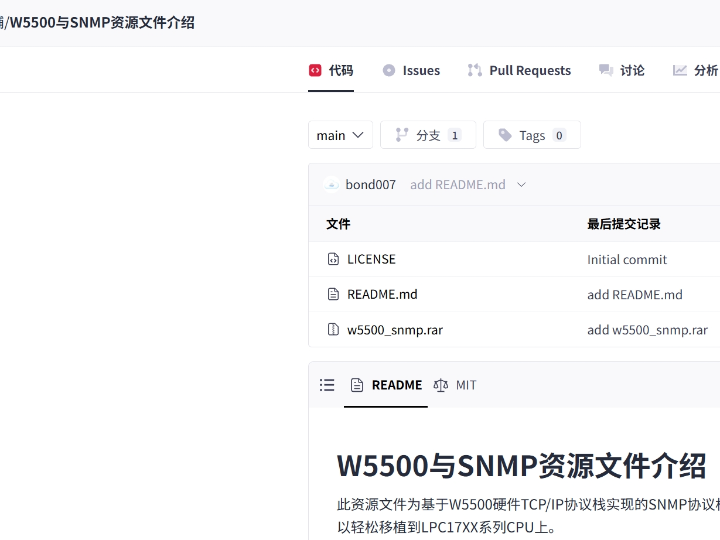
How to Build an Industrial SNMP Agent with WIZnet W5500 on LPC1758?
Summary
This project uses an NXP LPC1758/LPC17xx microcontroller and WIZnet W5500 to implement an SNMPv2 agent for industrial device monitoring and management. The LPC1758 firmware owns the management information base, request processing, device-specific measurements, alarms, and configuration logic, while W5500 provides the Ethernet MAC/PHY, hardwired TCP/IP transport, hardware sockets, and packet buffering. The source describes implementation code, technical documentation, and LPC17xx porting guidance, although its visible GitCode page does not expose inspectable project files.
What the Project Does
The project provides resources for running SNMPv2 over W5500 with an LPC1758 host processor. It is intended to help developers implement network monitoring, remote configuration, and management functions, then migrate the firmware to other LPC17xx devices. The project description identifies three main parts: W5500-based network communication, an SNMPv2 implementation, and LPC1758/LPC17xx porting documentation.
The resulting Industrial IoT data path is:
Industrial sensors and control logic → LPC1758 device model → MIB object handlers → SNMPv2 agent → W5500 UDP socket → SPI → W5500 Ethernet interface → industrial switch → SNMP management station
An SNMP manager can request managed values, modify permitted configuration objects, and receive asynchronous notifications from the agent. Standard SNMPv2 operations include Get, GetNext, GetBulk, Set, Response, Inform, and Trap PDUs.
In an industrial product, the MIB can expose values such as operating state, supply voltage, temperature, communication counters, firmware version, alarm state, reset reason, uptime, output status, and configuration parameters. Device-specific validation must remain in the LPC1758 application rather than in the Ethernet controller.
Where WIZnet Fits
The exact WIZnet product is W5500. It connects to the LPC1758 through SPI and sits between the application processor and the Ethernet network.
W5500 contains an embedded 10/100 Ethernet MAC and PHY, supports hardware TCP/IP protocols including UDP and IPv4, provides eight independent sockets, includes 32 KB of internal Tx/Rx buffer memory, and supports SPI operation up to 80 MHz.
For this project, W5500 performs four architectural functions:
- It terminates the physical Ethernet connection.
- It handles IPv4, ARP, and UDP transport for SNMP traffic.
- It buffers received requests and transmitted responses.
- It exposes socket and network state to the LPC1758 through SPI.
The LPC1758 is a 100 MHz Cortex-M3 microcontroller with up to 512 KB flash and 64 KB SRAM. It also includes an Ethernet MAC, but using that peripheral would still require an external PHY and a host-managed network stack. The W5500 approach instead supplies the PHY and hardwired TCP/IP processing in a separate device, reducing the amount of network-stack integration performed by the LPC1758 firmware.
That separation is useful when the processor must continue handling industrial I/O, control tasks, local fault handling, and MIB calculations while Ethernet communication is active.
Implementation Notes
The GitCode page describes implementation code and porting documents, but it did not expose inspectable source files during verification. Project-specific functions, pin assignments, MIB definitions, and buffer sizes therefore cannot be quoted reliably. The implementation should be reviewed as the following architecture.
Hardware interface
The LPC1758 should connect an SSP/SPI peripheral to W5500 using SCLK, MOSI, MISO, and chip select. W5500 reset should be driven by an LPC1758 GPIO, and the active-low interrupt output should be connected when event-driven socket handling is required. The Ethernet side requires the transformer, connector, termination, power filtering, and layout specified by the WIZnet reference design.
Network initialization
At startup, firmware should:
- Reset W5500 and verify SPI register access.
- configure the MAC address, IP address, subnet mask, and gateway;
- verify PHY link status;
- allocate a W5500 socket for the SNMP agent;
- open the socket in UDP mode;
- begin servicing SNMP requests.
The official WIZnet ioLibrary_Driver provides Berkeley-style socket APIs and includes application-protocol components for SNMP agent and trap operation.
SNMP processing
A received datagram should pass through the SNMP message decoder, security or community validation, PDU dispatcher, object-identifier lookup, and MIB callback layer. The callback should read or modify the actual industrial application state and then return the result to the encoder.
The MIB layer must not write hardware outputs directly without range checking, operating-state validation, authorization checks, and persistence rules. For example, a Set request that changes an alarm threshold should first validate the requested range and only then update runtime and nonvolatile configuration.
Trap generation
The firmware can create traps for events such as link failure, sensor limit violation, watchdog reset, power recovery, configuration change, or equipment fault. Trap production should be rate-limited and queued so that a repeating hardware fault does not consume all network or processor time.
Practical Tips / Pitfalls
- Verify W5500 version-register access and PHY link before debugging SNMP parsing or MIB behavior.
- Keep the MIB representation separate from hardware drivers; MIB callbacks should call validated application interfaces.
- Reserve dedicated W5500 sockets for SNMP requests, traps, diagnostics, and future maintenance services.
- Record malformed packet counts, unknown OIDs, denied Set requests, socket errors, trap drops, and SPI recovery events.
- Confirm whether the supplied implementation is SNMPv2c. Community-based SNMPv2 uses a community-oriented administrative framework, while the source does not verify SNMPv3 authentication or privacy support.
- Restrict management traffic with an industrial firewall, management VLAN, or access-control list when stronger protocol security is unavailable.
- Test cable removal, switch restart, manager flooding, malformed ASN.1 data, repeated traps, duplicate IP addresses, and W5500 reset recovery.
FAQ
Q: Why use WIZnet W5500 for this industrial SNMP agent?
A: W5500 provides a bounded hardware interface for Ethernet, IPv4, UDP sockets, and packet buffering. The LPC1758 can therefore spend more firmware and memory resources on MIB objects, industrial I/O, alarms, validation, and recovery behavior instead of operating a complete software TCP/IP stack. Its eight sockets and 32 KB internal buffer memory also make network resource allocation explicit.
Q: How does W5500 connect to LPC1758?
A: It connects through an LPC1758 SSP/SPI peripheral using SCLK, MOSI, MISO, and chip select. Reset should be controlled by a GPIO, while the W5500 interrupt signal can notify firmware about socket and network events. W5500 operates as an SPI slave and supports SPI modes 0 and 3.
Q: What role does W5500 play in this SNMP project?
A: W5500 carries SNMP request, response, and trap datagrams between the LPC1758 and the management network. It handles the Ethernet link, IPv4 and UDP transport, socket state, and Tx/Rx buffers. The LPC1758 remains responsible for SNMP message processing, MIB lookup, object access, application validation, and industrial device behavior.
Q: Can beginners follow this project?
A: Developers should already understand C firmware, SPI, UDP sockets, object identifiers, and basic SNMP manager-agent behavior. A practical bring-up sequence is SPI verification, W5500 network initialization, UDP loopback testing, one read-only MIB object, multiple object types, controlled Set operations, and finally trap generation.
Q: How does this W5500 architecture compare with Lantronix Ethernet modules?
A: W5500 is a chip-level SPI network controller. The product MCU retains direct ownership of the SNMP agent, MIB model, timing, and recovery logic. A representative Lantronix product such as XPort EDGE is a module-level embedded Ethernet gateway designed to network-enable serial devices and includes its own networking, management, security, and configuration facilities. Lantronix provides interfaces such as a web manager, CLI, XML interface, and Web APIs.
For an existing serial product that primarily needs secure serial-to-Ethernet conversion and remote module management, the Lantronix approach can reduce connectivity integration work. For a product requiring a tightly coupled custom MIB, direct access to real-time control state, and firmware-controlled SNMP behavior, LPC1758 plus W5500 provides a more direct architecture. These approaches are not drop-in replacements: one is an MCU-controlled Ethernet offload chip, while the other is an integrated connectivity gateway.
Source
Original project: GitCode, “W5500与SNMP资源文件介绍: 基于W5500硬件的SNMP协议实现项目.” The project page identifies W5500, SNMPv2, LPC1758, LPC17xx porting material, implementation resources, and technical documentation. An explicit repository license was not confirmed from the visible page.
Related project description: CSDN, “W5500与SNMP资源文件介绍.” The article is published under CC 4.0 BY-SA and describes the SNMPv2 implementation, LPC1758 target, LPC17xx migration guidance, and included resource categories.
WIZnet references: W5500 datasheet, product documentation, hardware design guidance, and official ioLibrary_Driver. The driver repository is MIT-licensed and includes socket APIs and SNMP agent/trap components.
Processor reference: NXP LPC1758 product information and datasheet.
SNMP references: RFC 3416 for SNMPv2 operations and RFC 1901 for community-based SNMPv2.
Comparison reference: Lantronix XPort EDGE product and integration documentation.
Tags
#W5500 #WIZnet #LPC1758 #LPC17xx #SNMPv2 #IndustrialIoT #Ethernet #NetworkManagement #MIB #Lantronix
LPC1758에서 WIZnet W5500으로 산업용 SNMP Agent를 구축하는 방법은?
요약
이 프로젝트는 NXP LPC1758/LPC17xx microcontroller와 WIZnet W5500을 사용해 산업용 장치 모니터링 및 관리를 위한 SNMPv2 agent를 구현합니다. LPC1758 firmware는 Management Information Base, request processing, 장치별 측정값, alarm, configuration logic을 담당하고, W5500은 Ethernet MAC/PHY, hardwired TCP/IP transport, hardware socket, packet buffering을 제공합니다. 원본 프로젝트는 implementation code, technical documentation, LPC17xx porting guidance를 제공한다고 설명하지만, visible GitCode page에서는 실제 project file을 확인할 수 없었습니다.
프로젝트가 하는 일
이 프로젝트는 LPC1758 host processor에서 W5500을 통해 SNMPv2를 실행하기 위한 resource를 제공합니다. 개발자가 network monitoring, remote configuration, management function을 구현하고 firmware를 다른 LPC17xx device로 이식할 수 있도록 설계되었습니다. 프로젝트 설명에서 확인되는 주요 구성은 다음과 같습니다.
W5500 기반 network communication
SNMPv2 implementation
LPC1758 및 LPC17xx porting documentation
산업용 IoT 환경의 데이터 흐름은 다음과 같습니다.
Industrial sensor 및 control logic → LPC1758 device model → MIB object handler → SNMPv2 agent → W5500 UDP socket → SPI → W5500 Ethernet interface → industrial switch → SNMP management station
SNMP manager는 관리 대상 값을 읽고, 허용된 configuration object를 수정하며, agent가 전송하는 비동기 notification을 받을 수 있습니다. SNMPv2에서는 Get, GetNext, GetBulk, Set, Response, Inform, Trap PDU가 사용됩니다.
산업용 제품의 MIB에는 operating state, supply voltage, temperature, communication counter, firmware version, alarm state, reset reason, uptime, output status, configuration parameter 등이 포함될 수 있습니다. 장치별 validation logic은 Ethernet controller가 아니라 LPC1758 application에 유지해야 합니다.
WIZnet이 들어가는 위치
이 프로젝트에서 사용되는 정확한 WIZnet 제품은 W5500입니다. W5500은 SPI를 통해 LPC1758에 연결되며 application processor와 Ethernet network 사이에 위치합니다.
W5500은 embedded 10/100 Ethernet MAC and PHY, UDP 및 IPv4를 포함한 hardwired TCP/IP protocol, 8개 independent socket, 32 KB internal Tx/Rx buffer memory를 제공합니다. SPI는 최대 80 MHz까지 지원합니다.
이 프로젝트에서 W5500은 다음 기능을 담당합니다.
Physical Ethernet connection 종단
SNMP traffic을 위한 IPv4, ARP, UDP transport 처리
수신 request 및 송신 response buffering
SPI를 통한 socket 및 network state 제공
LPC1758은 최대 100 MHz로 동작하는 Cortex-M3 microcontroller이며 최대 512 KB flash와 64 KB SRAM을 제공합니다. LPC1758에는 Ethernet MAC도 포함되어 있지만, 이를 사용하려면 external PHY와 host-managed network stack이 추가로 필요합니다. W5500을 사용하면 PHY와 hardwired TCP/IP processing을 별도 device에서 처리하므로 LPC1758 firmware가 직접 통합해야 하는 network stack 범위가 줄어듭니다.
이러한 분리는 processor가 Ethernet communication 중에도 industrial I/O, control task, local fault handling, MIB calculation을 계속 수행해야 하는 환경에서 유용합니다.
구현 참고 사항
GitCode page는 implementation code와 porting document가 포함되어 있다고 설명하지만, 검증 가능한 source file은 노출하지 않았습니다. 따라서 project-specific function, pin assignment, MIB definition, buffer size는 신뢰성 있게 인용할 수 없습니다. 구현 구조는 다음과 같이 설계하는 것이 적절합니다.
Hardware interface
LPC1758의 SSP/SPI peripheral은 SCLK, MOSI, MISO, chip select를 통해 W5500에 연결해야 합니다. W5500 reset은 LPC1758 GPIO로 제어하고, event-driven socket handling이 필요하다면 active-low interrupt output도 연결해야 합니다.
Ethernet 측에는 WIZnet reference design에 맞는 transformer, connector, termination component, power filtering, PCB layout이 필요합니다.
Network initialization
Startup firmware는 다음 순서로 동작해야 합니다.
W5500을 reset하고 SPI register access를 검증합니다.
MAC address, IP address, subnet mask, gateway를 설정합니다.
PHY link status를 확인합니다.
SNMP agent용 W5500 socket을 할당합니다.
해당 socket을 UDP mode로 엽니다.
SNMP request 처리를 시작합니다.
WIZnet 공식 ioLibrary_Driver는 Berkeley-style socket API를 제공하며 SNMP agent 및 trap 관련 application-protocol component도 포함합니다.
SNMP processing
수신된 datagram은 다음 단계로 처리해야 합니다.
SNMP message decoder → security 또는 community validation → PDU dispatcher → object identifier lookup → MIB callback layer
MIB callback은 실제 industrial application state를 읽거나 수정한 후 결과를 encoder에 반환해야 합니다.
MIB layer는 range checking, operating-state validation, authorization check, persistence rule 없이 hardware output을 직접 변경하면 안 됩니다. 예를 들어 Set request가 alarm threshold를 변경하려는 경우, 요청 값의 범위를 검증한 후 runtime configuration과 nonvolatile configuration을 업데이트해야 합니다.
Trap generation
Firmware는 다음과 같은 event에 대해 trap을 생성할 수 있습니다.
Ethernet link failure
Sensor limit violation
Watchdog reset
Power recovery
Configuration change
Equipment fault
Trap은 rate limiting과 queue를 적용해야 합니다. 반복되는 hardware fault가 network bandwidth나 processor time을 모두 사용하지 않도록 해야 합니다.
실무 팁 / 주의점
SNMP parsing이나 MIB behavior를 debug하기 전에 W5500 version register access와 PHY link를 먼저 확인해야 합니다.
MIB representation은 hardware driver와 분리하고, MIB callback은 검증된 application interface를 호출하도록 구성해야 합니다.
SNMP request, trap, diagnostics, maintenance service용 W5500 socket을 미리 분리해 예약해야 합니다.
Malformed packet count, unknown OID, denied Set request, socket error, trap drop, SPI recovery event를 기록해야 합니다.
제공된 구현이 SNMPv2c인지 확인해야 합니다. Community-based SNMPv2는 community 중심의 administrative framework를 사용하며, 원본 설명에서는 SNMPv3 authentication 또는 privacy support가 확인되지 않았습니다.
강화된 protocol security가 없다면 management VLAN, industrial firewall, access-control list로 SNMP traffic을 제한해야 합니다.
Cable removal, switch restart, manager flooding, malformed ASN.1 data, repeated trap, duplicate IP address, W5500 reset recovery를 테스트해야 합니다.
FAQ
Q: 이 산업용 SNMP agent에 왜 WIZnet W5500을 사용하나요?
A: W5500은 Ethernet, IPv4, UDP socket, packet buffering을 위한 제한된 hardware interface를 제공합니다. LPC1758은 complete software TCP/IP stack을 운영하는 대신 MIB object, industrial I/O, alarm, validation, recovery behavior에 더 많은 firmware 및 memory resource를 사용할 수 있습니다. 8개 socket과 32 KB internal buffer memory를 통해 network resource allocation도 명확하게 관리할 수 있습니다.
Q: W5500은 LPC1758에 어떻게 연결되나요?
A: LPC1758의 SSP/SPI peripheral을 사용해 SCLK, MOSI, MISO, chip select로 연결합니다. Reset은 GPIO로 제어하고, W5500 interrupt signal은 socket 및 network event를 firmware에 알리는 데 사용할 수 있습니다. W5500은 SPI slave로 동작하며 SPI mode 0과 mode 3을 지원합니다.
Q: 이 SNMP 프로젝트에서 W5500은 어떤 역할을 하나요?
A: W5500은 LPC1758과 management network 사이에서 SNMP request, response, trap datagram을 전달합니다. Ethernet link, IPv4 및 UDP transport, socket state, Tx/Rx buffer를 처리합니다. LPC1758은 SNMP message processing, MIB lookup, object access, application validation, industrial device behavior를 담당합니다.
Q: 초보자도 이 프로젝트를 따라갈 수 있나요?
A: C firmware, SPI, UDP socket, object identifier, 기본적인 SNMP manager-agent 구조를 이해하고 있어야 합니다. 권장 bring-up 순서는 SPI verification, W5500 network initialization, UDP loopback test, read-only MIB object 구현, 여러 object type 추가, 제한된 Set operation 구현, trap generation입니다.
Q: 이 W5500 아키텍처는 Lantronix Ethernet module과 어떻게 다른가요?
A: W5500은 chip-level SPI network controller입니다. Product MCU가 SNMP agent, MIB model, timing, recovery logic을 직접 제어합니다. 반면 Lantronix XPort EDGE와 같은 대표적인 module-level embedded Ethernet gateway는 serial device를 network에 연결하기 위한 자체 networking, management, security, configuration 기능을 포함합니다. Web manager, CLI, XML interface, Web API 같은 관리 interface도 제공합니다.
기존 serial product에 secure serial-to-Ethernet conversion과 module-level remote management가 주로 필요하다면 Lantronix 방식이 connectivity integration 작업을 줄일 수 있습니다. 반대로 custom MIB, real-time control state 직접 접근, firmware-controlled SNMP behavior가 필요하다면 LPC1758과 W5500 조합이 더 직접적인 구조를 제공합니다.
두 방식은 직접적인 대체 관계가 아닙니다. 하나는 MCU가 직접 제어하는 Ethernet offload chip이고, 다른 하나는 통합형 connectivity gateway입니다.
출처
Original project: GitCode, “W5500与SNMP资源文件介绍: 基于W5500硬件的SNMP协议实现项目.” 프로젝트 page는 W5500, SNMPv2, LPC1758, LPC17xx porting material, implementation resource, technical documentation을 설명합니다. Visible page에서는 명시적인 repository license를 확인하지 못했습니다.
https://gitcode.com/Premium-Resources/eff53
Related project description: CSDN, “W5500与SNMP资源文件介绍.” 해당 article은 CC 4.0 BY-SA로 게시되었으며 SNMPv2 implementation, LPC1758 target, LPC17xx migration guidance, resource category를 설명합니다.
WIZnet references: W5500 datasheet, product documentation, hardware design guidance, official ioLibrary_Driver. Driver repository는 MIT license를 사용하며 socket API와 SNMP agent/trap component를 포함합니다.
https://docs.wiznet.io/Product/Chip/Ethernet/W5500
https://github.com/Wiznet/ioLibrary_Driver
Processor reference: NXP LPC1758 product information and datasheet.
https://www.nxp.com/part/LPC1758FBD80
SNMP references: RFC 3416 for SNMPv2 operations and RFC 1901 for community-based SNMPv2.
https://www.rfc-editor.org/info/rfc3416
https://www.rfc-editor.org/info/rfc1901
Comparison reference: Lantronix XPort EDGE product and integration documentation.
https://www.lantronix.com/products/xport-edge/
태그
#W5500 #WIZnet #LPC1758 #LPC17xx #SNMPv2 #IndustrialIoT #Ethernet #NetworkManagement #MIB #Lantronix