



How to Build a MicroPython Ethernet Firmware Flow with W5500 on ESP32?
This article presents an ESP32 + W5500 design aimed at MicroPython-based Ethernet access, with emphasis on board-level wiring,
How to Build a MicroPython Ethernet Firmware Flow with W5500 on ESP32?
Summary
This article presents an ESP32 + W5500 design aimed at MicroPython-based Ethernet access, with emphasis on board-level wiring, low-level SPI transaction control, and the firmware changes needed to make W5500 register access reliable under an interpreted runtime. In this architecture, the ESP32 runs the MicroPython environment and application logic, while the W5500 provides the wired Ethernet controller and hardware TCP/IP offload over SPI.
What the Project Does
The source is an education-oriented integration note for using W5500 with ESP32 under MicroPython. It covers three practical layers: the physical ESP32-to-W5500 wiring, the hardware constraints around power, crystal, and RJ45 magnetics, and a custom register-access path for MicroPython because the stock firmware does not natively include W5500 support. The article explicitly states that MicroPython official firmware does not support W5500 out of the box and frames the work as a bare-metal driver port built around the W5500 register map.
Architecturally, this is not a full high-level Ethernet library tutorial. It is closer to a firmware-porting guide: wire the chip correctly, stabilize the PHY and SPI path, then implement a register access layer that MicroPython can call without breaking W5500’s transaction rules. That makes it useful for education because it shows where Python-level convenience ends and hardware-specific transport control begins.
One important limitation: the article content appears to become mixed with unrelated material later in the page, so only the visible W5500/ESP32/MicroPython sections are safe to rely on. I am not treating the entire page as a coherent single project beyond those verified sections.
Where WIZnet Fits
The exact WIZnet product here is the W5500. In this project, it is the external Ethernet controller attached to ESP32 over SPI. WIZnet documents describe the W5500 as a hardwired TCP/IP Ethernet controller with integrated MAC and PHY, support for multiple hardware sockets, and SPI as the host interface. That matches the article’s design focus on using ESP32 as the host processor while offloading Ethernet protocol handling to the W5500.
For educational use, this is a strong example of hardware/software partitioning. The ESP32 is responsible for MicroPython runtime behavior, pin control, interrupt configuration, and custom transaction code, while the W5500 is responsible for Ethernet link handling and socket-capable network transport. That split matters because interpreted environments are convenient for application development, but they still need deterministic low-level access when talking to SPI Ethernet hardware.
On performance, the article’s argument is mostly architectural rather than benchmark-driven. It emphasizes deterministic wired behavior, lower EMI sensitivity than Wi-Fi, and the need for precise SPI timing under MicroPython. It does not provide rigorous measured throughput or latency tables, so the safe conclusion is that the design can be more predictable than Wi-Fi for embedded education and maker work, but actual performance will still depend on SPI implementation quality and firmware integration.
Implementation Notes
This project does use WIZnet products, and the article includes visible code snippets, but it does not provide a public repository with file paths or line-addressable source files. I therefore cannot verify a repository-backed codebase. The implementation details below are limited to what is directly visible in the article.
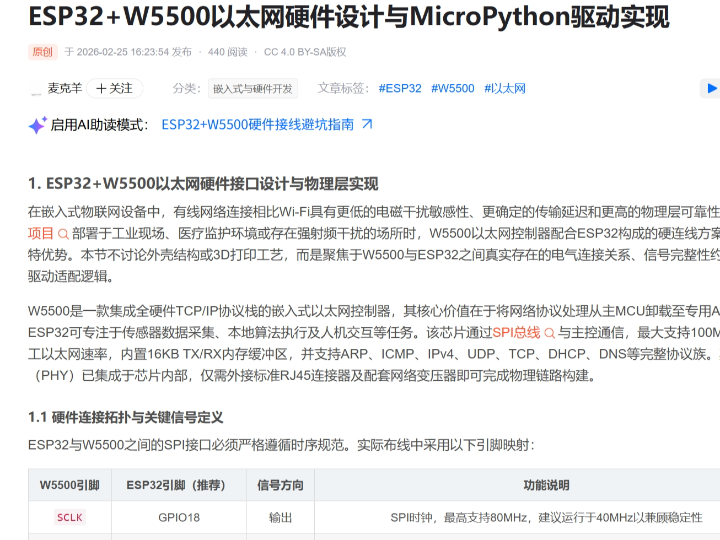
The first verified part is the hardware mapping between ESP32 and W5500. The article recommends SCLK on GPIO18, MOSI on GPIO23, MISO on GPIO19, SS on GPIO5, INT on GPIO4, and RST on GPIO16. It also states that INT should be configured as a falling-edge external interrupt and that RST must be held low for at least 2 microseconds after power-up before being released. Why this matters: the firmware flow begins with stable electrical ownership of clock, data, interrupt, and reset. Without that, no Python-side driver design will be reliable.
The second verified part is the register-layer definition shown inline:
MR = const(0x0000)GAR = const(0x0001)SUBR = const(0x0005)SHAR = const(0x0009)SIPR = const(0x000F)IR = const(0x0015)IMR = const(0x0016)
Why it matters: this is the start of a real W5500 driver abstraction, not a generic networking sketch. It shows that the MicroPython port is being built around direct register addressing, which is consistent with W5500’s host-access model.
The third verified part is the article’s central firmware claim: MicroPython’s machine.SPI.write_readinto() may not preserve the contiguous multi-byte transaction behavior required by W5500, so the author proposes bypassing the higher-level API and directly invoking lower-level SPI handling through from esp import spi_transaction. The visible snippet begins:
from esp import spi_transactiondef w5500_write(addr, data):cmd = bytearray([0x00, (addr >> 8) & 0xFF, addr & 0xFF])
Why it matters: this is the real firmware-flow lesson in the article. The challenge is not just “use SPI.” It is that an interpreted API may break transaction continuity in ways that matter to W5500 register and data access. So the project’s programming value lies in pushing the critical path down below the usual MicroPython abstraction.
Practical Tips / Pitfalls
Keep INT on a dedicated GPIO and use falling-edge interrupt mode, because the article treats it as a real event path for data-ready and connection-state changes.
Do not assume standard MicroPython SPI helpers are sufficient for W5500 burst-style access. The article explicitly warns about transaction fragmentation in write_readinto().
Treat the power design seriously. The article recommends separating digital and analog supply treatment and adding local decoupling around W5500 and its crystal path.
Keep the 25 MHz crystal network and PHY-side routing tight. The article calls out crystal tolerance, load capacitors, and differential routing constraints around the Ethernet side.
Start with register reads and writes before attempting full socket behavior under MicroPython. The visible implementation is clearly built from the register layer upward.
Be cautious with performance claims in interpreted firmware. The article argues for timing precision, but it does not publish controlled benchmarks for the MicroPython path.
FAQ
Why use the W5500 in a MicroPython ESP32 project?
Because it gives ESP32 a wired Ethernet path with hardware TCP/IP offload, which reduces the amount of full network-stack work the host must do directly. In educational projects, that lets students focus on register access, SPI control, and socket-oriented integration rather than building Ethernet support from scratch.
How does it connect to the platform?
The article recommends SPI wiring between ESP32 and W5500 with GPIO18/23/19 for clock and data, GPIO5 for chip select, GPIO4 for interrupt, and GPIO16 for reset, plus external RJ45 magnetics and a 25 MHz crystal network on the W5500 side.
What role does W5500 play in this specific project?
It is the Ethernet transport device under a custom MicroPython-accessible driver layer. The ESP32 runs the scripting environment and low-level transaction hooks, while the W5500 provides wired network connectivity and the register model the driver talks to.
Can beginners follow this project?
Yes, but it is better suited to learners who already know basic ESP32 pin mapping, SPI, and MicroPython module usage. The educational value is high, but this is still a driver-porting exercise rather than a plug-and-play scripting example.
How does this compare with Wi-Fi on ESP32?
The article positions wired Ethernet as less sensitive to EMI and more deterministic in latency than Wi-Fi in industrial or interference-heavy environments. That is a reasonable architecture-level comparison, though the article does not provide side-by-side measured benchmarks.
Source
Original article: CSDN post, “ESP32+W5500以太网硬件设计与MicroPython驱动实现,” published February 25, 2026. The page states CC 4.0 BY-SA. Because the later part of the page appears to include unrelated content, only the clearly visible ESP32 + W5500 + MicroPython sections were used here. Product facts were checked against WIZnet’s official W5500 documentation, and MicroPython platform status was checked against the official MicroPython site.
Tags
W5500, WIZnet, ESP32, MicroPython, SPI, Embedded Ethernet, Firmware Porting, Register Access, Education, Wired Networking, Hardware TCP/IP, Ethernet Controller