



How to Build a Commercial MQTT Client with WIZnet W5500 on STM32?
This commercial firmware architecture uses WIZnet W5500 on STM32 to implement a wired Ethernet MQTT client.
How to Build a Commercial MQTT Client with WIZnet W5500 on STM32?
Summary
This commercial firmware architecture uses WIZnet W5500 on STM32 to implement a wired Ethernet MQTT client. The source project is an STM32 + W5500 MQTT example and explanation resource that covers hardware preparation, environment setup, code implementation, function explanation, debugging, and testing, but the visible GitCode page exposes README-level information rather than inspectable source files. W5500 provides the Ethernet MAC/PHY, hardwired TCP/IP stack, socket engine, and internal Tx/Rx buffering, while STM32 firmware handles MQTT client behavior, topic publish/subscribe logic, product payloads, diagnostics, and commercial recovery policy.
What the Project Does
The project demonstrates how an STM32 microcontroller can use a W5500 Ethernet module to run an MQTT client. The GitCode page describes the project as a detailed STM32 + W5500 MQTT client example for learning and practical use, including hardware preparation, environment setup, code implementation, functional explanation, debugging, and testing. A related CSDN mirror adds that the example covers MQTT initialization, connection, message publish, and subscription behavior, with STM32CubeMX and HAL used for build flow.
For a commercial device, the data path is:
STM32 application → product data model → MQTT client layer → W5500 socket layer → SPI → W5500 → RJ45 Ethernet → router, gateway, local broker, or cloud MQTT broker.
This architecture fits wired gateways, metering products, factory service terminals, environmental monitors, machine controllers, and configuration appliances. The device can publish telemetry and subscribe to command topics, while firmware logs broker state, socket state, reconnect attempts, publish results, link state, and last error.
Where WIZnet Fits
The exact WIZnet product is W5500. It sits between the STM32 and the Ethernet connector. STM32 controls W5500 through SPI, chip select, reset, and optionally interrupt. W5500 handles Ethernet MAC/PHY operation, hardwired TCP/IP processing, socket state transitions, and packet buffering.
W5500 is a hardwired TCP/IP Internet controller with SPI access up to 80 MHz. It integrates a 10/100 Ethernet MAC and PHY, supports TCP, UDP, ICMP, IPv4, ARP, IGMP, and PPPoE, provides 8 independent sockets, and includes 32 KB internal memory for Tx/Rx buffers. WIZnet’s software-resource section also lists MQTT among supported services for W5500 through WIZnet driver resources.
This split is useful in commercial MQTT firmware because MQTT already brings broker addressing, credentials, keepalive timing, publish/subscribe state, and reconnect policy. W5500 keeps the lower TCP/IP and Ethernet transport boundary in hardware, so STM32 firmware can focus on product behavior, message validation, configuration storage, diagnostics, and long-run recovery.
Implementation Notes
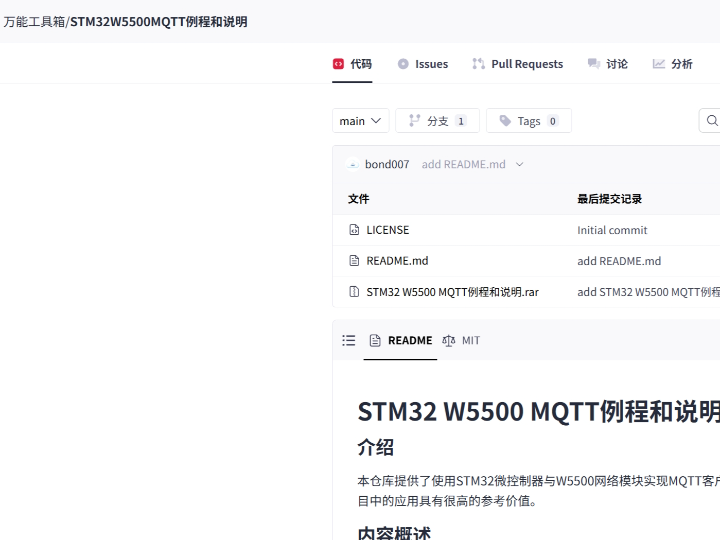
The GitCode repository confirms the STM32 + W5500 MQTT client resource and shows an MIT license marker, but the visible page did not expose inspectable source files during verification. Therefore, no project-specific source code from the GitCode archive is quoted here. The snippets below are verified reference snippets from WIZnet’s official ioLibrary_Driver, which WIZnet lists as an official W5500 driver resource.
File: Ethernet/wizchip_conf.h
What it configures: WIZnet chip selection and W5500 SPI interface mode.
Why it matters: a commercial STM32 MQTT project must first select W5500 and confirm SPI as the host interface before MQTT, sockets, or broker connection logic can be validated.
#define W5100 5100 #define W5100S 5100+5 #define W5200 5200 #define W5300 5300 #define W5500 5500 #define W6100 6100

#elif (_WIZCHIP_ == W5500) #define _WIZCHIP_ID_ "W5500\0"

#ifndef _WIZCHIP_IO_MODE_ #define _WIZCHIP_IO_MODE_ _WIZCHIP_IO_MODE_SPI_ #endif
The official configuration header defines W5500 as a supported WIZnet chip and selects SPI as the W5500 interface mode when no other mode is defined.
File: Ethernet/W5500/w5500.h
What it configures: W5500 register access for local IP, PHY status, version checking, socket mode, socket command, socket status, and buffer state.
Why it matters: commercial firmware needs register-level visibility to distinguish SPI faults, link faults, IP configuration errors, MQTT broker failures, socket-state problems, and peer-side disconnects.
#define setSIPR(sipr) \
    WIZCHIP_WRITE_BUF(SIPR, sipr, 4)

#define getSIPR(sipr) \
    WIZCHIP_READ_BUF(SIPR, sipr, 4)

#define setSn_MR(sn, mr) \
    WIZCHIP_WRITE(Sn_MR(sn),mr)

#define getSn_SR(sn) \
    WIZCHIP_READ(Sn_SR(sn))
The W5500 header exposes local IP access through SIPR, PHY status through PHYCFGR, chip identity through VERSIONR, and socket behavior through registers such as Sn_MR, Sn_CR, Sn_SR, Sn_TX_FSR, and related TX/RX buffer registers.
Practical Tips / Pitfalls
- Validate SPI read/write, chip select timing, reset behavior, and W5500 version read before testing MQTT.
- Route W5500 reset to an STM32 GPIO so firmware can recover Ethernet without rebooting the whole product.
- Use interrupt if receive, disconnect, timeout, or send-complete events should not depend on constant polling.
- Log
VERSIONR,PHYCFGR, local IP, socket status, TX free size, RX received size, MQTT state, reconnect count, and last broker error. - Reserve W5500 sockets early for MQTT, diagnostics, local service, provisioning, and future maintenance workflows.
- Test cable removal, broker downtime, invalid credentials, duplicate IP, DHCP failure, router reboot, and long idle keepalive behavior.
- Measure application payload formatting, flash logging, and MQTT reconnect timing separately from Ethernet transport.
FAQ
Q: Why use WIZnet W5500 for a commercial STM32 MQTT client?
A: W5500 gives STM32 wired Ethernet with hardwired TCP/IP, 8 sockets, and 32 KB internal Tx/Rx buffering. That lets the firmware focus on MQTT topics, credentials, payload validation, reconnect policy, and diagnostics while W5500 handles Ethernet MAC/PHY operation, TCP/UDP behavior, socket state, and packet buffering.
Q: How does W5500 connect to the STM32 platform?
A: W5500 connects through SPI using SCLK, MOSI, MISO, chip select, reset, 3.3 V, and ground. Interrupt is optional for a simple polling implementation, but it is recommended for commercial firmware that needs bounded response to receive, disconnect, timeout, or send-complete events.
Q: What role does W5500 play in this project?
A: W5500 is the wired Ethernet transport engine for the MQTT client. STM32 builds MQTT messages, publishes product data, subscribes to command topics, and manages application behavior; W5500 manages the Ethernet link, hardwired TCP/IP processing, socket state transitions, and TX/RX buffers.
Q: Can beginners follow this commercial project?
A: Yes, if the work is staged. The practical order is STM32 project setup, SPI wiring check, W5500 reset check, version-register read, PHY link check, IP configuration, TCP socket test, MQTT broker configuration, publish/subscribe test, and long-run reconnect testing.
Q: How does W5500 compare with ENC28J60 for this MQTT use case?
A: ENC28J60 is a 10Base-T Ethernet controller with SPI interface, so it gives the host a lower-level Ethernet controller path. W5500 provides a higher-level hardwired TCP/IP model with 8 sockets and internal buffering, which is usually simpler for a commercial STM32 MQTT client that mainly needs bounded TCP communication to a broker rather than a host-managed TCP/IP stack.
Source
Original source: GitCode repository “STM32W5500MQTT例程和说明: 基于STM32与W5500的MQTT客户端实现项目.” The visible page describes an STM32 + W5500 MQTT client example covering hardware preparation, environment setup, code implementation, functional explanation, debugging, testing, and MIT licensing, but it did not expose inspectable source files during verification.
Related CSDN mirror: “STM32 W5500 MQTT例程和说明.” The article states CC 4.0 BY-SA licensing and describes the same project, including hardware preparation, STM32CubeMX/HAL build flow, MQTT initialization, connection, publishing, subscription, debugging, and testing.
Related technical overview: “STM32W5500MQTT例程和说明:实现MQTT客户端的详尽指南.” The article frames the project for embedded MQTT learning and mentions smart home, industrial automation, and remote monitoring as application areas.
WIZnet product reference: W5500 documentation and feature list, including hardwired TCP/IP, SPI up to 80 MHz, embedded 10/100 Ethernet MAC/PHY, 8 sockets, 32 KB internal buffer memory, and MQTT support through WIZnet software resources.
WIZnet driver reference: official ioLibrary_Driver, including W5500 chip selection, SPI interface configuration, register access, PHY status, socket control, and buffer-state access.
ENC28J60 comparison reference: Microchip ENC28J60 product page.
Tags
#W5500 #WIZnet #STM32 #MQTT #CommercialIoT #Ethernet #SPI #Registers #Firmware #Performance #Socket #ENC28J60
STM32에서 WIZnet W5500으로 상용 MQTT Client를 구축하는 방법은?
요약
이 상용 펌웨어 아키텍처는 STM32에서 WIZnet W5500을 사용해 유선 Ethernet MQTT client를 구현합니다. 소스 프로젝트는 STM32 + W5500 MQTT 예제 및 설명 자료이며, hardware preparation, environment setup, code implementation, function explanation, debugging, testing을 다룹니다. 다만 visible GitCode page는 inspect 가능한 source file이 아니라 README 수준의 정보만 노출합니다. W5500은 Ethernet MAC/PHY, hardwired TCP/IP stack, socket engine, internal Tx/Rx buffering을 제공하고, STM32 firmware는 MQTT client behavior, topic publish/subscribe logic, product payload, diagnostics, commercial recovery policy를 처리합니다.
프로젝트가 하는 일
이 프로젝트는 STM32 microcontroller가 W5500 Ethernet module을 사용해 MQTT client를 실행하는 방법을 보여줍니다. GitCode page는 이 프로젝트를 학습 및 실무 활용을 위한 상세한 STM32 + W5500 MQTT client example로 설명하며, hardware preparation, environment setup, code implementation, functional explanation, debugging, testing을 포함한다고 설명합니다. 관련 CSDN mirror는 이 예제가 MQTT initialization, connection, message publish, subscription behavior를 다루며, STM32CubeMX와 HAL을 build flow에 사용한다고 설명합니다.
상용 장치에서 데이터 흐름은 다음과 같습니다.
STM32 application → product data model → MQTT client layer → W5500 socket layer → SPI → W5500 → RJ45 Ethernet → router, gateway, local broker 또는 cloud MQTT broker
이 아키텍처는 wired gateway, metering product, factory service terminal, environmental monitor, machine controller, configuration appliance에 적합합니다. 장치는 telemetry를 publish하고 command topic을 subscribe할 수 있으며, firmware는 broker state, socket state, reconnect attempt, publish result, link state, last error를 기록해야 합니다.
WIZnet이 들어가는 위치
이 프로젝트에서 사용되는 정확한 WIZnet 제품은 W5500입니다. W5500은 STM32와 Ethernet connector 사이에 위치합니다. STM32는 SPI, chip select, reset, 선택적으로 interrupt를 통해 W5500을 제어합니다. W5500은 Ethernet MAC/PHY operation, hardwired TCP/IP processing, socket state transition, packet buffering을 처리합니다.
W5500은 최대 80 MHz SPI access를 지원하는 hardwired TCP/IP Internet controller입니다. 10/100 Ethernet MAC and PHY를 통합하고, TCP, UDP, ICMP, IPv4, ARP, IGMP, PPPoE를 지원하며, 8개 independent socket과 Tx/Rx buffer용 32 KB internal memory를 포함합니다. WIZnet software-resource section은 WIZnet driver resource를 통해 W5500에서 MQTT를 supported service로도 제시합니다.
이 분업은 상용 MQTT firmware에서 유용합니다. MQTT는 이미 broker addressing, credential, keepalive timing, publish/subscribe state, reconnect policy를 포함하기 때문입니다. W5500은 하위 TCP/IP 및 Ethernet transport boundary를 hardware에 유지하므로, STM32 firmware는 product behavior, message validation, configuration storage, diagnostics, long-run recovery에 집중할 수 있습니다.
구현 참고 사항
GitCode repository는 STM32 + W5500 MQTT client resource와 MIT license marker를 확인할 수 있게 하지만, visible page는 검증 중 inspect 가능한 source file을 노출하지 않았습니다. 따라서 GitCode archive의 프로젝트별 source code는 인용하지 않습니다. 아래 snippet은 WIZnet이 공식 W5500 driver resource로 제공하는 ioLibrary_Driver에서 가져온 검증된 reference snippet입니다.
파일: Ethernet/wizchip_conf.h
설정 내용: WIZnet chip selection 및 W5500 SPI interface mode
중요한 이유: 상용 STM32 MQTT project는 MQTT, socket, broker connection logic을 검증하기 전에 먼저 W5500을 선택하고 SPI가 host interface임을 확인해야 합니다.
#define W5100 5100 #define W5100S 5100+5 #define W5200 5200 #define W5300 5300 #define W5500 5500 #define W6100 6100

#elif (_WIZCHIP_ == W5500) #define _WIZCHIP_ID_ "W5500\0"

#ifndef _WIZCHIP_IO_MODE_ #define _WIZCHIP_IO_MODE_ _WIZCHIP_IO_MODE_SPI_ #endif
공식 configuration header는 W5500을 supported WIZnet chip으로 정의하고, 다른 mode가 정의되지 않은 경우 W5500 interface mode를 SPI로 선택합니다.
파일: Ethernet/W5500/w5500.h
설정 내용: local IP, PHY status, version checking, socket mode, socket command, socket status, buffer state를 위한 W5500 register access
중요한 이유: 상용 firmware는 SPI fault, link fault, IP configuration error, MQTT broker failure, socket-state problem, peer-side disconnect를 구분하기 위한 register-level visibility가 필요합니다.
#define setSIPR(sipr) \
    WIZCHIP_WRITE_BUF(SIPR, sipr, 4)

#define getSIPR(sipr) \
    WIZCHIP_READ_BUF(SIPR, sipr, 4)

#define setSn_MR(sn, mr) \
    WIZCHIP_WRITE(Sn_MR(sn),mr)

#define getSn_SR(sn) \
    WIZCHIP_READ(Sn_SR(sn))
W5500 header는 SIPR을 통한 local IP access, PHYCFGR를 통한 PHY status, VERSIONR를 통한 chip identity, 그리고 Sn_MR, Sn_CR, Sn_SR, Sn_TX_FSR 및 관련 TX/RX buffer register를 통한 socket behavior를 노출합니다.
실무 팁 / 주의점
- MQTT를 테스트하기 전에 SPI read/write, chip select timing, reset behavior, W5500 version read를 먼저 검증해야 합니다.
- W5500 reset은 STM32 GPIO에 연결해 전체 제품을 reboot하지 않고 Ethernet을 복구할 수 있게 해야 합니다.
- Receive, disconnect, timeout, send-complete event가 constant polling에 의존하지 않아야 한다면 interrupt를 사용하는 것이 좋습니다.
VERSIONR,PHYCFGR, local IP, socket status, TX free size, RX received size, MQTT state, reconnect count, last broker error를 기록해야 합니다.- W5500 socket은 MQTT, diagnostics, local service, provisioning, future maintenance workflow용으로 초기에 예약해야 합니다.
- Cable removal, broker downtime, invalid credential, duplicate IP, DHCP failure, router reboot, long idle keepalive behavior를 테스트해야 합니다.
- Application payload formatting, flash logging, MQTT reconnect timing은 Ethernet transport와 분리해서 측정해야 합니다.
FAQ
Q: 상용 STM32 MQTT client에 왜 WIZnet W5500을 사용하나요?
A: W5500은 STM32에 hardwired TCP/IP, 8개 socket, 32 KB internal Tx/Rx buffering을 갖춘 유선 Ethernet을 제공합니다. 따라서 firmware는 MQTT topic, credential, payload validation, reconnect policy, diagnostics에 집중하고, W5500은 Ethernet MAC/PHY operation, TCP/UDP behavior, socket state, packet buffering을 처리합니다.
Q: W5500은 STM32 platform에 어떻게 연결되나요?
A: W5500은 SCLK, MOSI, MISO, chip select, reset, 3.3 V, ground를 사용하는 SPI로 연결됩니다. Interrupt는 단순 polling implementation에서는 선택 사항일 수 있지만, receive, disconnect, timeout, send-complete event에 대한 bounded response가 필요한 상용 firmware에서는 권장됩니다.
Q: 이 프로젝트에서 W5500은 어떤 역할을 하나요?
A: W5500은 MQTT client를 위한 유선 Ethernet transport engine입니다. STM32는 MQTT message를 만들고, product data를 publish하며, command topic을 subscribe하고, application behavior를 관리합니다. W5500은 Ethernet link, hardwired TCP/IP processing, socket state transition, TX/RX buffer를 관리합니다.
Q: 초보자도 이 상용 프로젝트를 따라갈 수 있나요?
A: 가능합니다. 다만 단계적으로 진행해야 합니다. 실용적인 순서는 STM32 project setup, SPI wiring check, W5500 reset check, version-register read, PHY link check, IP configuration, TCP socket test, MQTT broker configuration, publish/subscribe test, long-run reconnect testing입니다.
Q: 이 MQTT use case에서 W5500은 ENC28J60과 비교하면 어떤 차이가 있나요?
A: ENC28J60은 SPI interface를 가진 10Base-T Ethernet controller이므로 host에 lower-level Ethernet controller path를 제공합니다. W5500은 8개 socket과 internal buffering을 갖춘 higher-level hardwired TCP/IP model을 제공하므로, host-managed TCP/IP stack보다 broker와의 bounded TCP communication이 중요한 상용 STM32 MQTT client에는 보통 더 단순합니다.
출처
Original source: GitCode repository “STM32W5500MQTT例程和说明: 基于STM32与W5500的MQTT客户端实现项目.” Visible page는 hardware preparation, environment setup, code implementation, functional explanation, debugging, testing, MIT licensing을 포함한 STM32 + W5500 MQTT client example을 설명하지만, 검증 중 inspect 가능한 source file은 노출하지 않았습니다.
https://gitcode.com/Universal-Tool/f1f97
Related CSDN mirror: “STM32 W5500 MQTT例程和说明.” 해당 article은 CC 4.0 BY-SA licensing을 명시하며, 같은 프로젝트의 hardware preparation, STM32CubeMX/HAL build flow, MQTT initialization, connection, publishing, subscription, debugging, testing을 설명합니다.
https://blog.csdn.net/gitblog_06794/article/details/147331254
Related technical overview: “STM32W5500MQTT例程和说明:实现MQTT客户端的详尽指南.” 해당 article은 embedded MQTT learning을 위한 프로젝트로 설명하며, smart home, industrial automation, remote monitoring을 application area로 언급합니다.
https://blog.csdn.net/gitblog_06767/article/details/147884746
WIZnet product reference: W5500 documentation and feature list, including hardwired TCP/IP, SPI up to 80 MHz, embedded 10/100 Ethernet MAC/PHY, 8 sockets, 32 KB internal buffer memory, and MQTT support through WIZnet software resources.
https://docs.wiznet.io/Product/Chip/Ethernet/W5500
WIZnet driver reference: official ioLibrary_Driver, including W5500 chip selection, SPI interface configuration, register access, PHY status, socket control, and buffer-state access.
https://github.com/Wiznet/ioLibrary_Driver
ENC28J60 comparison reference: Microchip ENC28J60 product page.
https://www.microchip.com/en-us/product/ENC28J60
태그
#W5500 #WIZnet #STM32 #MQTT #CommercialIoT #Ethernet #SPI #Registers #Firmware #Performance #Socket #ENC28J60