



Hardware Protocol Stack Dual-Port Engine: Breaking the Transmission Dilemma of Industrial PLCs
Hardware Protocol Stack Dual-Port Engine: Breaking the Transmission Dilemma of Industrial PLCs at the Chip Level
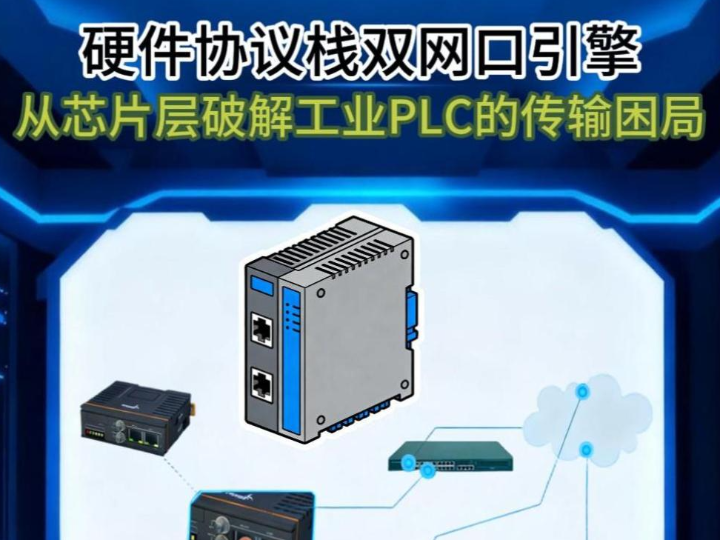
In industrial automation systems, Ethernet PLCs (Programmable Logic Controllers) serve as the core hub connecting field devices and the control center. The stability and real-time performance of their data transmission directly determine the accuracy of production monitoring and the efficiency of process control. However, traditional Ethernet PLCs rely on software protocol stacks to handle communication tasks. Their single-port architecture commonly faces challenges such as packet loss, latency, and bandwidth congestion when dealing with concurrent data acquisition from multiple devices and large data volume transmissions, becoming a key bottleneck in industrial production data flow.
The W55MH32 microcontroller paired with the W5500 Ethernet chip, featuring a hardware protocol stack and dual-port solution, leverages its innovative, highly integrated hardware architecture and industrial-grade features to reshape PLC communication capabilities at the chip level, providing an efficient and reliable technical solution for upgrading industrial automation communication.
1. PLC Ethernet Transmission Bottlenecks: Three Hurdles Faced by Traditional Solutions
The complex environment and diverse needs of industrial sites expose numerous transmission shortcomings in traditional Ethernet PLCs. These problems are particularly prominent in high-requirement scenarios such as flow metering and dense equipment monitoring:
- Low Protocol Processing Efficiency and Routine Packet Loss and Delay: Traditional PLCs use software protocol stacks to parse industrial protocols such as Modbus TCP, requiring MCU resources to process communication tasks in a time-sharing manner. When more than 5 sensors (such as flow and temperature sensors) are connected simultaneously, MCU resources are occupied by communication, resulting in high data parsing delays, high packet loss rates, and frequent disconnections of flow metering data and delayed control command issuance.
- Single Ethernet Port Bandwidth Congestion and Data Transmission Obstruction: Most traditional PLCs are equipped with only one Ethernet port, which must simultaneously handle both "field device data acquisition" and "upload data to the host computer/cloud." In scenarios involving continuous transmission of large amounts of flow metering data, the bandwidth of a single Ethernet port is easily saturated, leading to data backlog. In severe cases, this can even prevent the system from acquiring field data in real time, directly affecting the timeliness and accuracy of production decisions.
- Weak anti-interference capability and insufficient link reliability: Electromagnetic interference and voltage fluctuations in industrial environments can easily cause software protocol stack crashes; moreover, the single-port architecture lacks redundancy design, and once the network cable becomes loose or the port fails, communication between the PLC and the outside world is immediately interrupted, causing core functions such as flow metering and equipment control to stop, resulting in direct production losses.
2. W55MH32: The Preferred Solution to Overcome PLC Transmission Bottlenecks
This solution uses the W55MH32 as the main control microprocessor and an external W5500 Ethernet chip to jointly build a highly integrated and efficient dual-port communication engine.
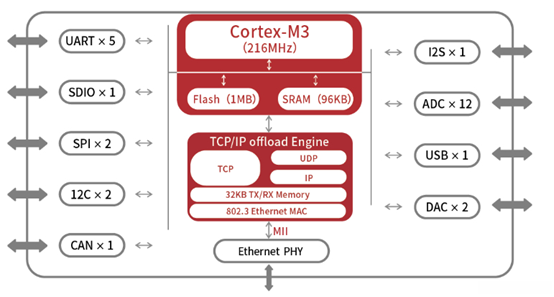
W55MH32L Chip System Block Diagram
1. High Hardware Integration, Simplifying Dual-Port Design
Compared to the traditional "MCU + dual MAC + dual PHY" solution, the W55MH32 integrates a 10/100M Ethernet MAC and PHY, achieving a dual-port architecture with the W5500, significantly simplifying hardware design and reducing PCB area. The W55MH32L (100QFN package) has 66 GPIO pins, fully meeting the control signal (CS, INT) and status display (LED) pin allocation requirements of the dual-port architecture, eliminating the need for additional I/O chips and further simplifying hardware layout.
2. Hardware TCP/IP Protocol Stack, Ensuring Efficient Dual-Port Communication
The W55MH32 features a built-in full hardware TCP/IP protocol stack, supporting core protocols such as TCP, UDP, ICMP, and IPv4, and has a 32KB Ethernet transceiver buffer and 8 independent hardware sockets. This architecture allows network data streams from both network ports to be bound to different sockets, achieving logical isolation and parallel transmission. For example, one port (and its socket) can be dedicated to monitoring by the host computer, while the other port connects to the slave device.
3. Low cost and high cost-effectiveness, lowering the barrier to project implementation. From a BOM cost perspective, the W55MH32 dual-port solution requires only "1 main chip + 1 external W5500," significantly reducing component costs compared to the traditional solution of "1 MCU + 2 MACs + 2 PHYs." From a development cost perspective, the chip provides complete Ethernet driver examples (such as Modbus/TCP examples) and a matching development board (such as the W55MH32L-EVB), allowing developers to directly debug based on existing resources without developing protocol stack adaptation code from scratch, further shortening the development cycle.
4. Industrial-grade reliability and security, adaptable to complex scenarios.
The W55MH32's professional design for stability and security perfectly matches the industrial application requirements of dual-port solutions:
- Hardware Reliability: The chip integrates power-on/power-down reset (POR/PDR) and a programmable voltage monitor (PVD) in conjunction with voltage and temperature sensors. This allows for real-time detection of power supply anomalies and ambient temperature in both ports, triggering interrupts or resets to ensure stable system operation.
- Data Security: Supports hardware encryption algorithms (DES, AES, SHA, etc.) and true random number generation (TRNG). This system encrypts data transmitted through both network ports to prevent industrial control commands from being tampered with or stolen.
- System Protection: A built-in memory protection unit (MPU) can partition the memory access areas for data from both network ports, preventing abnormal data from one port from interfering with communication on the other. It supports an independent watchdog timer (IWDG) to prevent software freezes that could cause both network ports to fail. The chip operates within an industrial-grade temperature range of -40 to +85℃. Both network ports support automatic negotiation (full-duplex/half-duplex, 10M/100M) and LED status display for easy on-site troubleshooting.
5. Abundant Peripheral Resources, Flexible Expansion of Dual Network Port Functionality
The W55MH32 is equipped with a rich set of peripheral interfaces, allowing direct integration with the dual network ports to achieve diverse functions:
- It features three 12-bit ADCs and two DACs, enabling the acquisition of industrial sensor data and its transmission via the dual network ports, or the reception of network port commands and output of analog control signals.
- It integrates a CAN interface (2.0B active) and five USARTs (W55MH32L version), allowing interconnection between the dual network ports and fieldbus/serial devices to build a hybrid "Ethernet + bus" control network.
- It supports 12-channel DMA, enabling high-speed data transmission between the dual network ports and peripheral devices, avoiding MCU resource consumption.
For example, in a dual-network port PLC scenario, the chip can acquire analog signals via the ADC, transmit them to memory via DMA, and then send them to the host computer and slave station respectively via the dual network ports through the hardware protocol stack. The entire process requires minimal MCU intervention, efficiently balancing real-time performance and multi-tasking capabilities.
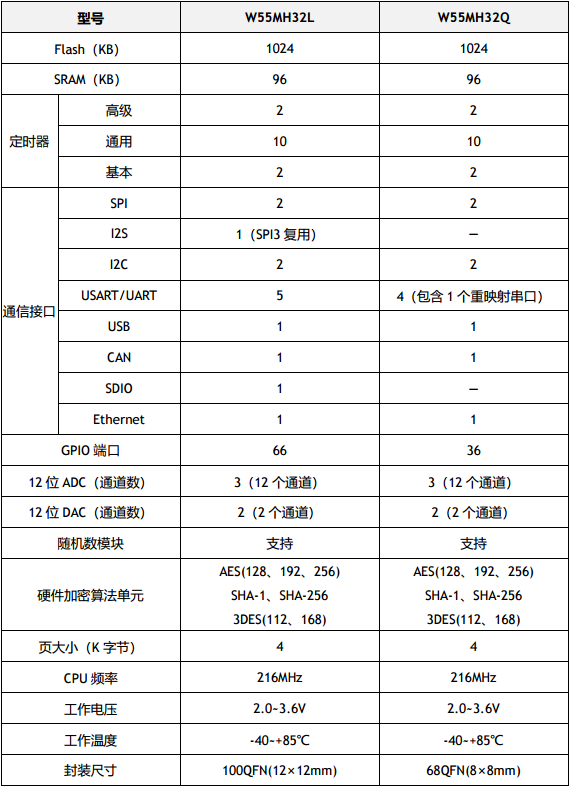
Device Function Configuration Table
III. Hardware Protocol Stack Dual-Port Solution: Breaking Through Transmission Bottlenecks at the Hardware Layer
Based on the W55MH32, the hardware protocol stack dual-port solution effectively addresses the pain points of traditional PLC transmission at the hardware architecture level through the collaborative design of "hardware-based protocol processing" and "dual-link functional partitioning," combined with the chip's high integration and strong protection features. Its core advantages are reflected in three dimensions:
1. Hardware Protocol Stack: Freeing Up the MCU, Achieving "Low Packet Loss and Low Latency"
The W55MH32 integrates a fully hardware TCP/IP protocol stack engine (TOE offload engine). The parsing and forwarding of commonly used industrial protocols such as Modbus TCP, UDP, ICMP, and IPv4 are all handled independently by hardware, significantly reducing MCU resource consumption and allowing the MCU to focus on core control algorithm execution.
This hardware protocol stack supports 8 independent hardware sockets, capable of handling 8 concurrent communications simultaneously. Equipped with 32KB independent transmit and receive buffers, it significantly reduces resource conflicts in multi-device communication at the physical level, making data transmission more stable and reliable.
Security Features: The chip integrates DES, AES, and SHA hardware encryption algorithm units, enabling real-time encryption of transmitted data and effectively mitigating industrial data security risks. It is supplemented by a TRNG true random number generator with four independent random sources, capable of generating 128-bit random numbers simultaneously, providing a high-security foundation for encryption and significantly reducing the risk of data being cracked or tampered with.
Reliability Assurance: The hardware protocol stack features industrial-grade anti-interference design, effectively resisting electromagnetic interference and reducing the impact of software anomalies. Combined with the chip's built-in independent watchdog timer and voltage/temperature sensor alarm functions, real-time monitoring and rapid recovery of the communication link are achieved, significantly improving the problems of traditional software protocol stacks being prone to crashes and difficult to recover.
2. Dual-Port Architecture: Functional Partitioning, Say Goodbye to Bandwidth Congestion and Link Interruption
The W55MH32 integrates a 10/100M Ethernet MAC and PHY, supporting independent deployment of dual network ports. Through a "physical separation, each performing its own function" strategy, it fundamentally improves the bandwidth bottleneck and link reliability issues of single network ports.
Industrial Scenario Diagram
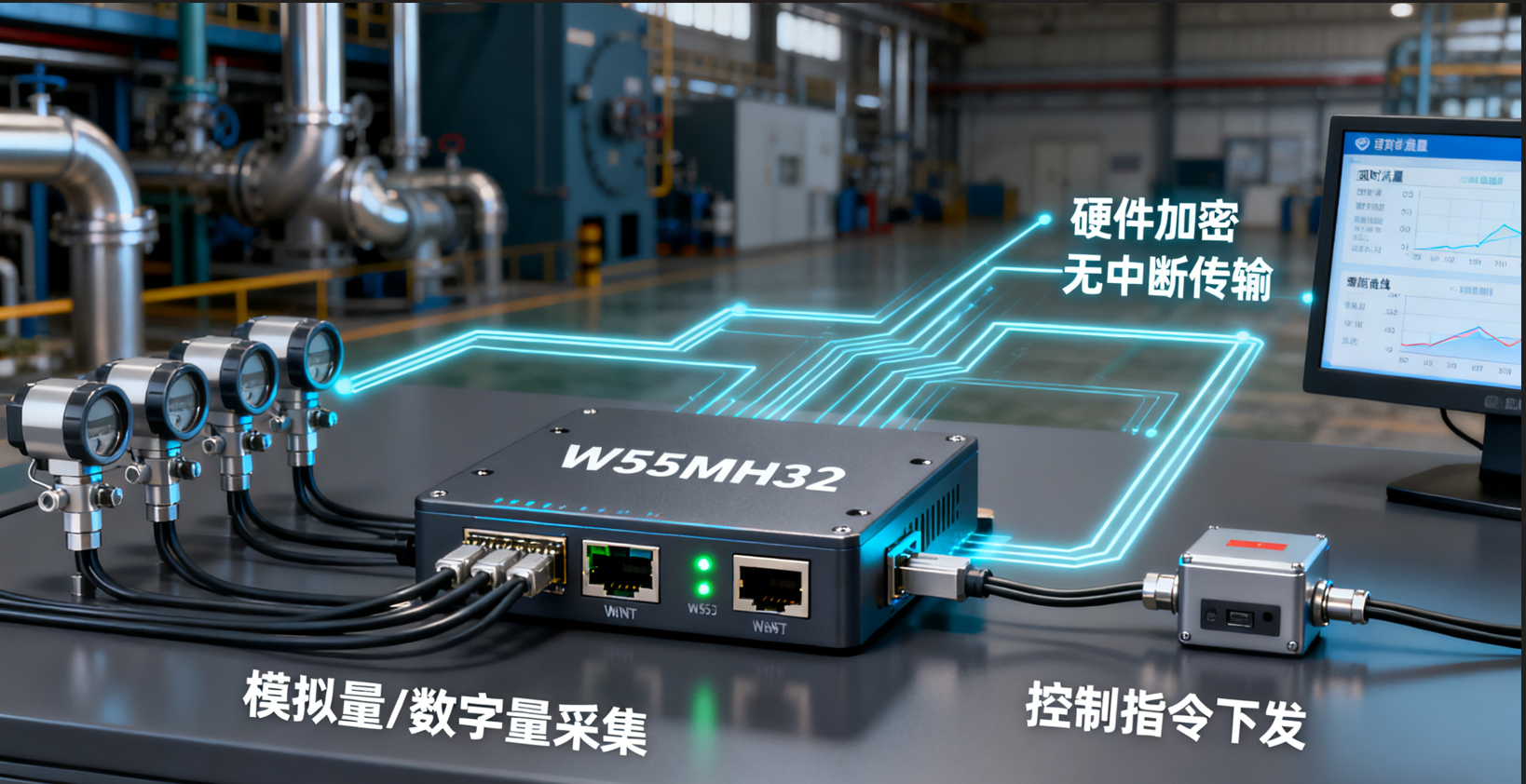
Network Port 1: Provided directly by the 10/100M Ethernet MAC and PHY integrated within the W55MH32 chip. Focused on field data acquisition: Directly connects to terminal devices such as flow sensors and actuators, using hardware-based Modbus TCP protocol for low-latency data acquisition and control command issuance. The chip has three built-in 12-bit ADCs (up to 12 input channels), directly adapting to analog signal acquisition from flow sensors without the need for additional ADC chips, simplifying hardware design and further reducing data transmission latency, perfectly meeting the millisecond-level control requirements of industry.
Network Port 2: Provided by the W5500 chip, which also integrates a hardware TCP/IP protocol stack, MAC, and PHY. Responsible for data upload and remote interaction: Connects to a host computer, MES system, or cloud platform to batch upload large amounts of field-collected flow metering data and equipment operation logs. A 32KB transmit/receive buffer ensures continuous, high-volume data transmission without backlog. Combined with the chip's Wake-on-LAN (WOL) function, it can remotely wake up the PLC in low-power mode, balancing energy saving and ease of maintenance.
Furthermore, the dual network ports can be flexibly configured as a "primary/backup redundant link": under normal conditions, the primary network port handles communication tasks, while the backup port monitors the link status in real time; if the primary network port fails, the backup port can automatically switch, achieving "millisecond-level" link self-healing and ensuring uninterrupted communication.
3. High Integration + Strong Protection: Adaptable to Harsh Industrial Environments, Simplified Development
The W55MH32, based on a 32-bit Arm® Cortex®-M3 core (operating frequency up to 216MHz), provides powerful computing performance and integrates a rich set of industrial-grade peripherals. In most common application scenarios, no additional expansion chips are required, significantly simplifying PLC hardware design.
Rich Communication Interfaces: Supports up to 12 communication interfaces, including 2 I2C, up to 5 USARTs, 2 SPIs, CAN 2.0B, and a USB 2.0 full-speed interface, allowing direct connection to various industrial equipment and communication modules.
Powerful Control Capabilities: Built-in 2 12-bit DACs and 17 timers (including 2 advanced PWM timers for motor control), capable of directly generating control signals to drive actuators such as valves and pumps without the need for additional signal generation chips.
Safe and Reliable Storage: 96KB SRAM supports address and data scrambling, and 1024KB flash program memory ensures data storage security and long-term stable operation.
Environmental Adaptability: The W55MH32 supports a wide voltage supply of 2.0-3.6V and an operating temperature range of -40~+85℃, tolerating voltage fluctuations and extreme temperatures in industrial environments. The chip also incorporates a programmable voltage monitor (PVD), which monitors the VDD/VDDA power supply and compares it with a threshold VPVD.
When VDD is lower or higher than the threshold VPVD... Interrupts are generated when interrupts occur. The interrupt handler can issue warning messages or switch the microcontroller to a safe mode, ensuring stable operation even in harsh industrial environments such as high temperature, electromagnetic interference, and voltage fluctuations.
4. Development Architecture and Production Advantages: Accelerating PLC Product Deployment
1. Hardware Design Advantages
The W55MH32 offers two package options (W55MH32L: 100QFN 12x12mm; W55MH32Q: 68QFN 8x8mm), adaptable to PLC product designs with different size requirements. The chip integrates core functions such as Ethernet PHY, hardware protocol stack, encryption unit, and ADC/DAC, significantly reducing the number of external components and lowering PCB design complexity and board area. All GPIOs can be forcibly configured with pull-up and pull-down resistors, saving external resistor costs while improving the anti-interference capability of I/O ports.
W55MH32L Pin Layout Diagram
2. Software Design Advantages
The W55MH32 provides a complete high-performance algorithm library and development toolchain, supporting Socket programming to simplify Ethernet application development without requiring in-depth debugging of underlying protocols. The chip supports Serial Single-Wire Debug (SWD) and JTAG interfaces, and with the embedded trace module (ETM), it enables rapid code debugging and optimization. Furthermore, the chip supports three low-power modes: sleep, stop, and standby. Combined with a VBAT-powered RTC and backup registers, it can reduce device power consumption without affecting communication response speed, meeting industrial energy-saving requirements.
3. Mass Production Cost Advantages The W55MH32's high integration reduces external chip procurement costs and PCB manufacturing costs. Simultaneously, relying on mature processes and a stable supply chain, it can reduce defect rates during mass production. The chip's built-in One-Time Programmable (OTP) unit (32 bytes) supports the embedding of product serial numbers and configuration parameters, simplifying calibration and configuration steps in the production process and improving mass production efficiency.
V. Project Schedule and Delivery Guarantee
Comprehensive Technical Support:
Provides high-quality examples of Modbus_TCP and other industrial communication protocols
Professional technical team provides full-process technical support
Complete technical documentation and design guidelines
Stable Supply Chain Guarantee:
Complete documentation and stable supply
Strict quality control system
Timely technical updates and iteration support
W55MH32 Documentation Link: https://www.w5500.com/w55mh32.html
VI. Typical Application Scenarios and Value Demonstration
1. Flow Metering and Energy Monitoring System
Scenario Characteristics:
Multi-channel sensor concurrent data acquisition in process industries
Continuous and uninterrupted metering data requirements
Energy efficiency management relies on accurate data support
Solution Advantages:
Equipment-side network ports focus on real-time data acquisition, effectively reducing the risk of metering data loss
System-side network ports independently upload data, avoiding data backlog
Hardware encryption ensures secure transmission of energy data
Core Value:
Achieves precise energy consumption management, provides a reliable data foundation for production decisions, and improves energy utilization efficiency.
2. Intelligent Manufacturing Equipment Cluster Control
Scenario Characteristics:
Dense production line equipment, high concurrency of control commands.
Real-time control and status monitoring must be performed simultaneously.
High timeliness is required for equipment collaboration.
Solution Advantages:
Control network ports ensure real-time command issuance and rapid response.
Information network ports independently handle data exchange, avoiding bandwidth conflicts.
Hardware protocol stack ensures synchronous control of multiple devices.
Core Value: Improves equipment collaboration efficiency, ensures continuous and stable production operation, and optimizes manufacturing processes.
3. Industrial IoT Edge Gateway
Scenario Characteristics:
Requires compatibility with multiple industrial protocols.
Data interoperability between field devices and the cloud platform.
Equal emphasis on transmission security and real-time performance.
Solution Advantages:
Field-side network ports adapt to various industrial bus devices.
Cloud-side network ports achieve secure data transmission.
Multi-protocol conversion requires no additional processing resources.
Core Value: Builds a reliable data channel, enhancing transmission security while ensuring real-time performance, and driving digital transformation.
4. Redundancy Control for Critical Infrastructure
Scenario Characteristics:
Extremely high system reliability requirements
Communication interruption could cause significant losses
Complex and harsh environmental conditions
Solution Advantages:
Automatic switching between primary and backup network ports for seamless redundancy
Hardware-level reliability design adapts to harsh environments
Real-time link monitoring for rapid fault recovery
Core Value: Significantly reduces the risk of single-point failures, ensuring continuous and stable communication of critical systems and guaranteeing production safety.
This hardware protocol stack dual-network port solution, through architectural innovation, demonstrates significant advantages in multiple typical industrial scenarios. It solves the core communication bottleneck faced by traditional PLCs in complex industrial environments at the chip level, providing a reliable network connection foundation for intelligent manufacturing upgrades.
VII. Summary of Technical Advantages Based on the W55MH32's hard protocol stack dual-port solution, through the core design of "hardware-based protocol processing + dual-port functional partitioning + high integration and strong protection," it precisely overcomes the transmission bottlenecks of traditional PLCs:
Performance Breakthrough: The hard protocol stack significantly reduces the burden on the MCU, achieving low-latency, low-packet-loss communication, highly adaptable to multi-device concurrent data acquisition scenarios.
Architectural Innovation: Physical separation and redundancy design of the dual-port significantly alleviates bandwidth congestion, avoids single-point-of-failure risks, and ensures communication continuity.
Cost Optimization: High integration simplifies hardware design, helping to reduce the overall system cost.
Security and Reliability: Industrial-grade protection and hardware encryption technology build a solid defense for industrial data security.
As a core solution for upgrading industrial automation communication, the W55MH32, with its robust performance and rich features, empowers next-generation PLC products, helping enterprises overcome transmission bottlenecks, achieve precise monitoring, efficient control, and safe operation and maintenance of the production process, and accelerate the transformation of industrial automation towards intelligence and efficiency.
————————————————
Copyright Notice: This article is an original work by CSDN blogger "Playing with Ethernet," and is licensed under CC 4.0 BY-SA. Please include the original source link and this statement when reprinting.
Original Link: https://blog.csdn.net/2301_81684513/article/details/155233781