



Getting Started with WIZnet EVB-Pico2 and MicroPython: Hardware Innovation Made Simple
The intersection of powerful networking hardware and high-level programming languages is reshaping how we approach embedded systems development.
Getting Started with WIZnet EVB-Pico2 and MicroPython: Hardware Innovation Made Simple
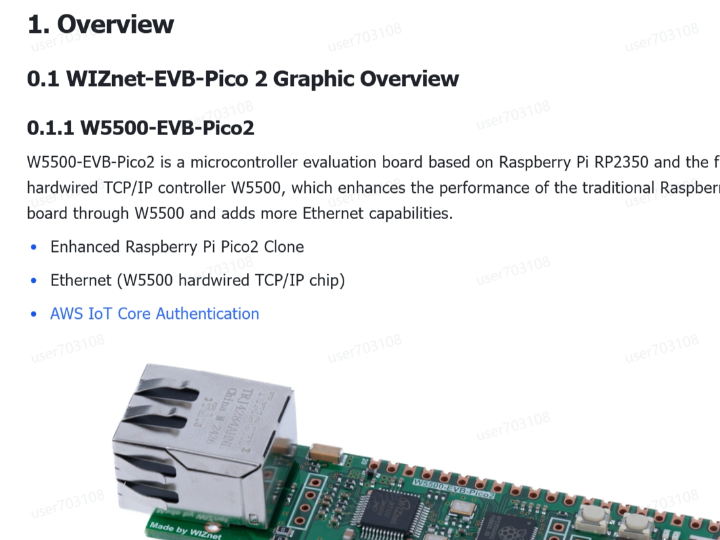
The intersection of powerful networking hardware and high-level programming languages is reshaping how we approach embedded systems development. At the forefront of this shift is the WIZnet W6300/W5500/W5100S-EVB-Pico2 Development Board. This platform merges the robust, hardwired TCP/IP capabilities of WIZnet chips with the processing power of the Pico2 generation, offering developers an exceptional foundation for internet-connected hardware projects.
To unlock the full potential of these boards without getting bogged down in traditional, dense development cycles, MicroPython serves as the ideal development language.
Why Choose MicroPython for EVB-Pico2?
Traditionally, microcontrollers required complex C/C++ toolchains, meticulous register configuration, and lengthy compilation times just to blink an LED or initialize a network socket. MicroPython completely changes this paradigm.
Skip Low-Level Compilation: MicroPython abstracts away the underlying hardware complexities, allowing you to run script files directly on the board.
Focus on Logic: By bypassing repetitive boilerplate code, you can dedicate your energy entirely to "hardware interaction + functionality implementation."
Rapid Prototyping: The interactive Read-Eval-Print Loop (REPL) allows you to test commands and interact with peripherals in real-time, accelerating debugging.
From Scratch to Comprehensive Application
This tutorial series is meticulously structured to guide you through every stage of your development journey. Whether you are a hobbyist picking up a microcontroller for the first time or an experienced engineer deploying an edge device, the curriculum scales to meet your needs:
Getting Started from Scratch: Learn how to flash the MicroPython firmware onto your EVB-Pico2, set up your integrated development environment (IDE), and control basic onboard peripherals like GPIOs and ADCs.
Network Hardware Interaction: Dive into WIZnet’s core strength. You will learn how to easily configure static or dynamic IPs and manage stable ethernet connectivity via simple Python scripts.
Comprehensive Practical Applications: Combine hardware control with network protocols. Build practical, real-world applications such as MQTT clients for IoT telemetry, localized web servers, and sensor-to-cloud data pipelines.
By stripping away the steep learning curve of low-level compilation, the WIZnet EVB-Pico2 and MicroPython tutorial empowers you to turn concepts into functional, networked hardware realities faster than ever before. Welcome to the future of streamlined embedded design!
Link: https://f1829ryac0m.feishu.cn/wiki/CFScwuqEkikUqnkTCICc6zMzn3f