



Breaking the Single-Chip Barrier: How to Reconstruct the Serial-to-Ethernet Development Architecture
Breaking the Single-Chip Barrier: How to Reconstruct the Serial-to-Ethernet Development Architecture with W55MH32
Introduction: The Connectivity Dilemma in the Internet of Things Era
With the rapid development of Industry 4.0 and the Internet of Things (IoT), the demand for networking traditional serial port devices is exploding. However, engineers face multiple technical barriers in the development of serial-to- Ethernet devices. Issues such as transmission rate bottlenecks, limited interface numbers, complex hardware design, and difficulties in protocol stack debugging act like layers of shackles, hindering product innovation and market responsiveness. How to overcome these bottlenecks and achieve fast, stable, and economical device networking has become a focus of common concern in the industry.
1. Four core pain points of traditional serial-to-Ethernet solutions
Device Function Configuration Table
1.1 Rate bottlenecks limit data value
Traditional serial port solutions are limited by hardware architecture, with common speeds ranging from 115.2Kbps to 1Mbps. This speed bottleneck is particularly pronounced when dealing with high-speed AD acquisition devices, industrial cameras, and other similar equipment. This speed limitation directly leads to:
Severe data latency affects system real-time performance.
High-frequency sampling data forced to reduce sampling rate
The overall system performance cannot be fully utilized
1.2 Limited Interfaces Restrict System Expansion
Most microcontrollers only provide 1-3 serial ports, while modern industrial scenarios often require simultaneous connection to multiple sensors such as temperature and humidity sensors, gas concentration sensors, vibration monitoring sensors, image acquisition sensors, and position sensors . Engineers are forced to adopt the following complex solutions:
External multi-channel serial port expansion chips increase PCB complexity and potential points of failure.
Using serial port multiplexing technology sacrifices real-time performance and reliability.
Designing a multi-level data acquisition system significantly increases cost and maintenance complexity.
1.3 Bulky hardware architecture increases design risks
Traditional Ethernet solutions require the classic combination of "MCU + MAC chip + PHY chip + network transformer", an architecture that brings many problems:
The PCB layout is complex and occupies valuable board space.
Signal integrity challenges are increasing, especially in high-frequency environments.
The increased number of components leads to a decrease in yield and an increase in cost.
Power supply design is complex, requiring consideration of multiple voltage domains and power management.
1.4 Network protocol stacks consume valuable development resources
The implementation and debugging of software TCP/IP protocol stacks is a complex technical area that engineers must navigate.
Understanding and implementing complex network protocols presents a steep learning curve.
Memory resource consumption is high, especially for resource-constrained embedded systems.
Real-time performance and reliability are difficult to balance, requiring extensive testing and verification.
Increased cybersecurity vulnerability risks necessitate maintenance by a professional team.
Cross-platform compatibility issues increase software maintenance costs.
2. W55MH32: A revolutionary all-in-one solution
2.1 Chip Architecture Innovation: Redefining Integration
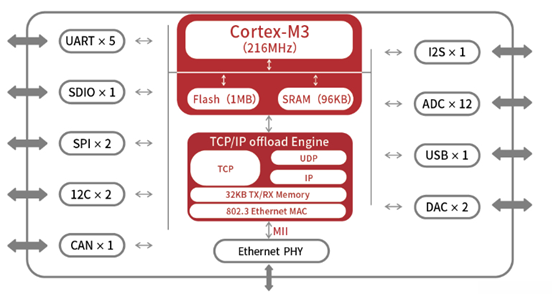
System Architecture
The W55MH32 adopts an advanced SoC architecture design, realizing the functions of multiple independent chips in traditional solutions within a single chip:
Core integration module:
High-performance processor core with a clock speed of 216MHz
5-channel independent UART controller
10/100M Ethernet MAC Controller
Ethernet PHY physical layer interface
Hardware TCP/IP protocol stack
Abundant peripheral interfaces (SPI, I2C, GPIO, etc.)
This high degree of integration brings direct advantages:
Chip-level integration significantly reduces the PCB footprint required to achieve the same functionality.
Shorter signal path, significantly improved electromagnetic compatibility
Single-chip solutions reduce supply chain risks
2.2 Breakthrough in Serial Port Capabilities: Meeting Diverse Access Needs
Multi-port serial port configuration strategy:
Five independent serial ports, supporting full-duplex asynchronous communication.
Flexible baud rate configuration, covering everything from low-speed sensors to high-speed devices.
Each serial port can be configured independently to support different communication protocols.
Hardware flow control support ensures reliable data transmission.
A leap in the performance of high-speed serial ports:
Serial port 1 is designed for high-speed applications, with speeds up to 13.5 Mbps.
Supports DMA transfer, greatly reducing CPU load.
Suitable for high-bandwidth devices such as industrial cameras and high-speed data acquisition cards.
Its 13.5Mbps speed enables it to easily handle large data stream applications such as high-definition images and high-speed data acquisition, which are difficult for traditional serial ports to process.
2.3 Hardware Protocol Stack: A Fundamental Innovation in Network Communication.
Limitations of traditional software protocol stacks:
CPU resource usage reached 30%-70%, resulting in a significant decrease in core business processing performance.
Large response latency makes it difficult to guarantee real-time performance.
Limited number of connections, poor scalability
Significantly affected by system load, posing stability challenges.
Advantages of the W55MH32 hardware protocol stack:
Dedicated hardware handles the TCP/IP protocol, resulting in extremely low CPU utilization.
Supports multiple parallel connections, up to 8 concurrent connections.
Deterministic delay to meet industrial real-time requirements
Built-in multiple network protocols: TCP, UDP, IPv4, ARP, ICMP, IGMP
Supports DHCP client/server and DNS client.
Hardware-level network security features provide more reliable data protection.
3. Transformation of Developer Experience: A Leap from Complexity to Simplicity
3.1 Simplified Hardware Design
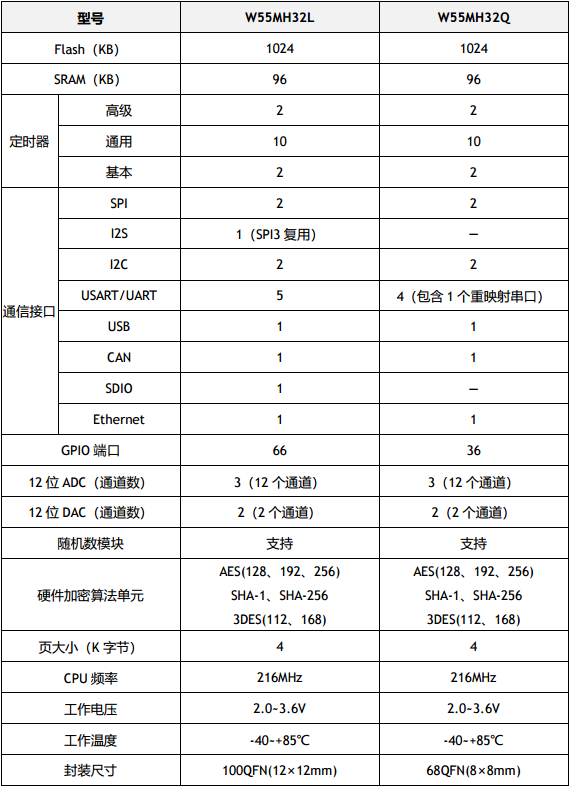
System Architecture
The W55MH32 provides proven reference designs, significantly lowering the barrier to hardware design:
Simplified circuit structure: Traditional solutions require a series connection of 'MCU + serial port expansion chip + MAC chip + PHY chip + network transformer', while the W55MH32 single chip integrates all core functions, requiring only the following external components:
① 1-2 voltage domain power supply filtering circuits
② Reset circuit
③ RJ45 interface + network transformer
④ A few passive filtering components. No additional expansion chips are needed, greatly simplifying the circuit link and significantly shortening the signal path.
Simplified peripheral circuitry:
The power supply circuit has been simplified from multiple channels to 1-2 channels.
The number of peripheral components for network interfaces has been reduced by more than 60%.
PCB layout area reduced by 50%-70%
3.2 Accelerating Software Development
The chip is paired with a complete software development ecosystem:
Abundant software resources:
Application examples cover mainstream scenarios:
Modbus TCP Example Reference
Multi-channel data acquisition and uploading
Remote configuration and management
Quick start path:
Hardware design: Refer to the official schematic and PCB layout, to be completed in 1-2 weeks.
Software porting: Modifying example TCP and other routine code.
Protocol adaptation: Adjust the communication protocol according to actual needs.
System integration: Interfacing and testing with upper-layer systems
3.3 Debugging and Maintenance Optimization
Built-in diagnostic functions for quick identification of network and communication problems.
Supports remote firmware upgrades, reducing maintenance costs.
Long-term software support and technology updates
4. In-depth analysis of application scenarios
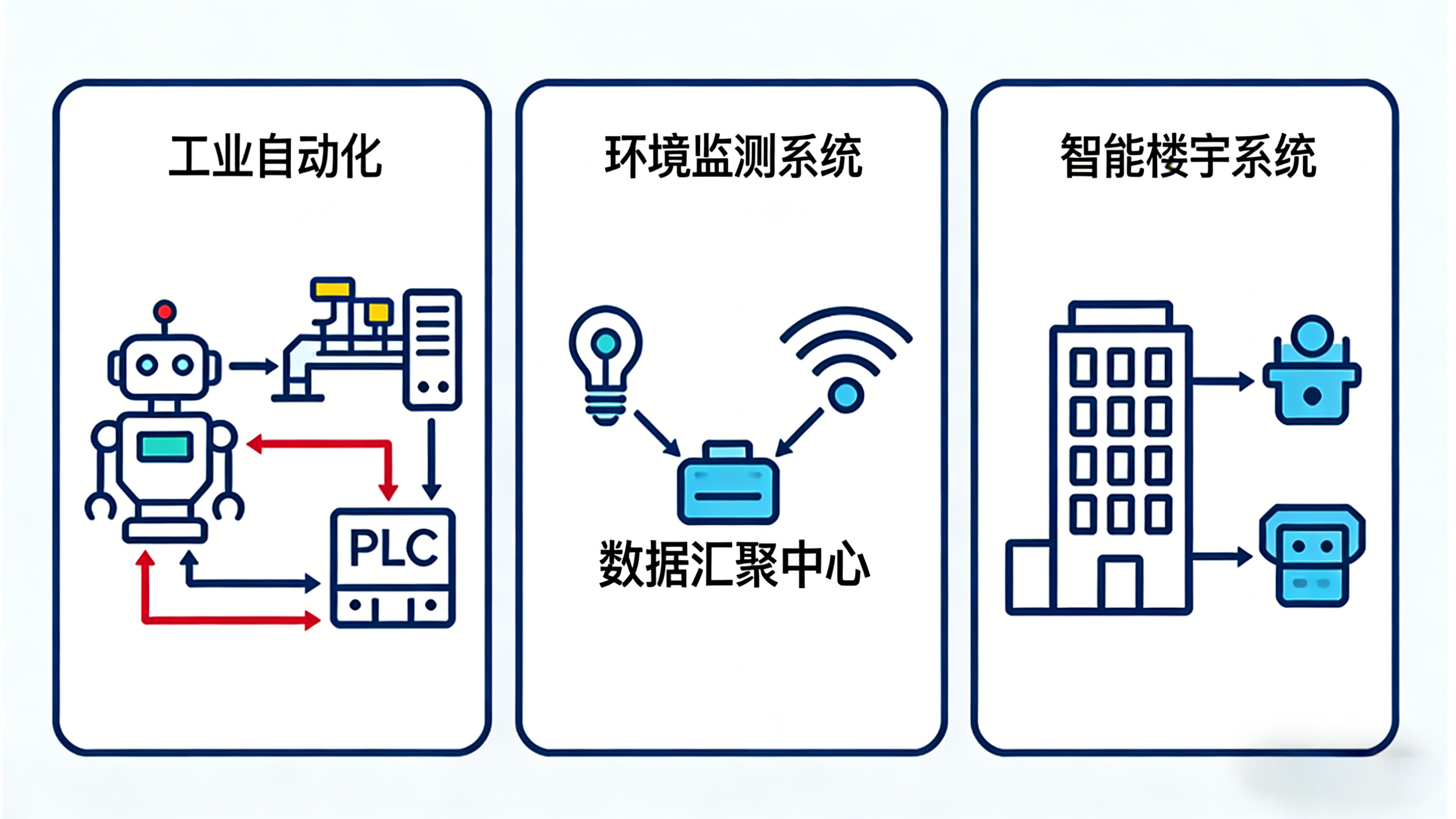
4.1 Industrial Automation Scenarios
Challenge : Factory production lines need to connect to multiple types of equipment such as PLCs, sensors, actuators, and HMIs, with high real-time requirements .
Solution :
The five serial ports are connected to: a barcode scanner (high-speed port), a temperature sensor, a pressure sensor, a motor controller, and a local display terminal.
Uploaded to the system in real time via Ethernet
The hardware protocol stack ensures real-time response to control commands.
4.2 Environmental Monitoring System
Challenge : Distributed monitoring points need to connect to multiple environmental sensors, resulting in complex wiring.
Solution :
Multiple sensors can be accessed locally and aggregated through a single chip.
It can be paired with 4G and Wi-Fi modules for wireless backhaul, or transmitted directly via wired Ethernet, significantly reducing on-site cabling.
Reconnection and data caching ensure data integrity
4.3 Intelligent Building System
Challenge : A unified network management
solution is needed for multiple subsystems (security, fire protection, air conditioning, lighting) .
Supports multiple protocols and is compatible with different communication standards of various subsystems.
High reliability design to meet building automation requirements
Network security management to prevent unauthorized access
5. Analysis of economic benefits and time advantages
5.1 Cost Structure Optimization
Direct cost reduction:
The number of chips was reduced from 3-4 to 1.
External components reduced by more than 60%
Reduced surface mount and assembly costs
Indirect cost savings:
Development cycle shortened by 50%-70%
Test verification time significantly reduced
Reduced maintenance and upgrade costs
Simplified inventory management
5.2 Productization Acceleration Benefits
Faster market response speed, seizing market opportunities
Additional revenue window from early listing
Rapid iteration capability, continuously optimizing product competitiveness
Reduce project risks and increase success rate
6. Future Outlook and Technological Trends
6.1 The trend of integration continues to deepen
With advancements in semiconductor technology, future chips will integrate even more functions:
Integration of wireless connectivity features (Wi-Fi, Bluetooth)
More advanced security features integration
The addition of AI inference accelerators
High optimization of power management
6.2 Enhanced Edge Computing Capabilities
The next generation of chips will enhance edge computing capabilities on top of network connectivity:
Local data preprocessing and analysis
Real-time decision-making capability
Cloud-based collaborative optimization
6.3 Improved ecosystem
Build a more complete ecosystem around core chips:
More diverse industry application solutions
Deep integration of cloud platform
Continuous optimization of the development toolchain
Community support and technology sharing
7: Project schedule and delivery guarantee
Comprehensive technical support:
Provides high-quality examples of Modbus_TCP and other communication protocols .
Professional technical team provides full technical support
Comprehensive technical documentation and design guidelines
Stable supply chain guarantee:
Complete documentation and stable supply
Strict quality control system
Timely technology updates and iteration support
Information link for W55MH32: https://www.w5500.com/w55mh32.html
Conclusion: Ushering in a New Era of Embedded Networking
The emergence of the W55MH32 chip not only solves the specific technical challenges of serial-to-Ethernet development, but also represents a profound transformation in embedded system design philosophy. From fragmented component integration to highly integrated SoCs, from complex software debugging to hardware acceleration, from lengthy development cycles to rapid productization paths—this shift is redefining the possibilities of networking embedded devices.
For businesses, choosing the W55MH32 is not just choosing a chip, but also choosing an efficient, reliable, and economical path to device intelligence. In today's increasingly competitive Internet of Things (IoT) landscape, this choice can determine the market fate of a product and even a company.
When technical barriers are lowered and development efficiency is improved, innovation will no longer be limited by implementation difficulty, but will return to its essence of solving practical problems and creating user value. The W55MH32 and the highly integrated solutions it represents are opening the door to the world of smart IoT for more developers, enabling ideas to be implemented faster and value to be realized more quickly.
————————————————
Copyright Notice: This article is an original work by CSDN blogger "Playing with Ethernet" and is licensed under CC 4.0 BY-SA. Please include the original source link and this statement when reprinting.
Original Link: https://blog.csdn.net/2301_81684513/article/details/156390438