


Sensy One E1 Pro Multi Sense
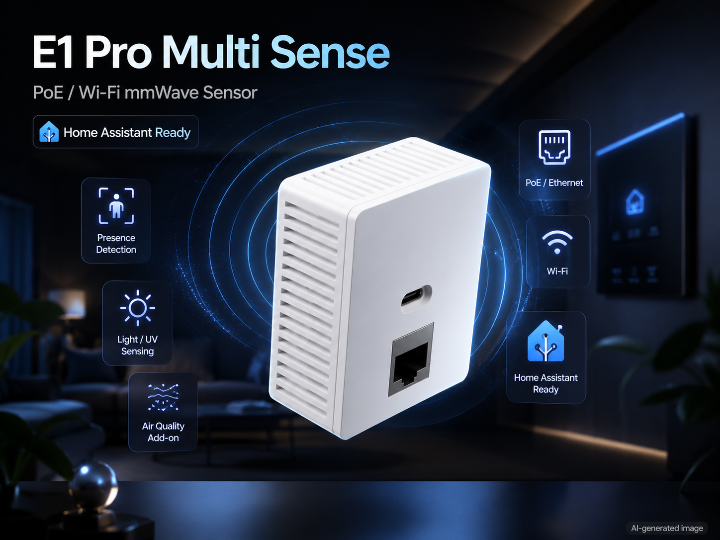
A PoE/Wi-Fi mmWave presence sensor for Home Assistant, supporting presence detection, light/UV sensing, air-quality add-ons, and local automation.
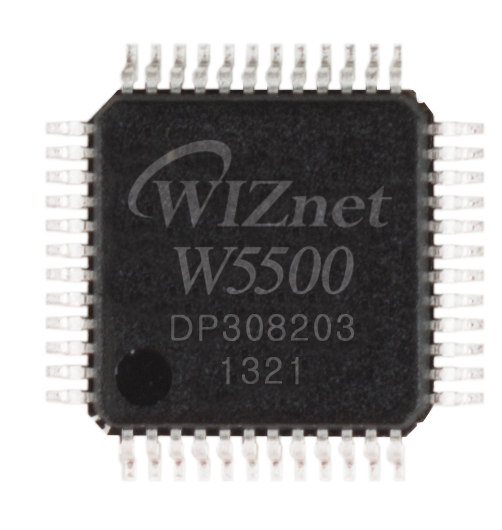
WIZnet - W5500
x 1

Sensy-One E1 Pro Multi Sense — PoE/Wi-Fi mmWave Presence Sensor for Home Assistant
Recommended Components
- WIZnet W5500
- ESP32-C3 / ESP32 Series
- PoE / Ethernet
- USB-C
- Hi-Link LD2460 mmWave Radar
- Bosch BME280
- Lite-On LTR-390UV
- Sensirion SCD40 CO₂ Add-on
- Bosch BME688 Air Quality Add-on
- RGB LEDs
- Piezo Buzzer
- ESPHome
- Home Assistant
📌 Overview
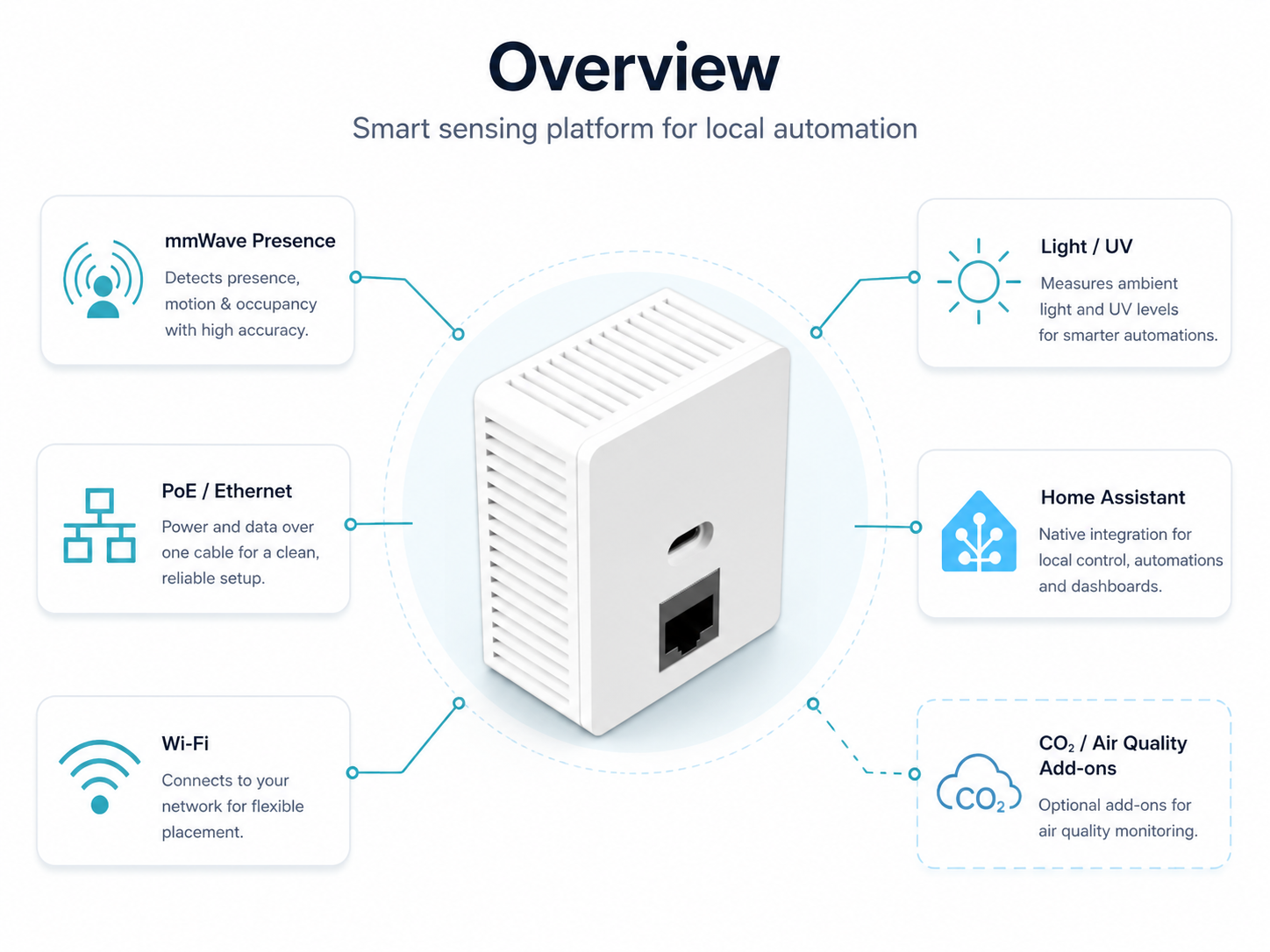
Sensy-One E1 Pro Multi Sense is a PoE/Wi-Fi mmWave presence sensor designed for Home Assistant users. While a typical motion sensor focuses on detecting whether movement occurred, the E1 Pro uses mmWave radar to understand whether a person is present in a room, where they are located, and how they are moving.
This product is not just a single-purpose presence sensor. It is closer to a smart home sensing platform that combines mmWave radar, light/UV sensing, air-pressure sensing, optional CO₂ or air-quality add-ons, RGB LEDs, a buzzer, Home Assistant integration, ESPHome-based firmware, OTA updates, a zone editor, and wall/ceiling mounting accessories.
The E1 Pro is designed around PoE/Ethernet as a stable connectivity option, while also allowing Wi-Fi operation through Wi-Fi firmware. In other words, it can use Ethernet/PoE for reliable fixed installations, while still supporting Wi-Fi where wiring is difficult.
📌 Company / Brand Context
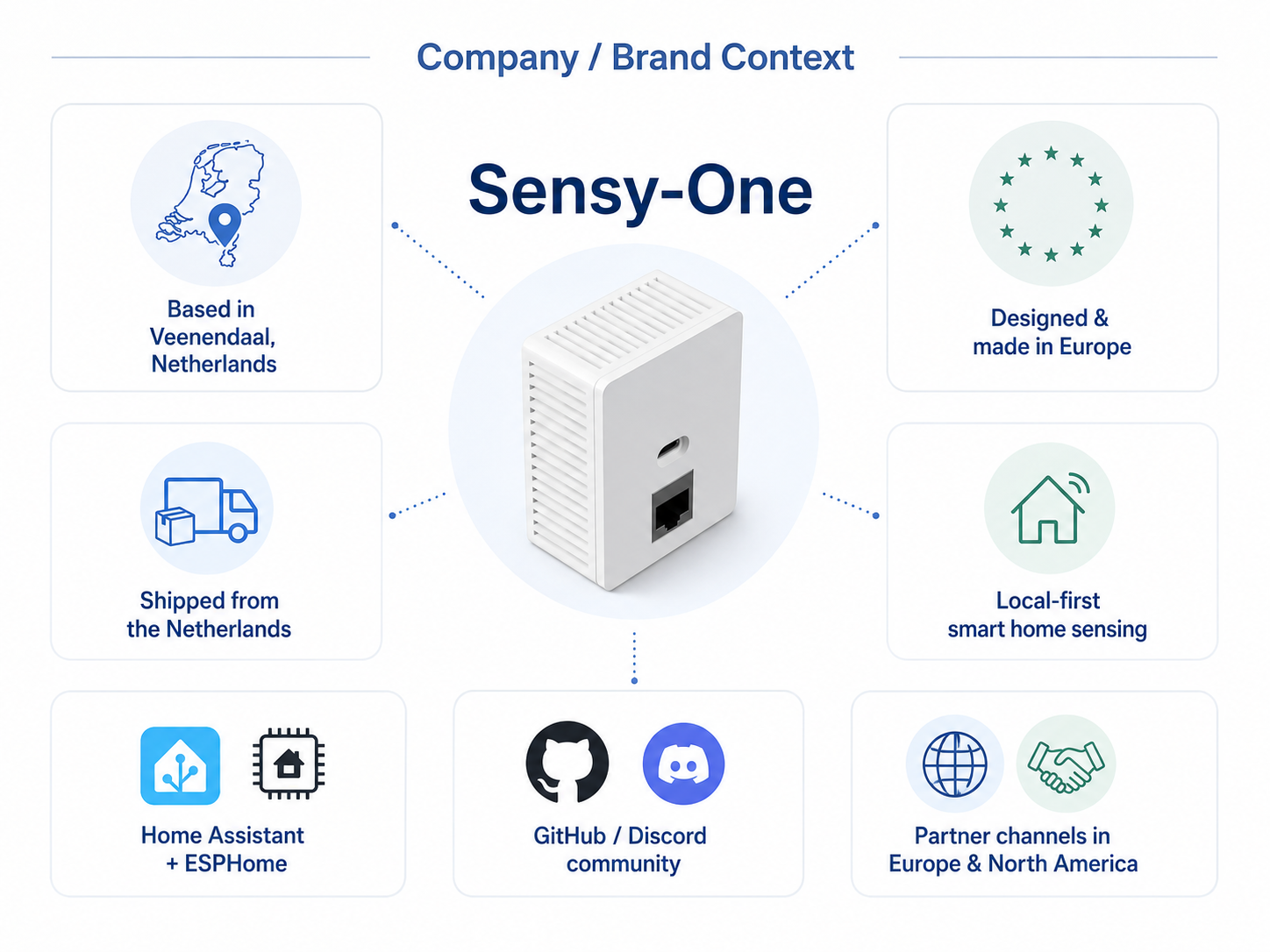
Sensy-One is a smart home sensing hardware brand based in Veenendaal, the Netherlands. According to its official website, the products are designed and manufactured in Europe and shipped from the Netherlands.
The company’s direction is fairly clear. Rather than simply selling standalone sensors, Sensy-One is building a Home Assistant-oriented local smart home sensing ecosystem.
- The Sensy-One ecosystem includes:
- mmWave presence sensor products
- air-quality sensor products
- CO₂ / BME688 expansion sensor modules
- PoE / Wi-Fi connectivity options
- Home Assistant auto-discovery
- ESPHome-based firmware
- Home Assistant add-ons / Zone Editor
- wall and ceiling mounting accessories
- OTA firmware updates
- GitHub issue and Discord community support
- partner sales channels in Europe and North America
From this structure, Sensy-One can be understood as a European smart home sensing hardware brand focused on local-first automation, Home Assistant friendliness, open-source firmware, and long-term stability. The product messaging also emphasizes local data processing in Home Assistant without cloud dependency or subscriptions.
📌 What is a mmWave Presence Sensor?
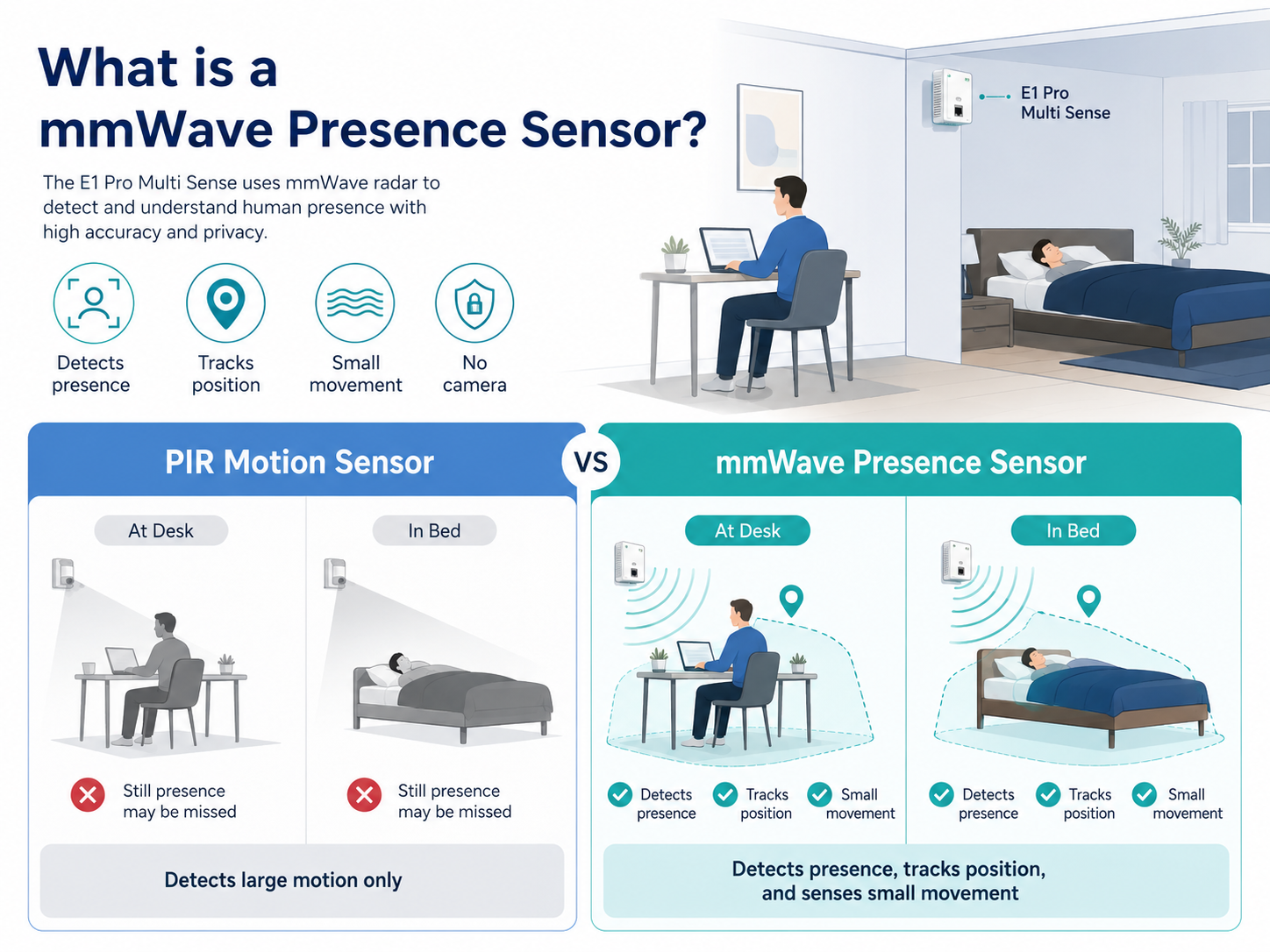
A mmWave presence sensor uses millimeter-wave radar to detect the presence of people or objects.
Traditional PIR motion sensors detect changes in infrared radiation when a person moves. Because of that, they can fail to detect someone who is sitting still at a desk or lying in bed for a long time.
A mmWave presence sensor can detect smaller movements and position information more sensitively. This makes it better at determining whether someone is still present in a space, even when they are not making large movements.
This difference is important in smart homes. It can help avoid situations where lights turn off while someone is still in the room, or where HVAC turns off while someone is quietly working at a desk. The E1 Pro connects this presence data to Home Assistant automations, making lighting, ventilation, HVAC, alerts, and security automations feel more natural.
📌 Product Specifications
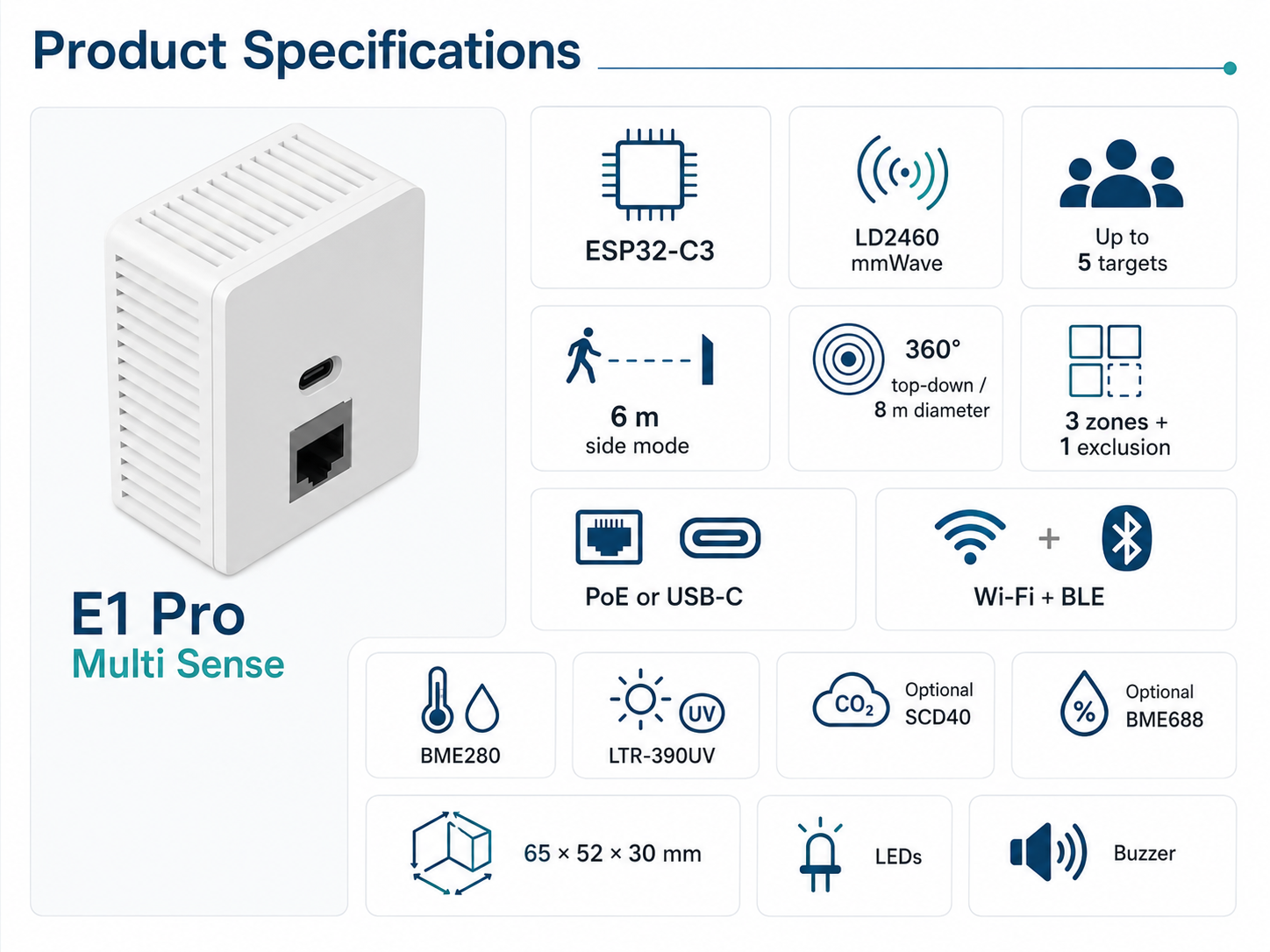
The E1 Pro Multi Sense is a compact sensor designed for fixed smart home installation.
- Processing & Connectivity
Based on the product page and the official GitHub README, the E1 Pro is described as being based on the ESP32-C3. The ESP32-C3 includes a 32-bit RISC-V single-core processor, and the product description highlights 2.4 GHz Wi-Fi, Bluetooth Low Energy, Ethernet, PoE or USB-C power, and compatibility with ESPHome and Home Assistant. - Presence Radar
The E1 Pro uses the Hi-Link LD2460 mmWave radar module. It is described as detecting presence, position, distance, and movement in real time, with support for tracking up to five targets simultaneously. In side mode, it offers up to 6 m detection range, a 120° horizontal field of view, and a 35° vertical pitch angle. In top-down mode, it provides 360° coverage with up to an 8 m diameter. - Detection Zones
The device supports three detection zones and one exclusion zone. This allows users to define areas where automations should trigger and areas that should be ignored. The Zone Editor is available as a Home Assistant add-on or Docker image. - Environmental Sensing
The base configuration includes a Bosch BME280 for air-pressure measurement. The product description explains that temperature and humidity readings from the BME280 are disabled because of self-heating inside the enclosure. For more accurate CO₂, temperature, and humidity measurement, the optional Sensirion SCD40 add-on can be used. - Optional Air Quality Add-ons
The SCD40 add-on provides true CO₂ measurement, temperature, and humidity. The BME688 add-on is designed to extend indoor air-quality monitoring with eCO₂ estimation, VOCs, IAQ, gas resistance, temperature, humidity, and pressure. These add-ons should be understood as optional extensions. - Light & UV Sensing
The Lite-On LTR-390UV sensor measures ambient light level, lux, and UV index. This enables automations related to daylight, cloud cover, sun exposure, lighting, shading, and energy efficiency. - Feedback Components
The device includes four front-facing full-color RGB LEDs and a piezo buzzer rated around 80–90 dB at 2.7 kHz. These can be used for presence feedback, alerts, system status, and ambient lighting effects through Home Assistant automations. - Power and Installation
The E1 Pro can be powered through PoE or USB-C. With PoE, both power and network connectivity can be handled through a single Ethernet cable, which is useful for ceiling or wall-mounted installations. The enclosure is described as being optimized to reduce mmWave signal interference, improve airflow, and support passive cooling. Its size is 65 × 52 × 30 mm.
📌 What This Product Does
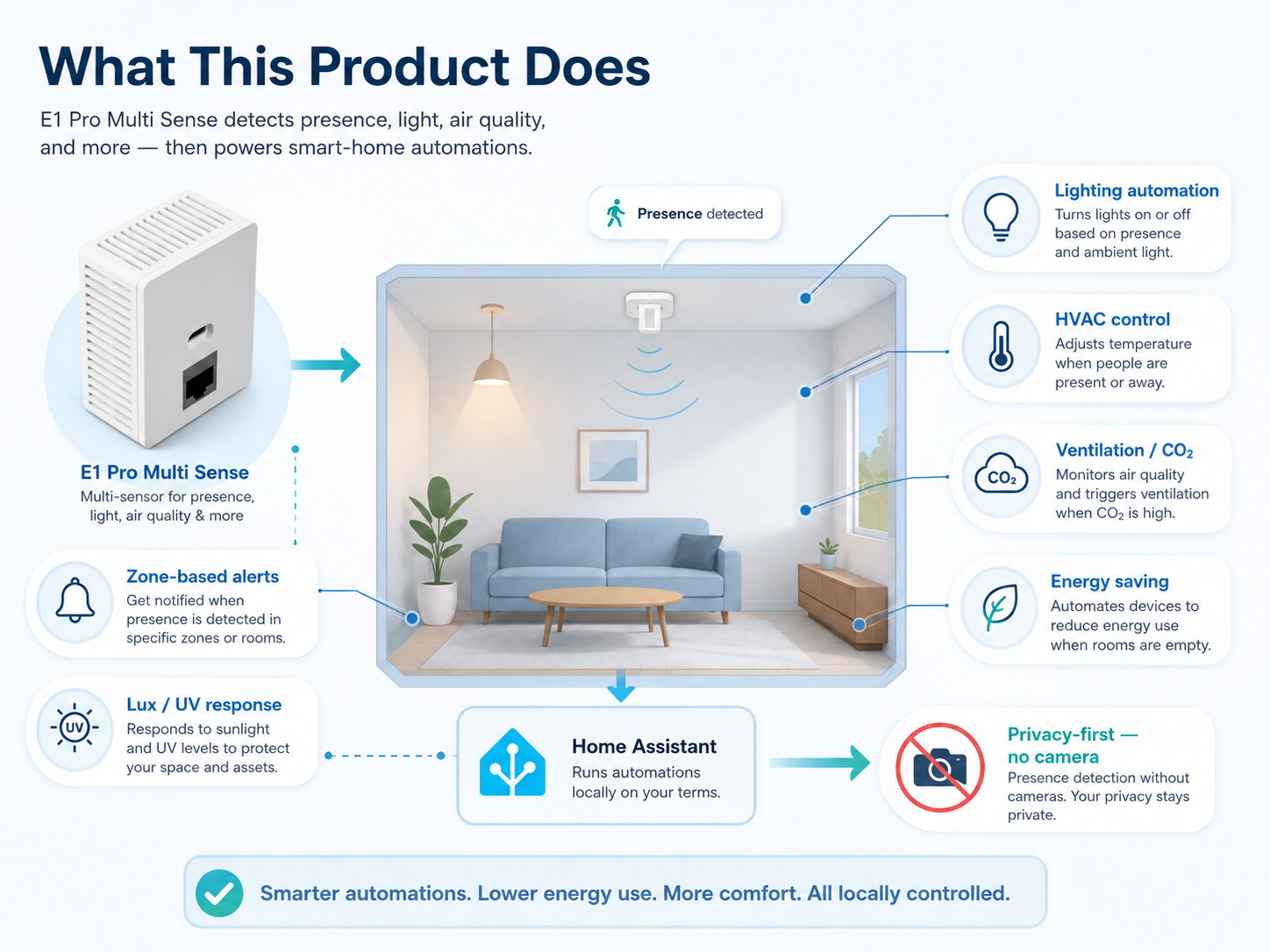
The E1 Pro Multi Sense is an advanced presence sensor for Home Assistant.
Its main role is to detect whether someone is present in a space and provide position and movement data to Home Assistant automations. This can be used for room-level lighting automation, HVAC control, ventilation control, security alerts, and energy-saving automations.
Example automations include:
- Turning on lights when someone enters a room.
- Keeping lights on while someone remains seated at a desk.
- Switching HVAC to energy-saving mode when a room is empty.
- Starting ventilation when CO₂ rises.
- Adjusting blinds or lighting based on UV or lux values.
- Triggering alerts or LED feedback when someone enters a specific zone.
- Ignoring false-trigger areas such as beds, doors, or reflective surfaces using exclusion zones.
The E1 Pro is also meaningful because it detects presence without using a camera. It uses radar-based data rather than images or video, making it suitable for privacy-sensitive smart home environments.
📌 Why Ethernet / PoE Matters
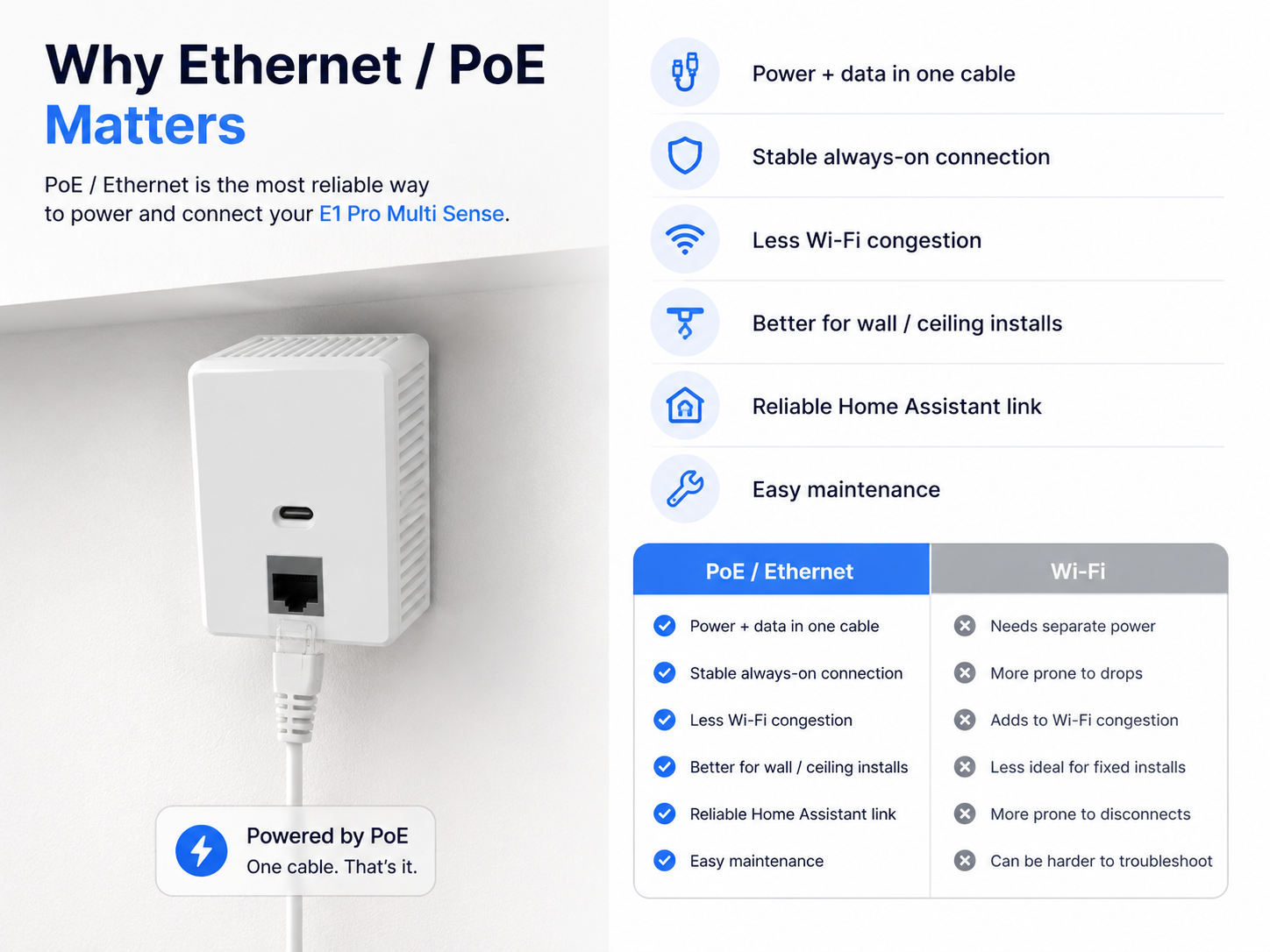
A presence sensor is an always-on device. When it is connected to lighting, HVAC, security, or ventilation automation, network reliability directly affects automation quality.
The E1 Pro is designed to send data primarily over Ethernet and can be powered through PoE or USB-C. With PoE, power and network connectivity can be handled with a single cable, which is useful for fixed ceiling or wall installations.
The advantages of a PoE/Ethernet presence sensor include:
- Less dependence on Wi-Fi congestion.
- More stable Home Assistant connectivity.
- Better suitability for fixed sensor installations.
- Simpler power and network wiring.
- Better fit for always-on sensing devices.
- Easier maintenance for ceiling or wall-mounted installations.
The E1 Pro also supports Wi-Fi, but the product positioning clearly treats Ethernet/PoE as an important connectivity option for stable fixed installation.
📌 Role and Application of the WIZnet Chip
Related WIZnet product: W5500
Based on the official GitHub configuration evidence provided by the user, the Sensy-One E1 series configuration includes ethernet: type: W5500 and SPI pin settings. Based on that configuration, the E1 series can be considered an example of a PoE presence sensor using WIZnet W5500 for Ethernet connectivity.
However, the currently accessible product page and official GitHub README directly emphasize “Ethernet / PoE support” and “ESP32-C3-based” hardware. From the product page and README alone, it is not safe to claim that every sales revision definitely includes W5500. Therefore, in this curation, W5500 usage should be described as a configuration confirmed from public firmware settings.
In the E1 Pro, the role of the W5500 is to act as the Ethernet controller that connects a Home Assistant presence sensor to a stable wired LAN. Since a mmWave presence sensor is always on and continuously sends presence data to Home Assistant, Ethernet/PoE is a strong fit for fixed smart home installations.
📌 Network Stack Note
Based on the currently accessible product page and official GitHub README, it is difficult to definitively classify the W5500 network stack implementation used by the E1 Pro.
The product emphasizes ESPHome and Home Assistant compatibility, and supports both Ethernet/PoE and Wi-Fi firmware. The configuration evidence provided by the user includes W5500 Ethernet settings, but the public README alone does not clearly show whether the W5500 is used through a TOE/socket-library approach, ESPHome’s Ethernet component, or another abstraction layer.
The safest technical description is:
Public configuration evidence indicates a W5500 Ethernet configuration, but the currently accessible product page and README are not enough to confirm direct TOE/socket-library usage. The W5500 usage and network-stack classification would be clearer with firmware YAML, build configuration, BOM, or hardware revision confirmation.
📌 Hybrid Network Status
The E1 Pro Multi Sense can be considered Hybrid Network-ready from a WIZnet perspective.
The product provides PoE/Ethernet as a stable primary connectivity option and also supports Wi-Fi installation through Wi-Fi firmware. In addition, BLE proxy functionality can bridge nearby BLE devices into Home Assistant.
This does not mean the product is an Ethernet-to-Wi-Fi bridge or router. A more accurate description is that it is a multi-connectivity smart home sensor that can use wired Ethernet or wireless Wi-Fi depending on the installation environment, while also supporting BLE proxy functionality.
📌 Company Ecosystem and Product Line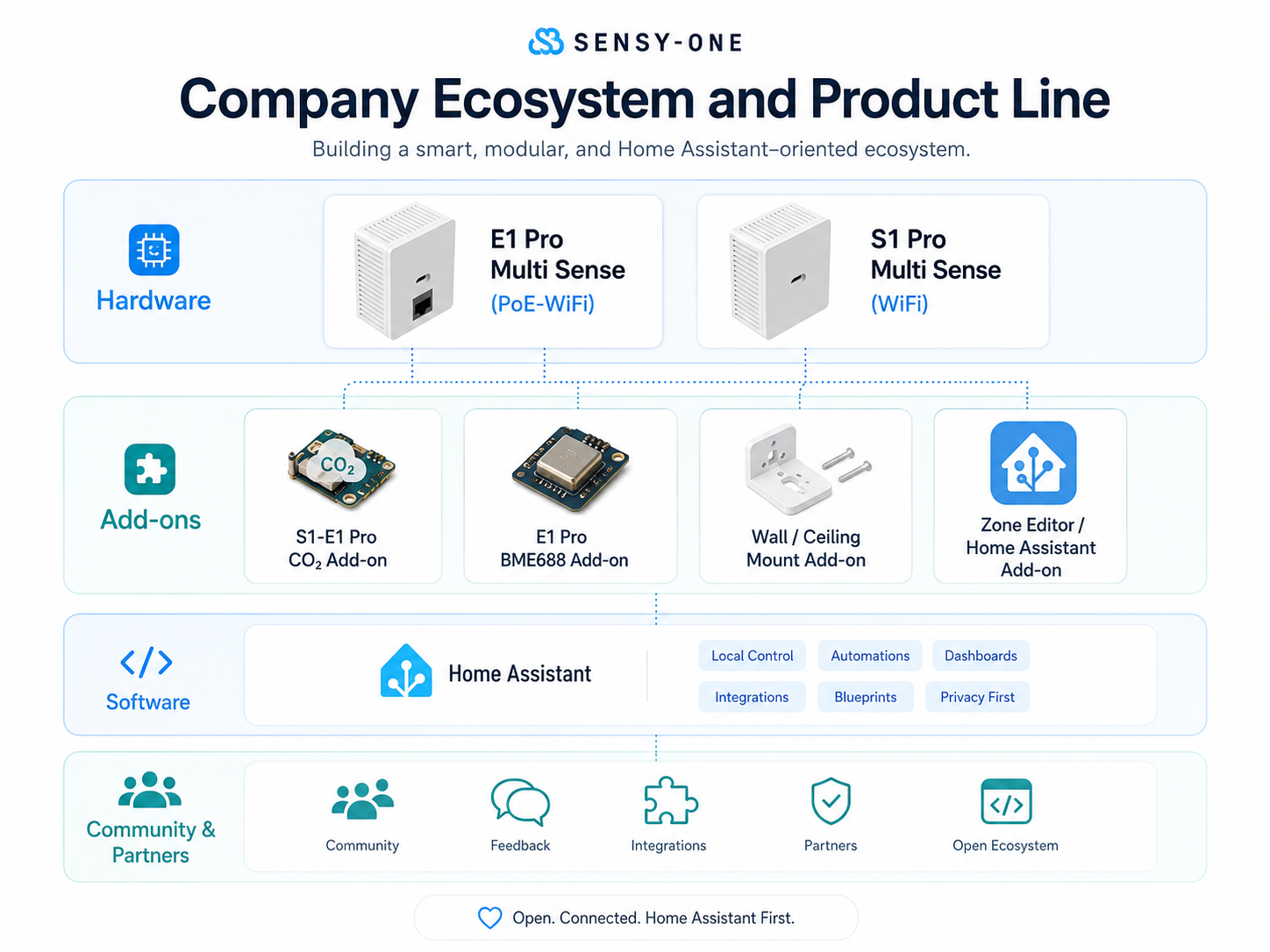
Sensy-One is not only selling the E1 Pro as a single device. It is building a sensor ecosystem for Home Assistant users.
Based on the official site, the product line includes presence sensors, air-quality sensors, add-ons, mounting accessories, and regional partner channels. The currently visible ecosystem includes:
- E1 Pro Multi Sense (PoE-WiFi): a PoE/Ethernet-oriented mmWave presence sensor
- S1 Pro Multi Sense (WiFi): a Wi-Fi-based presence sensor
- S1-E1 Pro CO₂ Add-on: an SCD40-based CO₂ expansion module
- E1 Pro BME688 Add-on: an air-quality expansion module for VOC, IAQ, and gas-resistance sensing
- Wall / Ceiling Mount Add-on: accessories for flush wall or ceiling installation
- Home Assistant Add-on / Zone Editor: a software ecosystem for visual presence-zone setup and analysis
The sales ecosystem is not limited to direct sales. The official site lists partner channels for the Netherlands & Europe, the United States & Canada, and France & Europe. Orders are described as being shipped from the Netherlands.
This makes Sensy-One look like a European smart home sensing hardware brand that combines hardware, firmware, add-on modules, mounting accessories, software tools, and community support around the Home Assistant ecosystem.
📌 Features
mmWave presence detection
The E1 Pro uses the Hi-Link LD2460 mmWave radar to detect presence, position, distance, and movement. It is described as supporting tracking for up to five targets.
Wall / ceiling detection modes
The device supports side mode and top-down mode for both wall-mounted and ceiling-mounted installation.
Detection zones and exclusion zone
Users can configure three detection zones and one exclusion zone to separate automation areas from ignored areas.
Home Assistant integration
The product is designed around Home Assistant and ESPHome. In Ethernet mode, it supports Home Assistant auto-discovery. In Wi-Fi mode, it supports setup through BLE Improv or a built-in access point.
PoE / Ethernet-oriented connectivity
The device supports PoE or USB-C power, with Ethernet as an important data path for stable fixed installation.
Wi-Fi firmware option
By flashing Wi-Fi firmware, users can deploy the device in Wi-Fi mode. Wi-Fi provisioning can be done through Bluetooth Improv or the built-in access point.
BLE Proxy
The BLE proxy feature can be used with BLE-based presence and proximity solutions.
Environmental sensing
The base device provides air pressure and light/UV sensing, while SCD40 or BME688 add-ons can expand the device with CO₂ and air-quality sensing.
LED and buzzer feedback
Four front-facing RGB LEDs and a built-in buzzer can provide presence, alert, and system status feedback.
Local-first privacy
The product performs radar-based presence sensing without a camera and emphasizes local data processing through Home Assistant.
📌 System Architecture
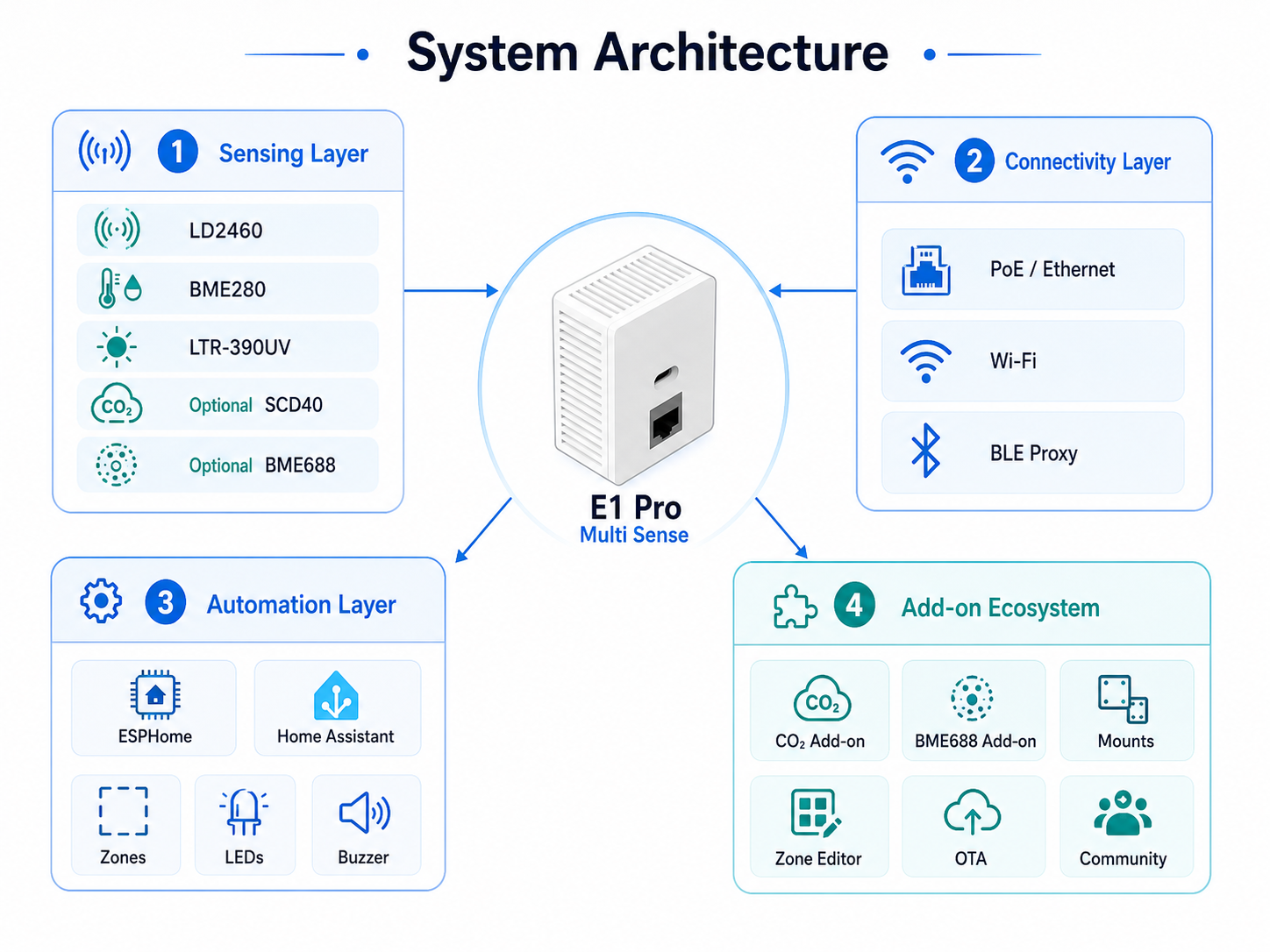
The E1 Pro can be understood through four layers: sensing layer, connectivity layer, automation layer, and add-on ecosystem.
In the sensing layer, the LD2460 mmWave radar provides presence and position data, while BME280, LTR-390UV, optional SCD40, or optional BME688 provide environmental data.
In the connectivity layer, PoE/Ethernet is used as the stable path for fixed installation. If needed, users can flash Wi-Fi firmware and use Wi-Fi mode. BLE proxy connects nearby BLE devices to Home Assistant.
In the automation layer, Home Assistant and ESPHome are the center. Users can connect presence, zone, light, air-quality, buzzer, and LED states to Home Assistant automations.
In the add-on ecosystem, the product is extended by CO₂ add-ons, BME688 air-quality add-ons, wall/ceiling mounts, Zone Editor, firmware updates, GitHub issues, and Discord community support.
📌 Usage, Market, and Application Value
The E1 Pro is suitable for smart home users who want reliable room-level presence detection.
Main use cases include:
- Home Assistant-based lighting automation
- Room-level presence detection
- HVAC / ventilation automation
- Occupancy-based energy saving
- Smart security alerts
- Presence sensing in bedrooms, living rooms, offices, bathrooms, and hallways
- CO₂-based ventilation control
- Indoor air-quality monitoring
- BLE tag or wearable-based room-level presence
- PoE-based ceiling or wall-mounted installation
From a market perspective, it is suitable for DIY smart home users, Home Assistant users, ESPHome users, privacy-conscious users who prefer local automation, and smart home installers looking for reliable PoE sensors.
The product’s camera-free presence sensing is also important. It allows occupancy and movement-based automation without video capture or cloud image analysis, which is attractive in privacy-sensitive smart home environments.
📌 Additional Insight for W5500 / WIZnet
The E1 Pro is meaningful from a WIZnet perspective because it shows the value of Ethernet in the smart home PoE sensor market.
Many smart home sensors have evolved around wireless technologies such as Wi-Fi, Zigbee, and Thread. However, a mmWave presence sensor is always on, continuously sends data, and is often installed permanently on a ceiling or wall. For this type of device, PoE/Ethernet can be an excellent option.
If W5500 is used in this product configuration, WIZnet can take several insights from it:
- W5500 can be used not only in industrial devices, but also in premium smart home sensors.
- PoE presence sensors are a strong example of reliable wired smart home infrastructure.
- The Home Assistant / ESPHome ecosystem is an important maker channel for WIZnet Ethernet products.
- A Wi-Fi and Ethernet selectable product structure fits well with a Hybrid Network-ready message.
- mmWave + Ethernet + local automation is a strong combination for the privacy-first smart home market.
📌 Summary
Sensy-One E1 Pro Multi Sense is a PoE/Wi-Fi mmWave presence sensor for Home Assistant. It detects presence and position through mmWave radar and expands environmental sensing through light/UV, air pressure, optional CO₂, and optional air-quality add-ons.
Sensy-One is a European sensing hardware brand based in Veenendaal, the Netherlands. The company describes its products as designed and manufactured in Europe and shipped from the Netherlands. Its ecosystem is built around Home Assistant, ESPHome, open-source firmware, add-ons, mounting accessories, and community support.
From a WIZnet perspective, the important point is that the public GitHub configuration provided by the user indicates a W5500 Ethernet setup. The E1 Pro provides PoE/Ethernet as a stable connectivity path and also supports Wi-Fi firmware and BLE proxy, making it a Hybrid Network-ready smart home sensor.
However, the product page and official GitHub README describe ESP32-C3-based hardware. Therefore, it is not safe to claim that every sales revision uses an ESP32-S3 + W5500 combination unless BOM, hardware revision, or firmware YAML evidence is confirmed.
📌 FAQ
Q1. What is the Sensy-One E1 Pro Multi Sense?
It is a mmWave presence sensor and environmental sensor for Home Assistant. It can detect presence, position, and movement, and it can also provide indoor environmental data.
Q2. What kind of company is Sensy-One?
Sensy-One is a European sensing hardware brand based in Veenendaal, the Netherlands. According to the official site, its products are designed and manufactured in Europe and shipped from the Netherlands.
Q3. What ecosystem is Sensy-One building?
Sensy-One is building a local smart home sensing ecosystem around Home Assistant and ESPHome, combining sensor hardware, firmware, add-on modules, mounting accessories, Zone Editor, OTA updates, and GitHub/Discord community support.
Q4. What is this product used for?
It can be used for lighting automation, HVAC control, ventilation, security alerts, energy saving, indoor air-quality monitoring, and room-level presence detection.
Q5. Which WIZnet chip is involved?
According to the configuration evidence provided by the user, the public GitHub configuration includes ethernet: type: W5500. Therefore, it can be treated as a W5500 Ethernet-based PoE sensor example.
Q6. Does every product unit include W5500?
It is not safe to claim that based only on the public product page and README. Sales revision, BOM, schematic, firmware YAML, or manufacturer confirmation would be needed.
Q7. Is it TOE/socket-library based?
The currently available public documents are not enough to confirm that. The W5500 configuration is an important signal, but the actual network stack needs to be confirmed through firmware YAML and build settings.
Q8. Is it a Hybrid Network product?
Yes, from a WIZnet perspective it can be described as Hybrid Network-ready. It uses Ethernet/PoE as a stable connectivity option and also supports Wi-Fi firmware and BLE proxy.
Q9. Why is it meaningful for WIZnet?
It shows that W5500 can also be relevant in the smart home PoE presence sensor market, especially within the Home Assistant / ESPHome ecosystem.