



GND接続機能付リモート同軸切替器 RNS216M (Naset RNS216M: A W5100S-EVB-Pico2-Based 6-Port Remote Coaxial Switch)
Naset RNS216M is a six-port HF/50 MHz coaxial switch using W5100S-EVB-Pico2 for browser-based LAN control, local switching, and automatic grounding.
Overview
Amateur-radio stations often use different antennas for different frequency bands. When several antennas share one transceiver, a coaxial switch is needed to select the active feed line.
NATEC’s RNS216M extends this traditional switching function to Ethernet. Up to six HF and 50 MHz antennas can be connected and selected either with the local rotary switch or remotely from a web browser on the LAN. No dedicated client application is required.
Another important feature is its GND connection function. Unselected antenna ports are connected to ground, and all ports automatically return to the grounded state when power is removed.
About NATEC and Naset
NATEC Co., Ltd. is an antenna and wireless-accessory manufacturer based in Kawagoe, Saitama, Japan. Since its establishment in 1990, the company has developed and manufactured amateur-radio antennas, communication antennas, measurement antennas, coaxial cables, and related RF accessories.
NATEC also provides custom and small-lot OEM manufacturing and operates its own direct online shop, SHOP ASMON.
Naset is NATEC’s newer network-oriented product brand.
NATEC describes Naset around the concept of “network × antenna,” reflecting growing demand for LAN-based remote control and antenna products designed as part of a broader networked station system.
The RNS216M is a clear example of that direction.
Traditional Antenna Accessory
          +
      LAN Control
          ↓
        Naset
Rather than remaining a purely mechanical RF accessory, the coaxial switch becomes part of a network-controlled radio station.
What Is the RNS216M?
The RNS216M is a six-port remote coaxial switch for HF and 50 MHz stations.
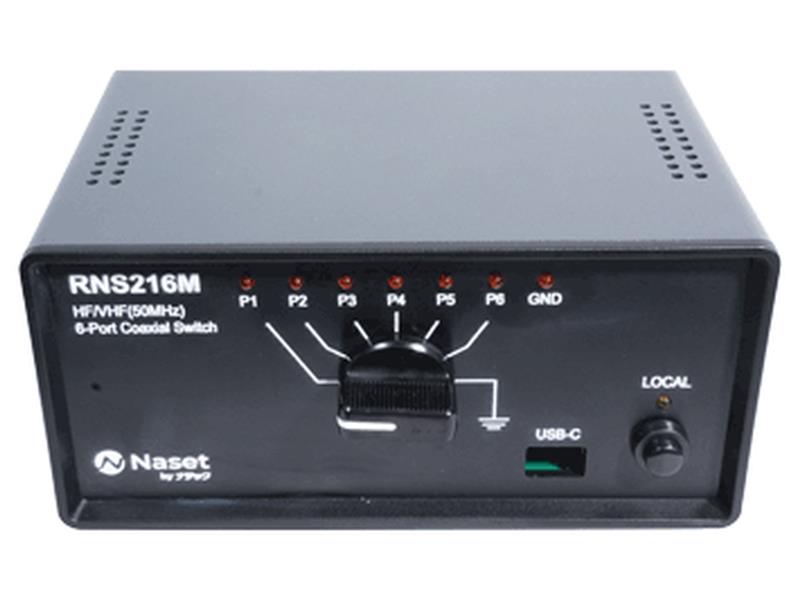
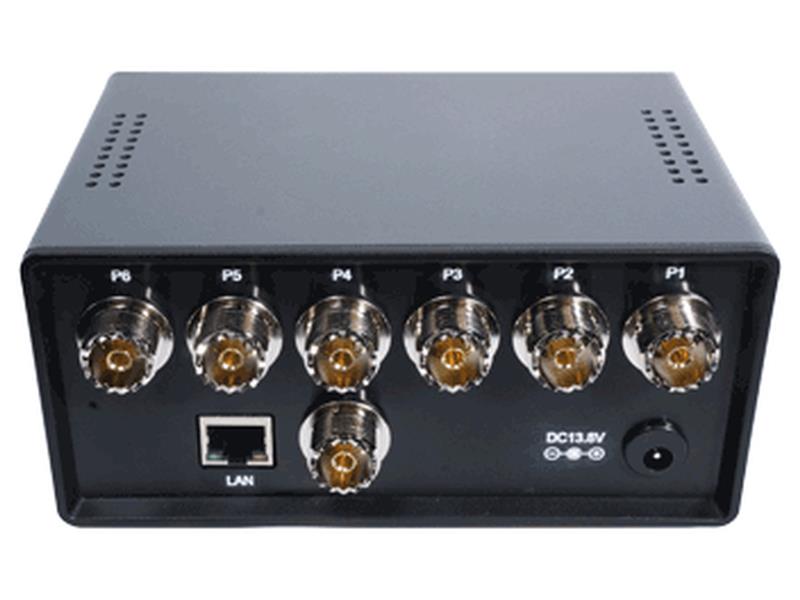
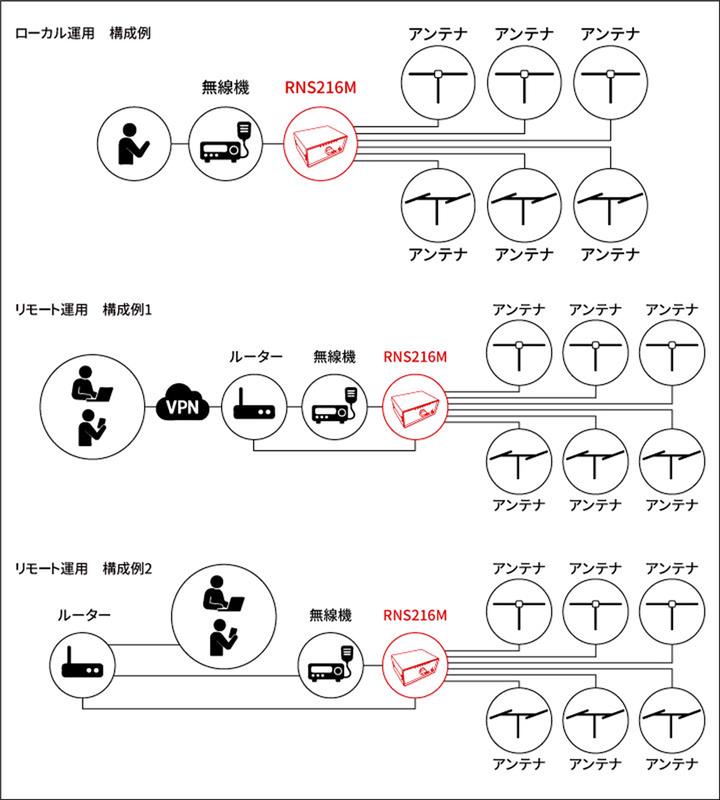
One transceiver is connected to the common RF path, while up to six antennas are connected to ports P1 through P6. The operator can then choose the active antenna using either the front-panel rotary switch or a browser over Ethernet.
Main Specifications
| Specification | Published Value |
|---|---|
| Frequency | Up to 60 MHz |
| Antenna ports | 6 |
| Impedance | 50 Ω |
| Maximum RF input | 150 W |
| Insertion loss | ≤ 0.15 dB |
| Isolation | ≥ 60 dB |
| VSWR | ≤ 1.2 |
| RF connector | M-J |
| Remote control | Web browser over Ethernet |
| Local control | Rotary switch |
| Network | DHCP / Static IPv4 |
| Local name resolution | mDNS |
| Power | USB Type-C or DC 13.8 V (8–16 V) |
| Maximum current | 250 mA |
| Size | Approx. 150 × 106 × 70 mm |
| Weight | Approx. 700 g |
The RF specifications above are manufacturer-published values.
How It Works
Web Browser
     │
     │ Ethernet / HTTP
     ▼
W5100S-EVB-Pico2
┌────────────────┐
│ W5100S         │
│ RP2350         │
└───────┬────────┘
        │
        ▼
   Relay Control
        │
 ┌──────┼──────────────┐
 ▼      ▼              ▼
P1     P2    ...       P6
        │
        ▼
 Selected Antenna
In remote mode, the user selects the required antenna port or GND state through a web browser.
DHCP can be used for automatic network configuration, while a static IP address is also supported. With DHCP enabled, the unit can be reached through the local hostname:
rns216m.local
When a static IP address is used, mDNS is disabled.
It is important to distinguish the control path from the RF path:
RF Signal
Transceiver ↔ Coaxial Relay ↔ Antenna

Control Signal
Browser ↔ Ethernet ↔ RNS216M Controller
Ethernet is used only for remote control. The actual transmitted and received RF signal remains on the coaxial path.
Why the GND Function Matters
The RNS216M connects unselected antenna ports to GND.
If power is lost, all antenna ports automatically return to the grounded state. This can be useful in unattended or remotely operated radio stations where the equipment may not always be physically accessible.
However, NATEC makes an important distinction: the GND function may help with induced surges and static electricity, but it is not a substitute for dedicated lightning protection and cannot handle the current from a direct lightning strike.
NATEC also warns users not to:
- Change antenna ports while transmitting
- Transmit while GND is selected
- Transmit through a port with no antenna connected
Switching during transmission may briefly leave the RF output open and could damage the transceiver.
Role of the W5100S-EVB-Pico2
One of the most notable aspects of the RNS216M is that NATEC does not use only a standalone Ethernet chip. The product integrates the complete WIZnet W5100S-EVB-Pico2 as its controller platform.
NATEC explicitly states that the RNS216M includes the Raspberry Pi Pico-compatible W5100S-EVB-Pico2 and that users can customize the software.
The board combines:
| Component | Role in the RNS216M |
|---|---|
| RP2350 | Browser logic, relay selection, rotary switch, LEDs |
| W5100S | Wired Ethernet interface |
| RJ45 interface | Physical LAN connection |
| RF relay section | Actual antenna signal switching |
WIZnet documents the W5100S-EVB-Pico2 as a Pico-compatible RP2350 board with integrated W5100S Ethernet. The W5100S is connected to the RP2350 over SPI and provides the wired Ethernet interface used by the application.
W5100S-EVB-Pico2 Documentation
The role of WIZnet is therefore straightforward:
The W5100S provides the wired LAN interface, while the RP2350 runs the application logic that controls the coaxial relays and browser interface.
The W5100S does not directly switch the RF signal.
Firmware and Customization
NATEC does not treat the RNS216M as a completely closed appliance.
The official download page provides firmware-related materials, including source and firmware-update files, while the product page itself highlights software customization as one of the benefits of using the W5100S-EVB-Pico2.
Firmware can be updated over USB by entering firmware-update mode and copying the appropriate UF2 file to the device.
NATEC also notes that a repaired unit may be returned with the factory-default firmware, so users who customize the software should keep their own backup.
Because redistribution and modification terms may change over time, users should check the latest official download conditions before publishing modified source or firmware files.
NATEC on X — Product News, Manufacturing, and Customer Trials
Among NATEC’s public social channels, X appears to be one of the company’s most actively used channels for product communication.
Official X: @Natec_Japan
The account is used for more than simple product-page links. NATEC shares content around:
| Content Type | Typical Content |
|---|---|
| New products | New antenna and RNS-series product announcements |
| Product trials | RNS216M and RNS112 rental information |
| Campaigns | Launch promotions and giveaways |
| Manufacturing | Antenna assembly and production work |
| Custom products | Special-purpose and custom antenna projects |
| Amateur-radio topics | Product information tied to the radio community |
The official RNS216M product page also includes a Related X (Twitter) section that links the product directly to rental and campaign posts.
This is particularly visible in the company’s 14-day rental program. Eligibility includes following the official @Natec_Japan account, making X part of the connection between product discovery, customer trials, and the amateur-radio community.
NATEC also provides product-introduction and browser-control demonstration videos from the RNS216M page, allowing users to move from a social announcement to a more detailed product demonstration.
The overall communication flow can be summarized as:
Product Announcement
       ↓
X / Radio Community
       ↓
Product Page / Demo Video
       ↓
14-Day Trial
       ↓
Direct Purchase
For a specialized amateur-radio product that may be difficult to find in ordinary retail stores, this combination of social communication, video demonstration, rental, and direct sales is particularly practical.
Sales and Product Trial
NATEC sells the RNS216M through its own direct online shop, SHOP ASMON.
At the time of review, the direct-shop price was:
¥52,800 including Japanese consumption tax
NATEC also offers a 14-day free rental program for eligible amateur-radio operators in Japan.
The rental program was introduced partly because customers reported that NATEC products are not always available for hands-on inspection at ordinary retail stores.
The program allows potential customers to test the RNS216M in their own station before deciding whether to purchase it.
RNS216M and the RNS112 Family
The W5100S-EVB-Pico2 is not used only in the RNS216M.
NATEC also uses the same WIZnet controller platform in its related RNS112S and RNS112N remote coaxial switches.
RNS112S / RNS112N Product Page
| Item | RNS216M | RNS112S / RNS112N |
|---|---|---|
| Main frequency range | HF + 50 MHz | Up to 1.3 GHz |
| Antenna ports | 6 | 2 |
| RF connector | M-J | SMA-J / N-J |
| RF power | 150 W | 50 W |
| Local operation | Rotary switch | Browser-oriented |
| Power | USB-C / DC | PoE / USB-C |
| Controller | W5100S-EVB-Pico2 | W5100S-EVB-Pico2 |
This indicates that NATEC is using the W5100S-EVB-Pico2 as a reusable network-control platform across multiple commercial RF products, rather than only in a single prototype.
Why This Product Matters
The RNS216M is a clear VAR example of a WIZnet evaluation board becoming part of a finished commercial product.
Three aspects are particularly noteworthy:
| Point | Why It Matters |
|---|---|
| Commercial integration | W5100S-EVB-Pico2 is a standard controller, not an optional module |
| Traditional RF + Ethernet | A conventional coaxial switch gains browser-based network control |
| Platform reuse | The same WIZnet board is also used in the RNS112 product family |
The Naset brand itself emphasizes “network × antenna.”
In that context, the WIZnet board is more than a way to add an RJ45 connector. It provides a common controller platform that helps NATEC extend traditional RF accessories into remotely operated network devices.
Current Status and Limitations
The RNS216M is a relatively new product introduced in 2026.
Public information currently confirms:
- RF specifications
- Browser-based control
- DHCP, static IP, and mDNS
- Local and remote operation
- Firmware downloads and customization
- GND behavior
- Direct sales
- Rental availability
- W5100S-EVB-Pico2 integration
However, the following information was not publicly established in this review:
- Cumulative units sold
- Number of installations
- Independent RF performance measurements
- Relay switching time
- Browser-control latency
- Long-term field reliability statistics
- Named large-scale customer deployments
Insertion loss, isolation, VSWR, and other RF figures should therefore be presented as manufacturer-published specifications, not independent laboratory results.
NATEC also supports the product itself but states that it does not provide configuration or troubleshooting services for a customer’s router, IP environment, DNS, or VPN infrastructure.
Related WIZnet Maker Projects
6x2 Antenna Switch IP Control
RemoteQTH’s 6x2 antenna-switch controller reads band information from two transceivers and automatically selects antennas while providing collision and hot-switching protection.
Its Ethernet control may be added through an optional network module, whereas Ethernet is built into every RNS216M through the W5100S-EVB-Pico2.
Open-Source Antenna Rotator Projects
Network-controlled antenna rotators address another part of the remote-radio workflow.
A coaxial switch determines which antenna is connected, while a rotator determines where the antenna is pointing. Together, these devices can form part of a remotely operated amateur-radio station.
Ethernet Hamlib-Based Rotator Control
Hamlib/rotctld-based Ethernet controllers focus on integration with existing station-control software.
The RNS216M takes a simpler user-interface approach: antenna selection is handled directly through a standard web browser without dedicated client software.
Conclusion
The Naset RNS216M combines a traditional six-port coaxial antenna switch with browser-based Ethernet control and automatic GND functionality.
Its key features include:
- Six selectable HF/50 MHz antenna ports
- Local rotary control
- Browser-based LAN control
- Grounding of unused ports
- Automatic GND state after power loss
- DHCP, static IP, and mDNS support
- Customizable firmware
- W5100S-EVB-Pico2 as the complete controller platform
The role of WIZnet is central to the design:
The RP2350 handles relay and application logic, while the W5100S provides the wired LAN connection that makes remote browser control possible.
The product is also significant as part of NATEC’s broader Naset “network × antenna” direction.
RNS216M demonstrates how a WIZnet evaluation board can move beyond prototyping and become the standard network-control platform inside a commercial RF product.
FAQ
Q. What is the RNS216M?
It is a remote coaxial switch that connects one transceiver to one of up to six HF/50 MHz antennas. It supports both browser-based remote control and local rotary control.
Q. Which WIZnet product is used?
NATEC officially identifies the W5100S-EVB-Pico2 as the controller installed inside the RNS216M.
Q. Does the RNS216M support PoE?
No. The RNS216M uses USB Type-C or DC power. PoE support is available on the related RNS112S/RNS112N family.
Q. What happens when power is lost?
All antenna ports automatically return to the GND state. This should not be treated as a replacement for dedicated lightning protection.
Q. Can users customize the firmware?
Yes. NATEC publishes firmware and related materials for the W5100S-EVB-Pico2-based controller. Users should check the latest official redistribution and modification terms before publishing modified files.
Source Snapshot
| Source | What It Confirms | URL |
|---|---|---|
| NATEC — RNS216M official product page | Product functions, W5100S-EVB-Pico2, RF specs, DHCP/mDNS, GND operation, video and related X content | RNS216M Official Product Page |
| NATEC — RNS216M downloads | Firmware downloads, update procedure, network-related documentation | RNS216M Downloads |
| NATEC — Naset | “Network × antenna” brand direction and LAN-based remote-control concept | Naset Brand Page |
| NATEC — Company profile | Company history, location, antenna business, and SHOP ASMON | NATEC Company Profile |
| SHOP ASMON | Direct sales and current listed price | RNS216M Direct Shop |
| NATEC — Rental program | 14-day trial, X follow requirement, and rental conditions | RNS216M Rental Program |
| NATEC Official X | Product announcements, rentals, campaigns, and manufacturing-related posts | @Natec_Japan on X |
| NATEC — RNS112S / RNS112N | Related products using the same W5100S-EVB-Pico2 control platform | RNS112 Series |
| WIZnet Documentation | W5100S-EVB-Pico2 architecture, RP2350, W5100S, SPI connection, and Ethernet features | W5100S-EVB-Pico2 Documentation |