



Ethernet P1 Dongel Pro+ (slimme meter lezer)
An ESP32-S3 + W5500 Ethernet dongle that connects P1 smart meters, water sensors, S0 pulse, and Modbus RTU data to Home Assistant/ESPHome.
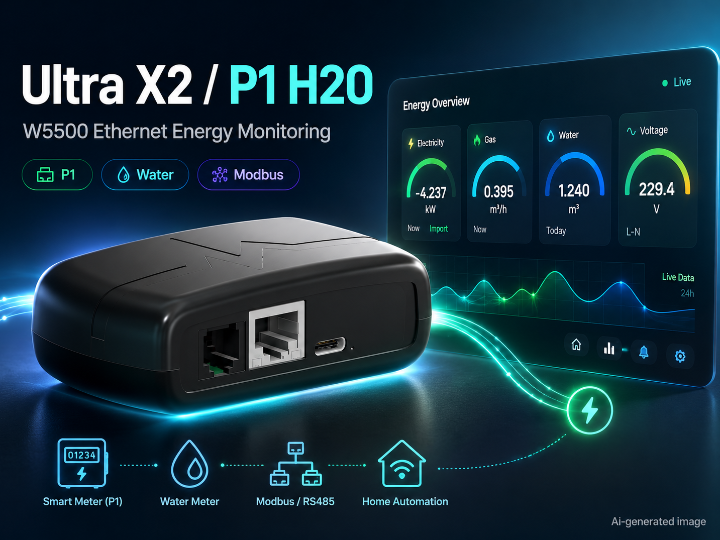
Smartstuff Ultra X2 / Ultra P1 H2O — W5500 Ethernet-Based Smart Meter, Water, and Modbus Energy Monitoring Dongle
Recommended Components
- WIZnet W5500
- ESP32-S3
- Smartstuff Ultra X2 Dongle
- Smartstuff Ultra Mini Dongle
- P1 Smart Meter Interface
- P1 Output / P1 Bridge
- Water Sensor / H2O Module
- S0 Pulse Input
- RS485 / Modbus RTU Module
- USB-C
- RGB Status LED
- ESPHome
- DSMR-API
- Home Assistant
- Domoticz / Homey / OpenHAB
📌 Overview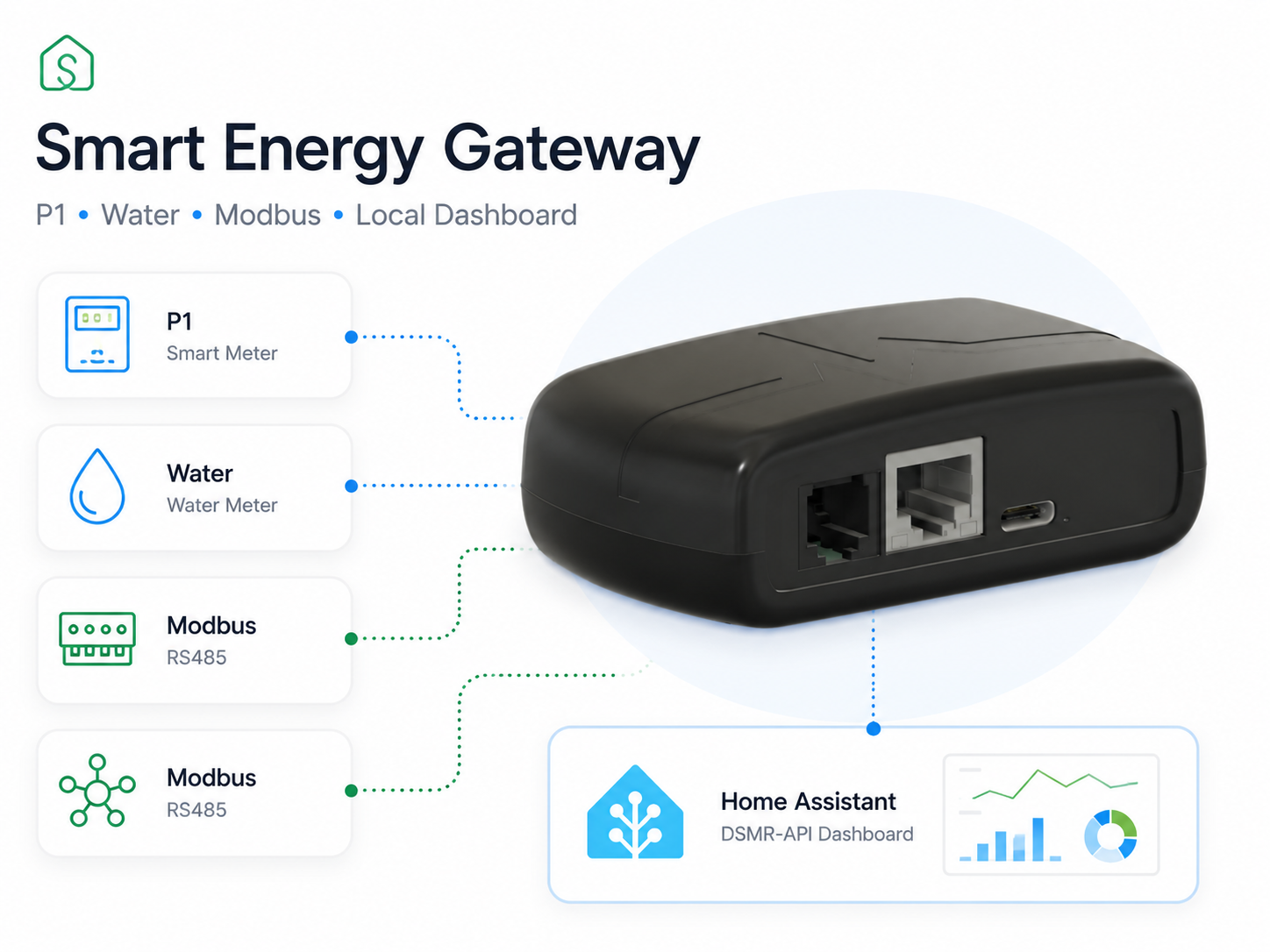
The Smartstuff Ultra X2 Dongle is a smart energy monitoring dongle designed to read P1/DSMR smart meter data commonly used in the Netherlands, Belgium, and other European smart meter environments, and connect that data to Home Assistant or DSMR-API dashboards.
The provided product URL points to Smartstuff’s Ethernet P1 Dongel Pro+ product page. This product is a plug-and-play Ethernet dongle for reading P1 smart meter data. Smartstuff’s higher-end product family, including Ultra X2 and Ultra Mini, expands this concept with Wi-Fi dual mode, RS485/Modbus RTU, water sensor/H2O, S0 pulse, extra I/O modules, and P1 output features.
The Ultra X2 is described by Smartstuff as a powerful all-rounder. It combines P1 input, P1 output, Ethernet, USB-C, RGB status LED, optional water sensor module, RS485 module, and galvanically isolated I/O module options. This makes it possible to integrate electricity, gas, water, pulse, and external meter data into one smart home system.
In simple terms, this product is a Dutch-style smart energy gateway that connects smart meter electricity/gas data, water usage, pulse meters, and Modbus RTU devices to Home Assistant, ESPHome, or DSMR-API.
📌 What is a P1 Smart Meter Dongle?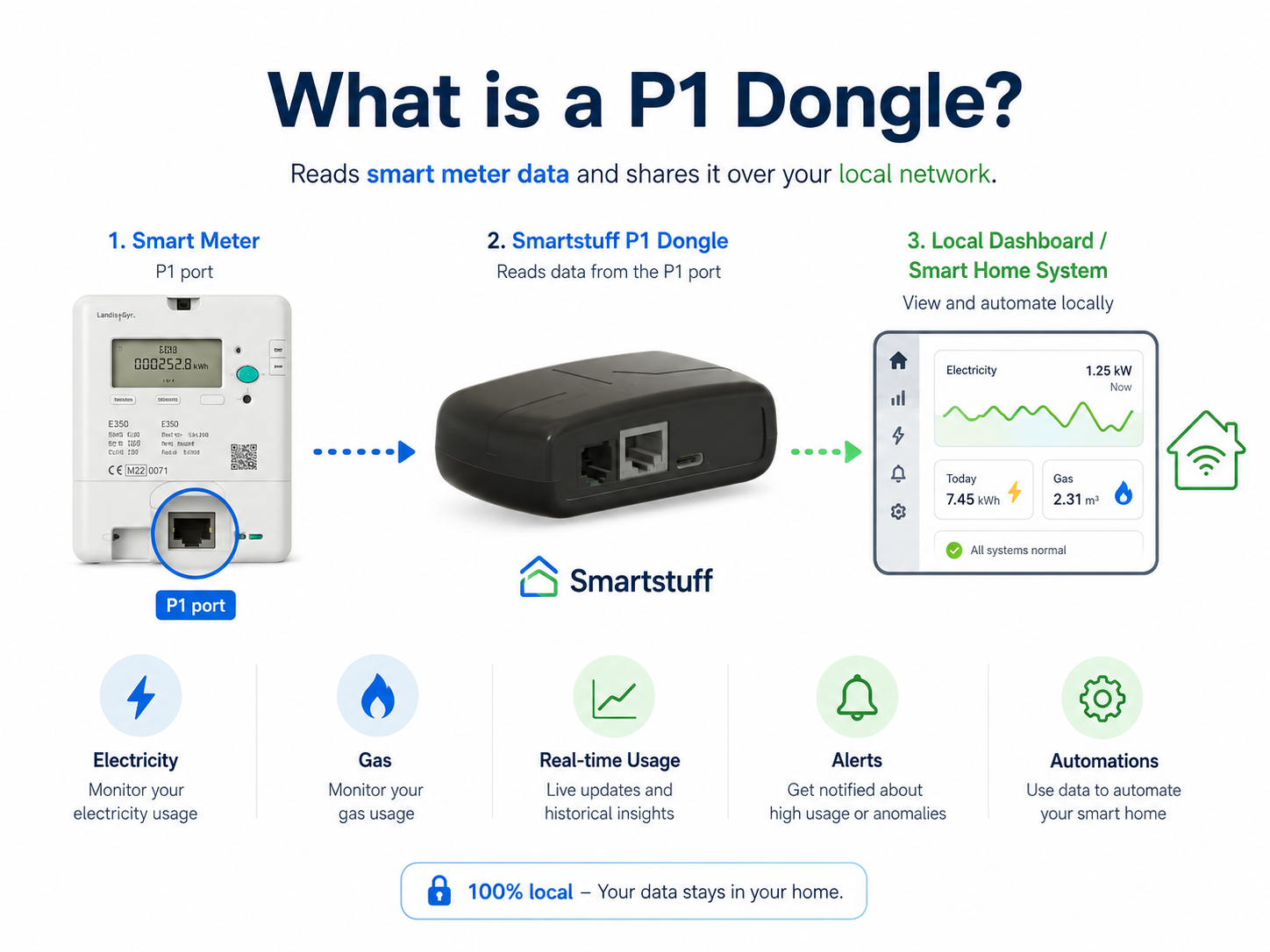
A P1 dongle is a device that connects to the P1 port of a smart meter and reads electricity and gas usage data.
Many smart meters in the Netherlands and Belgium provide data through the P1 port. This data can include electricity consumption, electricity production, voltage, current, and gas usage. By connecting a P1 dongle, users can view this data over the local network or integrate it into smart home systems such as Home Assistant.
For users, the value is straightforward:
- Monitor current power usage
- Track daily and monthly energy patterns
- Compare solar production and household consumption
- Track gas usage
- Connect smart meter data to Home Assistant automations
- Create high-usage or peak-power alerts
- Combine electricity, gas, water, S0 pulse, and Modbus data into one energy dashboard
The Smartstuff Ultra family expands the idea of a P1 dongle by supporting water, pulse counters, RS485/Modbus devices, and additional I/O modules.
📌 Company / Brand Context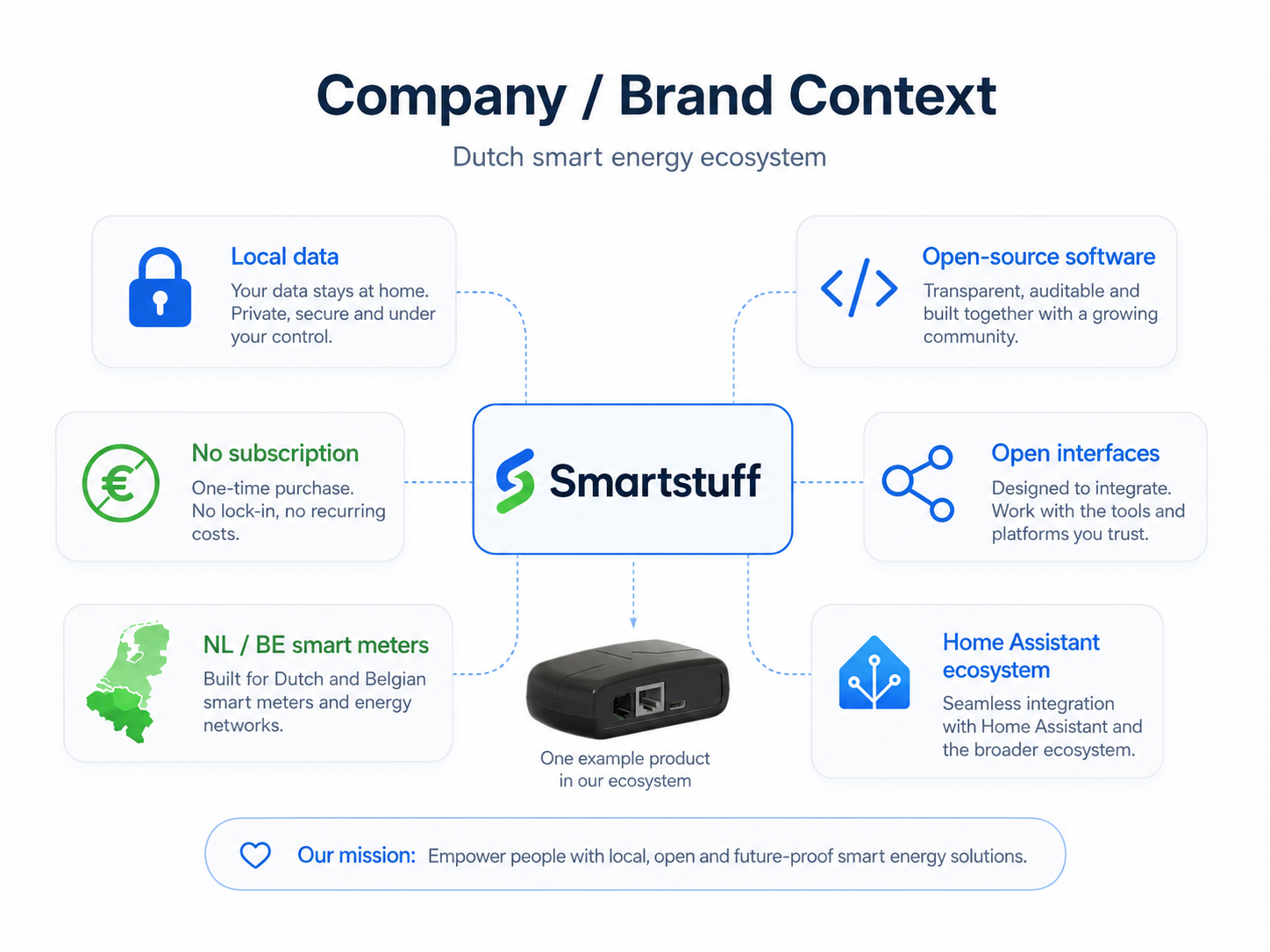
Smartstuff can be understood as a Dutch smart energy brand focused on the Netherlands and Belgium P1/DSMR smart meter ecosystem. Its official website is written in Dutch, and the product descriptions focus heavily on NL/BE smart meters and EU SMR meter support.
The product philosophy is also clearly visible in the product pages. Smartstuff emphasizes:
- Keeping users in control of their own data
- Local data ownership
- Open-source software
- No subscription fees
- Open interfaces for integration with other systems
This direction fits well with local smart home platforms such as Home Assistant, Domoticz, Homey, and OpenHAB. Smartstuff is not simply selling one smart meter reader. It is building an energy monitoring ecosystem that lets users read, store, analyze, and automate their own energy data locally.
The Smartstuff product line includes P1 smart meter dongles, Ethernet P1 dongles, P1 splitters, water reader dongles, NRG Monitor products, Ultra dongles, Ultra Mini, Modbus/P1 modules, and S0 pulse counters. These products share a common goal: making household and small-facility energy data easier to read, understand, and integrate.
📌 Product Line and Ecosystem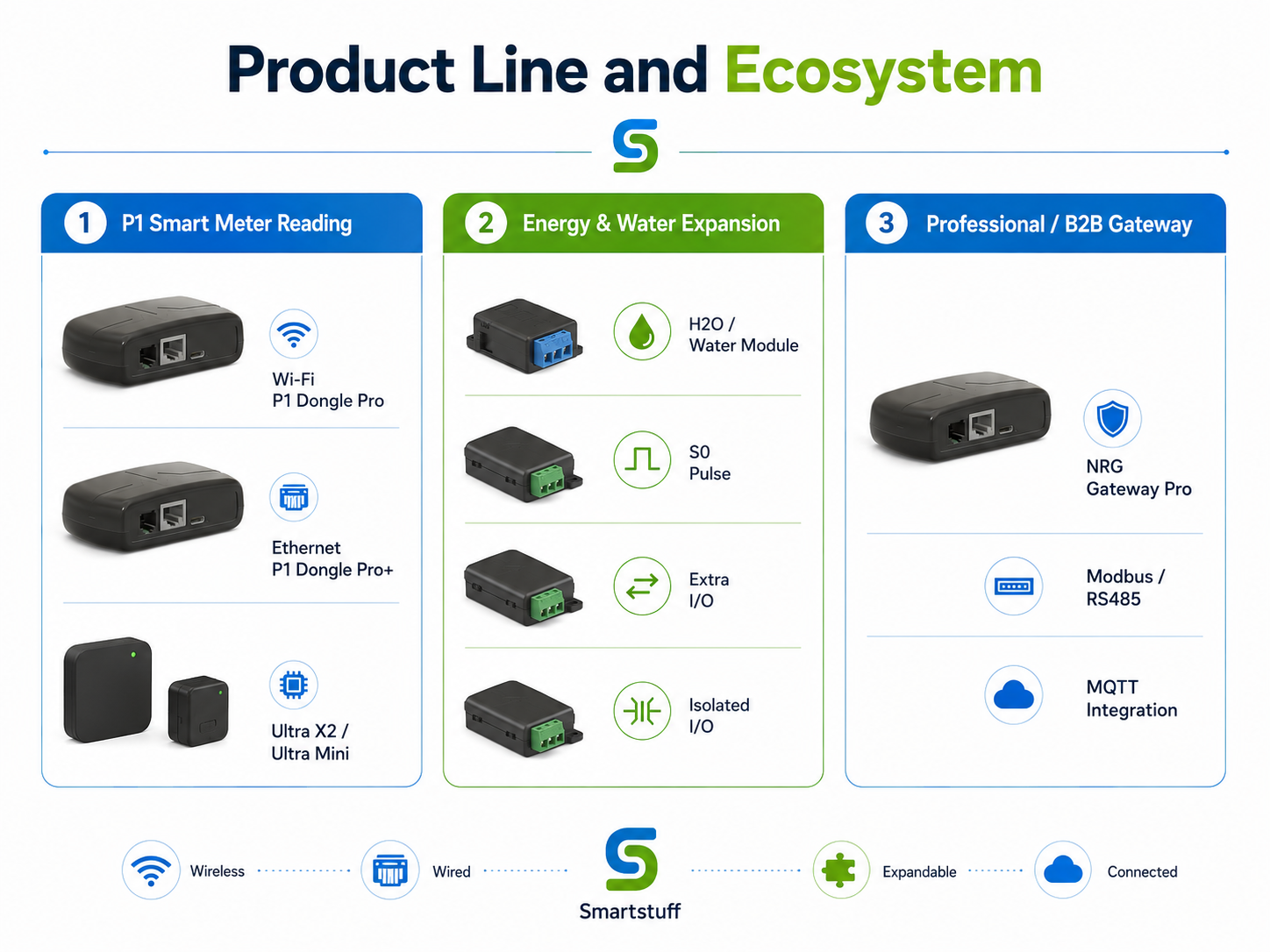
The Smartstuff ecosystem can be viewed in three main directions.
The first direction is P1 smart meter reading. Products such as the Wi-Fi P1 Dongle Pro, Ethernet P1 Dongel Pro+, Ultra X2, and Ultra Mini read smart meter P1 data and forward it to Home Assistant, DSMR-API, Domoticz, Homey, and similar systems.
The second direction is energy and water expansion. The Ultra family can add water sensor/H2O modules, S0 pulse inputs, extra I/O, and galvanically isolated I/O. This allows users to collect data beyond electricity and gas, including water meters, pulse-output devices, and external switch or I/O signals.
The third direction is professional and B2B gateway use. The Ultra Mini is positioned for professional/B2B environments, and the NRG Gateway Pro firmware option is presented for more advanced use cases such as mTLS MQTT broker integration.
Overall, the ecosystem expands from consumer smart meter monitoring into home energy dashboards, solar/consumption analysis, water metering, Modbus-based device integration, and B2B energy gateway applications.
📌 Product Specifications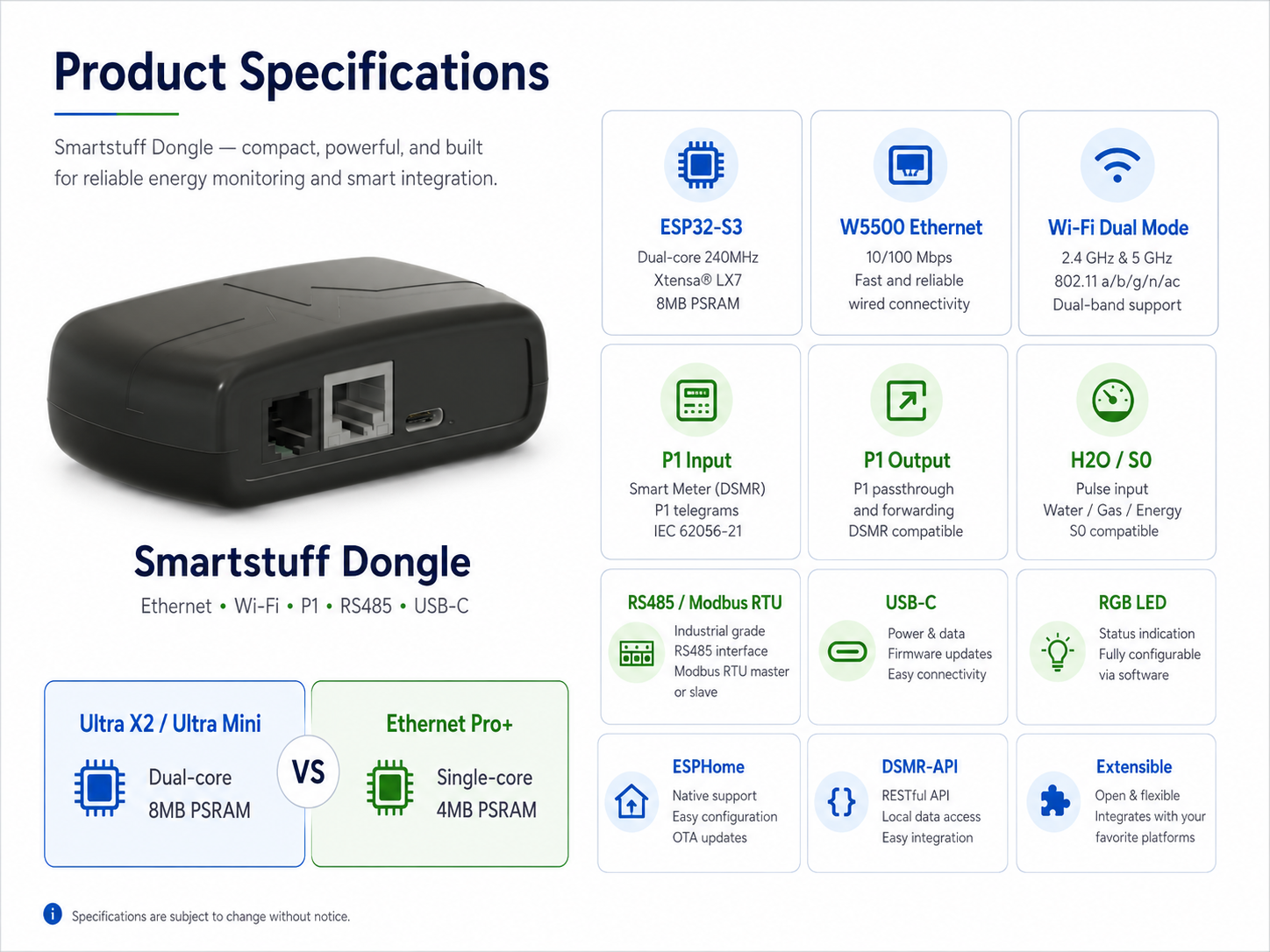
The Smartstuff Ultra X2 / Ultra Mini family is more expandable than the Ethernet P1 Dongel Pro+.
- Processor and Memory
The Ultra X2 and Ultra Mini are described as ESP32-S3 dual-core devices with 8MB memory. In the product comparison, the Ethernet Pro+ is listed as an ESP32-C3 single-core / 4MB device, while the Ultra Mini and Ultra X2 use ESP32-S3 dual-core / 8MB hardware. - Ethernet and Wi-Fi Dual Mode
The Ultra family supports Ethernet and Wi-Fi dual mode. The Ultra Mini description explains that when no Ethernet cable is connected, the device starts in Wi-Fi mode. When an Ethernet cable is connected, it uses the cable network and stops the Wi-Fi connection. From a WIZnet perspective, this makes it a Hybrid Network-ready design. - P1 Input and P1 Output
The device reads smart meter data through P1 input and also provides P1 output so another P1 device can remain connected. The Ultra X2 describes its P1 output as demand-based, bridged, and amplified. - Water / H2O and S0 Pulse
The Ultra X2 can use an H2O/S0 module to connect a water meter sensor or S0 input. The Ultra P1 H2O ESPHome configuration also shows a setup where P1 smart meter data and water sensor pulses are handled together. - RS485 / Modbus RTU
An RS485 module can be used to connect Modbus RTU devices. Depending on the module combination, the Ultra X2 can support up to two RS485/Modbus RTU functions. - Extra I/O and Isolated I/O
The Ultra X2 can be expanded with extra I/O and galvanically isolated input/output modules. This allows the device to go beyond a simple meter reader and connect to different external devices. - Firmware Options
The Smartstuff Ultra family supports firmware options such as ESPHome, DSMR-API, and NRG Gateway Pro. ESPHome is suitable for Home Assistant integration, while DSMR-API is suitable for standalone web dashboards and local data storage.
📌 What This Product Does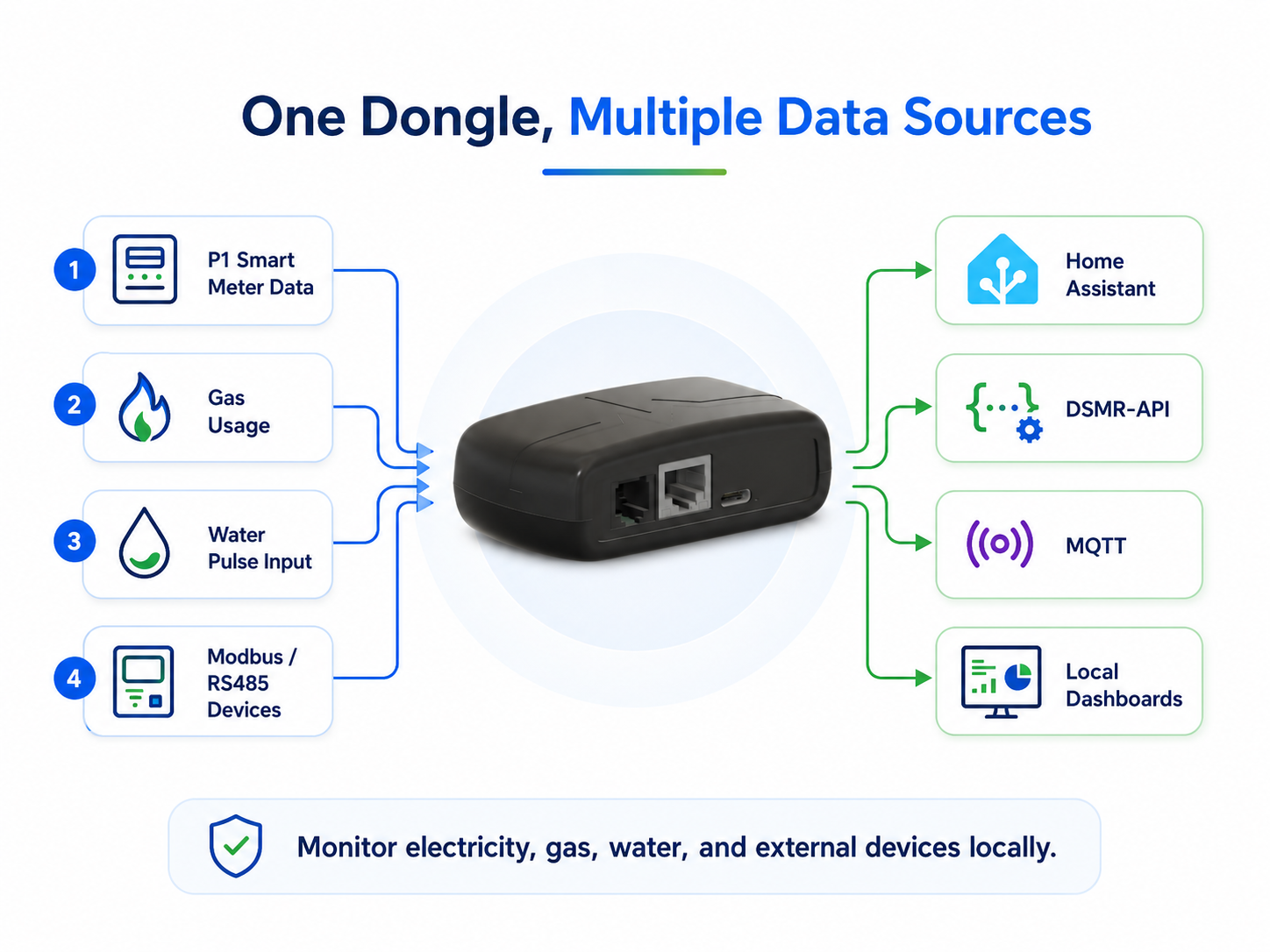
The Smartstuff Ultra family collects several types of energy and metering data and brings them into Home Assistant or a local dashboard.
The basic function is reading P1 smart meter data. It can read electricity consumption, electricity production, gas usage, voltage, current, and real-time power data from the smart meter and forward them to Home Assistant or DSMR-API.
In the Ultra P1 H2O configuration, the device can also read water meter pulses. This allows users to monitor electricity, gas, and water consumption together in Home Assistant.
With an RS485 module, Modbus RTU devices can also be connected. Possible devices include inverters, energy meters, external meters, or industrial-style sensors that support Modbus RTU.
The device also supports P1 output and Virtual P1 functionality. This allows data sharing with other P1 devices or processing raw P1 data received from another P1 dongle. This is useful when the smart meter’s P1 port is already occupied.
📌 Why Ethernet Matters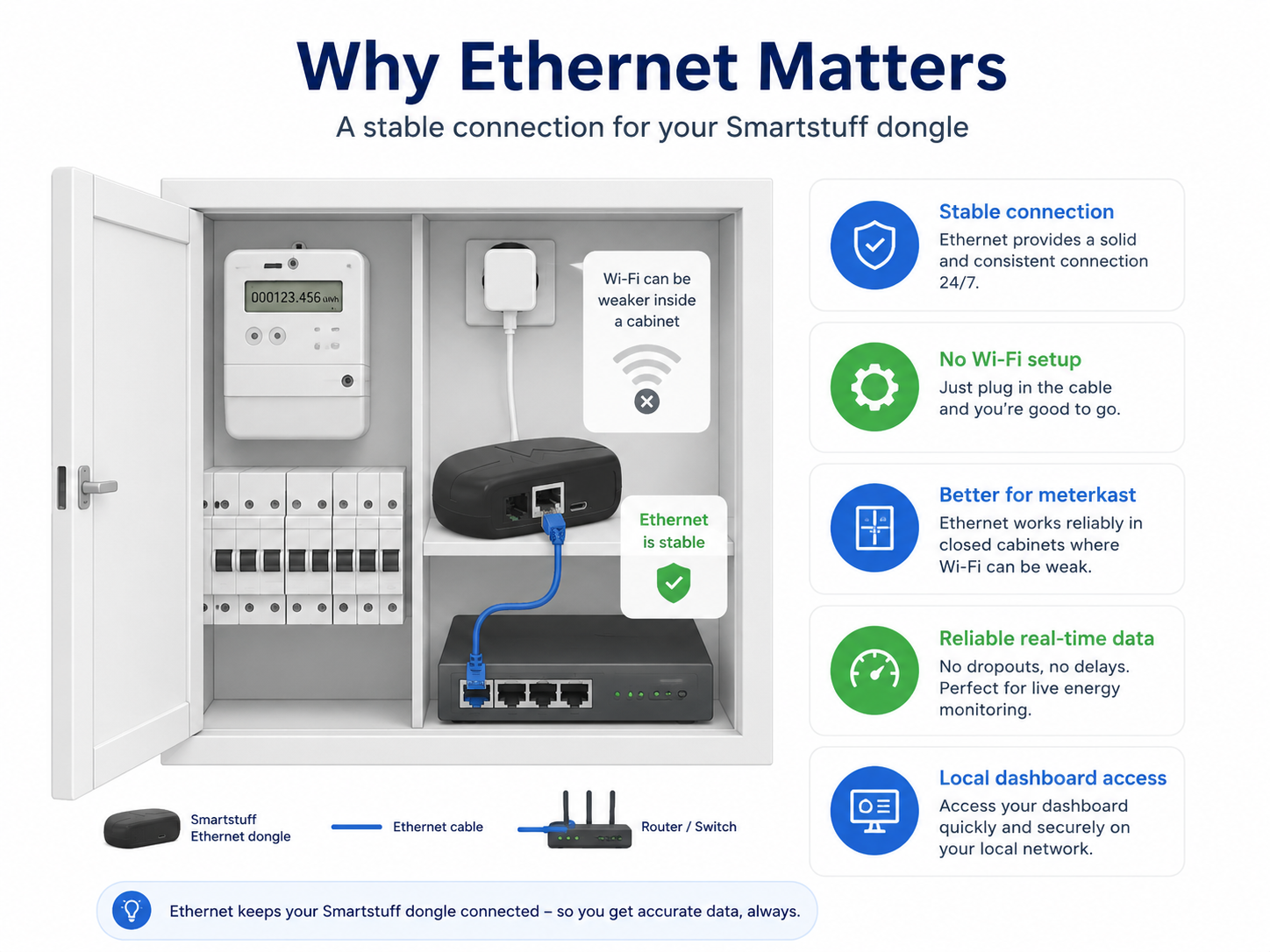
A smart meter dongle is usually installed in the meter cabinet, known in Dutch as the “meterkast.” This is often where the electricity and gas meter are located. Wi-Fi signal quality may be poor there, or the router/switch may be close enough that Ethernet is the more natural option.
The advantages of an Ethernet-based P1 dongle include:
- Network connection without Wi-Fi setup
- Stable delivery of smart meter data to Home Assistant
- Easy connection to a router or switch inside the meter cabinet
- Reliable collection of real-time energy data
- Better support for local interfaces such as DSMR-API dashboards, MQTT, and REST API
- Less dependency on Wi-Fi changes or signal issues
Because the Ultra family supports both Ethernet and Wi-Fi, users can choose wired or wireless connectivity depending on the installation environment.
📌 Role and Application of the WIZnet Chip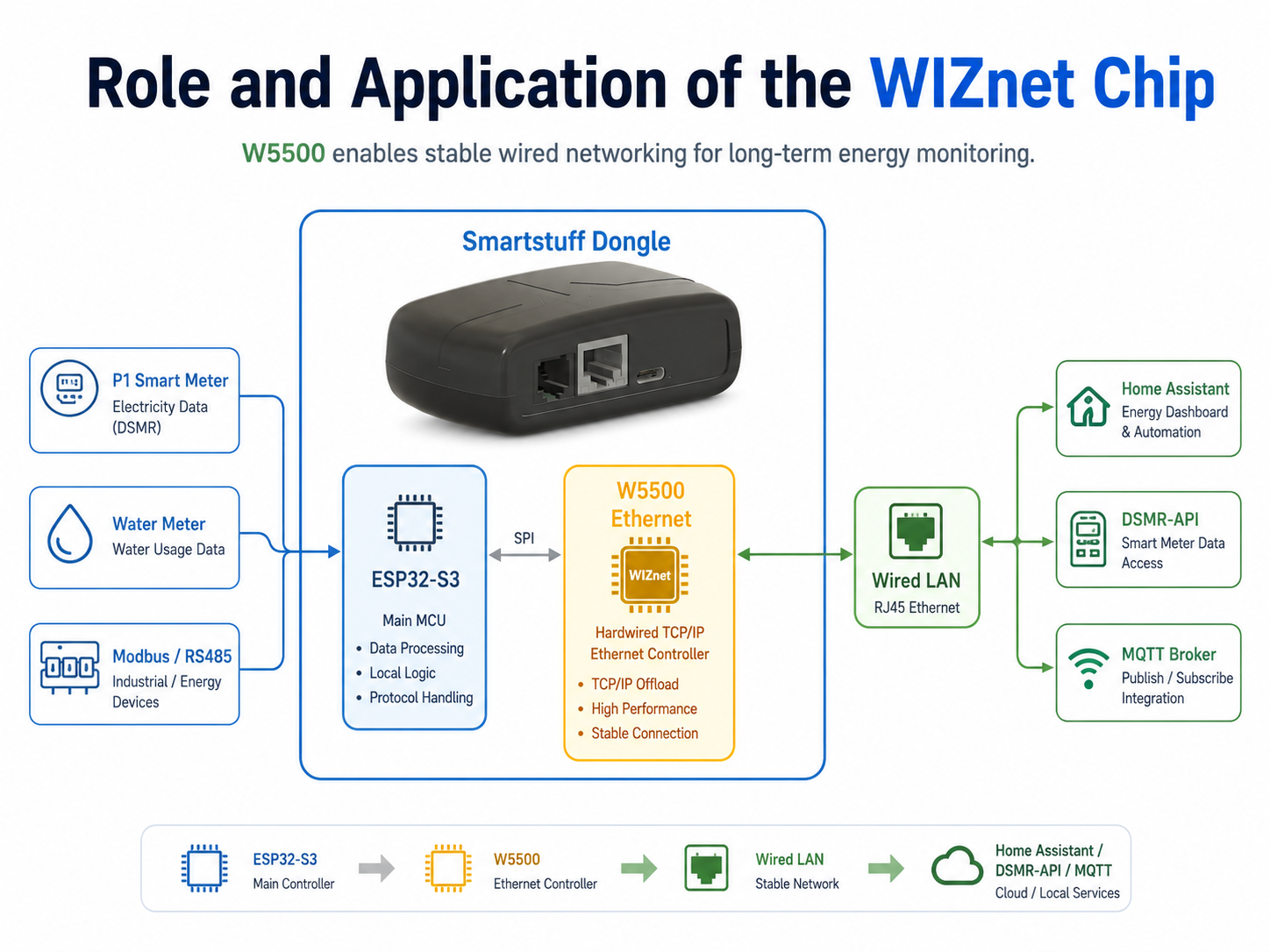
Related WIZnet product: W5500
The public Smartstuff Ultra ESPHome configuration files show ethernet: type: W5500. The ultra.yaml, ultra-p1-h2o.yaml, and ultra-x2.yaml configurations all include ESP32-S3 settings and W5500 Ethernet settings.
Based on this, the W5500 acts as the Ethernet controller that connects the ESP32-S3-based P1 / water / Modbus energy monitoring dongle to a wired LAN.
The W5500 is important here because of the type of data being handled. Smart meter and water meter data do not require high bandwidth, but they do require long-term, stable collection. In Home Assistant, DSMR-API, MQTT, and Modbus integrations, network stability strongly affects the user experience.
W5500-based Ethernet is well suited for this type of device. In fixed locations such as the meter cabinet, especially near a router or switch, wired Ethernet can be a more natural and reliable choice than Wi-Fi.
📌 Network Stack Note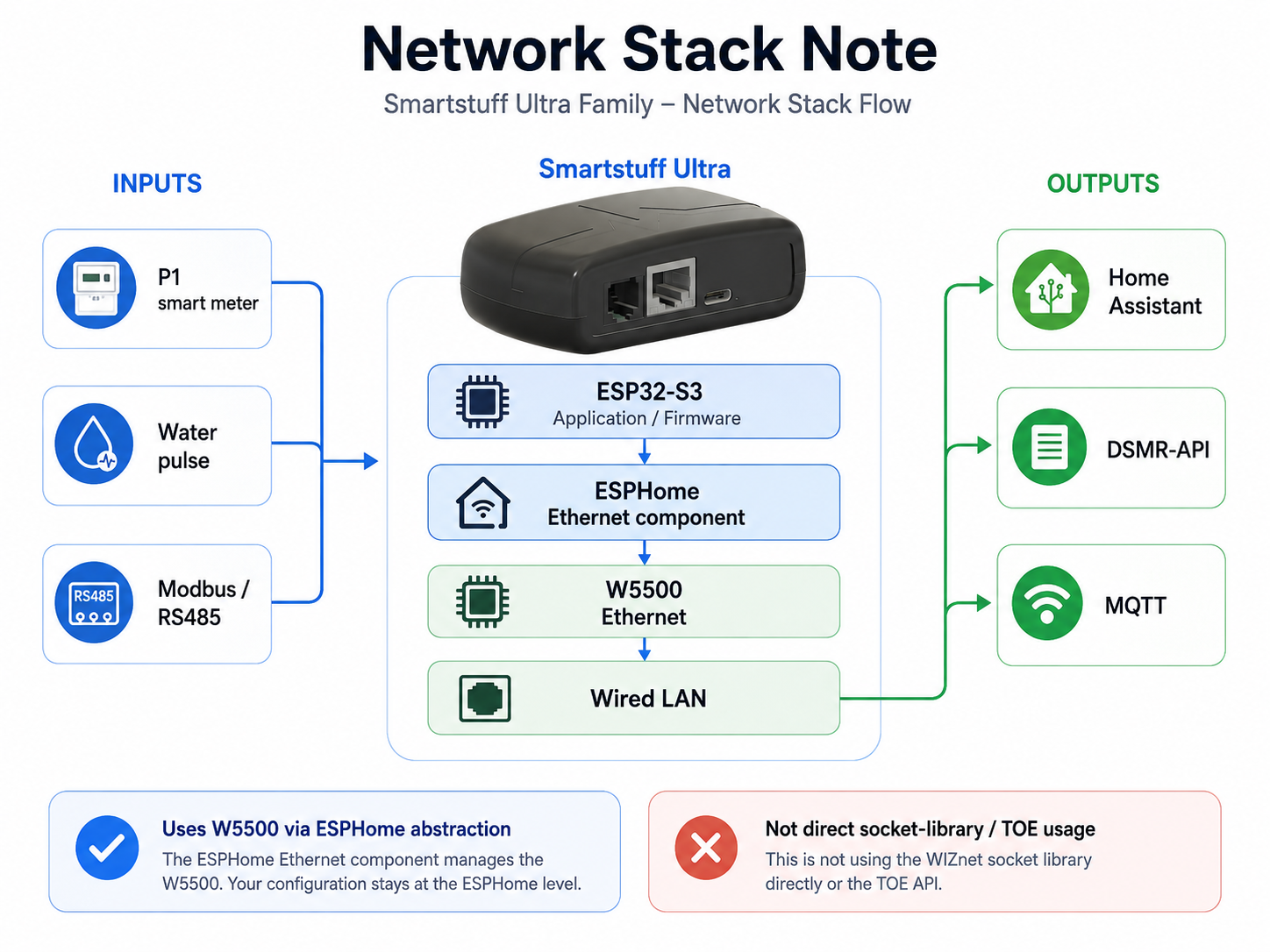
The public ESPHome configuration shows ethernet: type: W5500. This indicates that the Smartstuff Ultra family uses W5500 through ESPHome’s Ethernet component.
However, it would not be accurate to describe this as direct use of the WIZnet TOE/socket-library API. In ESPHome-based projects, the application code typically uses ESPHome and ESP32 networking abstractions rather than directly calling WIZnet socket APIs.
A safe technical description is:
The Smartstuff Ultra family is confirmed in public ESPHome configuration as an ESP32-S3 + W5500 Ethernet design. However, it should be treated as a product configuration using W5500 through ESPHome’s Ethernet component, rather than as a direct WIZnet socket-library or TOE example.
📌 Hybrid Network Status
The Smartstuff Ultra X2 / Ultra Mini can be considered a Hybrid Network product from a WIZnet perspective.
The Ultra family supports Ethernet and Wi-Fi dual mode. In particular, the Ultra Mini description states that if no Ethernet cable is connected, the device starts in Wi-Fi mode. When an Ethernet cable is connected, it uses the wired network and stops the Wi-Fi connection.
This means the product family considers both wired Ethernet and wireless Wi-Fi within one device line. It is not an Ethernet-to-Wi-Fi bridge or router. It is better understood as a smart energy dongle that can select either a wired or wireless network path depending on the installation environment.
A concise description would be:
The Smartstuff Ultra family is a Hybrid Network-ready energy monitoring dongle that supports both W5500 Ethernet and Wi-Fi dual mode. When Ethernet is available, it can use the wired network; when Ethernet is not available, it can operate in Wi-Fi mode.
📌 Features
- P1 smart meter reading
The device reads electricity and gas data from the smart meter P1 port and forwards it to Home Assistant, DSMR-API, MQTT, REST API, or other compatible systems. - Ethernet connectivity
W5500-based Ethernet provides stable wired networking without relying on Wi-Fi setup. - Wi-Fi dual mode
The Ultra family also supports Wi-Fi, allowing installation in environments where Ethernet is not available. - P1 output / splitter-like behavior
P1 output allows another P1 device to remain connected. This is useful when the smart meter’s P1 port is already in use. - Virtual P1 mode
The device can process raw P1 data from another P1 dongle as if it were a virtual P1 input. - Water sensor / H2O module
A water sensor module can read water meter pulses, allowing water usage to be monitored together with electricity and gas. - S0 pulse input
S0 pulse input enables pulse-based reading for electricity, water, or other compatible meters. - RS485 / Modbus RTU
An RS485 module allows connection to Modbus RTU devices. - DSMR-API firmware
DSMR-API provides a standalone web dashboard, local history storage, charts, MQTT, raw telegram port, and JSON REST interface. - ESPHome firmware
ESPHome firmware makes integration with Home Assistant easier. - NRG Gateway Pro option
The NRG Gateway Pro firmware option is mentioned for B2B use cases.
📌 System Architecture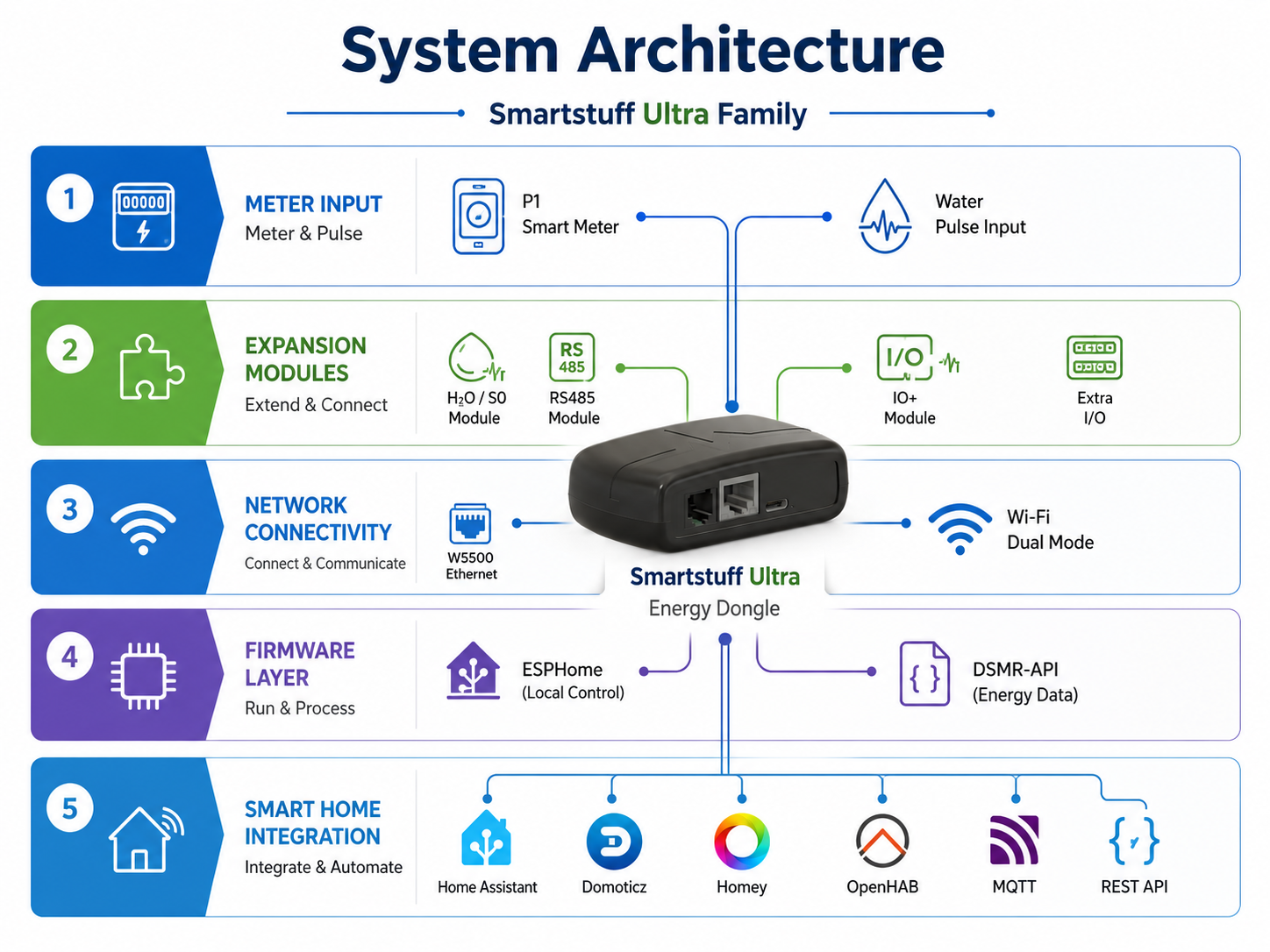
The Smartstuff Ultra family can be understood through five layers: meter input, expansion modules, network connectivity, firmware layer, and smart home integration.
The meter input layer reads P1 smart meter data. In the Ultra P1 H2O configuration, water sensor pulses are read as well.
The expansion module layer adds functions such as H2O/S0, RS485, IO+, and extra I/O modules. The Ultra X2 provides two module slots, allowing users to combine the functions they need.
The network connectivity layer provides W5500 Ethernet and Wi-Fi dual mode. If an Ethernet cable is connected, the device can use the wired network. If Ethernet is unavailable, it can operate in Wi-Fi mode.
The firmware layer can use ESPHome or DSMR-API. ESPHome is suitable for Home Assistant integration, while DSMR-API is suitable for standalone dashboards and local data storage.
The smart home integration layer connects the device to Home Assistant, Domoticz, Homey, OpenHAB, MQTT, REST API, and raw telegram interfaces.
📌 Usage, Market, and Application Value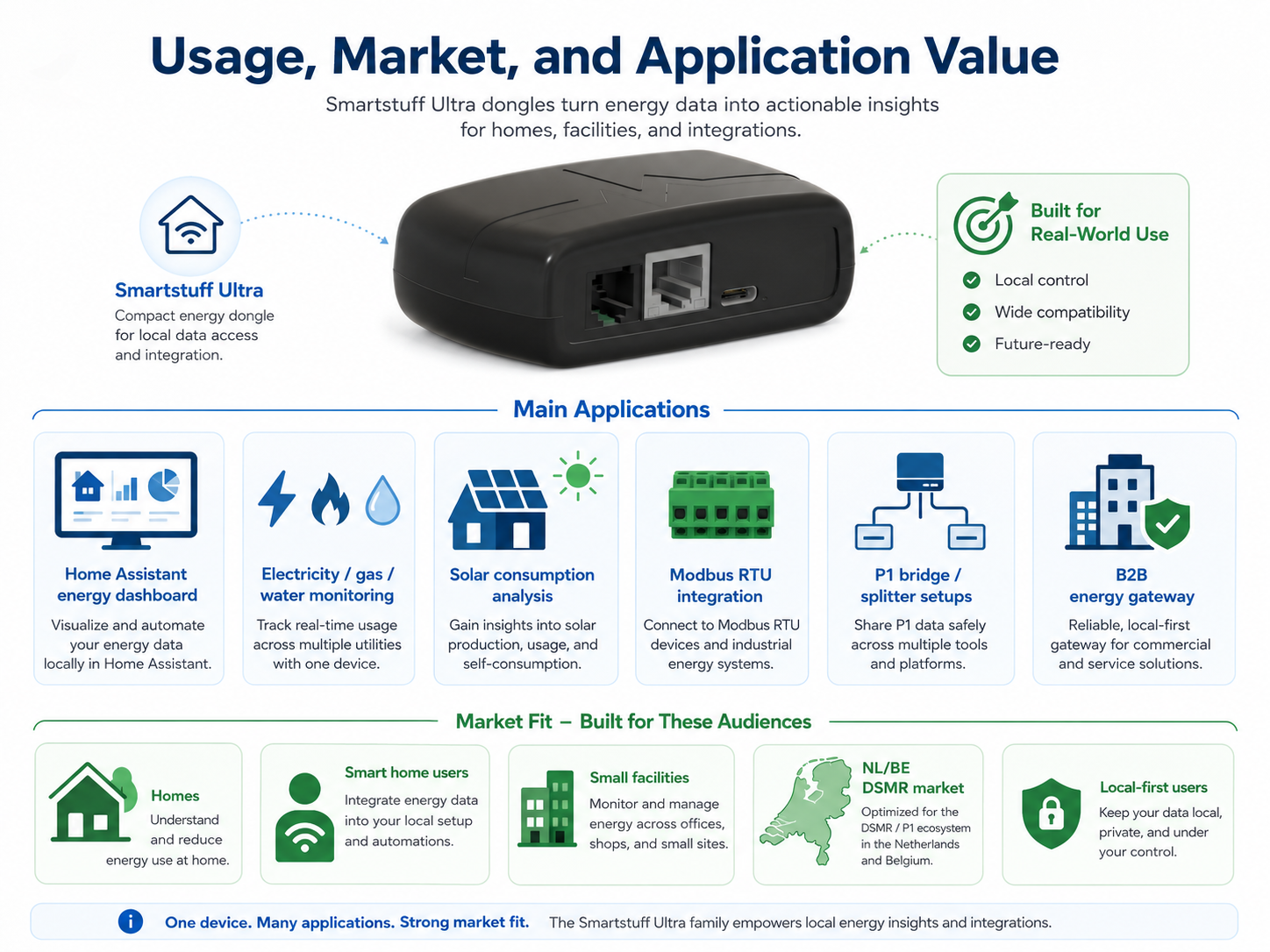
The Smartstuff Ultra family is suitable for users who want to understand and automate their energy usage.
Main use cases include:
- Home Assistant energy dashboards
- Electricity and gas smart meter monitoring
- Comparing solar production and household consumption
- Water usage monitoring
- S0 pulse-based meter reading
- Modbus RTU inverter or energy meter integration
- MQTT-based energy data collection
- DSMR-API standalone local dashboards
- P1 port splitter / P1 bridge setups
- B2B energy gateway or NRG monitoring
From a market perspective, this product line fits the Dutch and Belgian DSMR/P1 smart meter market particularly well. It is useful for Home Assistant users, households with solar panels, users interested in reducing energy costs, users who want to integrate water usage, and users who prefer local data without subscriptions.
This product family should be described as a local energy monitoring dongle for homes, small facilities, and smart home users, rather than as an industrial-grade power meter.
📌 Additional Insight for W5500 / WIZnet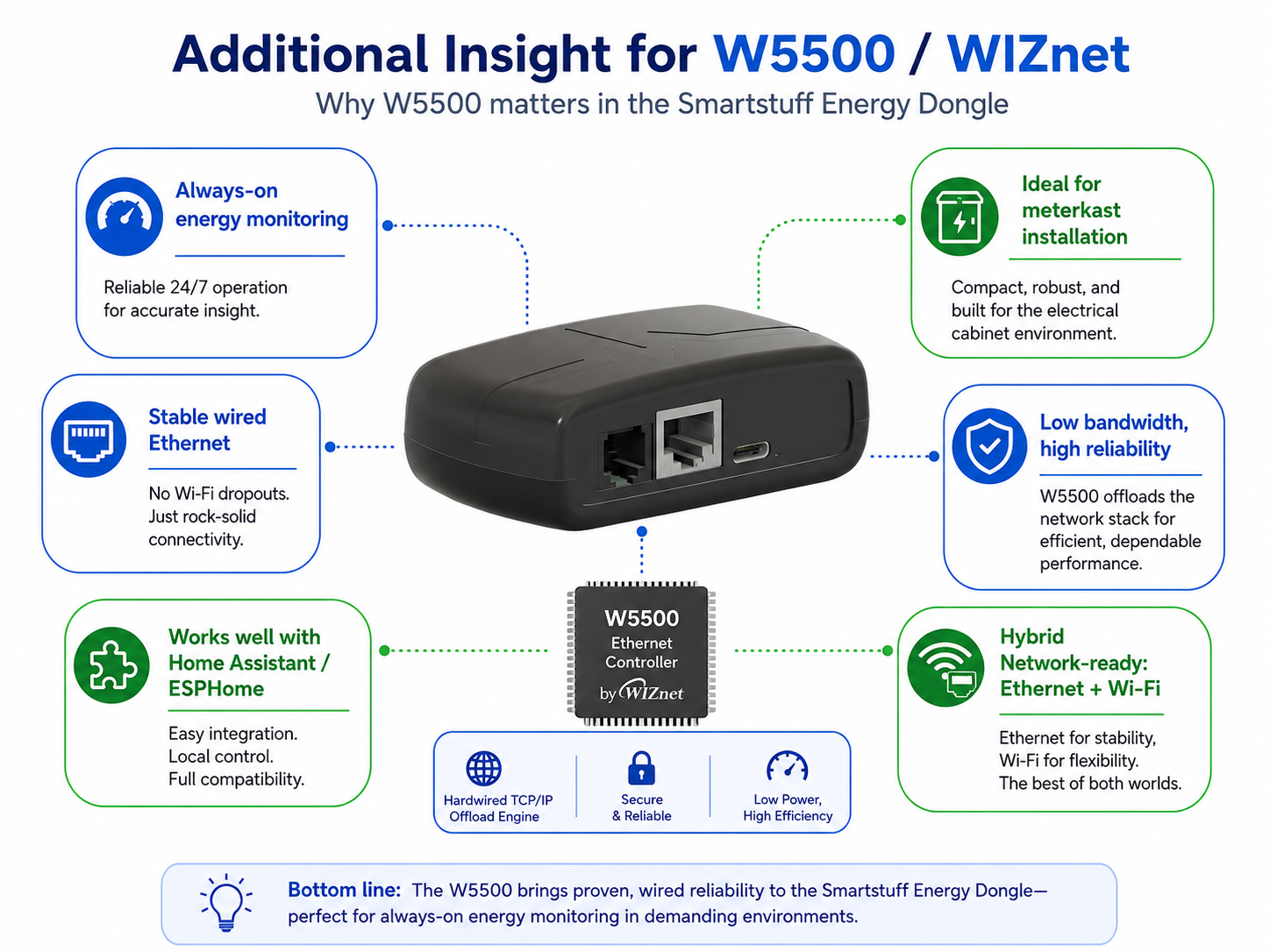
The Smartstuff Ultra family is meaningful from a WIZnet perspective because it shows the practicality of Ethernet in smart home energy monitoring devices.
A P1 smart meter dongle is always on and needs to transmit small amounts of data reliably over long periods. For this type of device, W5500 Ethernet can offer a more predictable connection than Wi-Fi.
The product also aligns well with WIZnet’s Hybrid Network message. The Ultra family supports both W5500 Ethernet and Wi-Fi dual mode. If an Ethernet cable is available, it can use a wired connection; otherwise, it can operate in Wi-Fi mode. This fits the idea of using wired and wireless networking depending on the situation.
Key WIZnet insights include:
- W5500 can be used in smart home energy monitoring dongles.
- The P1/DSMR smart meter market connects naturally with the Home Assistant / ESPHome ecosystem.
- Ethernet-based P1 dongles have practical value in meter cabinet installations.
- Wi-Fi + Ethernet dual mode fits well with Hybrid Network-ready messaging.
- W5500 is suitable for energy monitoring devices where stability and long-term connectivity matter more than bandwidth.
📌 Things to Know Before Use
Before using this product family, users should first decide on the installation environment and firmware option.
Important points to check include:
- Whether the smart meter supports P1/DSMR or EU SMR
- Whether Ethernet-only or Wi-Fi dual mode is needed
- Whether ESPHome firmware is preferred for Home Assistant integration
- Whether DSMR-API firmware is preferred for a standalone local dashboard
- Whether a water meter sensor and H2O module are needed
- Whether RS485/Modbus RTU devices will be connected
- Whether P1 output is needed
- Whether an older smart meter version requires external USB-C power
- Whether the selected module combination matches the Ultra X2 slot configuration
During initial setup, users should verify that P1 smart meter data is received correctly, Ethernet IP assignment works, and the device is recognized by Home Assistant if ESPHome is used.
📌 Summary
Smartstuff Ultra X2 / Ultra P1 H2O is a smart energy monitoring dongle family that connects P1 smart meter data, water sensor data, S0 pulse, RS485/Modbus RTU, P1 output, and Wi-Fi/Ethernet dual-mode networking to Home Assistant, ESPHome, or DSMR-API.
Smartstuff can be understood as a Dutch smart energy brand focused on the Netherlands and Belgium P1/DSMR smart meter market. The brand emphasizes local data, open-source software, no subscription fees, and open interfaces.
The key WIZnet-related point is that public ESPHome configurations show ESP32-S3 and ethernet: type: W5500. The W5500 provides a stable Ethernet interface for the Ultra family.
This product is a Hybrid Network-ready case from a WIZnet perspective. It supports both Ethernet and Wi-Fi dual mode, using the wired network when Ethernet is available and Wi-Fi mode when Ethernet is not available.
However, while public configuration confirms W5500 usage, manufacturer confirmation would be safer for making claims about every sales hardware revision. Also, because this is an ESPHome Ethernet component-based configuration, it should not be described as a direct WIZnet socket-library TOE example.
📌 FAQ
Q1. What is the Smartstuff Ultra X2 / Ultra P1 H2O?
It is a smart energy monitoring dongle that connects P1 smart meter, water sensor, S0 pulse, and RS485/Modbus RTU data to Home Assistant, ESPHome, or DSMR-API.
Q2. Which national market is it mainly designed for?
The official site is Dutch, and the product descriptions focus on NL/BE smart meters and EU SMR meter support. It is mainly targeted at the Dutch and Belgian P1/DSMR smart meter market.
Q3. What ecosystem is Smartstuff building?
Smartstuff emphasizes local data, open-source software, no subscription fees, and open interfaces. Its ecosystem connects with Home Assistant, DSMR-API, MQTT, REST API, Domoticz, Homey, and OpenHAB.
Q4. Which WIZnet chip is involved?
The public ESPHome configuration shows ESP32-S3 and ethernet: type: W5500. Therefore, the Ultra family can be considered a W5500 Ethernet-based energy monitoring product example.
Q5. Is the W5500 used through direct TOE/socket-library APIs?
Based on the public ESPHome configuration, it is safer to say that W5500 is used through ESPHome’s Ethernet component as a network interface, not as a direct WIZnet socket-library TOE example.
Q6. Is it a Hybrid Network product?
Yes. The Ultra family supports Ethernet and Wi-Fi dual mode. When an Ethernet cable is connected, it can use the wired network; when Ethernet is not available, it can operate in Wi-Fi mode.
Q7. Does it support PoE?
The Ultra X2 / Ultra Mini descriptions indicate that built-in PoE is not included, but a PoE adapter can be used as an option. The Ethernet Pro+ also offers a PoE adapter accessory.
Q8. What applications is it suitable for?
It is suitable for Home Assistant energy dashboards, electricity/gas/water usage monitoring, solar consumption analysis, Modbus RTU device integration, P1 splitter/bridge setups, and B2B energy gateway applications.