



Tocata Pedal
Tocata Pedal is a programmable MIDI foot controller. It adds wired Ethernet via W6100 and features a web editor for hybrid connectivity.
Thumbnail image: AI-generated image
Tocata Pedal: a programmable MIDI foot controller that now adds wired AppleMIDI through WIZnet W6100-EVB-Pico2
Introduction
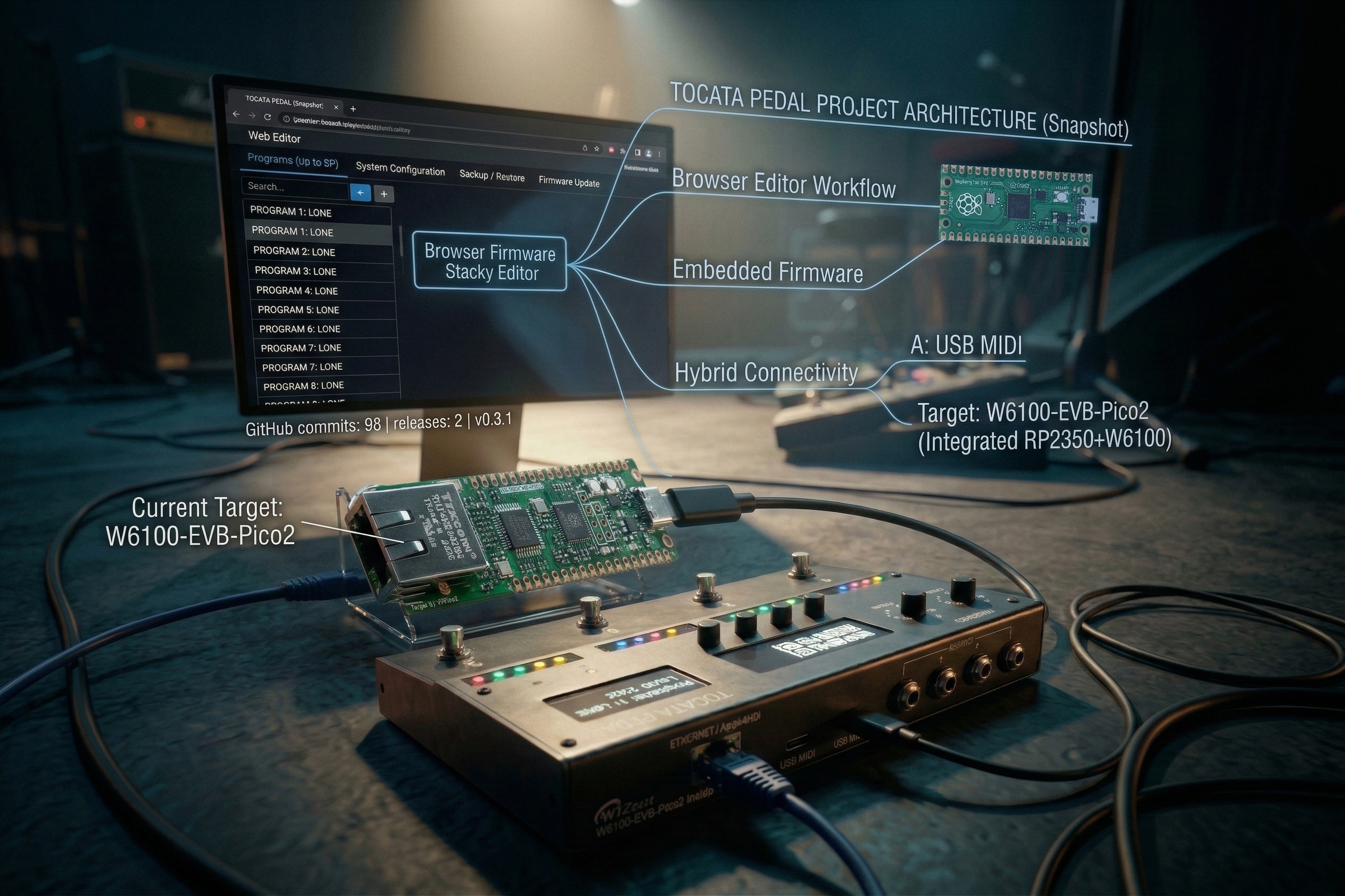
Tocata Pedal is, first and foremost, a programmable MIDI foot controller. In plain terms, it is a floor pedal a musician steps on to change presets, toggle effects, switch scenes, or move an expression-controlled parameter on other gear. It does not make the sound itself; it works as a smart remote for amp modelers, pedal switchers, synths, and computer-based rigs. Publicly, the repository is still early-stage, but it is active: GitHub currently shows 98 commits, 2 releases, and v0.3.1 as the latest release. (GitHub)
What this project is
AI-generated image
Based on the uploaded ZIP snapshot, Tocata Pedal is already more than a small firmware demo. It has a pedal firmware stack, persistent preset storage, a browser-based editor, backup and restore support, and a firmware-update path. The current source defines up to 99 programs, each with a name, a mode, global MIDI actions, up to 8 programmable footswitches, and an expression-pedal mapping.
A useful nuance here is that the project should not be overstated as “a W6100-based pedal from the beginning.” The safer reading from the current source is that Tocata Pedal is the product concept, and W6100-EVB-Pico2 is the current Ethernet-capable hardware target in this snapshot. The source still contains a separate Raspberry Pi Pico branch, so the Ethernet board is better described as a significant current addition than the entire historical basis of the project.
Why the WIZnet addition matters
In the uploaded source snapshot, the current firmware target is set to pico2 with BOARD_NAME W6100_EVB_PICO2 and WIZNET_CHIP W6100. That lines up with WIZnet’s own documentation, which describes W6100-EVB-Pico2 as an RP2350-based board that behaves like a Pico 2 but adds Ethernet through W6100. WIZnet also documents that GPIO16–21 are internally tied to the Ethernet chip for SPI and control, and that the W6100 platform supports TCP/UDP, IPv4/IPv6 dual stack, 8 sockets, and integrated 10/100 Ethernet MAC/PHY. (WIZnet Document System)
That matters here because W6100 is not acting as a vague “internet feature.” In the current Tocata Pedal code snapshot, it is the part that enables a wired network MIDI path. That is a meaningful but specific role: the pedal remains a MIDI controller first, and W6100 extends how that controller can connect.
How it works for players
AI-generated image
The everyday workflow is easy to picture.
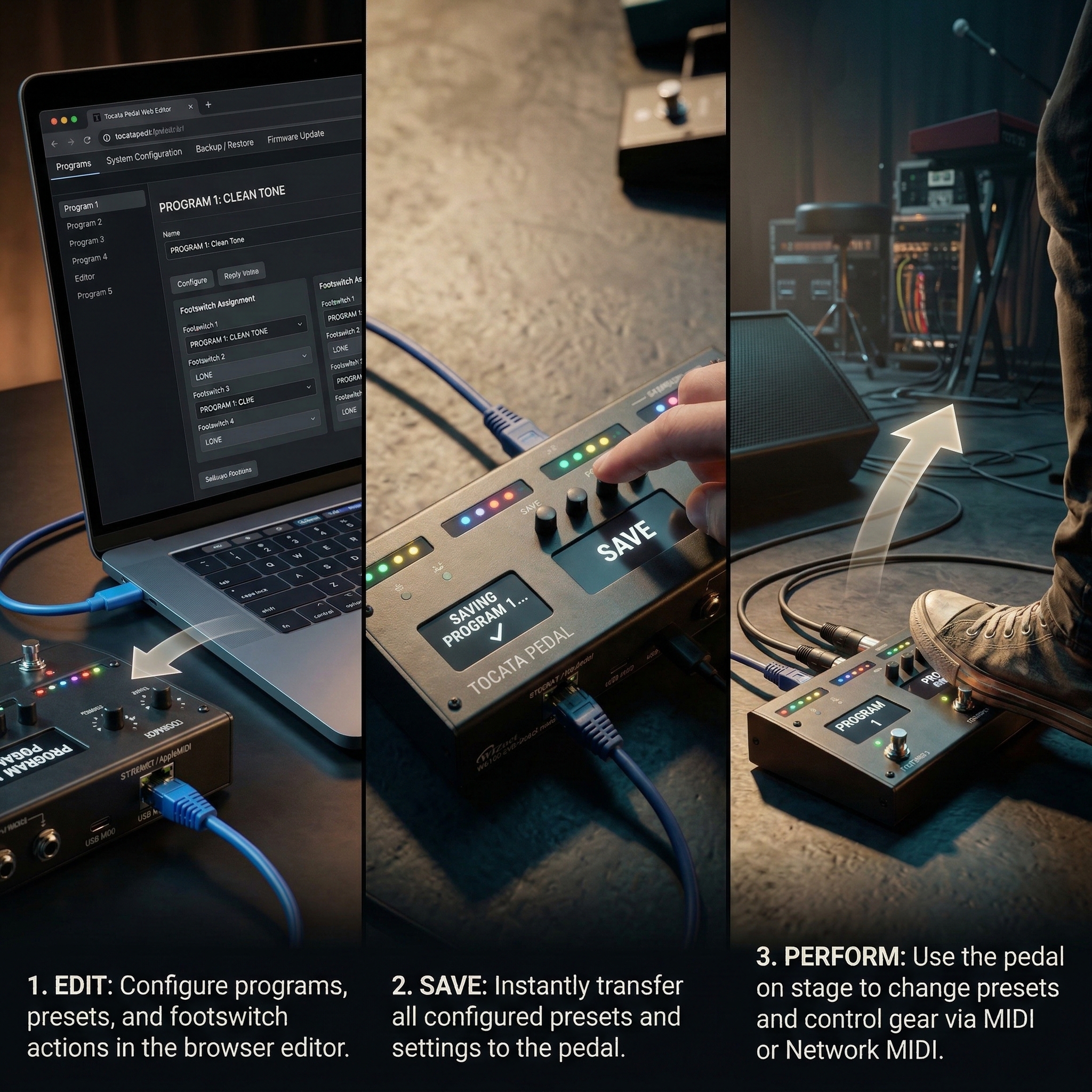
A player first connects the pedal to the editor and creates or edits pedal programs. In the uploaded ZIP snapshot, the browser UI is organized around Programs, System Configuration, Backup / Restore, and Firmware Update. That is important because it makes the project feel like a usable tool rather than a firmware image that must be recompiled for every change.
From there, the player saves programs into the pedal. Each program can define what a footswitch does, whether switches behave like stomp toggles or scene selectors, and what the expression pedal should send. On stage or in the studio, stepping on a switch makes the pedal send MIDI messages to the rest of the rig, while the display and LEDs show the active program and switch state. In the current snapshot, the controller can also react to incoming note data by switching into a tuner-style display mode, so it doubles as a small performance utility instead of only a trigger box.
In human terms, the workflow is simple: edit on a computer, save to the pedal, step on switches during performance, and let the pedal tell the rest of the rig what to do.
How it works for developers
AI-generated image
For developers, the project is more interesting because it spans embedded firmware, browser tooling, and host-side testing.
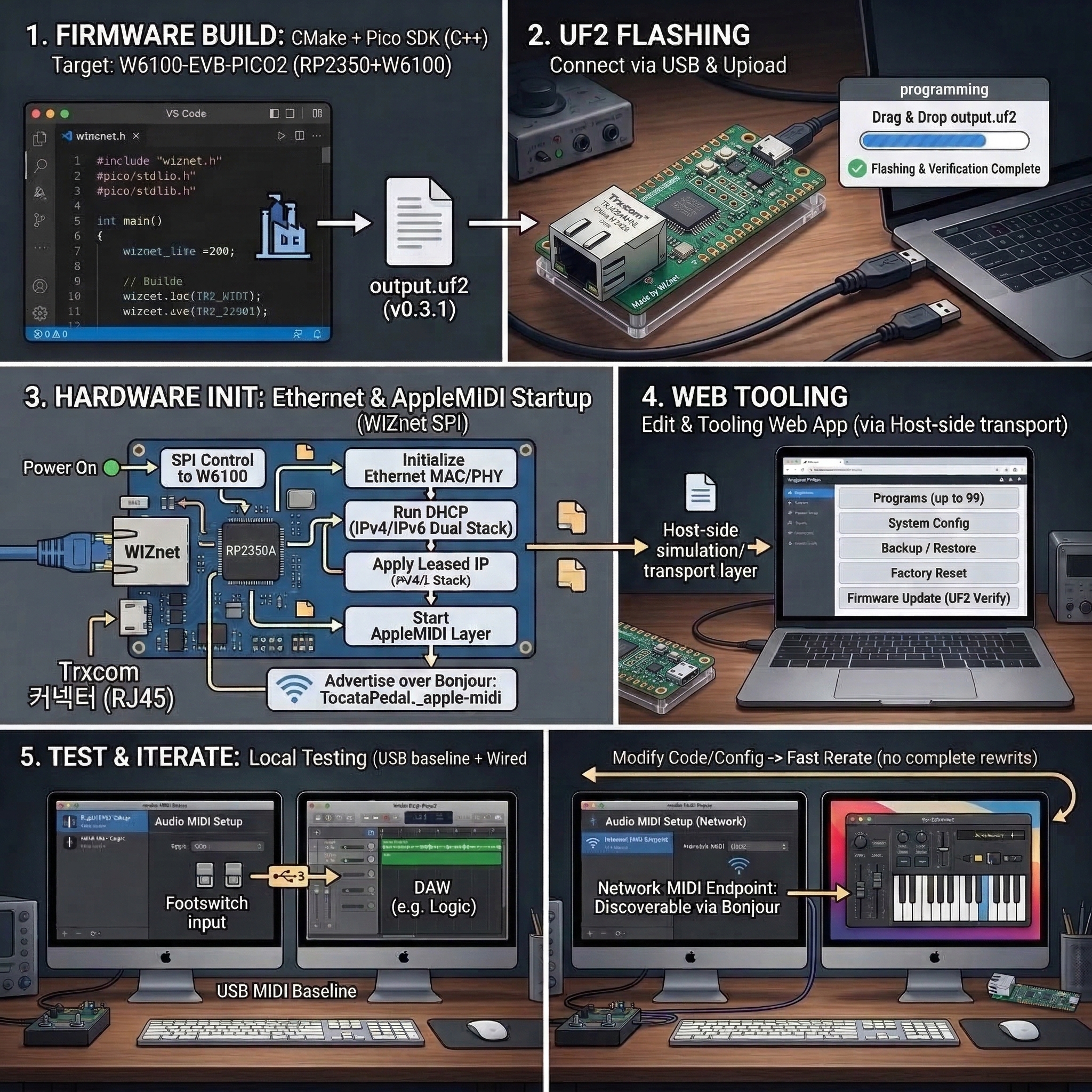
In the uploaded ZIP snapshot, the firmware is built with CMake + Pico SDK, and the current build selects W6100-EVB-Pico2. The same snapshot maps the larger pedal layout to multiple switch inputs, LEDs, a display, an expression input, and Ethernet on the W6100 SPI pins.
The visible network path is also straightforward in the current code. The firmware initializes Ethernet, runs DHCP, applies the leased IP, and then starts the AppleMIDI layer. The AppleMIDI service is advertised over Bonjour as TocataPedal._apple-midi, which makes the pedal discoverable as a network-MIDI endpoint on a local network.
On the tooling side, the web application is more complete than many small embedded music projects. In the uploaded source snapshot it includes:
- program and system-configuration editing,
- backup and restore,
- factory reset,
- UF2 firmware flashing and verification,
- and a host-side simulation / transport layer for development.
So the developer workflow is clear: build firmware, flash the board, edit programs in the web tool, test locally, and iterate without rewriting the whole device every time.
Hybrid connectivity
This is best described as a hybrid connectivity design, but with one important limit.
In the current snapshot, Tocata Pedal clearly supports:
- USB MIDI as the local baseline connection,
- and wired AppleMIDI / network MIDI through the W6100 Ethernet path.
So Ethernet is an added transport, not a replacement for USB.
That makes sense in the wider MIDI ecosystem. The MIDI Association describes RTP-MIDI as the IETF-standard way to send MIDI over networking protocols, and Apple’s own documentation shows MIDI being shared over an Ethernet network through Audio MIDI Setup on the Mac. In other words, network MIDI here is not a one-off custom trick; it fits a recognized workflow already used in studios and multi-device rigs. (MIDI.org)
There are also Wi-Fi SSID/key fields in the visible configuration model and browser UI, but in the source snapshot I reviewed there is not an equally clear, fully active Wi-Fi transport path comparable to the AppleMIDI Ethernet implementation. The safest description, then, is USB + wired Ethernet hybrid, not a finished USB + Wi-Fi + Ethernet product.
Why it matters
Tocata Pedal is interesting because it combines a familiar musician workflow with a more complete software stack than many DIY MIDI controllers.
It already includes preset storage, browser editing, backup and restore, and firmware update support. That makes it easier to imagine as a reusable platform rather than a one-off personal build.
The W6100 addition also gives the project a meaningful technical angle. Instead of staying USB-only, the pedal can participate in wired network MIDI setups. That is especially relevant for more advanced rigs where devices are distributed across a studio desk, rack, or stage system.
Market positioning
AI-generated image
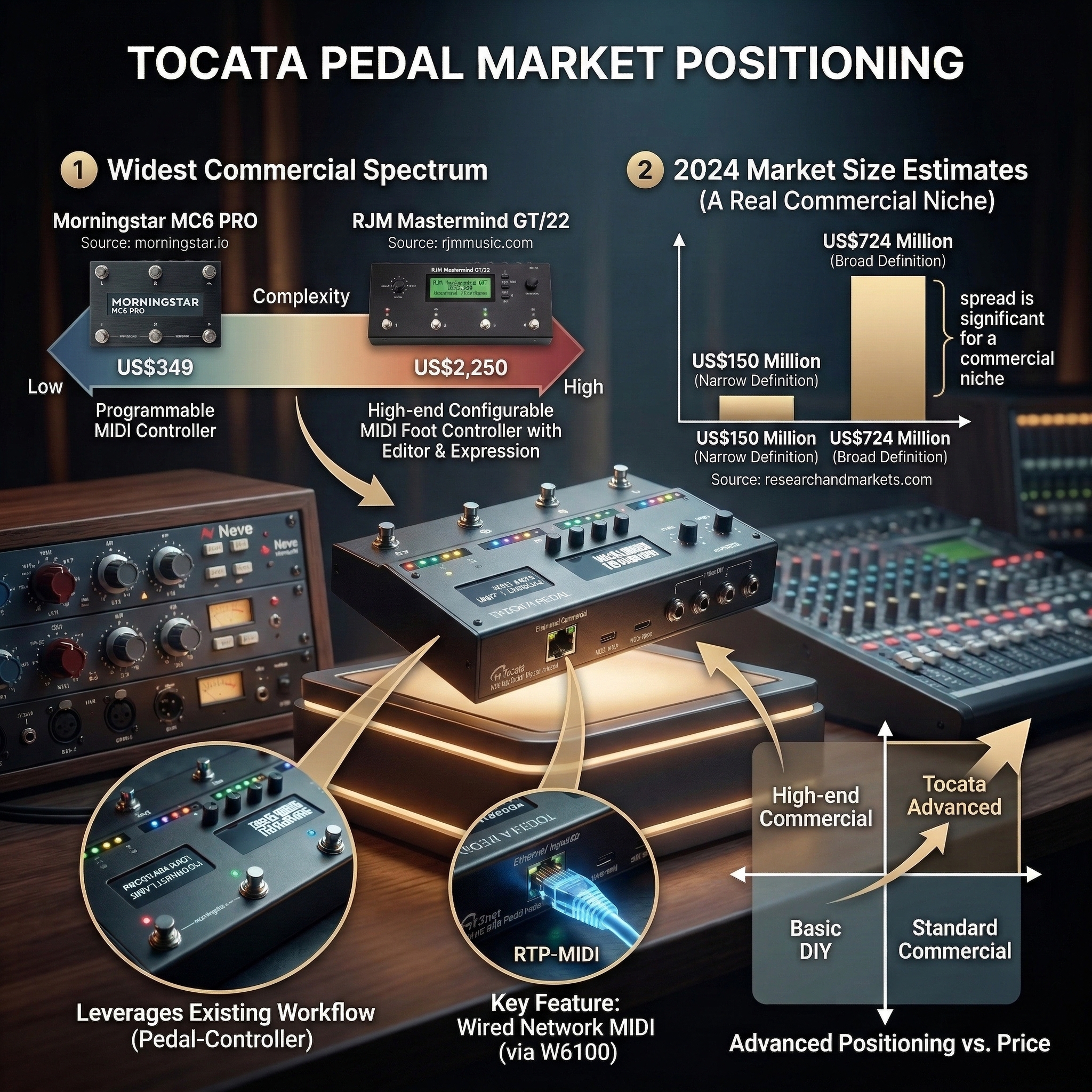
The closest market for Tocata Pedal is the programmable MIDI foot controller segment.
This is not a mass-market category, but it is clearly a real one. Commercial products already exist across a wide price range. For example, Morningstar’s MC6 PRO is sold as a programmable MIDI controller, and RJM’s Mastermind GT/22 is sold as a high-end configurable MIDI foot controller with editor software and expression support. (morningstar.io)
Public sizing for this exact market is not very clean. Different third-party reports estimate the 2024 MIDI foot controller market anywhere from about US$150 million to about US$724 million, depending on how narrowly the category is defined. That spread is too wide to treat as a precise number, but it is enough to say that this is a real commercial niche, not just a hobby curiosity. (researchandmarkets.com)
In that context, Tocata Pedal’s W6100 direction is commercially meaningful. It does not create a brand-new market by itself, but it does move the project toward a more advanced corner of the existing foot-controller market by adding wired network MIDI to the usual pedal-controller workflow.
Quick notes
The public GitHub page is still sparse, so the most useful technical reading comes from the uploaded ZIP snapshot rather than from a detailed upstream README. Publicly, the repository only exposes a minimal root structure with firmware/ and web/, plus basic release and activity information. (GitHub)
In the materials available here, I did not find a schematic, BOM, or demo video. That means the project currently looks stronger on firmware and user workflow than on hardware replication documentation.
One developer-facing caveat is also worth noting: in the visible AppleMIDI implementation, the invitation flow currently resolves a hard-coded Bonjour peer name. That is acceptable for development, but it would need to be generalized before the network workflow becomes plug-and-play for a wider user base.
FAQ: Tocata Pedal (W6100-Based Network MIDI Foot Controller)
This FAQ covers the core features, workflow, and technical architecture of the Tocata Pedal, a programmable MIDI foot controller that features wired AppleMIDI over Ethernet using the WIZnet W6100-EVB-Pico2.
Q1. What is the Tocata Pedal?
The Tocata Pedal is a programmable MIDI foot controller designed for musicians. It acts as a "smart remote" to change presets, toggle effects, switch scenes, or control expression parameters on other audio gear (like amp modelers, pedal switchers, and synths). It does not generate sound itself, but rather triggers actions across your musical rig.
Q2. What are its core features?
Unlike simple DIY trigger boxes, Tocata Pedal includes a comprehensive software stack ready for stage and studio use:
- Preset Storage: Saves up to 99 distinct programs directly on the device.
- Flexible Mapping: Configures global MIDI actions, 8 programmable footswitches (toggles or scene selectors), and an expression pedal input.
- Browser-Based Editor: Features a dedicated web application for editing programs, system configuration, backing up/restoring data, and flashing firmware (UF2).
- Performance Utility: Can analyze incoming note data to double as a tuner-style display.
Q3. Why use the WIZnet W6100-EVB-Pico2 board?
The most significant advantage of this board is the addition of wired network MIDI (AppleMIDI/RTP-MIDI).
- The W6100-EVB-Pico2 combines the RP2350 microcontroller with the W6100 hardware TCP/IP Ethernet chip.
- This allows the pedal to advertise itself on a local network as a Bonjour service (
TocataPedal._apple-midi). - It creates a hybrid connectivity design (USB + Wired Ethernet), allowing the pedal to integrate seamlessly into complex, distributed studio or stage setups where devices are far apart.
Q4. How does the workflow work for musicians vs. developers?
- For Musicians: Connect the pedal to the browser editor, set up your switch and pedal mappings, and save them to the device. On stage, simply step on the switches to send MIDI commands to your rig.
- For Developers: The firmware is built with CMake and the Pico SDK. Developers can edit configurations in the web tool and test host-side simulations locally, allowing for rapid iteration without needing to recompile and flash the board for every minor change.
Q5. How does this compare to commercial MIDI controllers?
Tocata Pedal targets the advanced programmable foot controller market, similar to commercial products like the Morningstar MC6 PRO or RJM Mastermind GT/22. While it is an open-source project, it stands out by offering a browser-based editor and moving beyond standard USB MIDI by incorporating wired network MIDI (AppleMIDI), making it highly relevant for advanced routing.
Q6. Are there any limitations or caveats for reproducing this project?
Based on the current repository snapshot, builders should note a few things:
- Hardware Documentation: While the firmware and web tools are robust, the repository currently lacks a complete Bill of Materials (BOM), KiCad schematics, or demo videos.
- Network Generalization: The AppleMIDI implementation currently uses a hard-coded Bonjour peer name. This is fine for development but needs to be generalized for true plug-and-play use by the wider public.
- Wi-Fi vs. Ethernet: Although the browser UI shows Wi-Fi configuration fields, the active, supported network path in the current code is wired Ethernet via the W6100 chip.
References
https://github.com/numeroband/tocata-pedal
https://docs.wiznet.io/Product/iEthernet/W6100/w6100-evb-pico2
https://docs.wiznet.io/Product/Chip/Ethernet/W6100
https://midi.org/rtp-midi
https://support.apple.com/guide/audio-midi-setup/ams1012/mac
https://www.researchandmarkets.com/reports/6093770/midi-foot-controllers-market-global-strategic
https://www.verifiedmarketreports.com/product/midi-foot-controllers-market/
https://www.morningstar.io/mc6-pro
https://manuals.morningstar.io/mc-midi-controller/mc6-pro-user-manual
https://shop.morningstar.io/
https://www.rjmmusic.com/mastermind-gt-22/
https://shop.rjmmusic.com/mastermind-gt-22-midi-foot-controller/