



Test system for simulating any line based on matrix switch
STM32 & W5500 matrix-switch system enables remote, software-defined EV harness simulation and fault injection, eliminating physical cables.
Thumbnail image generated by AI
A Matrix-Switch-Based Test System for Software-Defined Automotive Wire Harness Simulation
— Remote-Controlled Validation Architecture Using STM32, Fault Injection, and WIZnet W5500 Ethernet
Introduction
This patent addresses a very practical problem in modern automotive manufacturing:
how to validate wire harness inspection systems efficiently, without relying on large numbers of physical harness samples.
As vehicles—especially EVs and intelligent vehicles—become more complex, wire harnesses now include hundreds or even thousands of circuits, along with high-speed protocols such as CAN-FD and automotive Ethernet. Traditional validation methods, which depend on preparing and swapping real harness assemblies, are costly, time-consuming, and inflexible.
The patented system replaces physical harness variation with a matrix-switch-based circuit simulation platform, capable of reproducing arbitrary wiring topologies and injecting realistic fault conditions. The entire test setup is remotely controlled and logged over Ethernet using a WIZnet W5500, enabling automated and repeatable validation workflows.
Quick Background 1 — What Is an Automotive Wire Harness “Circuit”?
Generative AI–generated image
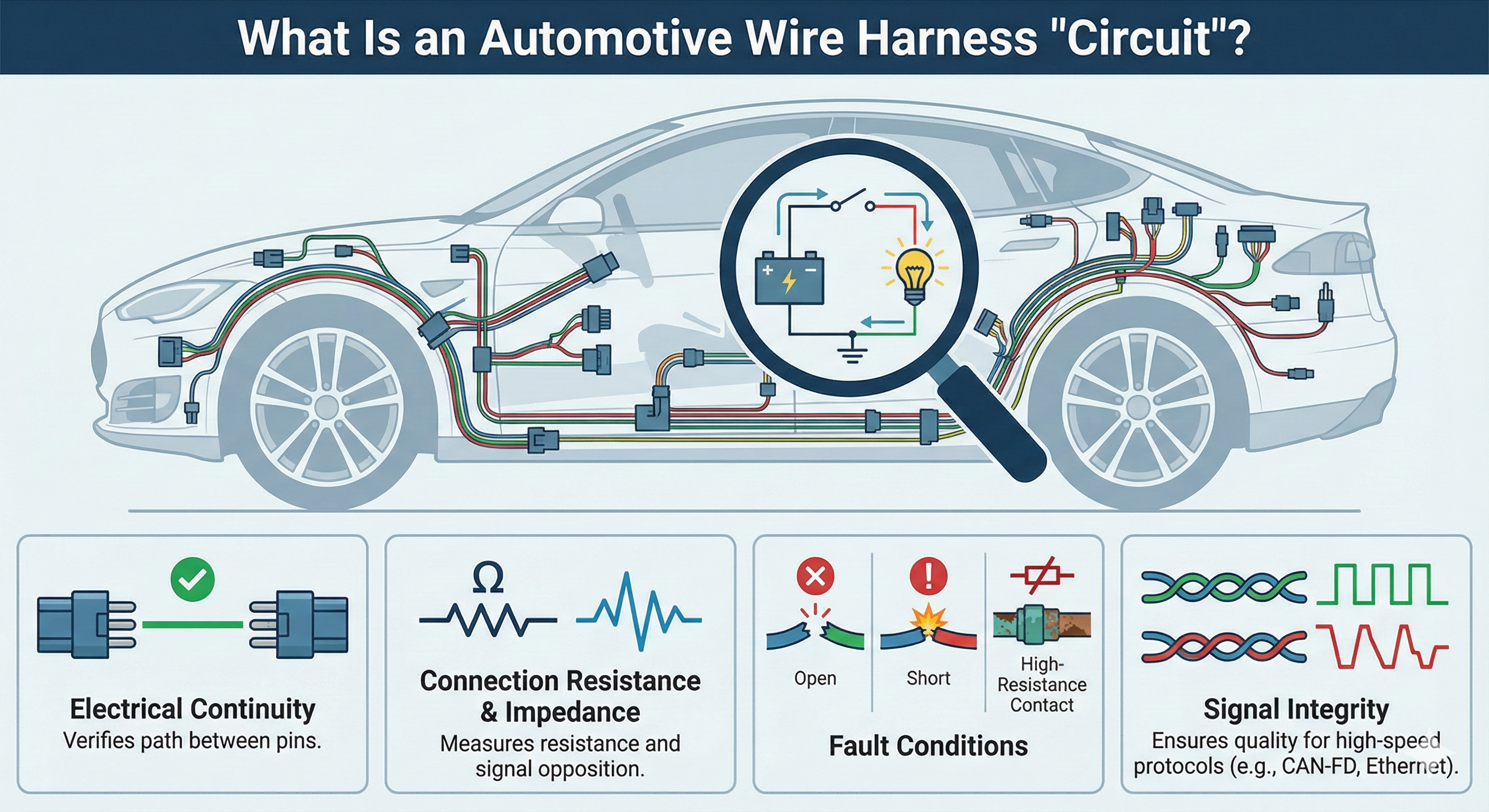
An automotive wire harness is the physical backbone that distributes power and signals throughout a vehicle. From a quality-assurance perspective, harness inspection systems typically verify:
- Electrical continuity between connector pins
- Connection resistance and impedance
- Fault conditions such as opens, shorts, and high-resistance contacts
- Increasingly, signal integrity requirements driven by high-speed communication lines
The patent explicitly frames wire harness inspection as a core manufacturing quality process, where both correctness and robustness of the inspection system itself must be verified.
Quick Background 2 — What Is a Matrix Switch, and Why Use It?
Generative AI–generated image
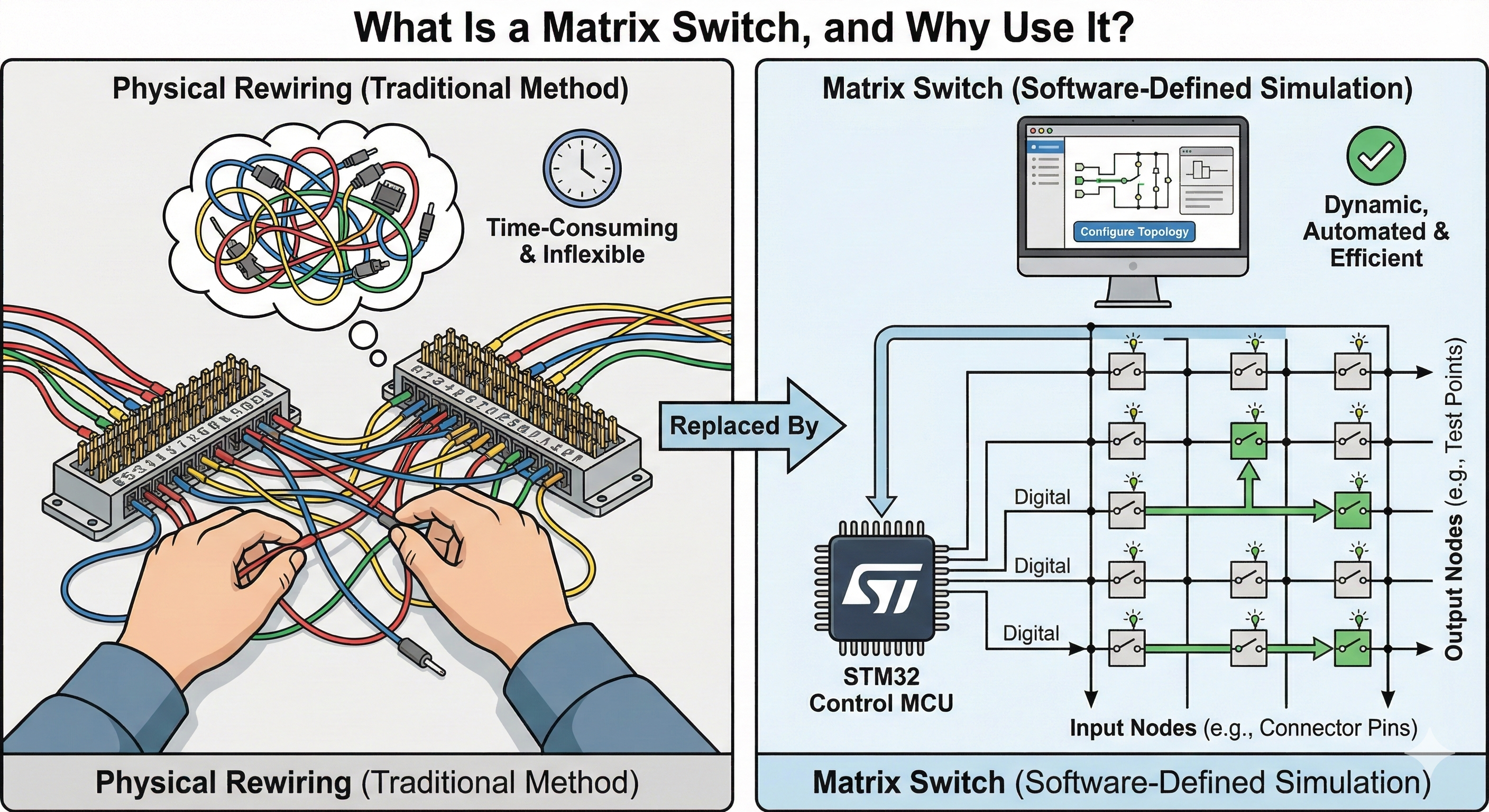
A matrix switch is a switching structure that allows many nodes to be selectively connected through programmable on/off paths.
In simple terms:
- Instead of physically rewiring terminals,
- The system uses switch combinations to define which pins are electrically connected.
In this patent, the matrix switch enables software-defined wiring simulation: any desired harness topology can be created dynamically by controlling switch states, without changing physical wiring.
Patent Snapshot
The patent defines a modular test system composed of four main hardware elements:
- Main control board (with Ethernet connectivity via W5500)
- Circuit simulation boards (sub-boards) using STM32 + matrix switches
- Fault injection boards for simulating electrical failures
- Modular backplane structure for scalable expansion
Together, these elements form a configurable platform for harness-inspection validation.
What This Patent Proposes
1) Arbitrary Circuit Simulation
Each circuit simulation board uses an STM32 MCU to control a matrix switch array.
By changing switch configurations, the system reproduces arbitrary pin-to-pin connectivity corresponding to different harness designs.
2) Fault Injection for Defensive Testing
Dedicated fault-injection boards introduce controlled electrical anomalies, such as:
- Open circuits
- Short circuits
- High-resistance contacts (poor connections)
- Parasitic capacitance effects
This allows inspection equipment to be tested not only under normal conditions, but also against realistic failure scenarios.
3) Network-Connected, Remote-Controlled Test Equipment
The main control board integrates an STM32 MCU with CAN/RS-485 interfaces and a WIZnet W5500 Ethernet module.
This transforms the test system into a network-connected validation platform, where test scenarios are configured remotely and results are centrally logged.
Architecture & Data Flow (Mechanism-First View)
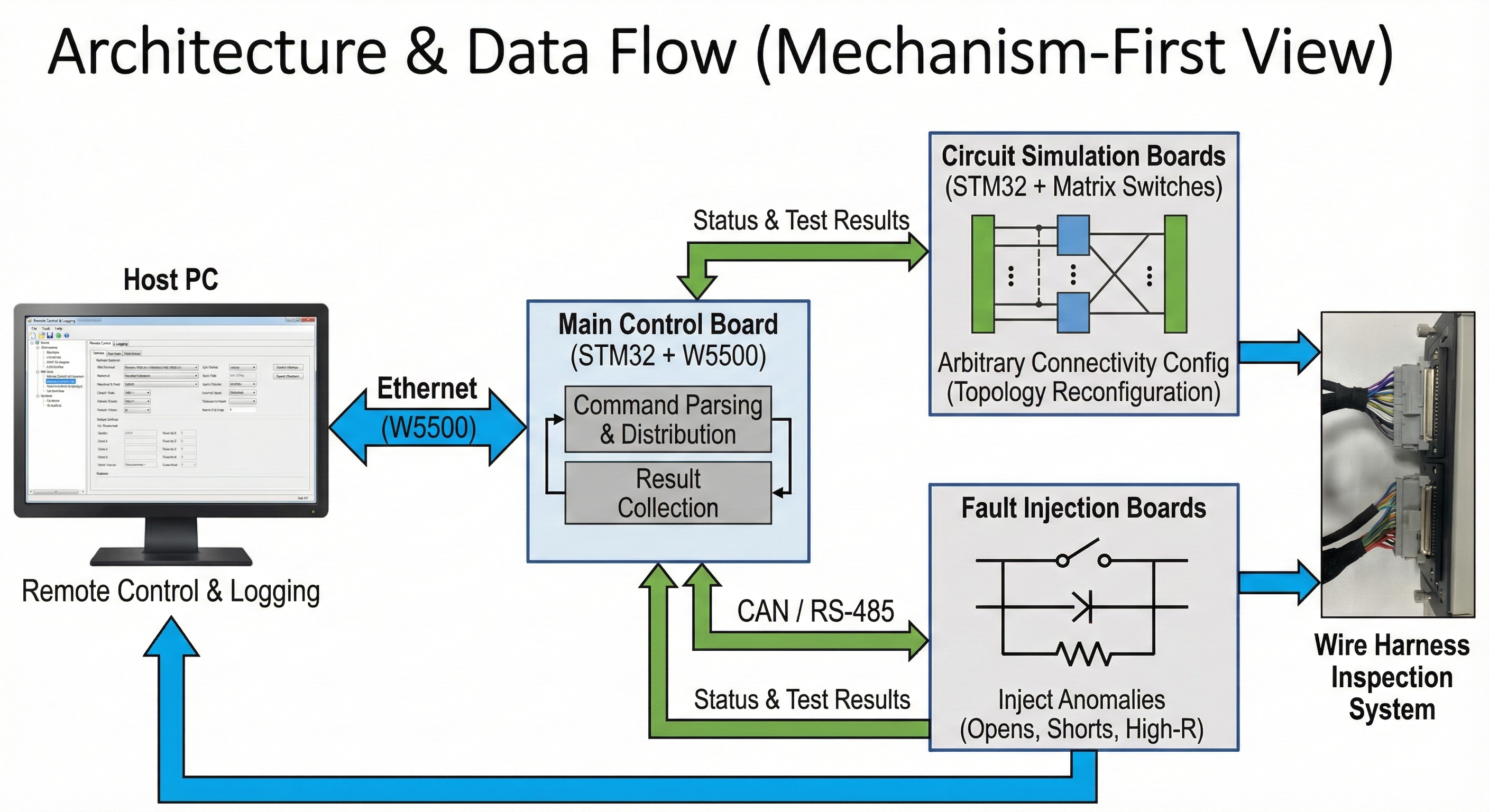
Overall Control Flow
Generative AI–generated image
Host PC
 ⇄ Ethernet (W5500)
 ⇄ Main Control Board (STM32)
 ⇄ CAN / RS-485
 ⇄ Circuit Simulation Boards + Fault Injection Boards
 ⇄ Status & Results
 ⇄ Ethernet (W5500) back to PC
1) Remote Control via W5500 Ethernet
From a host PC, an operator connects to the test system over wired Ethernet provided by the W5500 and defines test scenarios:
- Which terminals should be connected
- Which faults should be injected
- Test sequence and parameters
The W5500 provides the communication channel that delivers these commands to the main control MCU.
2) Command Distribution to Subsystems
The main STM32 parses incoming commands and distributes them via CAN:
- Circuit configuration commands → circuit simulation boards
- Fault parameters → fault injection boards
This layered control approach mirrors real automotive communication architectures.
3) Execution and Feedback
- Circuit simulation boards configure matrix switches to realize the requested wiring topology
- Fault injection boards apply electrical anomalies as instructed
- The main controller collects system status and inspection results
All results are transmitted back to the host PC over Ethernet via the W5500, where they are logged and analyzed.
How the WIZnet W5500 Is Used
In this patent, the W5500 is not a peripheral detail—it is central to system operation.
Role of the W5500:
- Provides reliable wired Ethernet connectivity between the test system and the host PC
- Enables remote configuration of wiring and fault scenarios
- Supports real-time result upload and persistent logging
In short, the W5500 forms the data backbone that makes this test platform suitable for automated production and validation environments.
Engineering Insight: Why Ethernet over USB or Serial?
General users might wonder: "Why didn't they just use a simple USB or UART connection to control the test board?" This system chooses W5500 Ethernet for specific engineering reasons that apply to many maker projects:
- Distance & Isolation: USB is typically limited to 5 meters. In a large factory or a test rig setup, the control PC might be tens of meters away. Ethernet (via W5500) supports up to 100m and uses magnetic transformers that provide galvanic isolation, protecting the expensive host PC from potential high-voltage faults in the harness tester.
- One-to-Many Scalability: With USB, connecting 10 test units requires messy hubs and driver management. With Ethernet, you can simply plug multiple test boards into a standard network switch. Each board gets an IP address, making it easy to scale the system from testing 1 harness to 100 harnesses simultaneously.
- Real-Time Logging: For "Digital Twin" or simulation applications, data consistency is key. The W5500 ensures that logs are transmitted reliably without the packet loss often associated with long-distance serial communication.
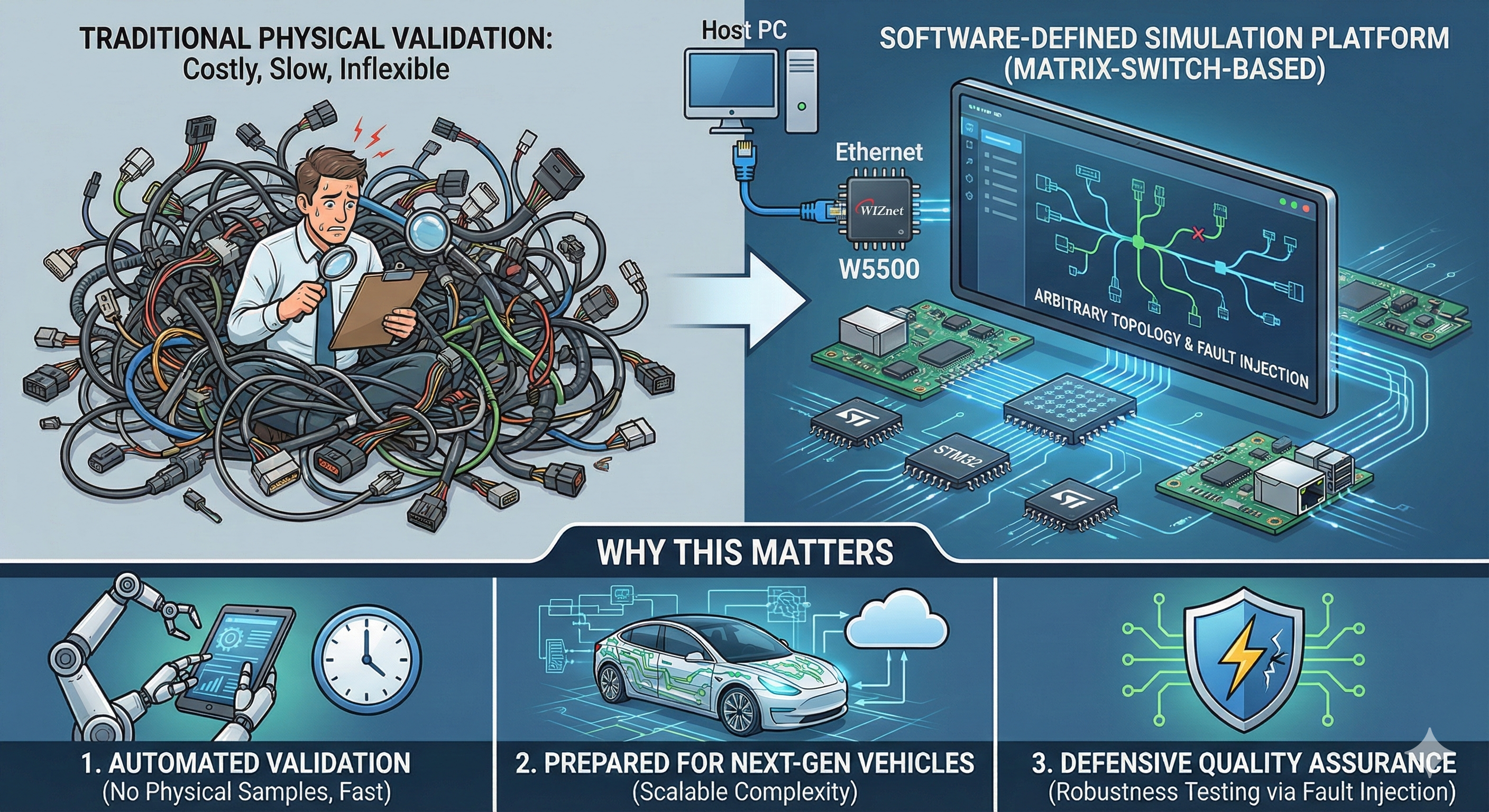
Why This Matters
Generative AI–generated image
1) Automated Validation Without Physical Harness Proliferation
By replacing physical harness variants with software-defined simulation, the system dramatically reduces setup cost, storage requirements, and validation time.
2) Prepared for Next-Generation Vehicles
As wiring complexity grows and high-speed communication becomes standard, inspection systems must be tested against a wider range of scenarios. This platform scales with that complexity.
3) Defensive Quality Assurance Through Fault Injection
The ability to deliberately inject faults allows manufacturers to validate not only correctness, but also robustness of their inspection equipment.
Why Industrial Leaders Choose WIZnet
For companies like HACINT, which develop mission-critical equipment for the automotive industry, reliability is not optional—it is mandatory. In a high-noise manufacturing environment where thousands of dollars depend on accurate harness testing, a network failure is unacceptable. This patent highlights why WIZnet remains a top choice for industrial automation:
- Hardware Offloading: The W5500’s Hardwired TCP/IP stack handles all network processing. This frees up the main STM32 MCU to focus entirely on the precise timing required for matrix switching and fault injection, without being interrupted by network traffic overhead.
- Stability in Noisy Environments: Unlike software-heavy OS implementations that can crash or lag, WIZnet’s hardware-based approach provides consistent, low-latency communication essential for remote-controlled factory equipment.
- Ease of Integration: By providing a simple SPI interface, WIZnet allows engineers to add robust Ethernet connectivity to almost any microcontroller (like the STM32 used here) without complex OS porting, significantly reducing time-to-market.
About the Applicant
Generative AI–generated image
The applicant, operating under the HACINT brand, is an industrial automation company focused on automotive wire harness manufacturing and inspection equipment.
Publicly available product information shows that the company supplies:
- Wire harness processing machines
- Wire harness inspection and testing systems
- Automated production and validation solutions for automotive and new-energy vehicles
This patent aligns closely with the company’s existing product portfolio and reflects real-world manufacturing requirements.
Related Commercial Products (Applicant Portfolio)
While the patent does not claim a one-to-one mapping to a specific product model, the applicant operates a family of commercial wire harness testing systems that clearly address the same problem domain.
Source: https://www.hacint.com.cn/
Direct reference links:
Wire Harness Testing / Inspection Product Category
https://www.hacint.com.cn/index/product/product/c_id/40.html

CS Testing Table
https://www.hacint.com.cn/Index/product/product_info/id/127/c_id/40.html

HCS6000A Wire Harness Testing System
https://www.hacint.com.cn/Index/product/product_info/id/219/c_id/40.html

New Energy Wire Harness Clip Testing Table
https://www.hacint.com.cn/Index/product/product_info/id/281/c_id/40.html

Test Module
https://hacint.com.cn/Index/product/product_info/id/150/c_id/40.html
These products cover continuity testing, insulation resistance, high-voltage cable verification, connector validation, and modular test expansion—exactly the environments where the patented system would be applied.
WIZnet Takeaway
From a WIZnet perspective, this patent is a concrete example of:
A wired Ethernet data pipeline enabling remote control, automation, and logging in industrial test equipment.
The W5500 serves as the communication bridge that connects configurable hardware, embedded control logic, and centralized test management software.
Frequently Asked Questions (FAQ)
Q: What is the main purpose of this Matrix-Switch-Based Test System?
A: The system is designed to validate automotive wire harness inspection equipment without needing physical harness samples. Instead of swapping real cables, it uses matrix switches to create "software-defined" wiring topologies, allowing for rapid, cost-effective, and flexible testing of complex EV and intelligent vehicle circuits.
Q: How is the WIZnet W5500 Ethernet chip utilized in this architecture?
A: The WIZnet W5500 acts as the communication backbone for the system. It connects the Main Control Board to the Host PC via wired Ethernet, enabling operators to remotely configure test scenarios, send commands to the matrix switches, and log inspection results reliably in real-time.
Q: What is "Fault Injection" in the context of this patent?
A: Fault injection is a defensive testing feature where the system deliberately introduces electrical anomalies—such as open circuits, short circuits, or high-resistance contacts. This ensures that the inspection equipment is robust enough to correctly detect and report failures, not just verify good connections.
Q: Why is this system better than traditional wire harness validation?
A: Traditional methods require manufacturing and physically swapping out large numbers of real wire harnesses, which is costly and time-consuming. This patented system replaces physical hardware variation with software configuration, drastically reducing setup time and enabling automated validation of high-complexity automotive networks (like CAN-FD and Automotive Ethernet).
매트릭스 스위치로 “자동차 와이어 하네스 회로”를 소프트웨어적으로 재현하는 검증 테스트 시스템
— STM32 기반 보드 체계 + 고장 주입 + WIZnet W5500 Ethernet 원격 제어/로그 파이프라인
Introduction
이 특허는 자동차 와이어 하네스(배선) 검사 시스템을 ‘검증하기 위한’ 테스트 시스템을 제안합니다. 핵심 문제의식은 이렇습니다:
하네스 검사 시스템을 제대로 검증하려면 원래는 차종/구성별로 다른 실제 하네스 실물이 많이 필요하고, 보관·교체·매칭이 번거로워 테스트 효율이 떨어집니다.
특허는 이를 해결하기 위해, 실제 하네스 대신 **매트릭스 스위치 기반의 “회로 시뮬레이터”**로 원하는 도통 관계를 구성하고, 동시에 **고장(단선/단락/접촉불량 등)**까지 주입해 검사 장비의 방어성까지 검증하는 구조를 제시합니다.
Quick background 1 — 자동차 와이어 하네스 “회로”가 무엇인가?
자동차 와이어 하네스는 차량 내 전기·전자 신호와 전원을 전달하는 배선 묶음이며, 생산 품질관리에서 중요한 검사는 보통:
커넥터 단자들의 도통(연결/단선) 여부
연결 저항/임피던스 수준
(차량 고속화로 인해) 고속 신호 전송 품질과 전자파 환경까지 포함한 안정성
을 확인하는 방식으로 이뤄집니다. 특허도 하네스 검사가 생산 공정의 핵심 품질관리이며, 도통/연결 임피던스/신호 품질을 확인한다고 설명합니다.
Quick background 2 — “매트릭스 스위치”가 무엇이고 왜 쓰나?
**매트릭스 스위치(스위치 매트릭스)**는 다수의 단자(노드) 사이 연결을, 스위치의 on/off 조합으로 만들어 내는 구조입니다.
쉽게 말해, “어떤 단자 A와 어떤 단자 B를 연결할지”를 물리 배선을 다시 뜯지 않고도 스위치 상태만 바꿔 재현할 수 있습니다.
이 특허에서 매트릭스 스위치는 “임의의 하네스 회로(도통 관계)를 구성”하는 핵심 부품으로 정의됩니다.
Patent snapshot
특허의 핵심 구성은 “보드 4종 세트”로 명확히 요약됩니다.
메인 컨트롤 보드(W5500 포함)
회로 시뮬레이션 보드(서브 보드): STM32 + 매트릭스 스위치
고장 주입 보드: 가변 저항/커패시터/다이오드
모듈형 백플레인(확장용 바닥판): IDC 방식 확장 + 보드-투-보드 커넥터 연결
What this patent proposes (핵심 발명 요소)
이 특허의 기술 포인트는 3가지로 정리됩니다.
임의 회로 시뮬레이션
서브 보드의 STM32가 매트릭스 스위치를 제어해, 요구된 “단자-단자 도통 관계”를 구성합니다.
고장 주입(Fault injection)
고장 주입 보드가 가변 R/C/다이오드 등으로 접촉불량(고저항), 단선/단락 등 상태를 인위적으로 만들어 “검사 시스템이 제대로 잡는지”를 검증합니다.
원격 제어 + 데이터 저장(네트워크형 테스트 장비)
메인 보드의 W5500이 상위 PC와 Ethernet 통신을 담당하고, 원격으로 지시를 내리고 테스트 데이터를 저장/업로드하는 흐름을 제공합니다.
Architecture & data flow (Mechanism-first)
특허가 설명하는 동작 흐름은 “상위 PC → W5500 → 메인 보드(STM32) → CAN → 서브 보드/고장 보드 → 결과 수집 → W5500로 업로드”로 정리됩니다.
1) 상위 PC가 W5500 Ethernet 인터페이스로 접속
운영자는 상위 PC에서 메인 보드의 W5500 Ethernet 인터페이스에 접속하여 테스트 요구를 입력합니다.
회로 시뮬레이션 지시: 예) “A1–B3 도통, C2–D5 도통” 같은 단자 연결 요구
고장 주입 지시(선택): 예) 접촉불량(저항값), 단락 등
W5500은 입력을 받아 메인 보드 MCU가 처리 가능한 형태로 전달합니다.
2) 메인 보드 STM32가 지시를 분해하고 CAN으로 하위 보드에 전달
메인 보드 STM32는 지시를 “서브 보드 제어”와 “고장 보드 제어”로 나누고, CAN 통신으로 목표 보드에 전송합니다.
(특허는 또한 서브 보드의 485/CAN 모듈이 차량 하네스의 485/CAN 버스 프로토콜과의 호환을 위한 것임을 언급합니다.)
3) 서브 보드는 매트릭스 스위치로 회로 구성, 고장 보드는 결함 상태를 주입
서브 보드는 지시받은 도통 관계대로 매트릭스 스위치를 on/off 하여 회로를 구성하고, 완료 상태를 메인 보드로 피드백합니다.
고장 주입 보드는 지시받은 파라미터에 따라 결함 조건을 만들어 주입합니다.
4) 결과 수집 및 업로드(로그) — 다시 W5500
설정 완료/테스트 수행 중, 메인 보드는 상태 및 테스트 데이터를 수집하고 이를 W5500을 통해 상위 PC에 업로드해 로그로 남기는 구성을 제시합니다.
How W5500 is used (WIZnet 관점 요약)
이 특허에서 W5500은 “보조 부품”이 아니라 원격 제어·데이터 수집 파이프라인의 중심으로 명시됩니다.
메인 보드와 상위 PC 사이 Ethernet 통신 담당
원격으로 테스트 지시를 내리고, 테스트 데이터를 저장/업로드
운영자 입장에서는 “PC에서 시나리오를 바꿔가며 반복 테스트”하기 위한 안정적인 유선 연결을 제공합니다.
Why it matters (파급력)
하네스 검사 장비 검증 자동화
실물 하네스 준비/교체 없이 다양한 배선 구조를 재현하고 고장까지 주입해 검증할 수 있어, 테스트 비용과 셋업 시간을 줄이는 방향입니다.
차량 배선 복잡도와 고속 통신 요구 대응
특허 배경은 차량 하네스가 수백~수천 회로로 복잡해지고, 고속 통신(CAN FD/차량 이더넷)과 전자파 환경까지 검증 요소가 늘어난다는 문제를 직접 짚습니다.
“고장 주입”으로 방어적 품질 확보
단선/단락/접촉불량 같은 결함 상태를 의도적으로 만들어, 검사 시스템이 이를 검출하는지 반복 검증할 수 있습니다.
About the applicant (출원사 소개)
출원사(브랜드명 HACINT)는 공식 사이트에서 와이어 하네스 제조/검사 공정에 사용되는 장비들을 다수 소개하고 있으며, 특히 “비파괴 검사(하네스 테스트)” 카테고리에서 하네스 검사/검증 장비 라인업을 운영합니다. (hacint.com.cn)
또한 자회사(예: Kunshan Haihong Intelligent Technology) 소개 글에서는 신에너지(전기차) 솔루션, 하네스 공정 최적화, 정보화 시스템, 자동화 라인 워크스테이션 등 제조 자동화 영역 활동을 언급합니다. (hacint.com.cn)
출원사 제품(특허 적용 가능성이 높은 실제 제품군) + URL
이 특허는 “하네스 검사 시스템을 검증하는 테스트 시스템”이고, 출원사는 실제로 하네스 테스트/검사 장비 제품군을 판매합니다. 아래는 직접 확인 가능한 링크입니다.
[하네스 테스트/검사 제품군(카테고리)]
https://www.hacint.com.cn/index/product/product/c_id/40.html

[CS Testing Table]
https://www.hacint.com.cn/Index/product/product_info/id/127/c_id/40.html

[HCS6000A Wire harness testing system]
https://www.hacint.com.cn/Index/product/product_info/id/219/c_id/40.html

[New Energy Wire Harness Clip Testing Table]
https://www.hacint.com.cn/Index/product/product_info/id/281/c_id/40.html

[Test Module]
https://hacint.com.cn/Index/product/product_info/id/150/c_id/40.html
제품 설명에는 도통/방수/커넥터 보조잠금/퓨즈박스 등 검사 모듈 구성과, 고전압 케이블/신에너지 하네스 시험 항목(내전압/절연/미소저항 등)이 언급됩니다. (hacint.com.cn)