



mpair
Open-source air-quality station on ESP32-C6: Matter/Thread + Wi-Fi 6, PoE+ and WIZnet W5500 Ethernet (SPI) for MQTT/Prometheus/REST export.
Thumbnail image: AI-generated image
mpair: Matter/Thread + PoE+ Air Quality Station on ESP32-C6 with WIZnet W5500 Ethernet
Introduction
mpair is an open-source air-quality monitoring station design that targets “installation-grade” connectivity (PoE/PoE+) and smart-home interoperability (Matter over Thread), while also keeping classic IP outputs on the table (MQTT / Prometheus / REST). The project centers on a single ESP32-C6 and adds 10/100 Ethernet via WIZnet W5500 over SPI, plus PoE/PoE+ power options. (GitHub)
What this is
AI-generated image
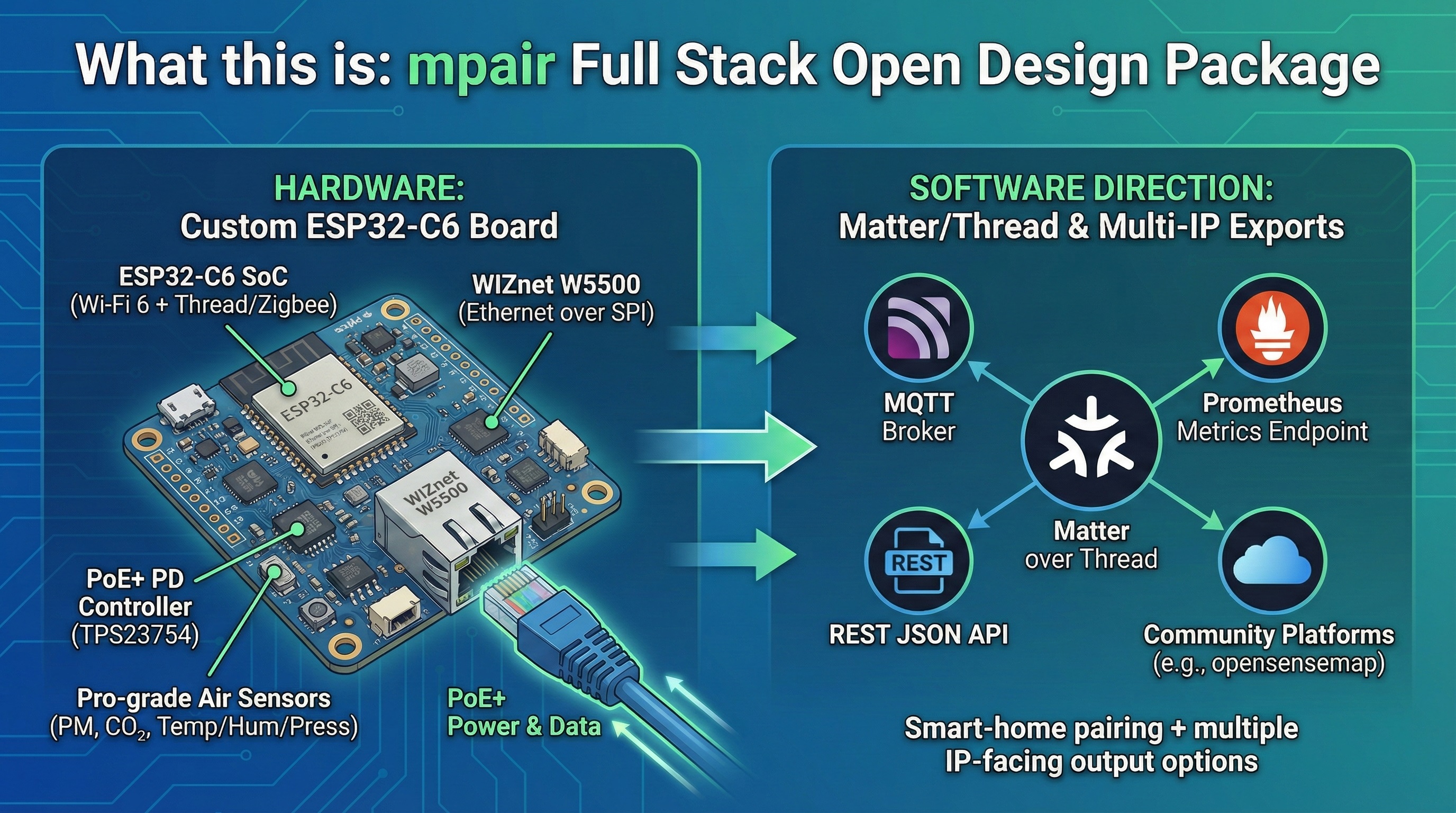
mpair is presented as a full stack, open design package:
- Hardware: a custom board concept built around ESP32-C6, pro-grade air sensors (PM, CO₂, humidity/temperature/pressure), plus PoE/PoE+ and wired Ethernet through W5500. (GitHub)
- Software direction: Matter/Thread support for smart-home pairing, and multiple IP-facing export options (MQTT, Prometheus metrics, REST API, plus publishing to community air-quality platforms). (GitHub)
Note on evidence: GitHub’s directory browsing intermittently failed in this session (“You can’t perform that action…”), so hardware/firmware implementation details below are additionally validated against the uploaded ZIP snapshot of the repository.
How it works
AI-generated image
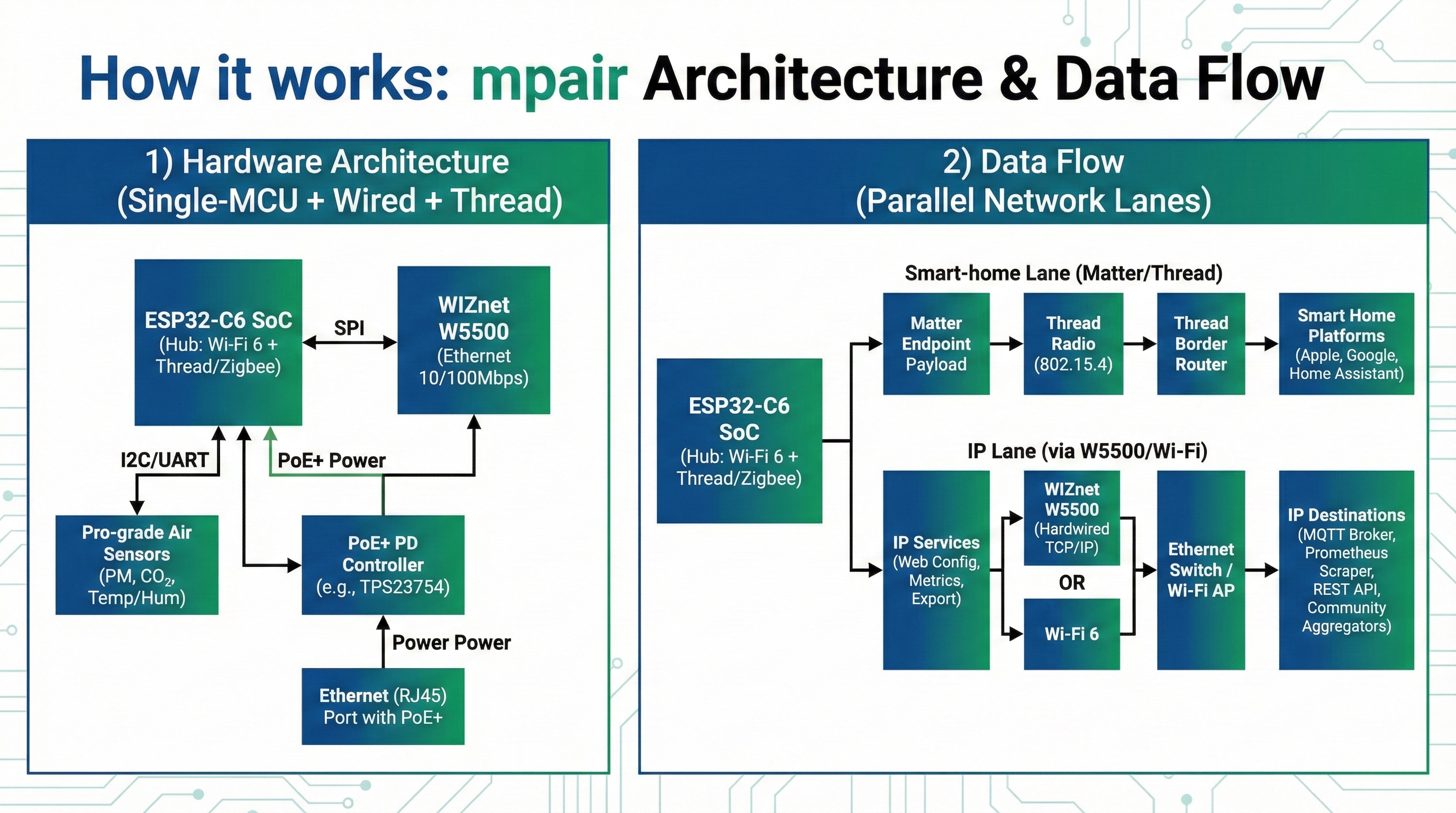
1) Hardware architecture (single-MCU + wired + Thread)
The hardware concept is “one controller, multiple network faces”:
- ESP32-C6 as the hub: chosen because it integrates 2.4 GHz Wi-Fi 6 and 802.15.4 for Thread/Zigbee, which is the core radio requirement for Matter-over-Thread endpoints. (Espressif Systems)
- WIZnet W5500 for Ethernet: the README explicitly calls out “Ethernet 10/100Mbps via W5500 (SPI).” (GitHub)
- PoE/PoE+ power: the feature list includes 802.3af/at PoE/PoE+. (GitHub)
- In the uploaded ZIP’s KiCad sources, the PCB includes a PoE PD controller footprint labeled TPS23754 and a W5500 footprint labeled W5500 (i.e., PoE+ and Ethernet are not just a README claim; they exist in the board design files).
2) Data flow (what moves over W5500)
mpair’s “network outputs” are described as multiple parallel lanes:
- Smart-home lane (Matter/Thread): sensor readings become a Matter endpoint payload routed over Thread to a border router and then into platforms like Home Assistant / Apple Home / Google Home (as implied by the Matter support prerequisite list). (GitHub)
- IP lane (Ethernet/Wi-Fi): the same measurements can be exposed to conventional infrastructure through:
- MQTT (push to a broker),
- Prometheus (scrape metrics endpoint),
- REST (JSON API),
- and publishing to “sensor.community / madavi / opensensemap / aqi.eco” style aggregators. (GitHub)
Where W5500 fits: for installations where Wi-Fi is undesirable (RF congestion, reliability, or security policy), W5500 becomes the wired interface for the device’s IP services—web config, metrics, and data export—while also aligning naturally with PoE “single cable” deployment.
In WIZnet terms, this is exactly the W5500 use case: a hardwired TCP/IP Ethernet controller that provides Internet connectivity to an MCU via SPI and supports TCP/UDP/IPv4 with multiple sockets, reducing firmware complexity around the Ethernet stack. (WIZnet)
3) Firmware status (what’s implemented vs. planned)
The public repo currently reads like a well-scaffolded platform:
- The ESP-IDF environment is spelled out (ZIP includes an ESP-IDF setup guide pinned to v5.5.2 for ESP32-C6) and a firmware directory exists for ESP32-C6.
- In the uploaded ZIP snapshot, the current
main.cis a skeleton with explicit TODO blocks (sensors, Ethernet/Wi-Fi, Matter/Thread, web server, HECA control).
This matters because it keeps the curation honest: the repo already shows strong “engineering packaging,” while the firmware features listed in the README should be read as the target feature set rather than fully shipped functionality. (GitHub)
Why WIZnet (W5500) is used here
The repository’s architecture implies two practical reasons to pick W5500:
- Wired reliability and installability: mpair explicitly combines PoE/PoE+ with Ethernet via W5500, which fits permanent, ceiling/wall-mounted sensor deployments where “power + data over one cable” is a deployment requirement. (GitHub)
- Firmware focus on application logic: W5500’s “hardwired TCP/IP” positioning matches a product goal like mpair, where the MCU budget is better spent on sensor fusion, calibration/compensation (humidity effects), local UI, and Matter behavior rather than implementing Ethernet stack plumbing. (WIZnet)
Why it matters (and where it can scale)
mpair is compelling from a “maker-to-product” pathway because it combines three signals that often appear in commercial air-quality devices:
- Market alignment: Matter/Thread is a current smart-home integration path, and ESP32-C6 exists specifically to bundle Wi-Fi 6 + BLE + 802.15.4 in a single SoC. (Espressif Systems)
- Installation-grade networking: PoE + wired Ethernet (W5500) makes the design relevant to small offices, classrooms, labs, and prosumer installs where Wi-Fi-only sensors are a non-starter. (GitHub)
- Practical “build package” habits: the project ships not only code scaffolding but also hardware CAD sources (KiCad project, footprints/3D models, mechanical model in the ZIP), development scripts, and environment documentation—exactly the kind of structure that makes derivative products and VAR-style adaptations feasible.
Reason: (mass-production potential) PoE+ + wired Ethernet + Matter-ready air sensor is a repeatable building block for fixed installs. (niche market) prosumer smart home + citizen-science publishing + lab/office indoor air quality dashboards.
Quick notes (reproducibility & caveats)
- Strong documentation footprint, but firmware maturity is still ramping: current code in the ZIP snapshot is intentionally scaffolded; expect real integration work for sensors, W5500 networking, and Matter application profiles.
- Manufacturing outputs may need exporting: the repo structure references gerbers/BOM locations, but in the uploaded ZIP snapshot those look like placeholders; the KiCad sources are present, so standard KiCad exports should fill the gap.
- No demo video/GIF spotted in the accessible repo snapshot; adding a short “PoE boot → metrics endpoint → Matter pairing” clip would materially improve validation for new builders.
Q: What is the mpair project?
A: mpair is an open-source air-quality monitoring station designed for "installation-grade" reliability. It combines a single ESP32-C6 microcontroller with WIZnet W5500 wired Ethernet and PoE+ (Power over Ethernet) support. It is designed to bridge professional sensor data with modern smart home standards like Matter over Thread.
Q: What sensors does the mpair station support?
A: The hardware design targets pro-grade air quality sensors, including modules for:
Particulate Matter (PM)
CO₂ (Carbon Dioxide)
Environmental metrics: Humidity, Temperature, and Pressure.
Q: Who is the target audience for this device?
A: mpair is ideal for offices, classrooms, labs, and prosumer smart homes where Wi-Fi reliability is a concern. It targets scenarios requiring permanent, maintenance-free installations that benefit from single-cable deployment (power and data combined).
References
https://github.com/marpi82/mpair
https://wiznet.io/products/ethernet-chips/w5500
https://docs.wiznet.io/Product/Chip/Ethernet/W5500
https://www.espressif.com/en/products/socs/esp32-c6